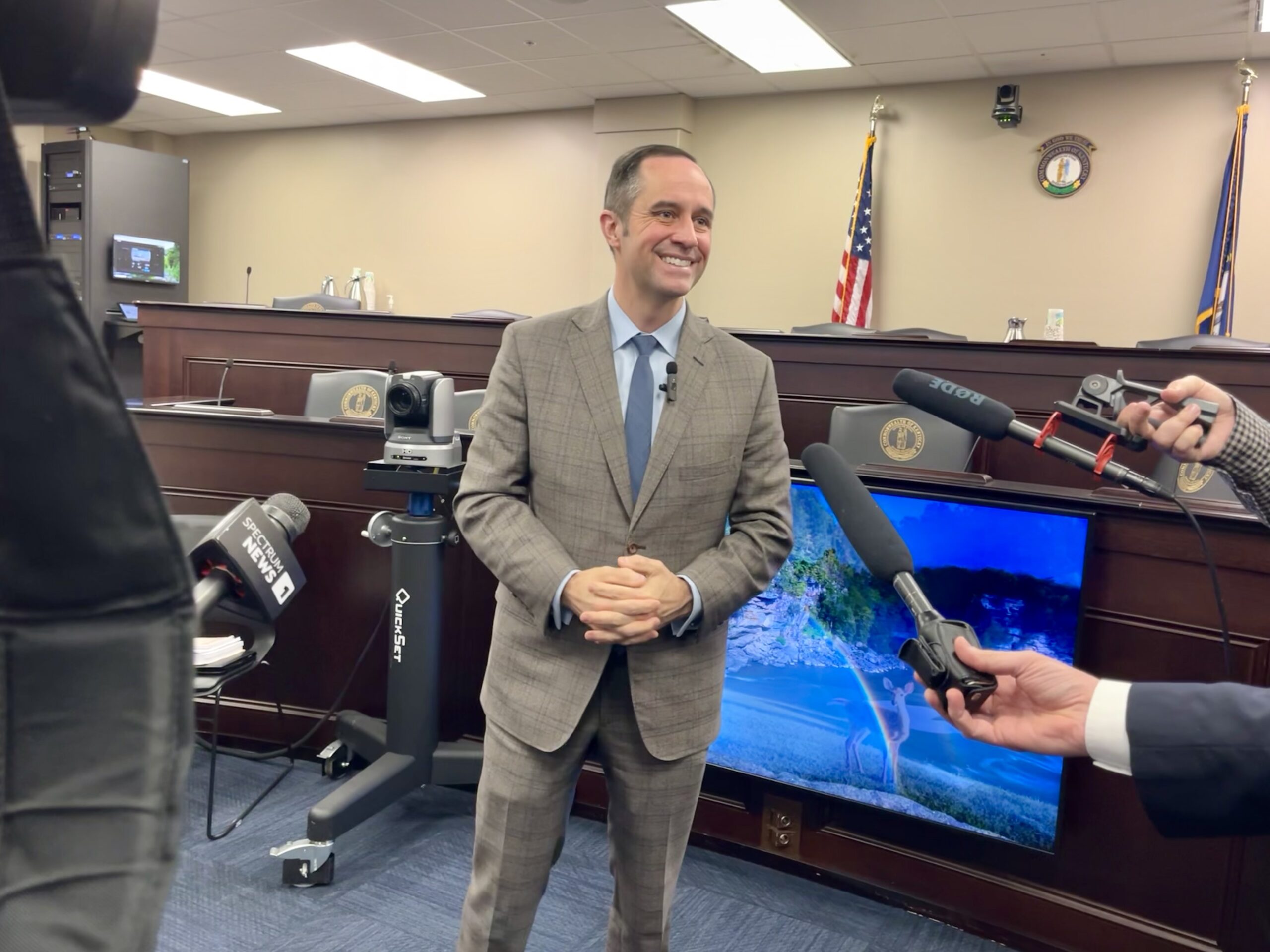
FRANKFORT — Child care advocates applauded elements of the Kentucky Senate’s budget, unveiled Wednesday, but said lawmakers have not gone far enough to save the struggling industry.
The proposed child care spending is a “monumental investment,” said Sarah Vanover, a policy and research director for Kentucky Youth Advocates.
“We appreciate the fact that this is more than what the House had delegated, that we’re moving in the right direction,” she told the Lantern. “We can build off of what is in this budget, but it’s not there yet.”
The Senate’s budget bills cleared the Appropriations and Revenue Committee Wednesday morning and were approved 37-1 by the full Senate later in the day.
Advertisement
Sarah Vanover (Kentucky Lantern photo by Isabella Sepahban)
Kentucky’s child care industry — which some are working to rebrand under an “early childhood education” umbrella — is counting on a boost from the 2024 legislative session as federal COVID-19 dollars that helped stabilize the industry during the last few years are running out. This leaves many centers to cut pay for their workers, raise tuition for parents, cut services and even close.
Without help from the General Assembly, Kentucky could lose more than a fifth of its child care providers, the Lantern has reported.
The Kentucky Center for Economic Policy previously estimated that $300 million is needed to replace the federal aid that’s ending. The state Department for Community Based Services says the need at closer to $100 million.
With the state help that is proposed in the House budget — a $52 million a year increase — experts estimated 16,000 kids could lose access to child care in 2024.
With the Senate’s proposal, according to Vanover, that number is 14,000.
Advertisement
In his December budget proposal, Gov. Andy Beshear pitched spending $141 million over the next two years to stabilize the child care industry, as well as $172 million to begin funding universal preschool for Kentucky 4-year-olds.
What is the Senate proposing?
Charles Aull, executive director of the Kentucky Chamber of Commerce Center for Policy and Research, said “there’s some really good progress in the Senate budget proposal.”
“From my perspective, it looks like the Senate has worked really hard to identify … how much General Fund dollars from the state actually need to be kicked in in order to continue some of the important changes that were made to CCAP (Child Care Assistance Program) over the past couple of years,” Aull told the Lantern.
The Senate has outlined these budget lines for child care:
$28 million annually – $21 million from the General Fund and $7 million in federal funds – in 2025 and 2026 for reimbursements to child care providers through the Child Care Assistance Program (CCAP). This is a decrease from what the House proposed: $40 million, and what Sen. Danny Carroll requested in his Horizons Act: $66 million, though he voted in favor of the proposal on the floor. Despite the decrease, “that piece is still much more than we’ve ever gotten,” Vanover said.
$14.8 million annually to provide child care for child care providers. This is “one of the great things that the Senate had that the House did not,” Vanover said. Sen. Chris McDaniel, chair of the Appropriations and Revenue Committee, said this was included because “the most effective program that we had seen and that we had heard about is the idea that if you’re a child care worker, we’re willing to pay for your child care.”
$10.6 million for CCAP assistance for families at 160% of the federal poverty level. This is the same as what the House proposed.
$2 million annually to award Innovations in Early Childhood Education Delivery Fund grants.
$2 million annually for the Employee Child Care Assistance Partnership (ECCAP). This passed into law in 2022 and incentivizes employers to help employees pay for child care.
$1.5 million annually to add a six-month adjustment period for families who are no longer eligible for CCAP. During that time period, those families would receive decreased benefits. This portion, McDaniel said, is to “eliminate the benefits cliff” for families.
$1.3 million annually to cover the cost of background checks for new child care staff. This is a point Carroll requested in his Horizons Act. These required background checks can cost around $90 per person, Vanover said. After that expense, they may reveal the person isn’t eligible for employment.
“(The) reimbursement rate for CCAP is probably our top priority and that’s a large amount that is still dedicated to that,” Vanover said. “So that’s a win there as far as maintaining funding.”
It’s “hard to say” if the steps are enough to stabilize the industry this year, according to Aull.
Advertisement
Brigitte Blom (Kentucky Lantern photo by Isabella Sepahban)
“CCAP is one of those things that literally allows (families) to participate in the workforce and without it … they’re going to have to choose between … ‘can I find somewhere for my child to be while I’m working?’” Aull said. “Or they (are) just going to say ‘it’s just going to make more sense for me to sit out of the workforce until maybe the kid is … five, six years old, maybe in grade school.’”
Brigitte Blom, the president and CEO of the Prichard Committee, said many points in the budget are “steps in the right direction.” But, she said, there is “unfinished business” for lawmakers to address.
“We seek decisive action to transform access to quality, affordable child care with at least a $150 million per year above FY 2024 levels,” Blom said in a statement. This is “essential if we are to provide a strong start for our children and support for Kentucky’s workforce.”
“We also call for the necessary funding to support high-quality teaching and broaden access to higher education, crucial elements for measurable, long-term impact,” Blom said.
What is missing in the Senate budget for child care?
The Senate and House will come together to agree on a final version of the state budget. Vanover would like to see them maintain CCAP eligibility for families at 85% of the state median income.
Without that step, Vanover said, “we could potentially lose a lot of working families that need child care assistance.”
Advertisement
She would also like to see more dollars dedicated to CCAP based on enrollment instead of attendance.
“CCAP, in the past, has paid only when children are there,” she said. “Which is not how schools work. You still have to pay teachers, you still have building expenses, those kinds of things.”
The budget could still change, and the numbers could continue to fluctuate until it’s finalized.
“As (the budget) currently exists on the Senate side, it’s a good step forward,” Aull said. “This is arguably probably the largest investment in child care that we’ve seen in terms of general fund dollars. And I think that’s something that’s worth celebrating and worth noting.” Jennifer Washburn, director and owner of iKids Childhood Enrichment Center in Benton, sports a shirt touting child care’s importance, Nov. 28, 2023. (Kentucky Lantern photo by Abbey Cutrer)
Kentucky is world-famous for attractions like Louisville Mega Cavern and Mammoth Cave National Park, and those are just a few of the places a day trip in the state can take you. You could also spend time with animals at spots like the Kentucky Horse Park or the Louisville Zoo. And for scenic outdoor fun, Red River Gorge and Cumberland Falls State Resort Park offer beautiful natural settings. Here are the best day trips you can take in Kentucky in 2026.
Louisville Mega Cavern (Within the City)
Louisville Mega Cavern. Image credit: H. Michael Miley / Flickr
This massive underground attraction offers a completely unique experience right in Louisville’s backyard. What was once a limestone quarry has been transformed into a 17-mile cavern featuring zip lines, an underground bike park, and tram tours that educate visitors about the cavern’s geology and history. The consistent 58-degree Fahrenheit temperature makes it an excellent choice year-round, particularly during hot summer days or cold winter months.
Families can spend hours exploring the underground rope course or racing through the zip-line attractions, while history enthusiasts will appreciate learning how the cavern was used as a fallout shelter during the Cold War. The facility even hosts underground events and holiday light shows during the winter season.
Louisville Zoo (Within the City)
Louisville Zoo. Image credit: Thomas Kelley / Shutterstock
Home to more than 1,500 animals representing species from around the globe, the Louisville Zoo provides an educational and entertaining experience for all ages. The zoo’s carefully designed exhibits recreate natural habitats, allowing visitors to observe animals in settings that mirror their wild environments. Highlights include the Glacier Run exhibit featuring polar bears and grizzly bears, and the Islands pavilion, where you can encounter orangutans and tigers.
The zoo frequently updates its exhibits and programs, ensuring that even repeat visitors will find something new to discover. Plan to spend at least half a day here, as the 134-acre facility offers plenty of ground to cover, along with dining options and play areas for younger children.
Advertisement
Muhammad Ali Center (Within the City)
Muhammad Ali Center. By Proof377 – Own work, CC BY-SA 4.0, Wikimedia Commons.
This downtown museum and cultural center celebrates the life and legacy of Louisville’s most famous native son while exploring themes of respect, confidence, and social justice. The interactive exhibits engage visitors with Ali’s boxing career, his stance on civil rights, and his humanitarian efforts around the world.
Beyond the permanent collection, the center regularly hosts traveling exhibitions, speaker series, and community events that continue Ali’s work of promoting peace and understanding. The building’s riverside location offers beautiful views of the Ohio River, and visitors can easily combine a trip here with a walk along the waterfront or a visit to nearby restaurants in the revitalized downtown district.
Mammoth Cave National Park (90 Minutes South)
Mammoth Cave National park
The world’s longest known cave system stretches for more than 400 miles beneath the rolling hills of south-central Kentucky. Ranger-led tours vary in difficulty and length, from easy walks suitable for families with young children to challenging expeditions that involve crawling through tight passages.
Above ground, the park features over 80 miles of hiking trails through hardwood forests, scenic river valleys, and historic areas that tell the story of early cave explorers and the people who once called this region home. The park offers something different each season, from spring wildflowers to fall foliage, making it worth visiting multiple times throughout the year. Be sure to book cave tours in advance, especially during peak summer months when they fill up quickly.
Red River Gorge (2 Hours East)
Red River Gorge
This geological wonderland in the Daniel Boone National Forest draws rock climbers, hikers, and photographers from across the country. Natural sandstone arches, towering cliffs, and dense forest create a landscape that feels almost primordial in its beauty. More than 100 natural arches dot the area, many accessible via moderate hiking trails that reward visitors with spectacular views.
Popular destinations within the gorge include Natural Bridge State Resort Park, where a sky lift carries those who prefer not to hike to the top of the 65-foot sandstone arch, and the numerous trails that lead to formations like Sky Bridge and Chimney Top Rock. Spring and fall bring the best weather for hiking, though the summer months offer opportunities for swimming in the Red River itself.
Cumberland Falls State Resort Park (2 Hours Southeast)
Cumberland Falls
Often called the “Niagara of the South,” this 68-foot waterfall spans 125 feet across the Cumberland River, creating a powerful display of natural force that impresses even seasoned travelers. The falls are famous for producing a moonbow during full moons on clear nights, one of only two places in the Western Hemisphere where this phenomenon occurs regularly.
Day visitors can access multiple viewpoints via short hiking trails, including paths that lead to the base of the falls for an up-close perspective. The surrounding state park offers additional trails through old-growth forest, opportunities for whitewater rafting when water levels permit, and picnic areas with river views. Plan your visit after periods of heavy rain when the falls are at their most dramatic.
Bernheim Arboretum and Research Forest (30 Minutes South)
Bernheim Arboretum and Research Forest
This 16,000-acre nature preserve combines scientific research with public recreation, offering visitors a chance to experience one of the largest privately owned natural areas in the eastern United States. More than 40 miles of hiking trails wind through various ecosystems, from grasslands to mature forests, while the Canopy Tree Walk elevates visitors 75 feet above the forest floor for a bird’s-eye perspective.
The arboretum’s collection includes thousands of labeled trees and plants, making it an educational destination for botany enthusiasts and casual nature lovers alike. Art installations scattered throughout the property, including the massive Forest Giants sculptures, add an unexpected creative element to the natural setting. Seasonal events like the spring wildflower display and fall color tours draw crowds, but the preserve’s size means you can always find quiet spots for contemplation.
Advertisement
Land Between the Lakes National Recreation Area (2 Hours 30 Minutes Southwest)
Land Between the Lakes National Recreation Area
Situated between Kentucky Lake and Lake Barkley, this 170,000-acre peninsula offers water recreation, wildlife viewing, and outdoor activities in abundance. The area includes beaches for swimming, boat ramps for accessing both lakes, and miles of trails for hiking, mountain biking, and horseback riding. Elk and bison herds roam through dedicated ranges where visitors can observe these magnificent animals from viewing areas and roads.
The Homeplace 1850s Working Farm provides living history demonstrations that show what rural life was like in the region before the lakes were created. While slightly farther than other destinations on this list, the variety of activities available makes the drive worthwhile, particularly for those interested in water sports or wildlife photography.
My Old Kentucky Home State Park (45 Minutes South)
Stephen Foster statue at My Old Kentucky Home State Park.
The historic mansion at the heart of this Bardstown park inspired Stephen Foster’s famous song and now serves as a window into antebellum Kentucky life. Guided tours of Federal Hill mansion reveal elegant architecture and furnishings from the early 1800s, while the surrounding grounds feature gardens and walking paths perfect for a leisurely afternoon.
The park also hosts an outdoor amphitheater that presents “The Stephen Foster Story,” a musical that runs during summer months. Bardstown itself merits exploration, with its downtown area featuring bourbon distilleries, historic churches, and restaurants that showcase Kentucky’s culinary traditions. Combining a park visit with bourbon tastings and lunch in town creates a full day of varied experiences.
Kentucky Horse Park (1 Hour 20 Minutes East)
Kentucky Horse Park
More than 50 breeds of horses from around the world call this working horse farm and educational theme park home. Visitors can watch horses being trained, attend live shows featuring various riding styles and breeds, and explore museums dedicated to equine history and the sport of thoroughbred racing.
The park’s grounds include miles of trails for walking or horseback riding, a petting farm for younger visitors, and seasonal events like championship horse shows and polo matches. Located in Lexington, the heart of Kentucky’s horse country, the park captures the state’s deep connection to these animals while making the experience accessible to those with no prior equestrian knowledge. The twice-daily Parade of Breeds show alone justifies the visit, showcasing the diversity and beauty of different horse breeds in a single spectacular presentation.
Kentucky Derby Museum (Within the City)
Kentucky Derby Museum
Even if you can’t attend the famous race at Churchill Downs in May, this museum brings the excitement and history of the Kentucky Derby to life any day of the year. Interactive exhibits explain how horses are bred and trained for racing, while historic displays showcase the greatest champions and most memorable moments from Derby history.
The 360-degree theater experience makes visitors feel like they’re actually in the midst of the race, complete with the roar of the crowd and the thunder of hooves. Guided tours of Churchill Downs track and grandstand are available when races aren’t taking place, giving you access to areas typically seen only by owners and jockeys. The museum shop offers everything from commemorative mint julep glasses to authentic racing silks, perfect for souvenirs or gifts.
Wrapping Up Your Kentucky Adventures
Kentucky’s remarkable concentration of diverse attractions within easy driving distance of Louisville makes it an ideal destination for spontaneous day trips and weekend exploration. From the depths of the world’s longest cave system to the heights of Red River Gorge’s natural arches, from world-class museums to pristine natural preserves, the state delivers experiences that rival those found in regions requiring much more extensive travel.
Advertisement
The accessibility of these destinations means you can tailor trips to match the weather, your energy level, and your interests without the stress of complex planning or overnight stays. Whether you’re drawn to outdoor adventures, cultural enrichment, or family-friendly attractions, Kentucky’s day trip options ensure you’ll find compelling reasons to explore something new every weekend throughout 2026.
KENTUCKY (WKYT) – Monday marks the one-year anniversary of the Lexington shooting spree that left two people dead and another two injured.
One of the injured was Kentucky State Police Trooper Jude Remilien, who was shot in the leg outside of Blue Grass Airport after he pulled over the shooter, Guy House.
Good Samaritans saved Remilien’s life that day.
So, one year later, how is he doing, and what is he up to?
Advertisement
PREVIOUS COVERAGE:
2 killed in Lexington church shooting after trooper shot; suspect killed, officials say
KSP trooper shot near Blue Grass Airport shares his story
According to KSP, Remilien is doing just fine physically and is currently assigned to the public affairs branch.
He has also taken on an active role in KSP’s Youth Academy Program as an instructor and mentor.
The program is a several-day experience in which teenagers interested in law enforcement, public safety, and community service train like state troopers.
West Kentucky Allied Services Paducah office on July 9.
Advertisement
Max Davis
PADUCAH — Affordable Care Act marketplace rates are set to rise again in 2027, according to public filings, and West Kentucky Allied Services said that it could be catastrophic for those affected.
The ACA marketplace is a public platform for buying private insurance plans and applying for premium tax credits and Medicaid.
The rate increases can be found in 77 publicly released ACA rate filings submitted to state regulators on June 30. The rates reveal a median 14% rate hike across the country and double-digit rate increases for two policies in Kentucky.
Advertisement
“For our low-income clients, we’re already seeing that a good number of them find prices are so out of reach that they are having to make a decision between paying rent or utilities or having health care coverage, and sad to say, a good number are deciding not to have health care coverage,” Uppinder Mehan, CEO of West Kentucky Allied Services, said.
Mehan said that the ACA marketplace was supposed to be the more affordable alternative to other private plans, but has become just as expensive. He explained that this has put many in Kentucky in a bind, especially those who do not qualify for Medicaid.
“I think the main driver is that the kind of support states like Kentucky have enjoyed in the past few years, that is, support from the federal government for Medicaid, has simply vanished,” Mehan said. “The decision was made by the current administration to no longer fund states in their Medicaid costs, and so now states like Kentucky have to come up with the resources to pay for the coverage for its citizens, or look to save money wherever they can, and unfortunately, what that often ends up meaning is that people end up losing coverage.”
Advertisement
“Those of us who are in the middle are beginning to feel the squeeze more and more. A greater portion of folks’ budgets are going towards health care than ever before, and they’re finding it a challenge to find suitable coverage,” Uppinder Mehan, CEO of West Kentucky Allied Services, said.
Max Davis
ACA rates also increased in 2025 by a median of 20% across publicly available data. 2026’s change is lower, but according to the Kaiser Family Foundation, it is the second-highest rate change since 2018 and shows some premiums on the marketplaces have jumped by more than a third in two years.
“As more people become aware, they’re beginning to actually contact their representatives, which is probably the best thing you can do is let people in our state government know that there are concerns that you have about this,” Mehan said. “There are a number of committee hearings that are still going on, and my hope is that we can find a better solution.”
Advertisement
While not every provider’s proposed rate is publicly available at this time, Mehan said that almost every provider is scheduled to raise their prices by 8% to 14%. The two Kentucky rate increases included in the 77 available on June 30 have Anthem Health Plans of Kentucky increasing by a proposed 16.9% and WellCare Health Plans of Kentucky increasing by 20.7%.
“A greater portion of folks’ budgets is going towards health care than ever before, and they’re finding it a challenge to find suitable coverage,” Mehan said.