World
US readiness plays 'significant' role in fending off Iranian attack on Israel


The “significant” role the U.S. played in helping Israel fend off Iran’s aerial assault on Tuesday came just hours after Secretary of Defense Lloyd Austin assured Israeli Defense Minister Yoav Gallant that the U.S. had “increased force readiness” and stood ready.
“This is a significant escalation by Iran,” White House National Security Advisor Jake Sullivan told reporters Tuesday. “It is equally significant that we were able to step up with Israel and create a situation in which no one was killed in this attack in Israel.”
The comments were made following massive missile strike fired by Iran in which some 180 missiles were fired at Israel.
According to Iranian state media, the Iranian Revolutionary Guard Corps (IRGC) said the attack was in retaliation for the Friday assassination of Hezbollah leader Hassan Nasrallah, who was killed alongside IRGC commander and military advisor Brig. Gen. Abbas Nilforushan, as well as Ismail Haniyeh, the leader of Hamas who was killed in July during a visit to Tehran.
Israel’s Iron Dome anti-missile system intercepts rockets, as seen from Ashkelon, Israel, October 1, 2024. (REUTERS/Amir Cohen)
IDF MEETS LITTLE RESISTANCE FROM HEZBOLLAH AFTER WEEKS OF HITTING TERROR TARGETS, OFFICIALS SAY
“In response to the martyrdom of Ismail Haniyeh, Seyyed Hassan Nasrallah and Martyr Nilfroshan, we targeted the heart of the occupied territories,” the IRGC said in a statement reported by Iranian media. “If the Zionist regime reacts to Iran’s operations, it will face crushing attacks.”
Following the attacks, Israel closed its airspace, residents in Tel Aviv and Jerusalem were ordered to shelter in place and the Israeli security cabinet said it would convene Tuesday night in a bunker in Jerusalem, according to Israeli news outlet the Jerusalem Post.
It remains unclear if Iranian missiles had made contact with any targets, though the Israeli Defense Force (IDF) told Fox News Digital that no casualties were yet known.
A map showing the positions of U.S. Navy assets in the Middle East.
In a statement to Fox News, a U.S. defense official said, “[In] accordance with our ironclad commitment to Israel’s security, U.S. forces in the region are currently defending against Iranian-launched missiles targeting Israel.
“Our forces remain postured to provide additional defensive support and to protect U.S. forces operating in the region,” the official added.
Defense Secretary Lloyd Austin, standing right, and Israeli Defense Minister Yoav Gallant, standing left, listen to the playing of the Israeli National Anthem during an arrival ceremony at the Pentagon in Washington, Tuesday, June 25, 2024. (P Photo/Susan Walsh)
ISRAELI MINISTERS FRUSTRATED OVER US, IDF LEAK ON LEBANON OPERATION: REPORT
Earlier on Tuesday, the Pentagon said in a readout regarding the second call Austin has held with Gallant in the last 24 hours, that the secretary “made it clear that the United States is well-postured to defend U.S. personnel, allies, and partners in the face of threats from Iran and Iran-backed terrorist organizations and is determined to prevent any actor from exploiting tensions or expanding the conflict in the region.”
Three U.S. guided-missile destroyers have been positioned off the eastern Mediterranean to help defend Israel, including the USS Arleigh Burke, USS Bulkeley and USS Cole — which reportedly played a closely coordinated role in defending against the Iranian attack on Tuesday.
“Today, Iran launched nearly 200 ballistic missiles towards targets in Israel. The United States military coordinated closely with the Israeli Defense Forces to help defend Israel against this attack,” Sullivan said. “U.S. naval destroyers joined Israeli Air Defense units in firing interceptors to shoot down inbound missiles.”
In April, during the last major attack that Iran levied at Israel when it fired more than 300 drones and missiles, the USS Arleigh Burke and the USS Carney shot down more than 81 attack drones and at least six ballistic missiles using guided-missile destroyers.
The ballistic missiles were shot down using the SM-3 ballistic missile interceptors from the ships that were also positioned in the eastern Mediterranean at the time. The SM-3 has a range of up to 1,550 miles.
Israel has several of its own defense systems outside of what its offshore allies provide, including the infamous Iron Dome which is designed to intercept short-range rockets and artillery shells fired from distances of two to 43 miles away.
Rockets fly in the sky, amid cross-border hostilities between Hezbollah and Israel, as seen from Tel Aviv, Israel, October 1, 2024. (REUTERS/Ammar Awad)
But it also has systems that are capable of stopping missiles fired from greater distances, like its Arrow Missile Defense System, which can intercept missiles fired from up to 1,500 miles away and above the earth’s atmosphere.
The air defense system known as David’s Sling is also designed to intercept enemy planes, drones, tactical ballistic missiles, medium to long-range rockets and cruise missiles fired at a range of 25 to 190 miles away.
IDF spokesman Rear Adm. Daniel Hagari said that it was believed the Iranian strikes had stopped, and told Israelis it was safe to leave their shelters.
“During the defense, we carried out quite a few interceptions. There are some impacts in the center and areas in the south of the country,” Hagari said Tuesday night local time. “At this stage we are still carrying out an assessment [of the attack], but we are unaware of casualties.”


France is gearing up to host a meeting of the “Coalition of the Willing” ahead of this year’s 14 July celebrations, with at least 25 heads of state or government due to meet in Paris on Monday to discuss support for Ukraine.
ADVERTISEMENT

ADVERTISEMENT
Created in Paris and jointly led with the United Kingdom, the coalition has now expanded to include 37 countries, meeting both in person and via video conference. Two new members, Moldova and North Macedonia, are scheduled to take part in Monday’s meeting for the first time.
Meeting at the Hôtel des Invalides, the allies will aim to “strengthen,” according to the French presidency, a renewed sense of unity and cooperation in support of Ukraine, which was reaffirmed at the recent G7 summit in Évian and at the NATO summit in Ankara, where allies committed to sending €70 billion in military aid to Kyiv in 2026.
The objective is to show that Western allies are continuing their support for Ukraine and that Moscow cannot rely on “war fatigue,” according to an adviser to French President Emmanuel Macron.
Coalition leaders will focus on air defence cooperation, including newly announced US plans for the licensed production of Patriot missiles in Ukraine. They will also discuss the creation of an anti-ballistic missile system.
As for security guarantees for Ukraine in the event of a hypothetical ceasefire, the French presidency says that plans to deploy a multinational force, stationed away from the front lines, are “ready”. They remain, however, “subject to change”, given that the prospect of an end to hostilities still appears distant.
Beyond the presence of troops on the ground, these guarantees would be based on “legally binding” bilateral agreements and on US involvement in monitoring a ceasefire.
Ukrainian President Volodymyr Zelenskyy is expected to be in Paris on both Monday and Tuesday.
Bastille Day parade
The meeting is set to take place on the eve of France’s annual Bastille Day celebrations.
The Élysée Palace has said that this year’s parade will bring together nearly 6,800 service personnel, with 15% more troops than last year and a 30% increase in the number of vehicles and aircraft taking part.
In total, nearly 500 service members representing the countries of the Coalition of the Willing are expected to lead the parade.
The French military’s aerial acrobatics team, the Patrouille de France, is also expected to take part, accompanied by two Mirage fighter jets carrying Ukrainian co-pilots trained in France. German, British, Croatian, Danish, Spanish, Greek, Italian, Norwegian, Polish, and Swedish aircraft are also set to feature in the parade.


NEWYou can now listen to Fox News articles!
The Toronto Police Service is investigating after gunfire broke out Saturday night at a large Latin street festival in Midtown Toronto, leaving at least two people dead and four others wounded.
Police said they received reports of a shooting at St. Clair Avenue West and Arlington Avenue at 8:12 p.m. local time and discovered an active shooter situation.
First responders found six people suffering from gunshot wounds, officials said. Two of the victims were pronounced dead at the scene.
Police respond to an active shooter at the Salsa on St. Clair event in Toronto, Saturday, July 11, 2026. (Keito Newman/The Canadian Press via AP)
USPS WORKER ARRESTED AFTER ALLEGED MASS SHOOTING THREAT AGAINST TEXAS PRIDE EVENT, FBI SAYS
It is unclear what led to the shooting, and authorities said suspect(s) are still “outstanding.” No arrests have been made as of Saturday evening, police said.
Toronto Police Deputy Chief Frank Barredo said during a news conference there seemed to be an “exchange of gunfire” between two individuals targeting each other.
“This is a very chaotic scene,” he said. “I think we had something in the neighborhood of 13,000 people participating in this festival.”
Police initially described the incident as an active shooter situation before later determining that was not the case.
Police officers stand guard at the site of a deadly shooting at a salsa-themed street festival in Toronto, Ontario, Canada, July 11, 2026. (REUTERS/Cole Burston)
“There was some concern of an active shooter. That turned out not to be the case,” Barredo said.
Barredo said authorities were managing three separate crime scenes connected to the shooting. Two firearms have been recovered, he added.
Canadian Prime Minister Mark Carney said he was “horrified” by the shooting.
“My prayers are with the families grieving their loved ones, those who are in critical condition, and everyone who has been affected by this horrific event,” he said in a statement.
“My thanks to the police officers and other first responders whose courage and fast action prevented further tragedy,” he continued. “Police have my full support as they work to apprehend the perpetrators and bring them to justice.
Paramedics respond to an active shooter at the Salsa on St. Clair event in Toronto, Saturday. (Keito Newman/The Canadian Press via AP)
FOUR DEAD AND 29 SHOT IN CHICAGO WEEKEND VIOLENCE AS LEADERS TOUT CRIME PROGRESS
Following the shooting, the Toronto Transit Commission suspended train stops at the nearby St. Clair West station on Line 1 Yonge-University due to what officials described as a “security incident.”
Regular transit service has since resumed.
Authorities urged the public to avoid the area and follow all directives from police at the scene.
The TD Salsa on St. Clair Festival, Toronto’s biggest Latin culture celebration, was celebrating its 22nd annual event in Toronto’s Hillcrest Village.
Emergency Task Force vehicles and police officers are seen on the site of a shooting in Toronto on Saturday. (Jorge UZON / AFP via Getty Images)
CLICK HERE TO DOWNLOAD THE FOX NEWS APP
The Toronto Police Service told Fox News Digital no further information is available.
This is a developing story. Please check back for updates.
-

 Technology2 minutes ago
Rescue robot of tomorrow may be a cockroach in scuba suit
-
 Business5 minutes ago
L.A. cardrooms applaud court ruling to allow blackjack
-
 Entertainment10 minutes ago
Dan Finnerty profaned Bonnie Tyler’s hit in ‘Old School.’ He regrets the f-bombs at her shows
-
 Lifestyle17 minutes ago
Welcome to the summer of hot store openings and must-see art shows in L.A.
-
 Politics20 minutes ago
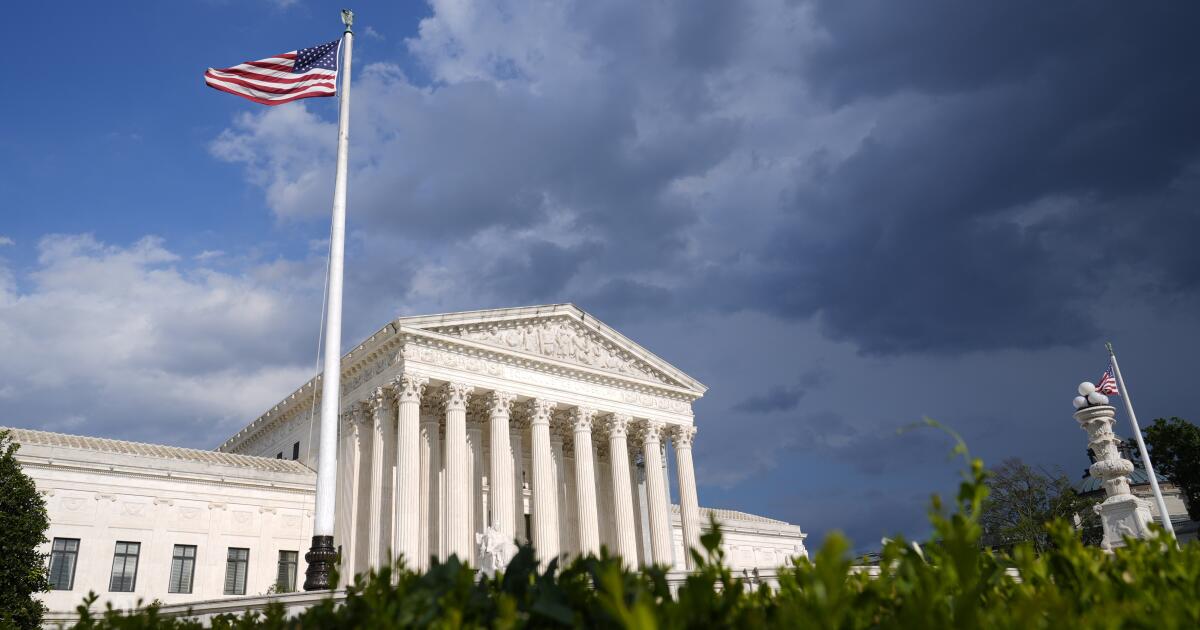
On birthright citizenship, the Supreme Court ‘originalists’ split on history and Trump
-
 Sports32 minutes ago
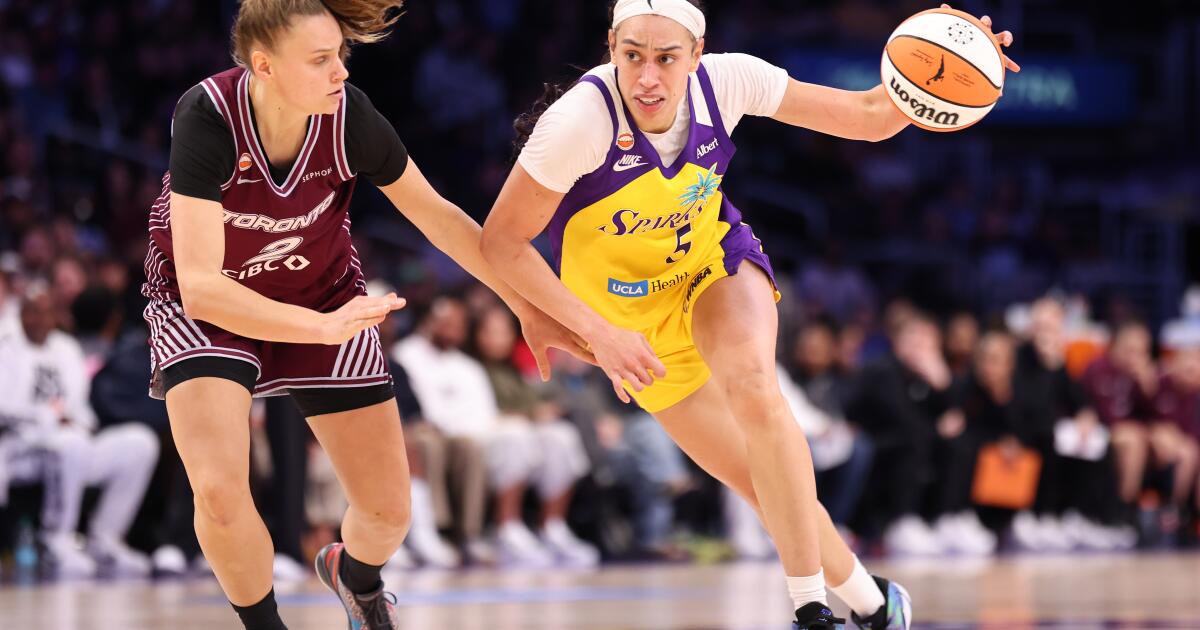
Dearica Hamby’s relentless effort and loyalty helped her retain key role with Sparks
-

 World40 minutes ago
‘Coalition of the Willing’ leaders to meet in Paris on Monday
-

 News1 hour ago
Mexico-US relations are already strained, but experts say they’re about to get worse | CNN

