World
The sea is higher than we thought and millions more are at risk, study finds


Climate change’s rising seas may threaten tens of millions more people than scientists and government planners originally thought because of mistaken research assumptions on how high coastal waters already are, a new study said.
Researchers studied hundreds of scientific studies and hazard assessments, calculating that about 90% of them underestimated baseline coastal water heights by an average of 1 foot (30 centimeters), according to Wednesday’s study in the journal Nature. It’s a far more frequent problem in the Global South, the Pacific and Southeast Asia, and less so in Europe and along Atlantic coasts.
The cause is a mismatch between the way sea and land altitudes are measured, said study co-author Philip Minderhoud, a hydrogeology professor at Wageningen University & Research in the Netherlands. And he attributed that to a “methodological blind spot” between the different ways those two things are measured.
Each way measures their own areas properly, he said. But where sea meets land, there’s a lot of factors that often don’t get accounted for when satellites and land-based models are used. Studies that calculate sea level rise impact usually “do not look at the actual measured sea level so they used this zero-meter” figure as a starting point, said lead author Katharina Seeger of the University of Padua in Italy. In some places in the Indo-Pacific, it’s close to 3 feet (1 meter), Minderhoud said.
Dilrukshan Kumara looks at the ocean as he stands by the remains of his family’s home in Iranawila, Sri Lanka, June 15, 2023. (AP Photo/Eranga Jayawardena, File)
One simple way to understand that is that many studies assume sea levels without waves or currents, when the reality at the water’s edge is of oceans constantly roiled by wind, tides, currents, changing temperatures and things like El Niño, said Minderhoud and Seeger.
Adjusting to a more accurate coastal height baseline means that if seas rise by a little more than 3 feet (1 meter) — as some studies suggest will happen by the end of the century — waters could inundate up to 37% more land and threaten 77 million to 132 million more people, the study said.
That would trigger problems in planning and paying for the impacts of a warming world.
People at risk
“You have a lot of people here for whom the risk of extreme flooding is much higher than people thought,’’ said Anders Levermann, a climate scientist at the Potsdam Institute for Climate Impacts Research in Germany, who wasn’t part of the study. And Southeast Asia, where the study finds the biggest discrepancy, has the most people already threatened by sea level rise, he said.
Minderhoud pointed to island nations in that region as an area where the reality of discrepancy hits home.
Children play on an uprooted tree along a beach in Mele, Vanuatu, July 19, 2025, that was once lined with vegetation, now largely lost to storms, erosion and other environmental pressures. (AP Photo/Annika Hammerschlag, File)

For 17-year-old climate activist Vepaiamele Trief, the projections aren’t abstract. On her island home in the South Pacific archipelago of Vanuatu, the shoreline has visibly retreated within her short lifetime, with beaches eroded, coastal trees uprooted and some homes now barely 3 feet (about 1 meter) from the sea at high tide. On her grandmother’s island of Ambae, a coastal road from the airport to her village has been rerouted inland because of encroaching water. Graves have been submerged and entire ways of life feel under threat.
“These studies, they aren’t just words on a paper. They aren’t just numbers. They’re people’s actual livelihoods,” she said. “Put yourself in the shoes of our coastal communities — their lives are going to be completely overturned because of sea level rise and climate change.”
Paying attention to the starting point
This new study is pretty much about what is the truth on the ground.
Calculations that may be correct for the seas overall or for the land aren’t quite right at that key intersection point of water and land, Seeger and Minderhoud said. It’s especially true in the Pacific.
Gravestones sit submerged in water on Pele Island, Vanuatu, a country heavily affected by rising seas July 18, 2025. (AP Photo/Annika Hammerschlag, File)

“To understand how much higher a piece of land is than the water, you need to know the land elevation and the water elevation. And what this paper says the vast majority of studies have done is to just assume that zero in your land elevation dataset is the level of the water. When in fact, it’s not,” said sea level rise expert Ben Strauss, CEO of Climate Central. His 2019 study was one of the few the new paper said got it right.
“It’s just the baseline that you start from that people are getting wrong,” said Strauss, who wasn’t part of the research.
Maybe not so bad, some scientists say
Other outside scientists said that Minderhoud and Seeger may be making too much of the problem.
“I think they’re exaggerating the implications for impact studies a bit — the problem is actually well understood, albeit addressed in a way that could probably be improved,” said Gonéri Le Cozannet, a scientist at the French geological survey. Most local planners know their coastal issues and plan accordingly, Rutgers University sea level expert Robert Kopp said.
That’s true in Vietnam in the high-impact area, Minderhoud said. They have an accurate sense of elevation, he said.
The findings come as a new UNESCO report warns of major gaps in understanding how much carbon the ocean absorbs. That report said that models differ by 10% to 20% in estimating the size of that carbon sink, raising questions about the accuracy of global climate projections that rely on them.
The coastline of Efate Island, Vanuatu is visible on July 19, 2025. (AP Photo/Annika Hammerschlag, File)

Together, the studies suggest governments may be planning for coastal and climate risks with an incomplete picture of how the ocean is changing.
“When the ocean comes closer, it takes away more than just the land we used to enjoy,” said Thompson Natuoivi, a climate advocate for Save the Children Vanuatu.
“Sea level rise is not just changing our coastline, it’s changing our lives. We are not talking about the future — we’re talking about the right now.”
___
The Associated Press receives support from the Walton Family Foundation for coverage of water and environmental policy. The AP is solely responsible for all content. For all of AP’s environmental coverage, visit https://apnews.com/hub/climate-and-environment



Former Olympic canoeist David Hearn denies damaging US President Donald Trump’s Washington, DC reflecting pool renovation.
Published On 9 Jul 2026
A former US Olympian has pleaded not guilty to vandalising the newly renovated Lincoln Memorial Reflecting Pool, in a case that has drawn national attention amid accusations that the administration of US President Donald Trump is trying to shift blame for a troubled renovation.
David “Davey” Hearn, a 67-year-old three-time Olympic canoe racer, entered his plea in federal court on Thursday after prosecutors accused him of “maliciously” damaging the “American flag blue” lining installed at the bottom of the reflecting pool at Trump’s request ahead of celebrations taking place at Washington’s National Mall for the 250th anniversary of the United States’ independence on July 4.
list of 4 itemsend of listRecommended Stories
Federal prosecutors allege Hearn pulled at the liner on June 19, causing more than $1,000 in damage. He has been charged with destruction of government property, an offence that carries a maximum prison sentence of 10 years.
Hearn denied the allegations. He admitted he stopped at the pool during a bike ride, reached inside and touched a section of lining that was already peeling away, but that he did not remove or damage it. He told The Associated Press he let go when a park employee told him to stop.
Hearn’s lawyers argue the prosecution is an attempt by the Trump administration to deflect attention from what they describe as a botched renovation project.
“This indictment reflects the administration’s effort to shift blame for their own failures,” they said in a statement. “The justice system exists to determine facts, not to provide political cover.”
The 620-metre (2,030-foot) reflecting pool reopened in June after Trump ordered the new liner to be installed across the bottom. He said he was compelled to go ahead with the $14.7m renovation after a friend visiting from Germany called the pool dark and disgusting.
But within days, algae began to spread across the surface, the water turned chartreuse green, and sections of the liner began peeling away.
Experts have explained that the dark new coat of paint at the bottom of the pool would elevate the temperature and allow algae to grow, and that algae blooms in water are common at this time of year, especially in shallow, stagnant water like that of the pool.
Trump blamed the issues on vandals, claiming without evidence that “corrosive and destructive chemicals” were poured into the pool and that vandals “took some form of knife or blade” and put a long “gash into the beautiful facade”, although no one has been charged over those alleged acts.
The US president warned that anyone who allegedly damaged the pool could face long prison terms. “Please remember that there is a 10 year prison sentence for the destruction, or even the attempted destruction, of such things — Which will be fully enforced!” he wrote on Truth Social.

Last week, US Attorney for the District of Columbia Jeanine Pirro announced the indictment against Hearn, accusing him of intentionally damaging the liner.
The US Department of the Interior has said that at least six people were arrested on suspicion of vandalising the pool in the weeks after it reopened. National Guard troops and US Park Police were deployed to protect the site, which was fenced off during July 4 celebrations.
Thursday’s hearing drew a packed courtroom, with dozens of supporters waiting outside after Hearn entered his plea.
The reflecting pool’s problems have continued, with Trump acknowledging it will need to be drained again so the damaged liner can be repaired.


Trump threatens more strikes on Iran at NATO summit
Fox News senior strategic analyst retired Gen. Jack Keane analyzes the latest U.S. strikes on Iran, the Strait of Hormuz’s strategic importance and breaks down Ukraine’s request for more aid on ‘America’s Newsroom.’
NEWYou can now listen to Fox News articles!
As President Donald Trump voiced growing frustration Wednesday with Iranian negotiators, accusing them of lying and cheating, the latest escalation has exposed an even more fundamental problem for Washington: whether the officials at the negotiating table have the power to deliver an agreement — or whether anyone in Tehran does.
“I don’t know if we’re going to have a deal. We may just do it without a deal,” Trump said at the NATO summit in Ankara. “These people, they lie and they cheat.”
But Trump’s frustration with Iran’s negotiators is only part of the problem. Since the death of Ayatollah Ali Khamenei, it has become increasingly unclear who in Tehran has the authority to make — and enforce — an agreement.
TRUMP SAYS IRAN CEASEFIRE IS ‘OVER’ AFTER IRANIAN ATTACKS TRIGGER MASSIVE US RESPONSE
Tehran has deployed a new front on social media including an influence campaign to sway Americans and undermine President Donald Trump’s push for a nuclear deal. (Hamed Malekpour / Middle East Images / AFP via Getty Images)
Mojtaba Khamenei succeeded his father as supreme leader after the elder Khamenei was killed in the opening U.S.-Israeli attacks on Feb. 28. But Mojtaba has not appeared publicly since the attack, and U.S. assessments cited by Reuters have described authority as dispersed among senior Revolutionary Guard commanders and powerful civilian officials.
Parliament Speaker Mohammad Bagher Ghalibaf, a former IRGC commander who led Iran’s negotiating delegation, has emerged as one of the country’s most powerful surviving political figures.
Banafsheh Zand, an Iranian-American journalist and editor of the Iran So Far Away Substack, said power inside the Islamic Republic has fractured since the death of Ayatollah Ali Khamenei, leaving the Islamic Revolutionary Guard Corps as the country’s dominant force.
“The person who is negotiating with the U.S. is not necessarily someone who is endorsed by the others,” Zand told Fox News Digital.
She described Ghalibaf as one power center competing with figures including IRGC commander-in-chief Ahmad Vahidi, Quds Force commander Esmail Qaani and former Foreign Minister Mohammad Javad Zarif.
Vahidi controls the IRGC’s overall military structure, while Qaani oversees its external operations and relationships with Iran-aligned armed groups across the region. Zarif, by contrast, remains closely identified with the more accommodationist political camp that previously championed negotiations and sanctions relief.
“The hardliners, in terms of their political presence, have also been pushed aside,” Zand said. “So really, it’s the IRGC. And within the IRGC, whoever signs the deal is not necessarily signing on behalf of everybody else. They’re signing on behalf of themselves.”
Her assessment reflects a central problem facing Washington: Iran’s negotiators, political institutions and military commanders may not share the same interpretation of what was agreed — or the same willingness to implement it.
US CLAWS BACK KEY CONCESSION TO IRAN AFTER FRESH ATTACKS ON COMMERCIAL SHIPS IN STRAIT OF HORMUZ
Iran’s Parliament Speaker Mohammad Bagher Qalibaf and Foreign Minister Abbas Araghchi were greeted by Pakistan Foreign Minister Ishaq Dar and Army Chief Field Marshal Gen. Asim Munir upon their arrival at Nur Khan airbase in Rawalpindi, Pakistan, on April 11, 2026. (Pakistan Ministry of Foreign Affairs/AP)
Yet Trump’s declaration does not necessarily mean diplomacy has been permanently abandoned.
Behnam Ben Taleblu, senior director of the Iran program at the Foundation for Defense of Democracies, told Fox News Digital that the clearest evidence would be the restoration of the U.S. blockade, the introduction of additional military forces or a new round of major economic sanctions.
Otherwise, he said, Trump may continue operating in the “gray zone” between negotiations and open war while keeping his options available.
The more difficult question is why Tehran would jeopardize sanctions relief and risk overwhelming American firepower when its military has already been severely degraded.
Ben Taleblu said Iran’s leaders appear to believe escalation is essential to the survival of the Islamic Republic.
“This is a regime that is weaker, but lethal, and less capable, but more confident,” he said. Iran’s leadership believes its adversaries have vulnerable economic and military interests throughout the Gulf, he added, while the regime itself is more willing to accept destruction.
People hold placards with an image of Iran’s new supreme leader Mojtaba Khamenei with late Iranian Supreme Leader Ayatollah Ali Khamenei, during a gathering to support Mojtaba Khamenei, amid the U.S.-Israeli conflict with Iran, in Tehran, Iran, March 9, 2026. (Majid Asgaripour/WANA (West Asia News Agency) Via Reuters)
“Their survival and their military success and their political success runs through more, not less, escalation,” he said.
Lisa Daftari, foreign policy analyst and the editor-in-chief of The Foreign Desk, agrees the escalation is deliberate, aimed at turning regional instability into leverage.
“By targeting commercial shipping and Arab states, the regime is signaling that it can hold global energy flows and America’s regional partners hostage to extract leverage, distract from its domestic crisis, and test U.S. red lines,” Daftari told Fox News Digital.
She said Tehran is betting that Washington and its Arab partners will be unwilling to sustain another war and will ultimately back down first.
“The regime’s core weapon is time,” Daftari said. “By escalating in the Persian Gulf and attacking ships and Arab states, they are creating rolling crises that raise the cost of confronting them while they consolidate power at home.”
Daftari argued that the strategy reflects the Islamic Republic’s longstanding character rather than a temporary response to pressure.
TRUMP ENTERS FINAL NATO SUMMIT DAY AS UKRAINE, DEFENSE SPENDING TAKE CENTER STAGE
Firefighters work in the aftermath of Iranian drone attacks, at a location given as Bahrain (Reuters)
“This regime was never designed to be reformed or softened,” she said. “What they are showing us now is exactly who they intend to remain: a hardline, revolutionary regime determined to stay in power.”
But determining how that strategy is translated into action is more complicated. Authority in Tehran appears divided, raising questions about who is directing the escalation and whether the officials negotiating with Washington can commit the broader security establishment.
That division is already visible in the dispute over the Strait of Hormuz.
A Middle Eastern source familiar with the issue told Fox News Digital that Tehran and Washington are operating from fundamentally different readings of Clause five of the memorandum. The publicly released text says Iran will use its “best efforts” to arrange safe commercial passage through the strait without charge for 60 days, while removing military and technical obstacles and conducting demining operations. It does not expressly state that foreign vessels must obtain Iran’s approval or use routes designated by Tehran.
According to the source, Iran interprets that language as giving it responsibility — and therefore authority — to coordinate shipping and determine the routes vessels use during the interim period. Washington’s interpretation is that Iran agreed to lift its maritime blockade and fully reopen the international waterway.
When the two sides have different interpretations of a single page, how do they intend to write a treaty, the source said.
Iran views control over passage through the Strait of Hormuz as one of its last major sources of leverage over the United States, Gulf governments and the global economy, the source said, “That is the heart of the matter.”
CLICK HERE TO DOWNLOAD THE FOX NEWS APP
The truck carrying the coffins of the slain Iranian Supreme Leader Ayatollah Ali Khamenei and members of his family makes its way through mourners during the funeral procession toward Azadi Tower in Tehran, Iran, on Monday, July 6, 2026. (Vahid Salemi/AP)
Taken together, the experts’ assessments suggest Tehran is unlikely to face a simple choice between surrendering to Trump’s pressure and returning to negotiations. Ben Taleblu said the regime believes its survival depends on “more, not less, escalation,” while Daftari said it is deliberately “playing out the clock” by creating repeated regional crises. That raises the prospect that, even if Iranian officials return to the table, the IRGC could continue targeting commercial shipping, U.S. interests and American allies to preserve its leverage and strengthen its position inside Iran.
-
 Business6 minutes ago
California soccer fans sue StubHub after it fails to deliver expensive World Cup tickets
-
 Entertainment9 minutes ago
Lucas Museum to give free annual passes to South L.A. neighbors, host community preview day
-
 Lifestyle14 minutes ago
Meow Wolf taps famed L.A. animation house for its new Los Angeles venue
-
Politics21 minutes ago
Column: Trump decries ‘communism’ while his government takes ownership of companies
-
 Science24 minutes ago
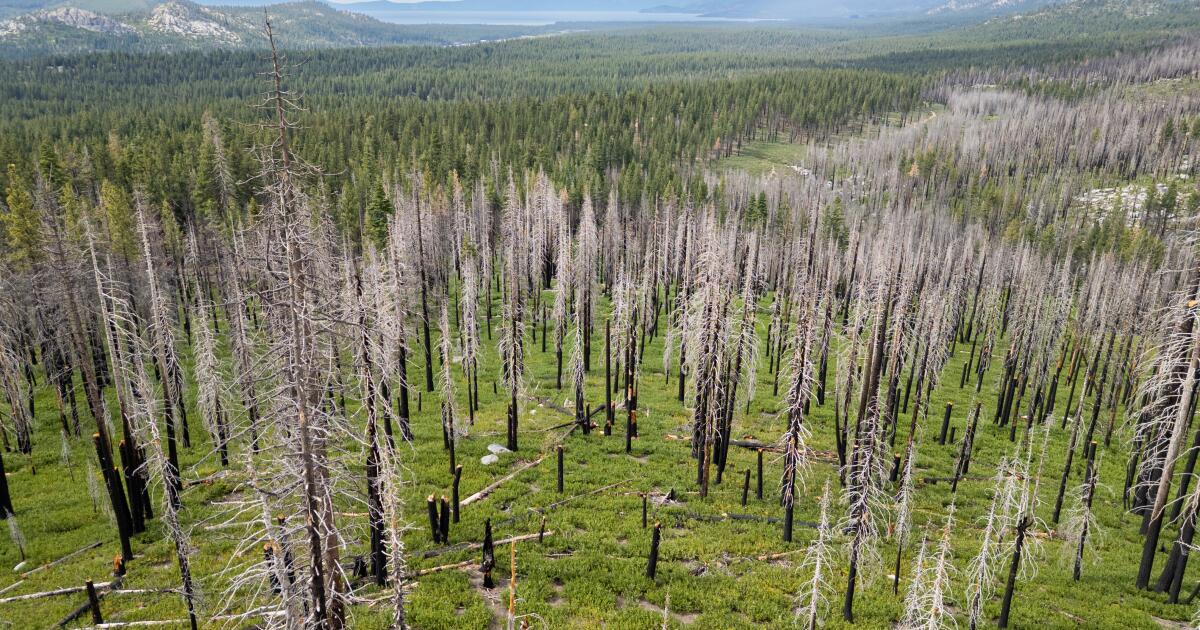
‘I’d rather my house burn down than get cancer’: Herbicide use upends California’s fight to save forests
-
 Sports29 minutes ago
Dodgers scheduled to visit White House in late July to celebrate 2025 World Series win
-

 World39 minutes ago
Former US Olympian pleads not guilty in DC reflecting pool vandalism case
-
 News1 hour ago
Former Olympian pleads not guilty in reflecting pool vandalism charges


