World
Jewish communities on high alert as Passover begins amid rising security threats nationwide


NEWYou can now listen to Fox News articles!
As Jewish families across the United States celebrate Passover, an intensifying threat environment is shaping how communities approach the holiday and beyond. Tensions tied to the war with Iran, attacks against Jews and Jewish institutions have led to concerns over the community’s safety and security.
From Miami to New York, officials are responding to what they describe as a sustained and evolving threat landscape. At a pre-Passover security strategy briefing at the NYPD, Police Commissioner Jessica Tisch told Jewish community leaders, “It is clear that we will be in a heightened state of alert for the foreseeable future,” a warning that comes as policymakers and security experts point to a widening gap between the level of threat facing Jewish communities and the federal resources available to protect them.
Despite security fears, funding for houses of worship in the United States remains below what experts say is needed to meet the current threat, even as antisemitic incidents continue to rise.
NYC BOOSTS PATROLS AMID ‘HEIGHTENED THREAT ENVIRONMENT,’ AFTER GUNMAN RAMS TRUCK INTO MICHIGAN SYNAGOGUE
Aftermath of the attack on Temple Israel synagogue in West Bloomfield, Michigan. An attacker rammed into the building on Thursday, March 12, 2026. (Temple Israel)
According to data from the Federal Bureau of Investigation, anti-Jewish hate crimes have consistently accounted for the largest share of religion-based crime incidents in the United States in recent years.
The gap between risk and resources has become a central concern for those working directly with affected communities. Scott Feltman, Preventative Security Analyst and Executive Vice President at One Israel Fund, said no religious group should have to choose between remaining open and ensuring safety.
“No one should feel unsafe walking into a synagogue, church, mosque or temple in New Jersey or anywhere in America,” Rep. Josh Gottheimer, D-N., told Fox News Digital, who in recent weeks has been advocating for an increase in federal Nonprofit Security Grant Program (NSGP) funding to $1 billion in fiscal year 2027, a proposal currently under consideration in Congress.
Recent attacks underscore the urgency. In Michigan, a man rammed a vehicle into a synagogue in West Bloomfield and opened fire while more than 100 preschool children were inside. In California, two Jewish men speaking Hebrew were reportedly assaulted in a restaurant while the attacker shouted antisemitic slurs.
Jesse Arm, Manhattan Institute vice president for external affairs, told Fox News Digital, “What the latest attempted massacre made clear — when an Islamist from Dearborn via Lebanon tried to ram an explosive-laden truck into a synagogue preschool in my hometown of West Bloomfield, Michigan — is that security works. The presence of trained, armed guards helped save the lives of 140 American children and their caretakers.
SIGN UP FOR ANTISEMITISM EXPOSED NEWSLETTER
“But the broader lesson for the Jewish community is that safety cannot be outsourced entirely to the federal government or to any administration. It requires a cultural shift: normalizing lawful firearm ownership and training, hardening facilities at every level, and investing in the day schools, camps and identity-forming institutions that build communities confident and rooted enough to defend themselves.”
Arm had praise for the administration in its fight against antisemitism: “President Trump has been a godsend for American Jewry. His administration has been unambiguous in its commitment to Jewish safety — naming antisemitism as a serious national security threat, taking a hard line on campus radicalism and prioritizing the kind of border security and counter-jihadist vigilance that the previous administration routinely soft-pedaled. American Jews should recognize that and be immensely grateful for it.”
Leo Terrell, chairman of the DOJ Task Force to Combat Antisemitism speaks during a reception for Black History Month in the East Room of the White House on Feb. 20, 2026. (Pool via AP)
JEWISH SUMMER CAMPS RAMPING UP SECURITY MEASURES AMID RISING ANTISEMITISM — AND PARENTS ARE FOOTING THE BILL
The federal Nonprofit Security Grant Program, administered by FEMA, currently allows at-risk institutions to apply for up to $200,000 per location. In practice, however, many organizations receive less than that amount, often after delays that can stretch one to three years, and demand for the program has exceeded available funding in recent years, with applications far outpacing the number of grants awarded, according to federal data.
Security experts add that the delay between identifying a threat and receiving funding can leave institutions without the protections recommended by security professionals during periods of heightened risk.
Antisemitic graffiti defaces Israeli-American Council HQ (The Israeli-American Council (IAC) national headquarters in Los Angeles)
To address those gaps, experts recommend layered security measures including trained personnel, reinforced entry points, surveillance systems, controlled access and emergency response training, which they estimate require between $400,000 and $500,000 in funding per location, roughly double the current federal cap. Security experts say both the funding level and the timeline for distribution have become central concerns as incidents continue to rise.
CLICK HERE TO DOWNLOAD THE FOX NEWS APP
Steven Ingber, CEO of the Jewish Federation of Detroit, said much of the financial burden for security continues to fall on the Jewish community itself rather than being fully addressed through government support.
As that debate continues, officials are urging institutions to remain vigilant and maintain close coordination with local law enforcement, particularly during periods of increased tension tied to global events.
Fox News Digital reached out to FEMA for comment but did not receive a response.



Rights groups have raised concerns about Trump’s efforts to change election administration before November’s midterms.
About two dozen Democrat-led states have filed a lawsuit against the administration of United States President Donald Trump to block an executive order setting new limits on mail-in ballots.
Friday’s lawsuit comes as voting rights groups charge that Trump is seeking to make it more difficult to vote before the consequential midterm elections in November.
list of 3 itemsend of listRecommended Stories
Trump, meanwhile, has argued that his efforts are meant to counter rampant voter fraud in US elections.
That opinion runs counter to the findings of independent election monitors, including the conservative Heritage Foundation, whose decades-spanning database has found an exceedingly low rate of election fraud.
New York Attorney General Letitia James was among the attorneys general in 23 states and the District of Columbia who filed Friday’s suit, alongside the governor of Pennsylvania.
In a statement, she argued that Trump’s executive order exceeded his presidential power.
“Free and fair elections are the cornerstone of our democracy, and no president has the power to rewrite the rules on his own,” James said.
Trump’s latest executive order, signed on Tuesday, calls on the Department of Homeland Security to “compile and transmit” a list of United States citizens who are eligible to vote in each state.
It then requires the United States Postal Service (USPS) to “transmit ballots only to individuals enrolled on a State-specific Mail-in and Absentee Participation List, ensuring that only eligible absentee or mail-in voters receive absentee or mail-in ballots”.
Voting rights groups have said the measures would likely rely on an incomplete federal list of US citizens and would heap too much responsibility on USPS.
Mail-in voting has increased across the US, in states that lean both Republican and Democratic, particularly after the COVID-19 pandemic. In the 2024 elections, a third of all ballots were cast by mail.
In Friday’s lawsuit, the states argue that Trump’s order violates the US Constitution, which says that state officials decide the “times, places and manner” of elections.
The states further maintain that only Congress can pass new restrictions related to how elections are conducted. Forcing a change to election administration so close to the November elections will also create chaos, according to the lawsuit.
The midterm elections will determine which party controls the US House of Representatives and Senate.
Trump has previously voiced concern that he may face impeachment proceedings, should the Republican Party see its majorities in both chambers disappear.
For years, Trump has maintained, without evidence, that his 2020 election loss was the result of widespread fraud, and he has pledged reforms to the voting system.
He previously signed executive orders seeking to overhaul US election administration, although they have been mostly blocked by the court system.
The Department of Justice has also sued several states in an attempt to gain access to voter information, and the FBI seized ballots from the 2020 election during a raid last January in Fulton County, Georgia, further stoking concerns.
Trump, meanwhile, has been pushing lawmakers to pass the “SAVE America Act”, which would require increased proof of US citizenship when registering to vote, including a birth certificate or a passport, as well as a photo ID to cast a ballot.
Rights groups have warned the measures could disenfranchise many voters, including women who changed their last name upon marrying.

Few parts of southern Lebanon remain untouched by the war.
Entire villages have emptied after Israel issued sweeping evacuation warnings for nearly all of the south. Israeli airstrikes have destroyed homes, severed bridges and razed parts of towns. Israeli ground forces have advanced deeper into southern Lebanon, clashing with Hezbollah militants in the rugged, hilly terrain.
The war has brought intense uncertainty to the south, a predominantly Shiite Muslim area dominated by Hezbollah for decades.
This week, Israeli officials offered their most explicit plan to date to occupy a swath of southern Lebanon from the border up to the Litani River after the ground invasion ends. That would amount to about 10 percent of the entire country. Israeli officials have said they aim to establish a “security zone” to prevent the territory from being used to attack Israel.
The hundreds of thousands of displaced Lebanese who fled the south will not be allowed to return to their homes until the “safety and security of northern Israeli residents is ensured,” the defense minister, Israel Katz, said on Tuesday.
Lebanon’s government has condemned Israel’s military campaign and appealed to the international community to intervene. Last week, Prime Minister Nawaf Salam warned the U.N. secretary general, António Guterres, about the risk of Israel annexing the territory south of the Litani River.
Razing border villages
Mr. Katz reiterated on Tuesday that Israel’s plan in southern Lebanon includes demolishing entire Lebanese towns on the border.
Many of Lebanon’s border villages were devastated in the previous escalation of fighting in 2024. At least six villages saw widespread destruction in that war. Israeli airstrikes that persisted after the cease-fire made it virtually impossible for residents to rebuild in those villages.
“There was nothing to return to” after the last war in 2024, said Alaa Suleiman, 40, who fled from his home Kfar Kila, a village along the border with Israel. “Even when people tried to put up prefabricated houses, they were targeted by strikes. It meant we had no hope of ever returning.”
Since the latest war broke out last month after Hezbollah fired rockets at Israel in solidarity with Tehran, Israel has appeared to accelerate its destruction of the border towns.
One video circulating on social media and verified by The New York Times shows several large simultaneous explosions on March 17 in Aita al-Shaab, which is about a mile from the border. Satellite images viewed by The Times from later that day confirmed the damage to the area. The town was already heavily hit in 2024.
The destruction of communities along the border is part of a deliberate strategy by the Israeli military, according to Mr. Katz, who said that the practice of flattening homes in southern Lebanon is “following the Rafah and Beit Hanoun model in Gaza.” There, Israel used bulldozers and controlled demolitions to erase entire neighborhoods.
Bombing bridges
In March, the Israeli military demolished most of the key bridges across the Litani River, in what it said was an effort to prevent Hezbollah from moving reinforcements and combat equipment to southern Lebanon. The waterway, which is as much as 20 miles from the Israeli border at its furthest point, has long marked the dividing line between southern Lebanon and the rest of the country.
Much of the Litani River is situated at the base of a ravine, making the bridges critical — both for civilians still living in the south to leave as well as for medical supplies, food and other essentials to reach those who have remained.
By blowing up the major bridges connecting northern Lebanon to the south, Israel has forced civilian traffic onto a handful of smaller crossings. Should Israel target those crossings, southern Lebanon would be almost entirely severed from the north.
Israeli officials have not made clear whether the military will reach the river itself or only control it from afar, nor how long the military intends to stay there.
A video filmed by Reuters and verified by The Times shows several fiery explosions across a large bridge in Qasmiyeh, in the south of Lebanon. Dark clouds of smoke can be seen rising into the air, along with debris.
Ground assault
After the previous war between Hezbollah and Israel ended in a cease-fire agreement in late 2024, the Israeli military occupied five outposts near the border inside Lebanon.
Since the start of a new war, Israel has sent in at least 5,000 ground troops, according to two Israeli officials who spoke on the condition of anonymity because they were not authorized to talk to the media.
Satellite images analyzed by The Times showed Israeli vehicles in new military positions in four Lebanese towns near the Israeli border. As of late March, vehicles were not visible much deeper into Lebanese territory than where Israeli troops previously reached during the 2024 ground invasion.
In the border town of Khiam, images reveal razed areas and destroyed buildings in various parts of the town.
A mix of Merkava tanks and armored personnel carriers are visible in the images, said Jeremy Binnie, Middle East defense specialist at Janes, a London-based defense intelligence firm.
News of the destruction in Khiam has stirred alarm among residents, nearly all of whom fled when the war broke out.
“After the last war, we rebuilt our home. We said it’s over. And now it’s all being destroyed again,” said Ali Akkar, 78, who was displaced from his home in Khiam. “In the last war, we had some hope to return home. Now we have none.”
Satellite imagery verified by The Times also suggests that there was an Israeli military presence at a hospital near Meiss al-Jabal, a town near the Israel-Lebanon border. Satellite imagery showed what appeared to be armored vehicles in various positions around the hospital complex.
While it has been possible to access satellite imagery from southern Lebanon, cloud coverage obscured the visibility of many areas after March 18, making more recent positions of Israeli forces in Lebanon harder to independently verify.
Targeting infrastructure
Israeli airstrikes have also hit homes, gas stations, money exchanges and other civilian infrastructure that the Israeli military says are being used by Hezbollah.
Israel struck in March at least four fuel stations run by the Al-Amana Petroleum Company, a major fuel distributor that was previously placed under U.S. sanctions for its alleged links to Hezbollah. Israeli officials say these stations are “significant economic infrastructure” for the group.
Video filmed by Agence France-Presse showed the damage to a gas station between the cities of Naqoura and Tyre, in southwest Lebanon. A sign hangs from the roof, which is partially damaged, and a large crater is visible on the pavement.
While Israeli officials say the gas stations help fund Hezbollah, they have also benefited many Lebanese. At times, they have sold fuel at subsidized prices, making them a lifeline for poorer people as the war in Iran drives up fuel costs.
The devastation has anguished residents of the south who have fled and watched from afar as their towns and villages have been destroyed.
“There’s so much more destruction, more fighting, the stakes of this war are much higher than the last one,” said Hooda Rajab, 28, who was displaced from her home on the outskirts of Khiam. “Now we’re asking: Will we ever be able to return home? Even if we can, will there be anything for us to return to?”
World
Iran’s tallest bridge collapses after reported US airstrikes; Iran threatens American allies in retaliation

NEWYou can now listen to Fox News articles!
Iran’s biggest bridge near Tehran has crashed down in a stunning scene captured on camera following reports of U.S. airstrikes, President Donald Trump announced Thursday, as he pressed the regime to make a deal before tensions escalate further.
The B1 highway bridge, a key link between Iran’s capital and the western city of Karaj, is considered the tallest in the Middle East and was only inaugurated earlier this year.
Iranian state TV reportedly warned of potential retaliation, claiming the state’s military has identified multiple bridges in American-allied Middle East nations as targets, according to Iran International.
Trump posted a video on social media capturing a massive plume of smoke and debris after the bridge’s apparent collapse.
KAROLINE LEAVITT FIRES BACK AT NBC NEWS REPORTER WHO ASKED IF TRUMP’S IRAN THREAT AMOUNTS TO A ‘WAR CRIME’
The B1 bridge near Tehran collapsed after reported U.S. airstrikes. (@realDonaldTrump/Truth Social)
“The biggest bridge in Iran comes tumbling down, never to be used again — Much more to follow! IT IS TIME FOR IRAN TO MAKE A DEAL BEFORE IT IS TOO LATE, AND THERE IS NOTHING LEFT OF WHAT STILL COULD BECOME A GREAT COUNTRY!” Trump said in a post on Truth Social.
The strike on the bridge was aimed at cutting drone and missile supply lines to Iranian firing units targeting U.S. and Israeli forces, Middle East outlet i24NEWS reported, citing sources.
Iranian state TV also said the bridge was hit twice, roughly an hour apart, resulting in civilian casualties, Fars News reported.
TRUMP TO ADDRESS NATION ABOUT IRAN AS HE SIGNALS WAR COULD END WITHIN WEEKS
President Donald Trump pauses as he finishes speaking about the Iran war Wednesday, April 1, 2026, in Washington. (Alex Brandon-Pool/Getty Images)
“A few minutes ago, the American-Zionist enemy once again targeted the B1 bridge in Karaj,” the broadcast said, noting that the first strike killed two civilians.
Fars News also reported that other areas of Karaj were struck.
Iran’s IRGC reportedly identified several bridges in American-allied nations as potential targets after the collapse of the B1 bridge. (Morteza Nikoubazl/Nur Photo)
CLICK HERE TO DOWNLOAD THE FOX NEWS APP
The outlet reported that Iran is considering plans to rebuild the bridge with the help of its engineers and experts.
In retaliation, Iran’s Islamic Revolutionary Guard Corps has reportedly identified several bridges in American-allied nations across the Middle East as potential targets, including infrastructure in Kuwait, Saudi Arabia, Bahrain, Abu Dhabi and the Jordan-West Bank region.

L.A. Affairs: I told my husband that something had to change. I just didn’t know what would come next

U.S. rescues pilot who ejected after fighter jet was shot down by Iran, officials say
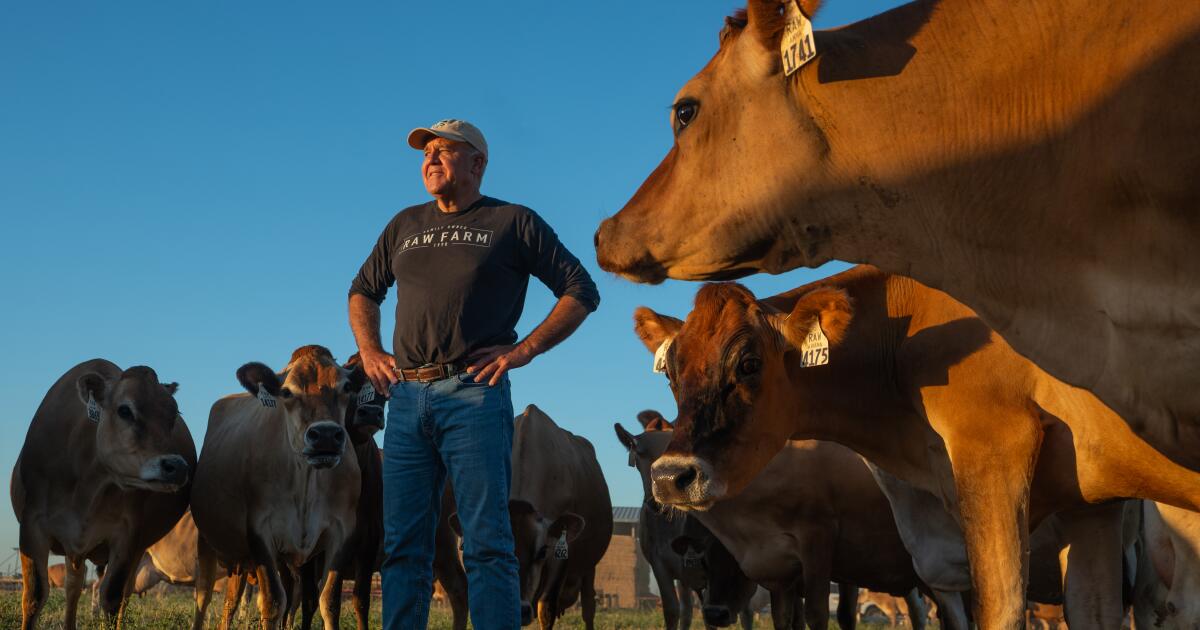
Amid E. coli outbreak, California-based Raw Farm voluntarily recalls cheddar cheese

Luka Doncic’s hamstring injury will test Lakers’ depth on eve of NBA playoffs

Two dozen Democrat-led states sue Trump over mail-in ballot limits

Florida High School Football Rankings: Top 25 teams – Oct. 21

How old is Bo Nix? What to know about Oregon quarterback ahead of 2024 NFL Draft

Cleary's 21 help Le Moyne down Central Connecticut State 69-64 in OT

99th annual Pony Swim held in Virginia

Indiana Members Credit Union announced as new anchor tenant at Bottleworks District
Two dozen Democrat-led states sue Trump over mail-in ballot limits

Trump’s ballroom fight sheds new light on an underground White House bunker

Video: Trump Struck Iran. Now Farmers Are Paying the Price.

What B-52 bombers bring to Iran fight — and what it means for the war now

Podcast: Hungary elects: what is at stake and who is likely to win?
-

 Culture1 week ago
Wil Wheaton Discusses ‘Stand By Me’ and Narrating ‘The Body’ Audiobook
-

 South-Carolina5 days ago
South Carolina vs TCU predictions for Elite Eight game in March Madness
-

 Miami, FL1 week ago
Jannik Sinner’s Girlfriend Laila Hasanovic Stuns in Ab-Revealing Post Amid Miami Open
-

 Culture1 week ago
What Happens When We Die? This Wallace Stevens Poem Has Thoughts.
-

 Minneapolis, MN1 week ago
Boy who shielded classmate during school shooting receives Medal of Honor
-

 Vermont5 days ago
Skier dies after fall at Sugarbush Resort
-

 Education1 week ago
Video: Transgender Athletes Barred From Women’s Olympic Events
-

 Politics5 days ago
Trump’s Ballroom Design Has Barely Been Scrutinized