News
Video: Trump Struck Iran. Now Farmers Are Paying the Price.


“When I saw the new fertilizer price, I’m like, holy crap. Talk about a kick to the gut.” Spring is here, which means it’s planting season in Iowa. For corn farmers preparing to sow their fields, the war with Iran couldn’t have come at a worse time. “So this is the fertilizer. So how much did the price of it go up after the war in Iran erupted?” “It went up about $250 a ton in my neck of the woods.” Iran’s closure of the Strait of Hormuz, a critical transit point for a third of the world’s fertilizer, sent the price soaring. The cost of two widely used nitrogen fertilizers shot up by 20 and 50 percent in the first few weeks of the war. A decade of inflation, low commodity prices and tariffs have squeezed Jolene Riessen’s profit margins. She’s now facing her toughest year yet as a farmer. “Every year is a risk when you farm. But this has kind of been compounding. Our prices have been low. And yet our input costs continue to ratchet up.” With the price of fertilizer already higher than last year, she put off buying until last month, hoping the price would go down. Then the war started and the opposite happened. With the window to plant closing, she had little choice but to buy at a high price. “For the amount of fertilizer I was going to buy, it had gone up about $13,000 in two days. What pot does that come out of? Fertilizer price, we can’t control. Fuel price, we can’t control. Where is it all going to end up? We don’t know.” “This is like the worst I’ve ever seen it. Gambling what our futures are going to look like.” Farmer Lance Lillibridge has been representing Iowa corn growers for 14 years. “The current conflict in Iran is hurting farmers everywhere in Iowa and across the country. If we’re not able to sustain our land with the nutrients that’s needed to grow a crop, then our yields are going to go down. Eventually going to drive up the price of corn, which is what we use to feed chickens, pigs and cattle, amongst other things. And eventually that is going to go back to the consumer at the grocery store.” While it may take some time for shoppers to see the price increase reflected in their groceries, Jolene’s costs continue to climb higher than what she makes for her corn. “This is the corn that we’ve been talking about.” “Yep.” At today’s price of corn, she could lose roughly $110 per acre across her 530 acres. “We just did the math. And so maybe looking at losing $58,000. So what am I going to do to negate that? I have never lost quite that much before.” Still, she has hoped the price of corn will go up this year to offset at least some of that loss. She keeps a close eye on its every move in the market. “Time to check the markets.” “How many times a day are you checking the prices?” “Sometimes you — Half-dozen times a day. And sometimes that isn’t enough. Now you know that at closing at 2 o’clock, they were, they were up 4 cents and now they’re down 2 cents. Which means that was a 6-cent move in the market. Crazy.” “And today, I’m promising to request additional farm relief for our great patriots in the next funding bill.” Last month, the Trump administration lifted sanctions on fertilizer sales from Belarus and Venezuela to try to ease the price surge and promised more aid to farmers. Still, Jolene is making hard calculations to stay on the farm that has been in her family for 85 years. “Those income sources could very well be selling some equipment. There’s a chance that there could be some ground sold. And then what are you left with? For some farmers, it’s a legacy. That’s my legacy that I’m selling. If it was up to me, the war would be done yesterday.”



News
ICE should do traffic stops despite recent shootings, Trump says, seeming to oppose new suspension

WASHINGTON (AP) — The Immigration and Customs Enforcement agency should continue vehicle stops after recent fatal shootings, President Donald Trump said on Wednesday, seeming to oppose a new suspension of the practice used as part of his immigration crackdown.
ICE is “doing a GREAT job, one that has to be done,” Trump wrote on his social media site.
The Republican president said that to remove criminals he claims were let into the country under the previous Democratic administration “we must be strong, tough, and smart, and we CANNOT give up one of ICE’s most important and effective Crime Fighting tools, THE TRAFFIC STOP!” Trump said, “Once we do, we are playing right into the criminal’s hands.”
Trump administration officials have told Immigration and Customs Enforcement officers to suspend most vehicle stops after two deadly shootings within a week, people familiar with the decision said Tuesday.
The suspension was ordered after an ICE officer shot and killed a Colombian driver Monday in Maine and a week after another officer shot and killed a motorist in Houston, renewing criticism of the agency’s enforcement tactics that were widely condemned last winter after the killings of Alex Pretti and Renee Good in Minnesota.
In Florida on Tuesday, a third man in roughly a week died during an encounter with immigration officers. This time, a 28-year-old man was killed after he was hit by a tractor trailer while running from immigration and other federal officers, authorities said.
It’s a narrative that has been repeated again and again since the Trump administration’s immigration crackdown began, with federal officers confronting drivers and then saying they opened fire when the drivers’ vehicles became a danger. That’s despite decades of warnings from policing experts that shooting into moving cars presents a danger of its own and should almost always be avoided.
There have been at least 10 deaths involving encounters with immigration agents since Trump launched his deportation campaign. At least four of those deaths involved people in vehicles, including the one last week in Houston, a trend so troubling that U.S. Sen. Susan Collins, R-Maine, said Tuesday that she had urged Department of Homeland Security Secretary Markwayne Mullin “to cease all non-urgent vehicle stops.”
John Sandweg, who was acting director at ICE, which is part of DHS, during President Barack Obama’s Democratic administration, estimated recently that there have been roughly 18 traffic stop shootings during the Trump immigration crackdown.
The office of Maine Sen. Angus King, an independent who caucuses with Democrats, was told by DHS that ICE was suspending traffic stops, office spokesperson Matthew Felling said.
ICE, which has been under pressure to beef up arrest and deportation numbers, often says people it’s trying to arrest are increasingly resistant to leaving their homes. ICE officers blame immigration advocates who advise immigrants to stay in their homes unless ICE produces a warrant signed by an independent judge instead of the administrative warrants the agency generally uses that are signed by another ICE officer. So, ICE officers say, they’re forced to find other areas in which to make arrests.
Shooting angers Maine
Hundreds of people in Maine protested Tuesday over the fatal shooting of Johan Sebastián Durán Guerrero, a 25-year-old Colombian national. Advocacy groups said Guerrero, who had a wife and a young daughter, was authorized to work in the United States.
DHS said Monday that an officer, “fearing for public safety,” shot and killed Durán Guerrero while officers were watching the home of someone they believed was in the U.S. illegally and facing a final order of removal from the country. It said in a post on X that when ICE tried to stop a car driven by someone who came from the home, the person attempted to flee in the vehicle and the officer fired.
That was a shift from how King earlier described the encounter, when he said Mullin told him the officer opened fire after the man tried to use his vehicle as a weapon. King said Mullin told him the officers were trying to serve an arrest warrant but not for the man who was shot.
In a scathing post on X, outgoing Colombian President Gustavo Petro called the shooting a targeted killing “at the hands of the U.S. government.”
Petro, who has openly quarreled with Trump, urged Trump to provide an explanation and accused ICE officers of treating Durán Guerrero as “an inferior being without rights.”
In Wednesday’s social media post, Trump told ICE to be “judicious, fair and smart, and go back and do your very important job.”
Maine’s congressional delegation on Tuesday demanded a “comprehensive, transparent, and expedited investigation.”
Questions surround the shooting
Photos showed bullet holes in Durán Guerrero’s car windshield, but the officers involved in the shooting didn’t have body cameras, leaving many questions. Among them are how close the officer was to the vehicle when shooting, whether officers told Durán Guerrero to stop and why ICE believes he had put the public in danger.
Border czar Tom Homan told reporters Tuesday that the investigation needs to play out and that officers will be held accountable if they are found to have acted inappropriately or illegally.
Maine’s attorney general’s office, which said it is working with federal agencies to investigate, said initial statements suggest the driver was trying to flee in the direction of the officer, whose name hasn’t been released and who was placed on leave.
Collins said Mullin told her the DHS inspector general is investigating in cooperation with the FBI.
Democrats seeking to unseat Collins in November have sought to connect her with ICE’s methods, which have drawn public scrutiny and derision. Collins later said in a statement that although ICE needs to improve, eliminating the agency would make the nation less safe.
Maine Secretary of State Shenna Bellows, a Democrat who is vying for Collins’ seat, called the ICE officers at the shooting “thugs” during a vigil Tuesday in Lewiston.
___
Whittle contributed from Biddeford, Maine; Brook from New Orleans; and Sisak from New York.
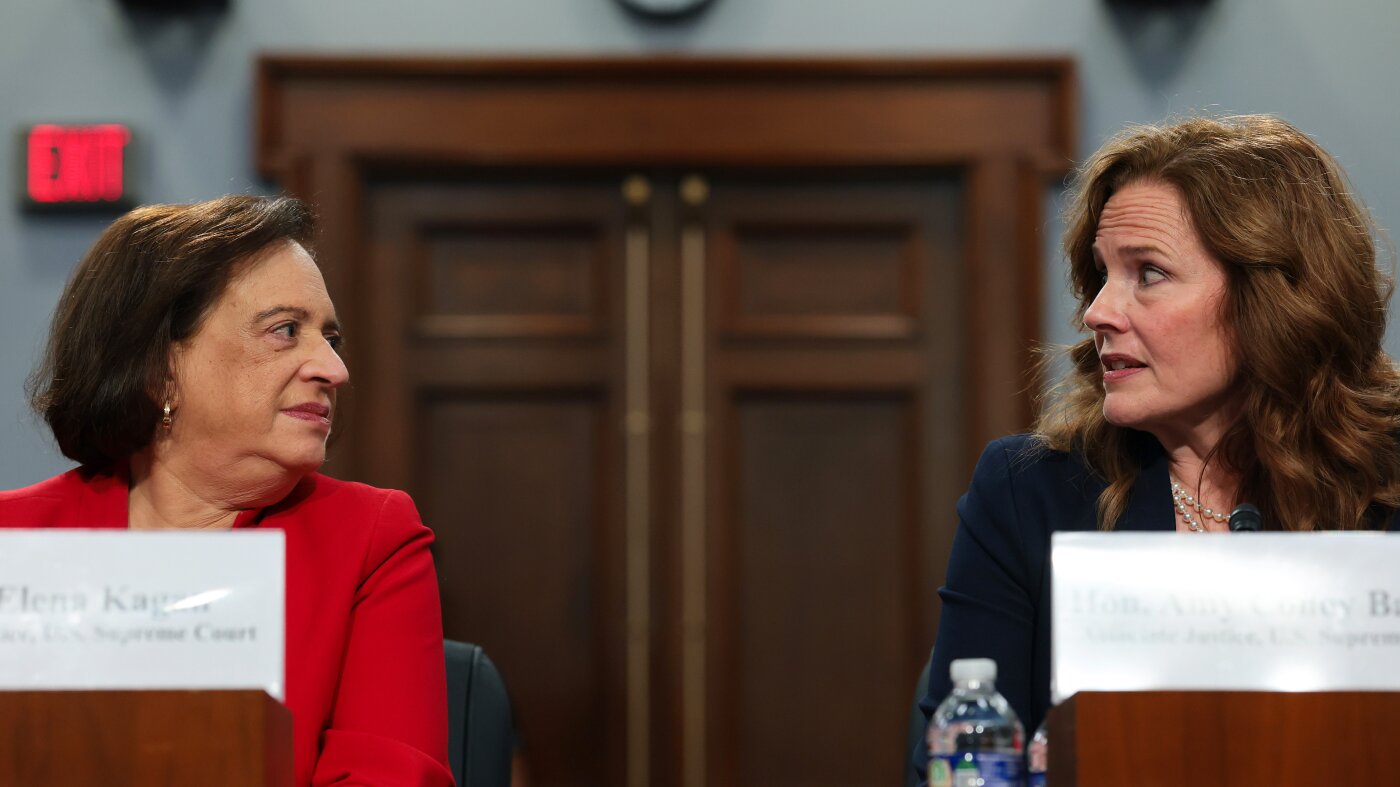
Supreme Court Justices Elena Kagan and Amy Coney Barrett testify before the House Appropriations Committee on Capitol Hill on July 14, 2026 in Washington, D.C.
Anna Moneymaker/Getty Images
hide caption
toggle caption
Anna Moneymaker/Getty Images
The Supreme Court did something Tuesday that it has not done in seven years. It sent two of the justices to Capitol Hill to testify about the court’s budget request for the coming year. The budget has grown dramatically in recent years because of the equally dramatic rise in the number and intensity of threats to the justices’ safety.
Designated as the court’s representatives were Justice Elena Kagan, appointed by President Obama, and Justice Amy Coney Barrett, appointed by President Trump.
As Kagan pointed out in her testimony, it was Republican Darrell Issa and Democrat Elijah Cummings who insisted that the court beef up its security ten years ago after Justice Antonin Scalia died in his sleep on a hunting trip, with no security anywhere nearby to respond quickly.

“They said, kind of like, we think you’re crazy, you know, that that you have less security than director of the Office of Personnel Management does,” she recounted the Congressmen as telling the Court, “and we think that you have to do better.”
Before that, the justices basically had little to no security. They drove their own cars to work; went to the movies and shopped at supermarkets unaccompanied, and did their private travel on their own. And frankly, they liked it that way, because having security is personally invasive.
In recent years, however, the court has undertaken major changes, including continually expanding the court police force to protect the justices and their homes at all times, and funding additional cybersecurity measures.
And yet, as Justice Kagan pointed out, the Court’s $207 million budget request is less than one tenth of one percent of the entire federal budget.
The justices spoke at length Tuesday about how rising threats impacted their lives. Justice Barrett came prepared with two harrowing stories. First was the day she brought home a bullet-proof vest.
“My 12-year-old son was standing in the doorway of my bedroom and he wanted to know what it was,” she testified, “and I didn’t know how to respond. I didn’t expect that performing this service was going to put me in the position of explaining to my children what a bulletproof vest was and why I had to wear one.”
She also described how just six weeks ago, her house was swatted, with local police responding to a fake emergency call. Local police could have stormed her home, but for the fact that her own security detail was there to prevent it.
Indeed, threats have deeply affected judges across America. After U.S. District Court Judge Esther Salas’s 20-year old son was murdered by a gunman seeking to kill her, many federal judges have reported receiving packages bearing the name of her slain son. Those threats, Justice Barrett testified, “are meant to intimidate and they’re meant to harass.”
Sen. Jack Reed (D-R.I.), asked questions about President Trump’s furious response to adverse rulings in the tariff and birthright citizenship cases, and whether Trump’s heaping insults on the court could play a role in jeopardizing the safety of some justices. Kagan had a two-part reply.
“Criticism is fair game. I mean, go for it. You know, life in the big city is that you’re subject to all kinds of criticism. But intimidation is a different thing entirely. And when political figures of any stripe are trying to intimidate judges,” she said, “that’s where we really have crossed the line.”
The hearings were not confined to issues of safety. Congresswoman Rosa De Lauro (D-Conn.) asked about the Supreme Court’s ethics requirements, noting that members of Congress and the executive branch are limited to gifts under $50, while the Supreme Court has no such limit.
She is supporting a bill that would impose upon the Supreme Court the same restrictions on receiving gifts that apply to Congress. And she called for an enforcement mechanism for the ethics rules adopted by the Supreme Court itself.
But Justice Kagan, who said she favors an enforcement mechanism, added that creating such a system is “hard.” After all, as she noted, “you wouldn’t want either the President or Congress” imposing a system on the court because that could well lead to compromising the independence of the judiciary.
One idea that Kagan seemed to like would be to create a panel of distinguished retired judges to enforce the court’s ethics code. But Justice Barrett seemed unpersuaded.
“Who selects the judges? How is the panel composed? There’s just a lot of complexity,” that hasn’t been worked out, she said. The disagreement between the two was, if anything, illustrative of just how hard it was to get the court to finally agree on even the relatively porous ethics code it voluntarily adopted in 2023.
The Justices were also questioned about the court’s emergency docket, dubbed by critics “the shadow docket.” These cases were extremely rare until the Trump administrations.
The critical difference between the emergency docket and the so-called merits docket is that emergency docket appeals often leapfrog over the lower courts, allowing the high court to decide cases without full briefing and argument, and inevitably without much, if any, explanation.
Critics, including Justice Kagan, have often criticized these unsigned and unexplained emergency docket orders for making it difficult for lower courts to know what the law is. Some have in fact accused the court of inviting the Trump administration to treat the docket like a fast-pass to getting policy rubber-stamped.
Questioned by Senator Chris Van Hollen (D-Md.), Kagan observed that part of the reason for the Court’s increasing use of the emergency docket comes from the fact that “we’ve granted a number of these…And when people know that relief is available, there are a lot of smart lawyers out there in the world who are going to say, ‘Why don’t we take our shot at that?’” In other words, the court’s own behavior may have invited the existing problem to metastasize.

Mexico has begun filing criminal complaints with state prosecutors in the United States over the deaths of its citizens in U.S. immigration custody and during enforcement operations, the foreign mini

Maine ICE shooting caught on security camera
Surveillance footage from two local businesses shows a white car driving in circles at a street intersection.
MEXICO CITY, July 13 (Reuters) – Mexico has begun filing criminal complaints with state prosecutors in the United States over the deaths of its citizens in U.S. immigration custody and during enforcement operations, the foreign ministry said on Tuesday.
Mexico’s government has also sent cease-and-desist letters to U.S. detention centers where Mexican nationals have died, the ministry added in a statement.
The filings follow the deaths of at least 14 Mexican nationals in ICE custody and several others during arrest operations, including the recent fatal shooting of a Mexican citizen by an ICE agent in Houston.
President Claudia Sheinbaum announced Mexico’s intention to escalate its response to the deaths last Friday, as she claimed that the government “cannot turn a blind eye to the Mexicans who have died.”
In addition to the measures in the U.S., Mexico’s foreign minister also contacted the United Nations High Commissioner for Human Rights regarding the deaths of Mexican nationals in ICE custody.
Mexico expects the U.N. office to gather information from U.S. authorities, analyze the events and “refer the case to the relevant special procedures of the Human Rights Council,” the statement added.
-

 Atlanta, GA3 minutes ago
Argentina advances to World Cup final with 2-1 win over England
-

 Minneapolis, MN9 minutes ago
BWCA wildfires continue to escalate, peacetime emergency extended
-

 Indianapolis, IN15 minutes ago
NFL Trade Rumor: Indianapolis Colts and Tampa Bay Buccaneers emerge as top landing spots for $4M Cleveland Browns’ QB
-

 Pittsburg, PA21 minutes ago
Postponed: Waiting on Parkway East bridge to be demolished in explosion
-

 Augusta, GA27 minutes ago
Augusta youth program feels state budget cut heading into new school year
-

 Washington, D.C33 minutes ago
National Guard continuing DC deployment through Inauguration ’29
-

 Cleveland, OH39 minutes ago
Cleveland Advances Housing Manufacturing Strategy with MMY US Selection and Historic Tax Credit Award for Wellman-Seaver-Morgan Building
-

 Austin, TX45 minutes ago
Austin Pets Alive! activates emergency response to assist shelters affected by flooding

