World
Exclusive: Israeli ambassador says no peace in Gaza unless Hamas hands over all 48 hostages, disarms


NEWYou can now listen to Fox News articles!
There will be no end to the war in Gaza if Hamas does not hand over all 48 living and deceased hostages and completely disarm per the terms of the agreement finalized overnight between Hamas and Israel, Jerusalem’s ambassador to the U.S., Yechiel Leiter, warned in an interview with Fox News Digital on Thursday.
The Israeli government is expected to approve the peace deal first presented by President Donald Trump late last month, and then agreed to by Prime Minister Benjamin Netanayhu.
But concerns remain over Hamas’ commitment and ability to return all the bodies of the deceased hostages within a 72-hour window beginning Friday night local time, as directed under the terms of the agreement.
Palestinians, including children, gathered in the city of Khan Yunis celebrate after the announcement of the ceasefire agreement in Gaza on Oct. 9, 2025 in Khan Yunis, Gaza. (Abdallah F.s. Alattar/Anadolu via Getty Images)
TRUMP PEACE DEAL TRIGGERS 72-HOUR COUNTDOWN FOR HAMAS TO RELEASE 48 HOSTAGES FROM GAZA
“They have an obligation to return everyone in 72 hours. Hopefully we’re going be able to keep everything within that framework,” Leiter said when asked about concerns over Hamas’ ability to immediately hand over all the deceased hostages. “There are some glitches that we have to deal with, and this issue is one of them.
“But we need to see all the bodies back, and I don’t think we’re going to be able to move forward until we do have everyone,” he added.
Leiter said a part of the problem is Hamas did not diligently keep track of where it left the bodies of the deceased, but warned that until every body is returned, Israel will not withdraw its forces from the Gaza Strip.
An international task force involving the U.S., Qatar and Egypt has been formed to help Israel recover the bodies of the deceased, but the White House did not respond to Fox News Digital’s questions regarding what role the U.S. will play or if there will be American boots on the ground aiding the search.
An agreement was reached overnight after mediators from the U.S., Egypt and Qatar worked for days with Hamas and Israeli officials to hash out details of the peace agreement, though it remains unclear if there were any changes made to Trump’s original 20-point plan.
Benjamin Netanyahu, Israel’s prime minister, left, and Yechiel Leiter, Israel’s ambassador to the U.S., speak to members of the media following a meeting with US House Speaker Mike Johnson, a Republican from Louisiana, not pictured, at the US Capitol in Washington, D.C., US, on Tuesday, July 8, 2025. (Graeme Sloan/Bloomberg via Getty Images)
FATHER OF YOUNGEST AMERICAN HOSTAGE HOLDS OUT SLIVER OF HOPE AFTER TRUMP SECURES GAZA PEACE DEAL
Reports over the weekend suggested Hamas objected to the calls that it completely disarm – though in exchange it would also be granted amnesty and a path out of Gaza to an accepting third party nation should they choose to leave – and Leiter was unable to shed light on whether Hamas has formally conceded to the disarmament terms.
“We hope it proceeds according to the president’s plan,” Leiter said. “We assume, having long experience with Hamas and Islamic Jihad and these terrorist organizations, that there are going to be glitches along the way.
“Look, they’re going down. This is basically a surrender on Hamas’s part. They don’t like it one bit, and they’re going to do whatever they can to try to show that they’re still relevant,” the ambassador warned.
People gather in Hostages Square during a rally as a participant displays a sign listing hostages’ names following the Israel-Hamas peace deal. (Dana Reany/Hostages and Missing Families Forum)
Disarmament is not a part of the first phase, which involves the complete return of all hostages, the partial withdrawal of Israeli troops to a designated line as agreed to by Israel and Hamas, and the release of nearly 2,000 Palestinian prisoners, including 250 of whom are serving life sentences for terrorist offenses, including murder.
The second phase would involve further withdrawal of Israeli forces in coordination with the complete disarmament of Hamas and demilitarization of the enclave. An international “peace body” headed by Trump would also be established to begin the process of rebuilding the Gaza Strip.
“We’ve put all the focus now on the first phase,” Leiter said, while acknowledging that Hamas has made comments suggesting it will not disarm and the second phase of a peace deal could once again collapse.
A smoke plume billows following Israeli bombardment on the Gaza Strip as seen from northwest of Nuseirat refugee camp in Gaza, on Oct. 9, 2025. (Majdi Fathi/NurPhoto via Getty Images)
“But that’s part of the plan – that’s very clearly part of the president’s plan. That was the goal set out by Prime Minister Netanyahu from the outset, that Hamas is disarmed, that Gaza is de-radicalized and demilitarized.
“We can’t go back into a situation where we have Jihadi militants sitting at our border, or else we haven’t accomplished anything,” the ambassador said. “This is performance-based. They disarm, they are disarmed if necessary, and then Israel withdraws.”



World
UK prosecutors charge 3, including dual Pakistani citizen, in arson attack on Jewish ambulances in London

NEWYou can now listen to Fox News articles!
British prosecutors charged three suspects — ages 17, 19 and 20 — in an alleged arson attack targeting Jewish community ambulances in north London.
The March 23 incident unfolded at around 1:45 a.m. in the Golders Green neighborhood, where four ambulances operated by a volunteer emergency service serving the Jewish community were deliberately set ablaze in a synagogue parking lot.
Hamza Iqbal, 20, Rehan Khan, 19, and a 17-year-old boy are accused of arson with intent to damage property while recklessly endangering life, according to the Metropolitan Police.
Officials said two of the suspects are British citizens, while one holds dual British and Pakistani citizenship.
GUILTY VERDICTS IN ISIS PLOT POLICE SAY COULD HAVE BEEN ‘THE DEADLIEST TERRORIST ATTACK IN UK HISTORY’
Members of the Jewish community view an alleged antisemitic arson attack in the Golders Green neighborhood of north London March 24, 2026. (Henry Nicholls/AFP)
All three were arrested Wednesday at separate locations across London.
They did not enter pleas and remained in custody after a roughly 45-minute hearing Saturday afternoon at Westminster Magistrates’ Court, according to The Standard.
Prosecutors said a fourth suspect was also arrested and taken into custody at the courthouse where the three charged men were appearing, according to Reuters.
UK COUNTERTERRORISM POLICE PROBE ANTISEMITIC ARSON ATTACK AS IRAN-LINKED GROUP CLAIMS RESPONSIBILITY
Firefighters tackle a blaze at Highfield Road in the Golders Green neighborhood of London after an apparent arson attack on four ambulances belonging to the Jewish Community Ambulance Service. (PA/PA Images via Getty Images)
U.K. Prime Minister Keir Starmer previously condemned the attack as a “horrifying” antisemitic act.
“An attack on our Jewish community is an attack on us all. We will fight the poison that is antisemitism,” Starmer wrote on X March 23.
A report from the SITE Intelligence Group says an Iran-backed network calling itself the Islamic Movement of the People of the Right Hand has claimed responsibility, according to Reuters.
UK ARRESTS 2 OVER ‘ANTISEMITIC ARSON ATTACK’ AS POLICE INVESTIGATE POSSIBLE IRAN LINK
Shadow Foreign Secretary Priti Patel visits the site after four ambulances belonging to Hatzola, a Jewish community organization, were set on fire in northwest London March 23, 2026. (Isabel Infantes/Reuters)
Despite the claim, officials have not formally classified the case as terrorism. However, counterterrorism police are leading the investigation, Metropolitan Police said.
CLICK HERE TO DOWNLOAD THE FOX NEWS APP
Police in the United Kingdom previously arrested two other men, ages 45 and 47, in the days after the attack. They were later released on bail, according to the Metropolitan Police.
“I want to reiterate that the support we had from the local community since this attack took place has been incredible, and we will continue to work closely with local policing colleagues to do everything we can to keep the public safe,” Commander Helen Flanagan, head of Counter Terrorism Policing London, said in a statement.
The Metropolitan Police did not immediately respond to Fox News Digital’s request for comment.
Fox News Digital’s Efrat Lachter and Greg Norman and Reuters contributed to this report.

Foreign Minister Sugiono told reporters that Indonesia wants a thorough UN investigation into the deaths of the peacekeepers.
Published On 4 Apr 2026
Indonesia has received the bodies of three United Nations peacekeepers who were killed in southern Lebanon during Israel’s invasion of the country, amid the ongoing United States-Israel war on Iran.
The coffins of the killed soldiers arrived in Indonesia on Saturday. They were carried on the shoulders of uniformed officers for a ceremony attended by President Prabowo Subianto.
list of 3 itemsend of listRecommended Stories
After the ceremony, Foreign Minister Sugiono told reporters that Indonesia wants a thorough UN investigation into the deaths of the peacekeepers who were part of the United Nations Interim Force in Lebanon (UNIFIL).
“This is a peacekeeping mission. Incidents such as this should not happen,” the minister told reporters at the airport.
“There must be a security guarantee for peacekeeping soldiers,” he added.
Last week, peacekeeper Farizal Rhomadhon, 28, was killed after a projectile exploded. A UN security source told the AFP news agency anonymously on Tuesday that fire from an Israeli tank was responsible for the attack.
A day later, two more Indonesian peacekeepers, Zulmi Aditya Iskandar, 33, and Muhammad Nur Ichwan, 26, were killed after an explosion struck a UNIFIL logistics convoy in southern Lebanon.
Iskandar’s father said he was shocked that peacekeepers were losing their lives in the conflict.
“We were really sad and regretful, because this is a UN troop, a peacekeeping troop, not deployed for war,” Iskandarudin, 60, told reporters at his house in West Java province.
The three men are expected to be laid to rest on Sunday, and the government has promised financial support for the families.
On Friday, UNIFIL announced that three peacekeepers were wounded after a blast at a UN facility near Adeisse and were taken to hospital.
The UN information centre in Jakarta said the “origin of the explosion” was unknown, but identified the injured soldiers as Indonesian.
“Repeated attacks or incidents of this kind are unacceptable,” the Indonesian foreign ministry said in a statement.
The government urged the UN Security Council “to immediately convene a meeting of troop-contributing countries to UNIFIL to conduct a review and take measures to enhance the protection of personnel serving with UNIFIL”.
The US-Israel war on Iran spread to Lebanon after Iran-aligned Hezbollah fired rockets at Israel, following the assassination of Iran’s Supreme Leader Ayatollah Ali Khamenei on the first day of the war on February 28.
Israel has bombarded the country for weeks and launched an invasion, with Israeli officials saying the mission intends to set up a security zone extending 30km (18.6 miles) from the Israeli border.

LOS ANGELES (AP) — The artist formerly and possibly again known as Kanye West reveled in support from one of his musical idols, Lauryn Hill, as he staged a sold-out Southern California concert meant to mark a comeback from years of controversy.
Eleven months after releasing a song titled “Heil Hitler” and just over two months after publishing an apology letter for his antisemitism, Ye let two decades of hits — and 70,000 screaming loyal fans — speak the loudest on Friday night at SoFi Stadium.
“I want to thank y’all for sticking by me all these years. Through the hard times, through the low times,” he told the crowd. “I love you for that.”
Hill joined Ye on a stage for the first time ever for an energetic rendition of his 2004 hit “All Falls Down,” which originally sampled her voice. Ye left the stage as she performed “Lost Ones” and “Doo Wop (That Thing)” before rejoining for his 2021 “Doo Wop”-sampling song “Believe What I Say.” They hugged as she exited.
Travis Scott, CeeLo Green and Ye’s tween daughter North West also strapped on safety harnesses to join Ye high above the stadium floor atop a striking half-orb stage, which alternately depicted a moon, a rotating Earth and a smoking sphere throughout the two hours-plus livestreamed performance.
A loud singalong of “Heartless” midway through the more than 40-song Good Friday show seemed to boost Ye’s spirits: “That’s what 80,000 people sound like, ladies and gentlemen. … They said I’d never be back in the States. Two sold-out concerts, baby!”
The first SoFi show Wednesday, his first major U.S. performance in nearly five years, turned out to be more of a warm-up as Ye was tentative in his rapping and drew attention to technical mishaps.
Fans at that show said they separated the 48-year-old performer’s personal beliefs and public statements from his music — and were ready to forgive after his January apology letter.
“You gotta back your family no matter what,” said Vince Da Prince, a rapper from Downey, Calif. “He’s a part of our fam since we were little kids.”
Added fan Yovani Contreras: “I don’t really bring into politics or the way someone’s personal opinion are. I’m into the music artistry … Like, I just, to me, Ye is always gonna be Ye. Kanye is always gonna be Kanye.”
Luis Velasquez said he’d been a longtime fan and had been put off by controversies in recent years, but felt the apology was sincere.
“Yeah he did apologize,” he said. “He’s taking the medication I think is what he mentioned. … For me as a fan that’s, like, respect, right? Like I think that’s cool enough to bridge that gap.”
Ye released his latest album, “Bully,” under both the names Ye and Kanye West, at the end of March. He dominated hip-hop and pop charts in the 2000s and early 2010s, winning 24 Grammy Awards despite public outbursts and a polarizing personality. He lost nearly all his major business partnerships and many fans after a string of controversies in the last several years including antisemitic remarks and social media posts.
He closed Friday night’s show with his “toast to the douchebags” hit “Runaway,” and walked out of the stadium behind his wife Bianca Censori and two of his children.

Natural disasters and political instability hampered U.S. museum attendance in 2025

A folk musician became a target for AI fakes and a copyright troll

UK prosecutors charge 3, including dual Pakistani citizen, in arson attack on Jewish ambulances in London

FBI’s Patel delivers blunt warning to law enforcement attackers: ‘We’re going to put you down’

Study reveals one simple eating habit that may help boost weight loss

Florida High School Football Rankings: Top 25 teams – Oct. 21

How old is Bo Nix? What to know about Oregon quarterback ahead of 2024 NFL Draft

Cleary's 21 help Le Moyne down Central Connecticut State 69-64 in OT

99th annual Pony Swim held in Virginia

Indiana Members Credit Union announced as new anchor tenant at Bottleworks District
FBI’s Patel delivers blunt warning to law enforcement attackers: ‘We’re going to put you down’

Indonesia receives bodies of peacekeepers killed in southern Lebanon
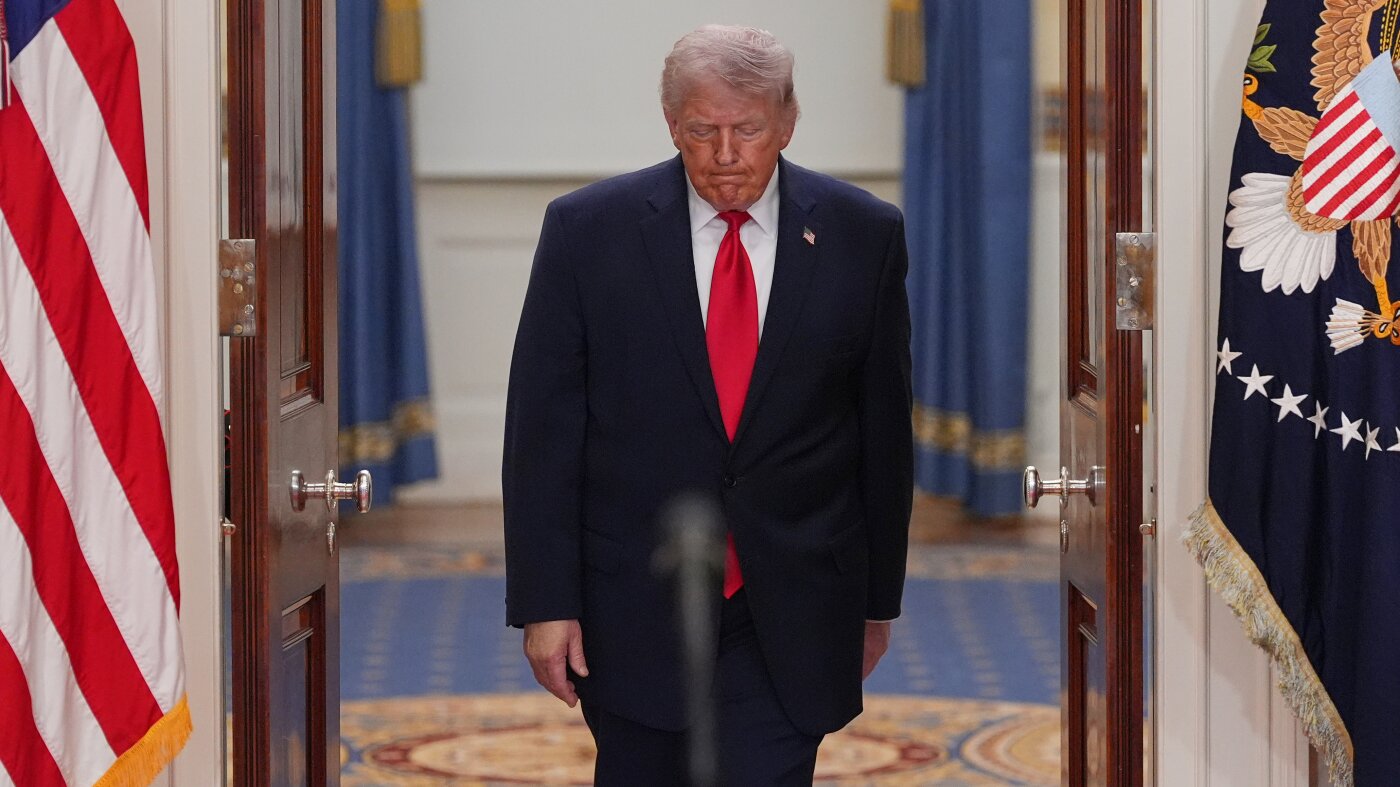
Judge halts Trump effort requiring colleges to show they don’t consider race in admissions

Trump says ‘America needs God’ in Good Friday message touting ‘resurgence of religion’
Fact check: How can a country actually withdraw from NATO?
-

 South-Carolina6 days ago
South Carolina vs TCU predictions for Elite Eight game in March Madness
-

 Miami, FL1 week ago
Jannik Sinner’s Girlfriend Laila Hasanovic Stuns in Ab-Revealing Post Amid Miami Open
-

 Education1 week ago
Video: Transgender Athletes Barred From Women’s Olympic Events
-

 Minneapolis, MN1 week ago
Boy who shielded classmate during school shooting receives Medal of Honor
-

 Vermont6 days ago
Skier dies after fall at Sugarbush Resort
-

 Politics7 days ago
Trump’s Ballroom Design Has Barely Been Scrutinized
-

 Atlanta, GA6 days ago
Fetishist ‘No Kings’ protester in mask drags ‘Trump’ and ‘JD Vance’ behind her wheelchair
-

 Politics1 week ago
WATCH: Senate hearing goes silent after Angel Father confronts top Dem over daughter’s death