World
EU countries seal €5-billion deal on military aid to Ukraine


European Union countries reached on Wednesday evening a hard-fought deal to boost and revamp military assistance to Ukraine.
The agreement struck by ambassadors in Brussels will inject an additional €5 billion into the European Peace Facility (EPF) until the end of the year, which will come on top of the €6.1 billion committed since early 2022.
The EPF gained prominence in the immediate aftermath of Russia’s war as member states rushed to provide Kyiv with the military equipment kept in their national stocks.
The facility partially reimburses the costs of these donations, allowing all countries, from the largest to the smallest, to chip in and help out. It is an “off-budget” scheme because the EU’s coffers cannot finance expenditure with military implications.
But in 2023, the EPF began to lose steam as stocks became gradually depleted and governments shifted to bilateral donations to Ukraine, rather than collectively. The facility was effectively paralysed in May after Hungary slapped a veto in retaliation for Kyiv’s designation of OTP Bank as an “international sponsor of war.”
The designation was lifted months later after an intense diplomatic push but Budapest kept preventing the release of a new €500-million tranche to top up the mechanism.
Meanwhile, a debate was launched to reform the EPF and make it more efficient, more predictable and better tailored to Ukraine’s needs.
The talks, however, became entangled in political considerations and dragged on for longer than expected: Germany insisted on discounting “in-kind contributions” (bilateral donations) from the country’s expected input while France, supported by Greece and Cyprus, demanded the EPF be used exclusively to purchase weapons and ammunition made inside the bloc.
The debate in Brussels stood in stark contrast with the events on the battlefield: in February, Ukrainian troops were forced to withdraw from the eastern city of Avdiivka, marking a small yet strategic win for Russia. The setback was linked to dwindling military supplies by Western allies, particularly from the United States, where a $60-billion support package is stuck in bipartisan infighting.
The circumstances piled pressure on ambassadors to break the impasse after multiple unsuccessful attempts. The compromise that emerged after Wednesday’s meeting contains the concessions needed to bring Paris and Berlin on board.
On the one hand, member states will give priority to EU-made weapons but will have the option to resort to alternatives produced abroad in cases when the bloc’s defence industry is unable to meet the demand. Additionally, an unspecified amount of the €5 billion will be devoted to boost joint purchases of military equipment, in line with the goals of an EU strategy unveiled earlier this month, a diplomat explained.
On the other hand, the revamped EPF will enable countries to take into account the value of their bilateral donations by using a formula to recalibrate their monetary contributions.
By reviving collective donations, Brussels hopes to alleviate the political tensions caused by the deep gaps in military donations to Ukraine: according to the Kiel Institute, Germany leads the bloc with €17.7 billion, followed by Denmark with €8.4 billion and the Netherlands with €4.4 billion. By contrast, three of the largest countries lag further behind: Italy (€0.67 billion), France (€0.64 billion) and Spain (€0.33 billion).
Paris has contested the institute’s methodology and argues its bilateral donations amount to €2.61 billion, still a far cry from Berlin’s.
In parallel, the Czech Republic has launched an initiative to procure 800,000 artillery shells from non-EU producers, which could be delivered to Kyiv in an accelerated timeframe. The project, which is set up outside of the EPF, has earned the endorsement of 18 countries, according to President Petr Pavel.
However, Prime Minister Petr Fiala later downgraded the number to 300,000 rounds.
This piece has been updated to include more information about the EPF deal.



As Israel’s war on Lebanon rages, hundreds gather in Rmeileh by Sidon Gate to watch the 2026 World Cup. Organised by influencer Bilal Haddad, the fan zone offers food trucks, shisha and family activities, giving people a rare chance to relax. Al Jazeera’s Justin Salhani went to check it out.
Published On 20 Jun 2026

WASHINGTON (AP) — Mark Schiefelbein has been based in Washington, D.C., with AP for about three years, and before that spent a decade in Beijing at AP’s China bureau.
Here’s what he had to say about this extraordinary photo.
Why this photo?
This was an event that had never happened before in the 250-year history of the United States and may never happen again: a night of mixed martial-arts cage match brawls on the South Lawn of the White House, with bloodied competitors battling it out in front of the president, vice president, and other leaders of the country. AP had other photographers ringside at the event focusing more on the fights themselves. So I felt my role was to capture the context of the evening — the location, the people in attendance, the environment.
How I made this photo
A small group of other photographers and I, the White House press pool, had been allowed to photograph part of the evening from a position in the stands directly opposite the White House. I was carrying four cameras with a variety of lenses from 12 mm to 300 mm. This let me capture everything from ultra-wide views of the “claw” structure built for the fights, to close-ups of leaders and celebrities in attendance. I had been following Diego Lopes with my longest lens as he moved around the ring celebrating his win over Steve Garcia. When I saw him start to climb onto the cage, I immediately realized there might be a possibility of a picture like this and zoomed out to capture more of the scene.
An octagon on the White House lawn for Trump’s 80th birthday and the nation’s 250th, in photos
Why this photo works
The White House is surely one of the most recognizable buildings in the world. The columns of the South Portico, the fighter standing with arms and legs spread wide in celebration, and the octagon padding of the UFC ring tell an entire story as your eyes move from top to bottom of the frame. With Lopes standing with his back to the camera, facing the White House, it becomes less a photo of him and more about the evening, the event, and the spectacle. It was fortunate that it was after nightfall, so things that might have been distracting, like the Marine Band and spectators seated behind the ring, are mostly in the dark. Only the key elements – the White House, Lopes, and the ring are lit up.
—
For more extraordinary AP photography, click here.
World
British Prime Minister Keir Starmer faces potential leadership challenge from newly-elected Andy Burnham

NEWYou can now listen to Fox News articles!
Andy Burnham has officially won his special election and regained a seat in Parliament, setting him up to challenge the deeply unpopular Keir Starmer as the leader of the Labour party and as prime minister.
Burnham, currently the mayor of Greater Manchester in northwest England, won a seat in Makerfield and came away with 55% of the vote in a field of more than a dozen candidates, according to The Associated Press. The runner-up was Rob Kenyon of Reform UK, a right-wing populist party, who received more than 9,000 fewer votes than Burnham.
Burnham last served as a member of Parliament in 2017 but strongly implied in his victory speech that he is returning with the intention to lead the United Kingdom.
“Everyone knows that politics isn’t working. Everyone can feel that the country isn’t where it should be. Tonight could, just could, be the turning point,” he said, according to the AP. “This result will bring about a country that works fairly for everywhere and for everybody.”
TRUMP ALLY NIGEL FARAGE DEALS MAJOR BLOW TO STARMER IN LOCAL UK ELECTIONS AS RESIGNATION CALLS MOUNT
Britain’s Labour party candidate Andy Burnham speaks to supporters after the Makerfield by-election in Ashton in Makerfield, England, on Friday, June 19, 2026. (Jon Super/AP)
This special election, called by-elections in Britain, was unusually significant because the area’s Labour MP, Josh Simons, intentionally resigned to allow Burnham to win the seat and pursue leadership.
The potentially outsized impact of this election was juxtaposed with the strange scene that unfolded when all the candidates gathered on Friday morning to hear the results. Burnham stood in between an independent candidate dressed in a fox costume and another candidate known as “Count Binface”.
As his name suggests, “Count Binface,” whose real name is Jonathan David Harvey, was wearing a trash can on his head and regularly runs in U.K. elections to advocate for increased voter turnout.
Starmer congratulated Burnham in a social media post on X, saying voters “chose Labour’s campaign of hope and optimism over division and hate.”
When asked about Burnham’s intentions to oust him as leader, Starmer said he will fight to remain prime minister, a position he has held for nearly two years.
“I’ve said repeatedly I’m not going to walk away from that,” Starmer told reporters.
Labour party candidate Andy Burnham, center, stands with other candidates on the podium at the Edge Wigan, awaiting the Makerfield by-election result announcement in Wigan, England, on Friday, June 19, 2026. (Jon Super/AP)
AS EPSTEIN-LINKED APPOINTMENT SPARKS BACKLASH, UK PM STARMER FACES PARTY REVOLT AMID RESIGNATION CALLS
Starmer led the Labour party to a landslide victory in July 2024 and ever since, his popularity has been eroding thanks to a persistently high cost of living, an anemic economy and a scandal over his willingness to accept gifts from wealthy donors.
Last September, Starmer was slammed for appointing Peter Mandelson as the British ambassador to the United States, when it was known as early as 2019 that Mandelson had a friendship with convicted child sex offender Jeffrey Epstein. Following an enormous public backlash, Mandelson was quickly dismissed from his post.
With Starmer as leader, Labour is increasingly losing liberal-minded voters to the Green Party, while also facing stronger challenges by Reform UK, a Nigel Farage-led party that advocates against mass migration and in favor of tighter border controls. Farage, an ally of U.S. President Donald Trump, said he was disappointed by Burnham’s victory.
Burnham is expected to head to London to be sworn in as soon as Monday. Under the British parliamentary system, the governing party can hold leadership elections in the middle of the term. The winner of such a contest can become prime minister without there having to be a national election.
British Prime Minister Keir Starmer awaits Switzerland’s Federal President Guy Parmelin on the sidelines of the G7 summit, in Evian-les-Bains, France, on Tuesday, June 16, 2026 (Isabel Infantes/Pool Reuters via AP)
CLICK HERE TO DOWNLOAD THE FOX NEWS APP
Under Labour rules, a lawmaker can challenge the leader if they win the backing of a fifth of their party’s members in the House of Commons. Burnham has enough lawmakers on board to trigger a leadership contest, according to a report from The New Statesman.
According to the AP, Culture Secretary Lisa Nandy said Burnham and Starmer will “have a conversation about what comes next” in the next few days.
The Associated Press contributed to this report.
-
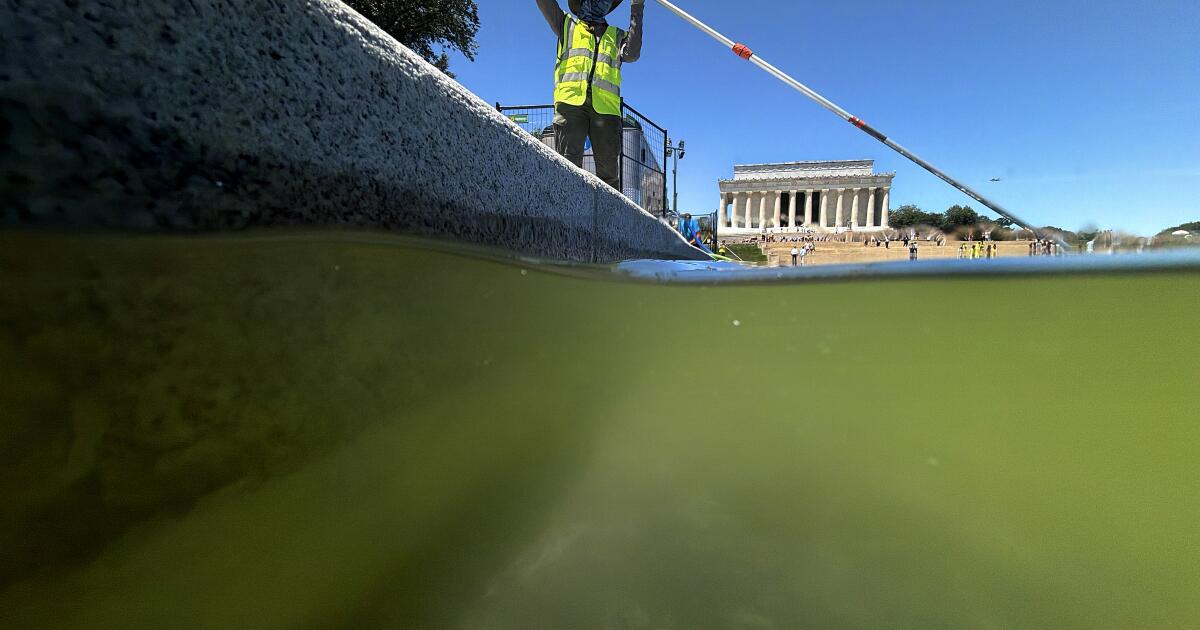 Science39 seconds ago
Here’s why the Lincoln Memorial Reflecting Pool went green so fast
-
 Sports4 minutes ago
Shohei Ohtani out of Dodgers’ lineup vs. Orioles for birth of his second child
-

 World16 minutes ago
Lebanese influencer organises World Cup event amid Israel’s attack on Leban
-
 News39 minutes ago
Air Force One, gifted to Trump from Qatar, arrives at Joint Base Andrews
-

 New York2 hours ago
Video: Fans Show Up to the Parade in Their Best Knicks-Themed Attire
-

 Los Angeles, Ca2 hours ago
Victims sought after man allegedly points gun at passing cars in Santa Clarita Valley
-

 Detroit, MI2 hours ago
Best barbershop in Metro Detroit: Finalists for this year’s Vote 4 The Best
-

 San Francisco, CA3 hours ago
How to watch San Francisco Giants vs. Miami Marlins

