Hawaii
A Deep Dive into Hawai‘i’s Shell Jewelry Industry – Hawaii Business Magazine


They adorn casual beachgoers, become treasured accessories for bridal parties and decorate the resplendent elite as they glide among guests at private dinners.
Hawaiʻi is a rich resource for this nascent business sector as demand builds across the Islands and across the globe. Exactly how big a business it has become is something of a mystery, though. State figures actually show the number of licensed sellers has declined in recent years, though officials admit that’s probably due to lack of awareness and noncompliance rather than reflecting reality.
“Shell jewelry has really only exploded in the last seven or eight years,” says Brooke Holt, founder and designer of 21 Degrees North Designs on Oʻahu. “Don’t get me wrong,” she adds, “I love shells. I love shell jewelry. That’s why I first wanted to make it, [but] I’m kind of over it at this point because it’s so oversaturated.”
When Holt started making shell jewelry in the mid-1990s, there weren’t many others creating newer styles of jewelry with Hawaiian shells outside of the revered tradition of Niʻihau shell lei. Now, jewelers selling shell designs are abundant, judging by the availability of choices online and in stores. Accessories such as sunrise shell necklaces, Hebrew cone earrings, and miter and Tahitian pearl bangles have become iconic staples of island style.
While the shell jewelry industry appears to be expanding in tandem with the popularity of this merchandise, it remains a largely under-documented domain, lacking the data necessary to quantify its true size and impact. Strict requirements of state regulations may actually be driving sellers to evade the mandates.
Technically, anyone taking marine life from Hawaiian waters for commercial purposes must hold a Commercial Marine License (CML), according to the state Department of Land and Natural Resources’ Division of Aquatic Resources (DAR). The license, which costs $100 for residents and $250 for non-residents annually, mandates strict monthly harvest reporting.
“It is important to note that because marine life is defined in the rule as including even parts of living organisms, this licensing requirement applies to the commercial collection of live specimens, empty shells, and even shell pieces,” says DAR Aquatic Biologist Bryan Ishida.
Regulation extends down the supply chain. Businesses that purchase marine life — including empty or fragmented shells — directly from CML licensees for commercial resale must obtain a Commercial Marine Dealer License (CMDL), which costs $100 per year and requires weekly reporting.
Ishida says these licensing fees “are vital to maintaining DAR’s objective of protecting aquatic resources for future generations.” By law, these proceeds are directed into the Commercial Fisheries Special Fund to bankroll research, monitoring and the staff that work in commercial fisheries management.
These reports also serve as an economic barometer. “CMDL reports, in particular, provide the ability to track even small changes to market demand, pricing and other trends,” Ishida explains.
However, the department admits licensing and reporting compliance in the shell sector is “likely quite low” compared to the seafood sector. According to their records, commercial participation peaked in 1977 with 44 shell collectors submitting reports; over the last decade, the number of CML holders reporting shell harvests has dwindled to ten or fewer annually.
This decline is primarily attributed to a lack of awareness. “DAR recognizes this and understands that increased outreach and non-enforcement measures are needed to raise compliance,” Ishida says, but the agency must prioritize using “their limited resources on the harvest of live aquatic life,” and most shells harvested for jewelry are thought to be empty shells.
Figaroa’s grandmother Loka Kenemaka Kaohelaulii (center) mentored him in the art of making Niʻihau shell lei, which she and her two companions are pictured wearing. Photo courtesy of Kealoha Figaroa
Honoring a Tradition
Shell jewelry has been an integral part of Hawaiian culture for centuries, with ample evidence indicating Niʻihau shell lei predate the arrival of Captain Cook in 1778. They are made of rare, tiny shells found off the rugged coast of the Forbidden Isle.
According to Kealoha Figaroa, founder of Niʻihau shell jewelry company Pūpū Creations, many of the shell species used to construct Niʻihau shell lei are found on other islands, but ones found on Niʻihau are prized because they “hold their luster” better. He guesses that this is because there’s comparatively less freshwater runoff into the ocean. “My family tells me on Niʻihau, the water is so pristine that you can see about 300 feet down into the bottom of the ocean,” he says. For his family, and many others from the island, the tradition of creating shell leis has been passed on for many generations.
Figaroa recalls memories from childhood spent at a table where elders would dump hundreds of shells for the children to organize. “All our grandparents… they would take all the kids, and they would tell us, ‘Okay, you need to sit here and sort these shells by color, by size, by all that.’ And of course, we hated it. But for the older people, it was very important for us to learn these things, so that when we do see these leis, we have much more appreciation for the leis.”
Once they had mastered the sorting process, the children would learn the delicate art of piercing the shells. Only after proving their proficiency in that skill were they allowed to begin stringing them together, starting with smaller pieces like earrings before eventually advancing to leis.
Still, Figaroa says that gathering shells from the beach is by far the most tedious part of the process. Figaroa explains that collecting a sufficient number of matching shells to create a high-quality, symmetrical lei requires immense patience. “It’s anywhere from two weeks all the way up to three years to make one lei,” he explains. The considerable time and craftsmanship required to create these intricate pieces are reflected in their price tag, which can reach upwards of tens of thousands of dollars.
Figaroa, who lives on Oʻahu, says his cousins frequently send him shells from Niʻihau to create the lei sold by his business, Pūpū Creations. “I allow space for my family members to also have some other items on sale so they can profit from it as well, and not just myself.” He says one reason he loves collaborating with his relatives is that “there’s different family members that have specific styles.”
One of his cousins, for example, specializes in delicate color gradients. And Figaroa, mentored by his grandmother, took after her in specializing in working with momi shells to create three-strand leis and the straight Kui Pololei style.

Jewelry and fashion designer Brooke Holt at work in her Mākaha studio. Photo by Aaron Yoshino
The Evolution of Shell Jewelry
Newer styles of Hawaiian shell jewelry have emerged in recent decades. They often feature cone shells, cowries, drupes and miters not typically found in the Niʻihau shell lei tradition.
One of the contemporary style shell jewelry makers on the scene is Anoʻipua Kaaloa, who started out as a shell collecting hobbyist. Kaaloa says the kinds of shells she finds differ based on whether or not she’s looking on the Windward Side or Leeward Side: On the east side, “I’ll find a lot of abbreviated cones, tumbled pink cones, the endemic Hawaiian golden yellow cones, strombs, Adam’s miters, lettered miters. Then on the other side of the island, I find so many cowries” and rarer shells to come by, “like marble cones, leopard cones.”
She says she saw other people making jewelry with their beach finds and thought, “That looks cool. I think I can do that with my shells.” Her business, ʻAnoʻipūpū Jewelry, sells everything from shell necklaces, earrings, bangles, belly button rings and keychains. She says her favorite pieces to make are resin earrings that contain a bunch of different micro shells because they are one of her more “unique” designs.
When she started selling her pieces in late 2024, Kaaloa says she was motivated to not only create “nice jewelry, but more affordable” merchandise, because a lot of the market is “really expensive.” When figuring out her price points, she says she considered “if I was to buy my own jewelry, what prices would I want to set?”
Like many other shell jewelry businesses, Kaaloa operates without a traditional brick-and-mortar storefront. Instead, she has built a loyal following through markets, appearing as a regular vendor at the Kakaʻako Farmers Market every Saturday and the Kailua Farmers Market on Sundays.
Despite having neither a physical shop nor an e-commerce website, Kaaloa found enough success at the markets that she was able to quit her former job in the food service industry and focus on running her business full-time a little over a year into opening ʻAnoʻipūpū Jewelry. “I’m grateful, that’s for sure,” she says.
Holt, founder and designer at 21 Degrees North Designs, makes jewelry from an array of materials, including coral, pearls, sandalwood beads, neon thread, lauhala, silver, gold and, of course, shells.
Having partially grown up in Mākaha, she’s been frequenting Oʻahu’s west side beaches in search of shells since the 1980s.
“I had different beaches for different shells,” Holt explains. “Some shells you can find up and down the coast, but others you can only find in very specific spots. I started then researching what types of shells grow in what types of reef situations.”
The daughter of a fashion designer mother and a glass blower father, Holt naturally felt inclined to do something creative with the shells she found, which led her to taking up jewelry making.
Holt finds that inspiration can strike from anywhere: “sometimes it’s a color, sometimes it’s a concept, sometimes it’s a place.” For instance, the design for one of her first pair of statement earrings began with a moment of observation while surfing.
Captivated by how “the water and the sun playing on the ripples gives it all those little dancing rings, I wanted to make earrings that represent that, so I made these concentric circle earrings. I like organic shapes and asymmetrical things.”
In an era of viral trends and mimicry, Holt says it’s important that her pieces stand out. That’s “the greatest compliment I can get, and I do hear it a lot at my markets. I want to be different. I don’t want to look like anyone else.”
One concern Holt has is the impact an increase in shelling has on the environment: “You want to encourage entrepreneurship, but again, we’re still perpetuating this culture of, take, take, take…. So, yeah, do we need to start having limits?”

Hawaiʻi’s most venomous cone shells (left to right): the banded marble cone (Conus bandanus), the textile cone (Conus textile), and the Hawaiian striated cone (Conus striatus). Photo: MarinelifePhotography.com
The Ethics of Shelling
It isn’t illegal to take live shells, but Ishida says “DAR requests that commercial collectors do so sparingly and only as demand requires as many species are quite rare” or little is known about their abundance. The agency strongly recommends collecting empty shells rather than live specimens.
“However, DAR asks commercial collectors to remember that shells, even when empty, contribute to the ecosystem, whether providing a home for a hermit crab or over years wearing down into sand and other seafloor substrate,” says Ishida.
For artisans like Figaroa, Kaaloa and Holt, the first rule of the reef is absolute: only take empty shells. They look for signs of life — like a visible body or a sealed operculum — whereas sand and rocks in the aperture indicate the shell is dead. “The only way shells can reproduce plentifully is if the reef system is healthy. If the reef is not healthy, you won’t get your shells,” Figaroa says.
Marine educator Keoki Stender, founder of MarinelifePhotography.com, warns that damage often happens through simple negligence, such as walking on reefs made of mussels and oysters at low tide: “If you trample it, you crush the shells. You kill hundreds at one time. You have to be mindful of what you’re stepping on.”
He also implores beachgoers to return things back to where they originally were when exploring the ocean and tide pools. For example, “If you leave the rock overturned, the sun’s going to fry everything [on the bottom], the fish are going to eat everything that is here and exposed, and then the life that was on the top of the rock is going to die [underneath], and the part of the reef where you turn the rock and put it onto the reef is going to kill everything on that part of the reef too,” he says.
Ishida reminds commercial collectors that as a natural resource, “empty shells are for everyone’s enjoyment. People who want to collect shells for their own personal collection, jewelry making for themselves, or just enjoying seeing them while diving should be able to do so. Accordingly, commercial collectors should think about their impact on not only the environment but others who may want to collect shells for non-commercial purposes.”

Keoki Stender pictured at his studio lab. Photo by Aaron Yoshino
Where Shells Come From and What to Look Out For
The shells used in jewelry come from animals in the mollusk phylum. To protect their vulnerable, soft bodies, many mollusks have evolved to build exoskeletons, a.k.a. shells, by secreting minerals through a specialized organ called the mantle.
Keoki Stender, a marine educator, photographer and founder of MarinelifePhotography.com, says that you can glean a great deal about a mollusk’s lifestyle by examining its shell. Cowries, for instance, are the heavy-duty tanks of the reef. Their domed, “bottom-heavy” shell is engineered for stability. “The ones that are most domic — a humpback, very domed, flat bottom — they would be more likely to be in a high surf environment,” Stender explains. Combined with a foot that provides powerful suction, the humpback cowries’ low center of gravity allows it to “handle the full force of breaking waves” without being swept away.
In contrast, he says, the streamlined, “tapered shape” of miters and augers allows them to easily crawl through sand in search of prey. And the elaborate, spiny architecture of murexes serves as a defense “designed so no one can bite them.”
The diversity of patterns, from the distinctive black markings on Hebrew cones to the vibrant ombré of sunrise shells, is produced by pigment-secreting cells in the mantle. These cells act much like an inkjet printer, depositing color at the growing edge of the shell.
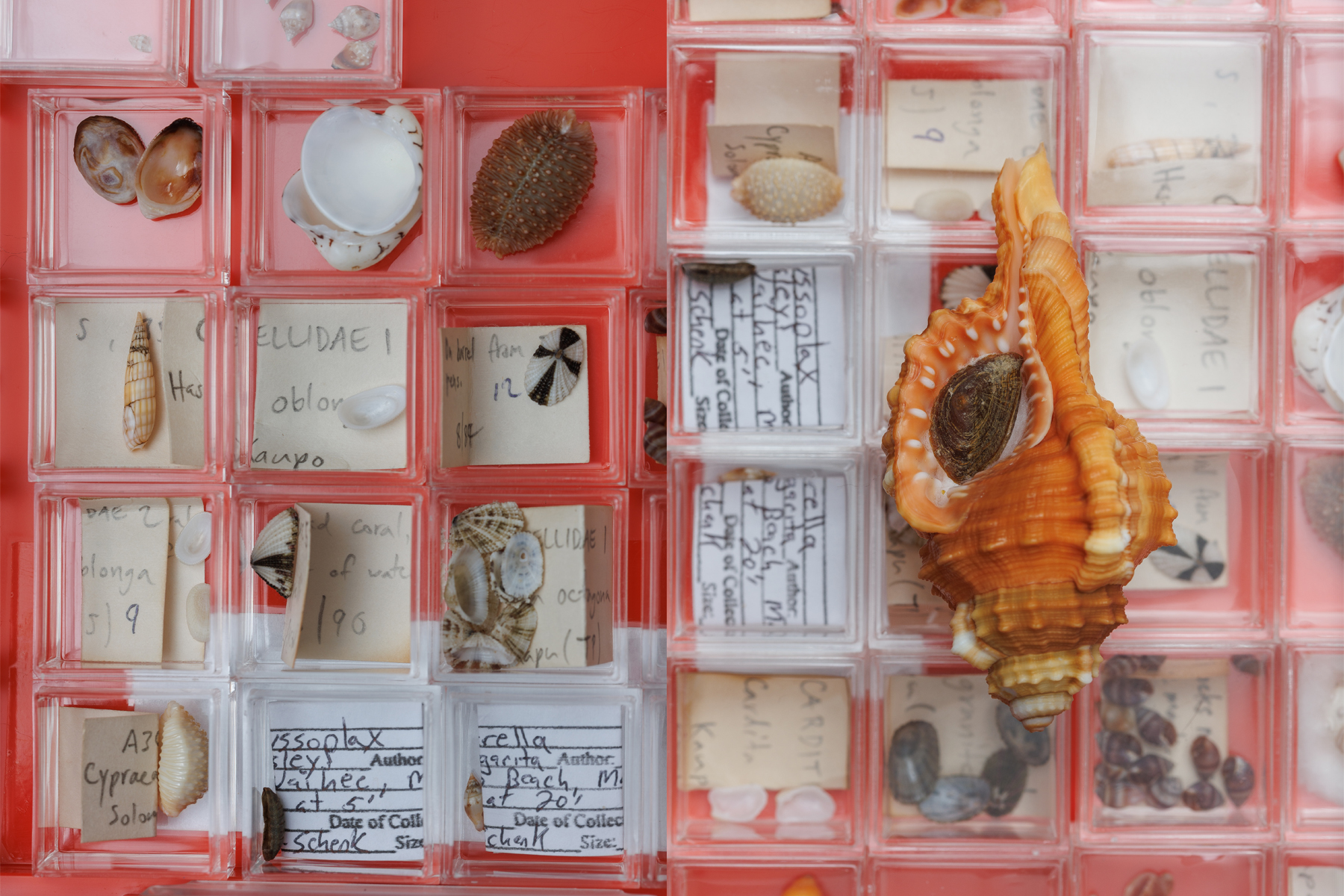
Some specimens in Stender’s extensive shell collection.
Cone snails are predators that hunt using a venomous harpoon-like tooth that shoots out the base of their shell. Their toxicity generally depends on that species’ diet. “The worm eaters are like a bee sting [to humans]. But if you’re allergic to bee sting, that can be really bad,” Stender warns. “The fish eaters are especially bad because if your prey is fast moving, you got to have a potent sting.”
Because specific cone snail species are among the most venomous animals on earth, being familiar with their patterns to discern which are dangerous is extremely important when handling. “The ones that have the worst sting are the tented pattern cones,” says Stender. In Hawaiʻi, textile, banded marble and striated cones possess a sting that is potentially fatal to humans.
Stender explains that lifespan varies significantly across species, noting a direct correlation between shell size and growth rate. “The bigger the shell, generally, the slower it grows,” he says, because the animal must extract a higher volume of minerals from both the water and its food to build its home. While Stender estimates that many micro-shell species live for only six months to a year, some larger mollusks — such as the leopard cone and tiger cowry — can live for a decade or longer.



Here’s what you need to know about the University of Arizona
UA was established in 1885, and its main campus is in Tucson. The Wildcats once had a live bobcat named Rufus as a mascot.
The Republic
If point guard JJ Mandaquit’s job at Arizona next season looks tricky and challenging, having to glue together a lineup full of potential NBA draft picks under the pressure of playing for a returning Final Four team, it might be worth considering what his grandfather and father have been up to.
They’ve been running a roofing company … in Hilo, Hawaii. The rainiest city in the country, on the windward side of the Big Island. Where some 130 inches of rain hit buildings every year, creating slick working conditions, and where, even in drier moments, there’s high humidity and trade winds to deal with.
“I had to go on the roof a couple of times,” Mandaquit said, chuckling. “But not in the rain.”
He had other things to do. With his basketball skills overshadowing the local level of play since his elementary school years, Mandaquit left Hilo as a sixth-grader to begin a higher-level basketball journey that put him in Tucson this year.
His family came with him to Oahu, where he transferred to the Iolani School of Honolulu. His father, Jason Sr., commuted back and forth between Oahu and the Big Island while still roofing, though his mother was able to transfer from Hilo to Honolulu within her job at Hawaiian Electric.
Everyone thought that was the plan for a while.
“It was a better opportunity, better education and more opportunity,” Mandaquit said. “When we left from Big Island to Oahu, that was a huge move for my family, a lot of sacrifice that went into it. I’m super grateful to my parents. When we made that move in the sixth grade, we thought that was going to be the move, that it was just going to end there, I’d go to high school there.”
It still wasn’t enough. Mandaquit outgrew the basketball scene again. By ninth grade, he moved on to Real Salt Lake Academy, which turned into Utah Prep.
In Hawaii, he found players have also been kept from high-profile West Coast clubs because of a quirky club-ball residency rule in which players are typically allowed to play only for a club in their state or a bordering one — and Hawaii borders only an ocean. So Mandaquit said he and other locals started their own “Sons of Hawaii” club to play on the “MADE Hoops” circuit.
It still wasn’t enough. Utah was next.
“We felt it was best to get out of Hawaii and chase this dream,” Mandaquit said. “It wasn’t an easy choice to leave home, but we felt looking at the big picture, if I want to play at the high Division I level, we almost felt that it was a necessity to get out of the islands, surround myself with better competition, be somewhere that allows me to be more exposed.”
That move paid off. Mandaquit grew into a high-major prospect at Utah Prep and became a mainstay with USA Basketball junior teams. He won three gold medals at FIBA events: At the 2023 U16 AmeriCup, the 2024 U17 World Cup and, on a team led by UA coach Tommy Lloyd, the 2025 U19 World Cup.
Only a secondary recruiting target of Arizona’s before he committed to Washington in November 2024, Mandaquit jumped out at Lloyd while playing for USA Basketball last summer. Mandaquit averaged 6.1 points and 5.4 assists — with nearly a 4-to-1 assist-turnover ratio — while hitting 6 of 10 3-pointers over USA’s seven-game romp.
“I had only seen him play a few times before (last summer), but I was just so impressed with his character, but also his tenacity and the effort he played with. Just how he impacted winning,” Lloyd said. “So obviously, when we saw his name on the transfer portal, it piqued my interest right away.”
Lloyd said he considered Mandaquit out of high school, but the Wildcats were also pursuing Brayden Burries and had Jaden Bradley projected to stay through last season. Lloyd said he also took a cautious recruiting approach in 2025 because “you just didn’t know” how rev-share and NIL were going to work out, since 2025-26 was the first year schools could pay players.
So Mandaquit chose the Huskies over USC and Creighton. He started the Huskies’ first five games but wound up playing off the bench for most of his 22 appearances, averaging 5.2 points and 2.1 rebounds while shooting 28.2% from 3-point range.
Mandaquit struggled with a foot issue in the preseason and eventually missed the Huskies’ last 11 games because of it, though he has since had corrective surgery and returned to the court at Arizona.
“It was a great learning experience,” Mandaquit said of Washington. “I didn’t have the year that I wanted to have, but just going through that experience is gonna be huge for me and my future. I’ve got one year of college basketball under my belt, and the Big Ten was awesome last year.”
After he left Seattle, SI’s Huskies website wrote that UW coach Danny Sprinkle “has to be reeling by Mandaquit’s departure,” saying Mandaquit’s playing style “seemed to match Sprinkle’s hard-nosed personality.”
Instead, Mandaquit will be playing for the same coach he said he loved playing under last summer in Switzerland. Mandaquit joined a team that included former UA forward Koa Peat, incoming UA freshman Caleb Holt and No. 1 NBA Draft pick A.J. Dybantsa, among others.
They were all stars, forced together to play team ball during the world’s highest-profile junior tournament.
Gold was the expectation.
“What he was able to do with our group in such a short amount of time, I just loved,” Mandaquit said of Lloyd. It was “just the culture that he was able to build. Obviously, it’s not the easiest job as a coach to be able to manage all of the star players and egos that we had. It was just the way that he was able to get everyone to just buy in and focus on a common goal, and ultimately go and reach that goal.
“It was amazing. It was the most fun I ever had playing basketball.”
Despite their bond, Mandaquit said he couldn’t have a recruiting conversation with Lloyd until after he entered the portal this spring. But that might have been a formality anyway.
Both Lloyd and Mandaquit knew plenty about each other at that point.
“This time it was fast,” Lloyd said. “We both knew what we wanted on both sides.”
Lloyd needed a true point guard to join North Carolina transfer Derek Dixon and Holt in a reloaded backcourt that lost NBA Draft picks in Burries and Bradley.
Mandaquit wanted to be under Lloyd for more than a few weeks.
Official elapsed time between Mandaquit’s early April entry into the transfer portal and his commitment to Arizona: Ten days.
“When this opportunity came back around, I couldn’t pass it up,” Mandaquit said. “I knew this is the place that I wanted to be, and I knew I wanted to be coached by Tommy.”
During an interview at McKale Center last month, Mandaquit said he’s since arrived at Arizona to find high-character guys around him, and that coaches are pushing him the way he wants to be pushed.
“I’m loving it so far,” Mandaquit said.
As a bonus, Mandaquit’s first season with the Wildcats will also take him nearly full circle. Not to Hilo and the Big Island, but to the Maui Invitational, the prestigious early-season event that Mandaquit said he routinely watched on television even if the inter-island hop and high ticket prices kept him out of the Lahaina Civic Center to watch in person.
This time, he’ll be in the building — and soaking up the atmosphere outside it. His parents, now living back in Hilo, can make the easy flight over to watch, too.
It probably won’t rain much, if at all, Lahaina being on the leeward side of Maui and all.
But, for Mandaquit, it’s still home.
“Hawaii means everything to me,” Mandaquit said. “I try to get back there as much as possible, and I feel the support of the state behind me. I feel their love, so it pushes me to work harder.”

A 32-year-old Pahoa man on probation for auto theft pleaded not guilty Thursday to sex assault charges.
Hilo Circuit Judge Peter Kubota maintained Brandon K.C. Sanchez’s bail at $108,000 and ordered him to return to court for further proceedings on Oct. 9.
A Hilo grand jury on Wednesday returned a five-count indictment charging Sanchez with second-degree sexual assault and four counts of fourth-degree sexual assault. He was also charged with five counts of violating probation.
According to court documents filed by police, the alleged offenses took place on the evening of June 15 and the victim was a 21-year-old woman.
The woman reportedly told police she had just met Sanchez when he was a customer at the Hilo fast-food restaurant where she worked. She agreed to hang out with him and allowed him to drive her car.
Sanchez drove to Honolii, and at one point told the woman he had recently gotten out of jail and wanted to have sex with her, which led to her telling him no multiple times, according to the documents.
Sanchez allegedly then asked if she’d kiss him, to which she assented under the condition that he stop the pressure to have sex.
On the way back to Hilo, Sanchez reportedly touched the woman’s breast and genitals through her clothing, put his mouth on her breast, and slipped a finger inside her genitals — all against her will.
Documents state that Sanchez admitted to police that he touched the woman’s breast through her clothing once, but denied all other allegations.
Second-degree sexual assault is a Class B felony offense that carries a maximum sentence of 10 years imprisonment. Fourth-degree sexual assault is a misdemeanor that carries a potential one-year jail term.
Sanchez remains in custody at Hawaii Community Correctional Center in lieu of bail.
Email John Burnett at john.burnett@hawaiitribune-herald.com.

HONOLULU (HawaiiNewsNow) – A hiker was rescued after suffering a medical emergency on the Diamond Head Crater Trail Saturday morning.
The Honolulu Fire Department said crews responded at about 10:30 a.m. after a woman in her 30s became unable to descend from the top of the trail.
Firefighters climbed the trail on foot while another crew prepared a nearby landing zone for air operations.
HFD’s Air 1 helicopter inserted rescue personnel to the woman’s location, where they assessed her condition and provided basic life support.
The hiker was then airlifted to the landing zone and transferred to Honolulu Emergency Medical Services shortly after 11 a.m.
No firefighter injuries were reported.
Copyright 2026 Hawaii News Now. All rights reserved.
-

 Denver, CO2 minutes ago
Nuggets sign former Denver West basketball player Alpha Diallo out of EuroLeague
-

 Seattle, WA8 minutes ago
Portland aims to top Seattle’s 405 e-bikes with 2-mile Guinness record ride and party
-

 San Diego, CA14 minutes ago
Top-ranked Jannik Sinner beats Alexander Zverev to win Wimbledon again
-

 Milwaukee, WI20 minutes ago
MLB Draft 2026: Milwaukee Brewers Draft Signing Tracker
-
Atlanta, GA26 minutes ago
Atlanta officials ‘throw out homeless tents and medicine’ near World Cup spot
-

 Minneapolis, MN32 minutes ago
Minneapolis City Council halts new data center developments until November
-

 Indianapolis, IN38 minutes ago
Quiet and comfortable tonight with the heat gradually returning this week | July 12, 2026
-

 Pittsburg, PA44 minutes ago
Pittsburgh Pirates Select Incoming Tennessee Baseball Transfer Outfielder In MLB Draft | Rocky Top Insider

