West
Uncle Sam’s Devil’s Island: From Al Capone to ‘Machine Gun’ Kelly, meet Alcatraz’s most infamous inmates

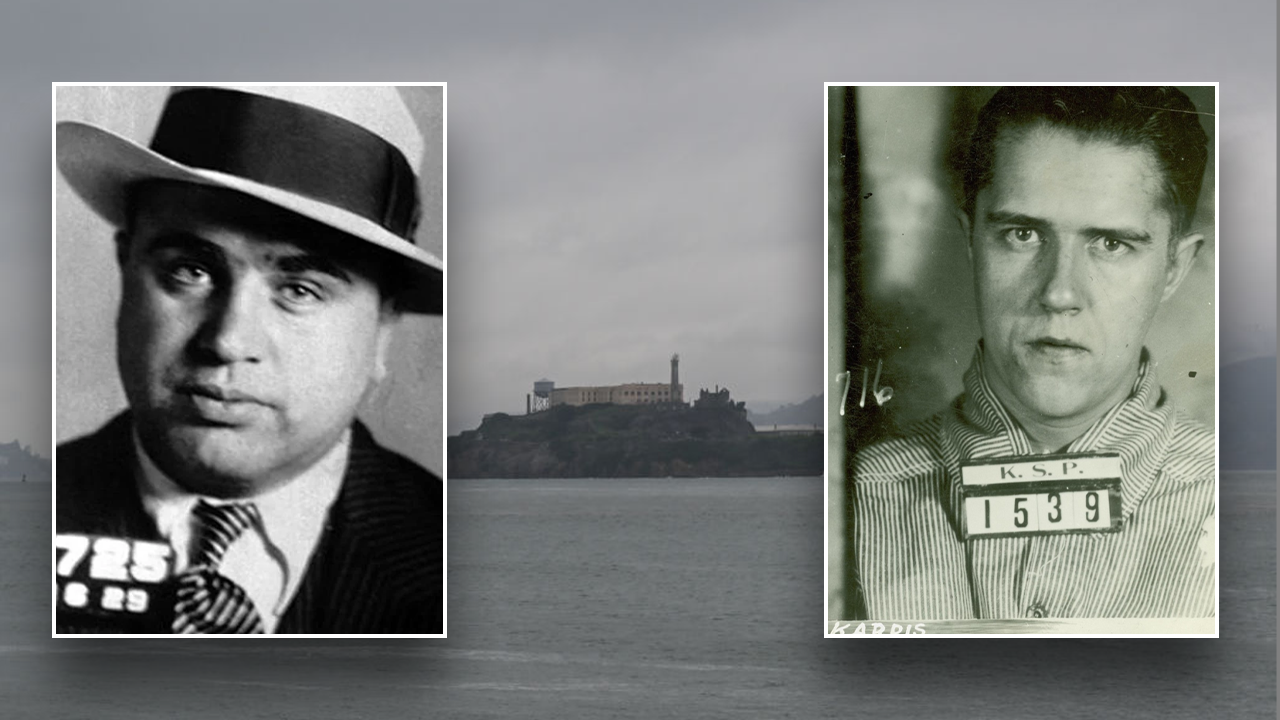
As President Donald Trump called for the reopening of Alcatraz in a Sunday evening Truth Social post, many Americans were reminded of the notorious prison off the coast of San Francisco, California.
“REBUILD, AND OPEN ALCATRAZ!” Trump wrote. “For too long, America has been plagued by vicious, violent, and repeat Criminal Offenders, the dregs of society, who will never contribute anything other than Misery and Suffering,” he wrote.
Trump directed several agencies, including the Bureau of Prisons, Department of Justice, FBI and Department of Homeland Security, to develop plans to reopen a “substantially enlarged and rebuilt” Alcatraz prison that would “house America’s most ruthless and violent Offenders.” He said the reopening of Alcatraz “will serve as a symbol of Law, Order, and JUSTICE.”
During its time as a federal prison, which spanned almost 30 years, Alcatraz housed a total of over 1,500 inmates. Read about the most infamous inmates below:
ALCATRAZ 2.0: FMR. FBI AGENT FLOATS ‘PERFECT’ NEW PRISON SITE THAT WOULD SCARE EVEN MOST HARDENED CRIMINALS
Al Capone was charged with tax evasion in 1931. (FBI)
Al Capone
Al Capone spent time at several prisons across America before serving a sentence at Alcatraz. Capone was charged with tax evasion in 1931, and while originally entering a guilty plea on June 16, 1931, he would change his plea to not guilty after the presiding judge said he wasn’t bound by any plea deal made, according to the FBI.
After being convicted on Oct. 18, 1931, Capone was sentenced to 11 years in federal prison, with his six-month contempt of court sentence brought down to time served. While attempting to appeal his conviction, Capone was being held at the Cook County Jail in Illinois.
He began his sentence at the U.S. Penitentiary in Atlanta, but was transferred to Alcatraz in 1934 after allegations that Capone was receiving cushy treatment by manipulating the prison system, according to History.com.
Capone was released from Alcatraz in 1939 for good behavior. He spent his last year at Alcatraz in a hospital after contracting syphilis.
After being released from Alcatraz, Capone didn’t return to his old style of life and was deemed to have the mentality of a 12-year-old child by a Baltimore psychiatrist in 1946. He lived with his wife and immediate family in Palm Island, an isle off of Miami, Florida.
He died of a stroke and pneumonia on Jan. 25, 1947.
1920s mug shot of George “Machine Gun” Kelly. (FBI)
George “Machine Gun” Kelly
George Kelly, along with hs wife, Kathryn Kelly, kidnapped Oklahoma business tycoon Charles F. Urschel and Walter Jarrett on July 22, 1933. Longtime associate Albert Bates also assisted in the kidnapping.
On July 26, 1933, J.G. Catlett, a close friend of Urschel, received a package written by Urschel which demanded he head to Oklahoma City and not communicate with the Urschel family. The package also received a ransom demand for $200,000.
After the ransom was completed, Urschel finally returned home on July 31, 1933.
The Kellys were arrested in Memphis, Tennessee during a Sept. 26, 1933 law enforcement raid by FBI agents and the Memphis Police Department. During the arrest, George Kelly allegedly famously cried “Don’t shoot, G-Men! Don’t shoot, G-Men!” according to the FBI.
George Kelly was locked away at Alcatraz from 1934-1951. He got his nickname “machine gun” after his wife bought him a machine gun and encouraged him to go into a life of crime.
LEGAL EXPERTS SAY TRUMP CAN DEFINITELY REOPEN ALCATRAZ, BUT COULD FACE ‘AVALANCHE OF LAWSUITS’
Robert Stroud killed a corrections officer in 1916. (Bureau of Prisons)
Robert Stroud – “Bird Man” of Alcatraz
In 1909, Robert Stroud killed a bartender who allegedly didn’t pay a prostitute he was pimping. He was convicted of manslaughter and served his sentence at U.S. Penitentiary, McNeil Island, Washington. While in federal prison, according to the Bureau of Prisons, Stroud attacked another inmate, resulting in his transfer to USP Leavenworth.
While at USP Leavenworth, Stroud killed corrections officer Andrew Turner in 1916.
Stroud was convicted of first-degree murder as a result, and was sentenced to death. In 1920, former President Woodrow Wilson commuted his sentence to life in prison.
While in prison, Stroud developed a deep interest in birds, and would go on to write two books about birds and their diseases. Prison officers eventually found contraband items hidden inside bird cages that Stroud got his hands on, resulting in his transfer to Alcatraz in 1942.
Stroud spent 17 years in Alcatraz before he died on Nov. 21, 1963.
Alvin Karpis was involved in the 1933 kidnapping of William A. Hamm, Jr. (FBI)
Alvin ‘Creepy’ Karpis
Alvin Karpis was a member of the Barker/Karpis gang, which was involved in a number of high-profile kidnappings.
Karpis was involved in the 1933 kidnapping of William A. Hamm, Jr., president of the Theodore Hamm Brewing Company, according to the FBI. Hamm, Jr. left the building when he was grabbed by four individuals who pushed him into a car.
Members of the Barker/Karpis gang were responsible for the kidnapping, and demanded a ransom of over $100,000. Hamm signed a number of ransom notes in Wisconsin before he was taken to a hideout in Bensenville, Illinois. After the ransom was paid, Hamm was released near Wyoming, Minnesota.
Using fingerprint technology, the FBI used fingerprints on the ransom notes to identify suspects in the kidnapping – Karpis, “Doc” Barker, Charles Fitzgerald, and other members of the gang.
Karpis was eventually arrested in New Orleans, Louisiana, with former FBI Director J. Edgar Hoover being part of the raid which led to his arrest on May 2, 1936.
Karpis, born in Montreal, spent 10 years in prison for burglary before working with members of the Barker family on more extreme crimes.
While Karpis was sentenced to life in prison, he spent time in various federal prisons, including Alcatraz. He was paroled in the late 1960s. He got his “creepy” nickname because of his smile.
Morton Sobell
Morton Sobell was convicted of espionage on behalf of the Soviet Union in 1951, but wasn’t convicted of providing the Soviet Union with stolen nuclear secrets, according to History.com.
He was sentenced to 30 years in prison, with 18 of them being spent in Alcatraz before he was paroled in 1969.
Julius and Ethel Rosenberg, who were charged along with Sobell, were sentenced to death through electric chair.
Read the full article from Here


SAN FRANCISCO (KGO) — A recent Civil Grand Jury report has identified wildfire risks in San Francisco’s Glen Canyon, warning that vegetation management is needed to reduce the potential for a fire in an area not typically associated with wildfire danger.
The report focuses on the canyon’s large population of Blue Gum eucalyptus trees, an invasive species originally imported from Australia.
Historical photographs show Glen Canyon was largely treeless in the late 1800s, when the land was used primarily as a dairy farm.
The eucalyptus trees were planted after investors believed the fast-growing species could be harvested for timber.
“And these people were so stupid, they didn’t realize they were going to build railroad ties and use the wood for building, and it’s worthless. It warps, it splits. it has no commercial value,” said Rick Carell, a member of the Civil Grand Jury.
While the timber venture failed, the trees remained.
Today, their flammability is a concern for fire safety officials and grand jury members.
MORE: 600 goats graze Poplar Beach in Halfmoon Bay to reduce wildfire risk
“The leaves have a lot of oil in them, and so actually, if it’s very hot, and it’s been very, very dry, they actually explode, because it’s highly flammable. And so, you can see here, look at all the debris right next to this road. So somebody throws a cigarette out into there, and you have a potential fire,” Carell said.
Carell said assessments of the trees have raised additional concerns.
“They evaluated something like 427 eucalyptus trees and 80% of them, back in 2012, were in bad shape,” he said.
Although CAL FIRE has repeatedly rated San Francisco’s wildfire risk as low because of the city’s cool, foggy climate, the grand jury report points to the 2025 Pacific Palisades fire in Los Angeles as an example of how fires can occur in urban areas where vegetation management is inadequate.
The report notes that Glen Canyon has only two fire hydrants, one near the Glen Park Recreation Center and another near a day camp building.
However, San Francisco’s Emergency Firefighting Water System provides additional resources through reservoirs, high-pressure hydrants and underground cisterns.
One nearby cistern at Chenery and Surrey streets can supply 75,000 gallons of water. Based on a fire engine’s typical pumping rate of 1,500 gallons per minute, that amount of water would be exhausted in about 50 minutes. Additional cisterns are located in surrounding neighborhoods.
MORE: CAL FIRE urging Bay Area residents to create defensible space as wildfire season begins
Despite the concerns, the report concluded that removing all eucalyptus trees is not a practical solution because of the canyon’s steep terrain. Large-scale removal could increase the risk of landslides. Instead, the report recommends managing vegetation by clearing brush and fallen debris and removing diseased trees.
“To remove any brush that might be a fire hazard, if something could really ignite quickly. We’re going to raise up the branches, the lower branches of the tree because that’s where a lot of the problem is for the spread of the fire, and if there are any dead trees that are really hazardous or branches that may hang over the roadway, that we can take them out as well,” said Rachel Gordon of the San Francisco Department of Public Works.
Public Works officials are expected to coordinate closely with CAL FIRE on vegetation management efforts.
“CAL FIRE guys, they train in the type of environment, and so what they do, they get their chainsaws out, they eliminate. They limb the trees, they bring out the debris and that sort of stuff so this is an ideal training site for them,” Carell said.
The San Francisco Public Utilities Commission, which manages a small portion of the canyon, has already removed trees on its property to prevent them from falling across O’Shaughnessy Avenue, a potential emergency evacuation route.
The agency has also hired habitat experts to remove non-native vegetation and replace it with fire-resistant native species, including coast live oaks.
“That has all these tannins in the foliage that resist fire. You can put a lighter right under that thing in the middle of the hottest day of the year, and it will not burn like these willows. They will not burn, and so that’s what we want to load our parks with instead of having things like the eucalyptus and the pine — which, as we all know, they just burn like a crazy Christmas tree fire,” said Habitat Specialist Josiah Clark.
The majority of the 66-acre canyon is managed by the San Francisco Recreation and Parks Department, which agrees that improved coordination among city agencies is essential to maintaining fire safety in the area.
Copyright © 2026 KGO-TV. All Rights Reserved.

The Regional Transportation District’s BroncosRide buses, running from Park-n-Ride lots around metro Denver to Broncos football games, will be back this fall after a five-year suspension.
RTD directors this week voted 10-5 to reinstate the service.
The agency suspended the service before the Broncos’ 2020-21 season due to bus driver shortages and agency concerns about public transit equity.
Despite RTD’s current budget crisis, the directors decided that the BroncosRide — which will cost $1.6 million, according to information that agency staff provided to directors — will help boost RTD’s lagging overall ridership and increase the appeal of public transit.
If the buses are full, Director Chris Nicholson said, fare revenues estimated at $497,855 will offset the cost.
“At RTD, we make lives better through connections, and there’s nothing better than seeing (Broncos quarterback) Bo Nix connect for a touchdown,” Nicholson said. “Previous boards didn’t see it as a fundamental part of service. We do.”
Before the Broncos’ Aug. 21 preseason home game against the Green Bay Packers, RTD officials plan to announce detailed plans to run about 92 buses from about 18 locations around metro Denver, including stations near Denver International Airport, East High School, the Highlands Ranch Town Center, Interstate 25/Broadway, Broomfield, Longmont, Littleton and Parker.
Get more Colorado news by signing up for our Mile High Roundup email newsletter.
Seattle, WA
FOLLOWUP: Sound Transit Board finalizes $400+ million spending installment for West Seattle light rail

Two weeks ago, we reported on the Sound Transit Board‘s System Expansion Committee recommending approval of actions to allot $406 million toward West Seattle light rail – the first big commitment after the ST3 plan revision that cemented ST commitment to WS. At this afternoon’s meeting of the full board, the actions all got final approval, as did a much-smaller installment of spending on Ballard light-rail planning.
(Here’s the full slide deck as presented at the committee meeting, also including the current WS light-rail cost estimate of around $5 billion.)
On the horizon, according to the most-recent ST email update, is work to advance the plan for the new cross-Duwamish River light-rail bridge, shown in this rendering:
 (Sound Transit rendering)
That work on the south end of Harbor Island (in a parking lot at 1001 Klickitat, according to city docs) will see crews drill a test bridge shaft approximately 10 feet wide and 250 feet deep to better understand ground conditions,” ST says, to obtain “key information needed to finalize the bridge design.”
-

 Detroit, MI17 minutes ago
Scene active as police shoot, kill man on Detroit’s west side
-

 San Francisco, CA27 minutes ago
Civil grand jury report warns of wildfire risk at SF’s Glen Canyon Park
-

 Dallas, TX32 minutes ago
Ivory Coast advances at World Cup, how to buy Ivory Coast tickets
-

 Miami, FL39 minutes ago
Men used fake credentials to enter Brazil vs. Scotland match at Miami Stadium, deputies say
-

 Boston, MA42 minutes ago
3 arrested after trying to break into downtown building, Boston police say – The Boston Globe
-

 Denver, CO54 minutes ago
RTD to bring back BroncosRide bus service after 5-year suspension
-

 Seattle, WA57 minutes ago
FOLLOWUP: Sound Transit Board finalizes $400+ million spending installment for West Seattle light rail
-

 San Diego, CA1 hour ago
Streetsblog San Diego Launches July 27 — Help Us Build the Future of Transportation Journalism – Streetsblog California

