West
Second Amendment fight: Gun rights group sues to block New York's body armor ban

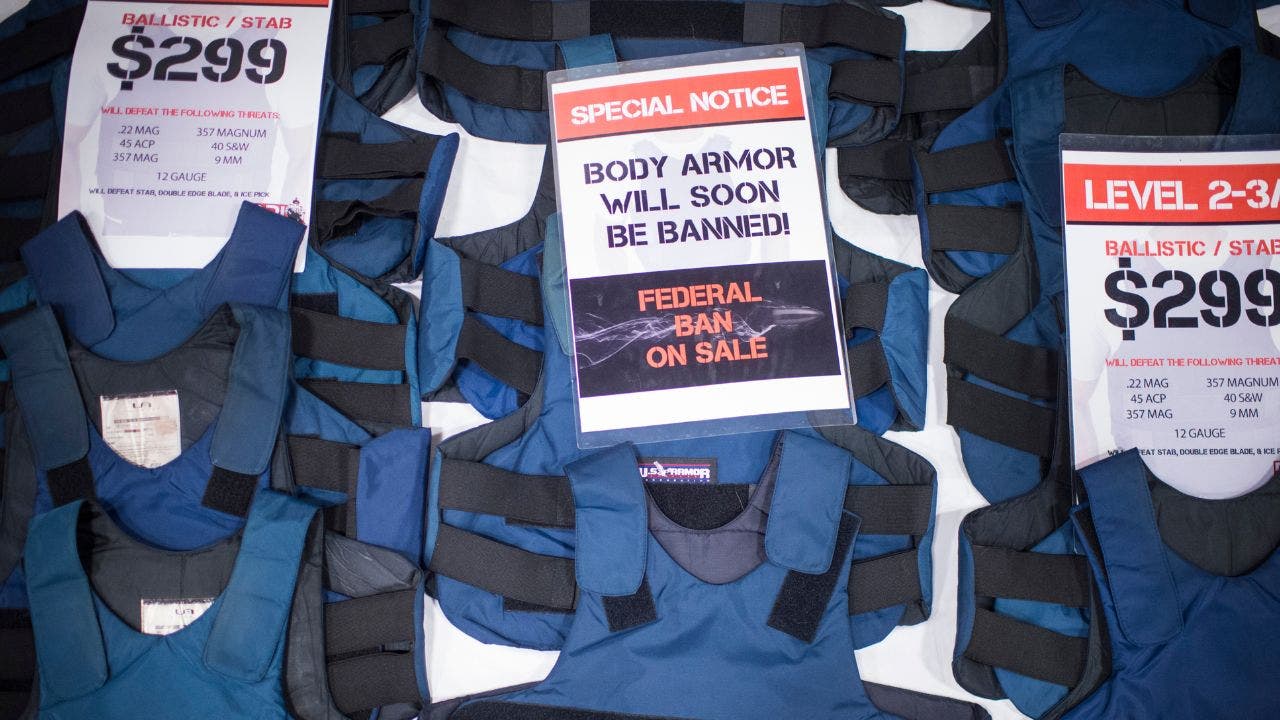
A gun-rights group is suing the state of New York in order to block the enforcement of its body armor ban.
The Firearms Policy Coalition (FPC), a California-based non-profit organization, filed its Second Amendment lawsuit in the Western District of New York on Monday, arguing the ban is unconstitutional and is seeking a declaratory judgment that New Yorkers have a fundamental right to keep and bear arms — including body armor. The group is also seeking a permanent injunction to halt the enforcement of the ban.
The law — which restricts sales of vests defined as “bullet-resistant soft body armor” — was hastily passed by state lawmakers following the Buffalo supermarket shooting in May 2022 which left 10 people dead. Shooter Payton Gendron was sentenced last year to 11 consecutive life sentences, having pleaded guilty to all state charges including murder, domestic terrorism and hate crimes. All 10 victims were Black.
GUN RIGHTS GROUP APPLAUDS AFTER FEDERAL APPEALS COURT DEALS BLOW TO NY CONCEALED CARRY LAW
A teacher puts on a bulletproof vest during a live fire training session in Thistle, Utah, on Oct. 5, 2019. (George Frey/Bloomberg via Getty Images)
New York’s ban is aimed at stopping criminals from gaining an advantage over peace officers, or security guards like Aaron Salter, who was killed trying to stop Gendron’s supermarket rampage.
During the killings, Gendron wore a steel-plated vest — armor strong enough to stop a handgun round fired by Salter, who tried to halt the shooting.
Under New York law, a person is prohibited from purchasing or taking possession of body armor if it is not being used in an eligible profession such as law enforcement or the military.
Furthermore, nobody is allowed to “sell, exchange, give or dispose of body armor…to an individual…not engaged or employed in an eligible profession,” the law states.
Violations are subject to a Class A misdemeanor for a first offense and a Class E felony for any subsequent offense.
FPC President Brandon Combs blasted the New York law while announcing the lawsuit.
JUSTICE DEPARTMENT INTENDS TO SEEK DEATH PENALTY FOR BUFFALO SUPERMARKET SHOOTER PAYTON GENDRON
Buffalo mass shooter Payton Gendron still faces federal charges in relation to the attack. (Erie County District Attorney’s Office/Scott Olson/Getty Images)
“New York’s body armor ban shows that the state’s commitment to authoritarianism has collapsed into absurdity, making it a crime to buy and use simple personal protective equipment,” Combs said in a statement. “New York’s laws have gone so far off the deep end that it would surprise exactly no one if Gov. Hochul and her goons banned safety glasses next. FPC looks forward to eliminating this unconstitutional law and teaching New York another lesson about constitutionally protected rights.”
FPC said that Americans have a deeply rooted tradition of keeping and wearing armor and says that whenever the usefulness of armor outweighed the burden of wearing it, armor was used. That tradition, combined with the lack of historical restrictions, “evinces a robust right to possess and wear body armor for self-defense,” the group said.
The case is captioned as Heeter v. James. Attorney General Letitia James, New York State Police Superintendent Steven James and Erie County Acting District Attorney Michael Keane are named as the defendants. FPC is joined in the case by Benjamin Heeter, an FPC member.
A New York law makes purchasing body armor illegal.
New York already has tough gun laws on the books and the state sought even more restrictions on gun owners following the 2022 Supreme Court ruling that declared the state’s previous concealed carry permitting requirements unconstitutional. Following that decision, New York passed the “Concealed Carry Improvement Act” (CCIA) but parts of it were struck down last year.
However, controversial parts of the law remain intact, including a requirement that applicants demonstrate good moral character and disclose household and family members on a permit application. New York is also allowed to enforce bans on concealed carry in so-called “sensitive places,” including theaters, bars, public parks and other spaces.
It’s also against the law to purchase pepper spray in New York, although using it in self-defense is legal.
Fox News’ Chris Pandolfo contributed to this report.
Read the full article from Here


Attorney General Aaron Ford announced Wednesday afternoon that his office has reached a nearly $30 million settlement with drug manufacturer Glenmark.
The settlement is part of a multi-state antitrust case against the generic drug manufacturer. 48 U.S. states and territories allege Glenmark engaged in a conspiracy to artificially inflate prices and reduce competition on the sale of more than 100 medications.
That includes drugs used to treat asthma, cancer and diabetes, among other conditions.
Nevada will distribute $41,000 to impacted agencies and over $13 million to a consumer restitution fund.
Individual Nevadans who bought one of Glenmark’s products between May 2009 and December 2019 may also be eligible for monetary compensation. Members of the public can find more information about eligibility at aggenericdrugs.com.

NEW MEXICO (KRQE) – Emergency crews are responding to a tank battery fire in the area of Frying Pan Road and Anthony Road in southern Lea County.
Officials are asking people to avoid the area and follow directions from emergency personnel and law enforcement. Multiple agencies are responding to the fire. No other information has been release, this is a developing story.

UMATILLA COUNTY, Ore. — A rollover crash on Interstate 84 in Umatilla County sent four people to the hospital Thursday morning, including three passengers who were later transferred for advanced medical care, according to Oregon State Police.
OSP said troopers responded at 8:27 a.m. Thursday, July 16, to a single-vehicle serious injury crash on I-84 eastbound near milepost 207.
Investigators said a gray Dodge Durango driven by Cullen Michael Derr, 38, of Battle Ground, Wash., was eastbound while towing a custom-built utility trailer when, for an unknown reason, it left the roadway. The vehicle rolled multiple times and caught fire, OSP said.
Police said three occupants were ejected during the crash: a 24-year-old woman, a 15-year-old male and a 9-month-old male infant. OSP said all four occupants, including Derr, were taken to a local hospital, and the three passengers were later transferred to hospitals in Oregon and Washington because of the severity of their injuries.
Derr was arrested for DUII, reckless driving, reckless endangering another person (three counts) and third-degree assault (three counts), and was lodged at the Umatilla County Jail, OSP said.
Interstate 84 was impacted for about one hour during the on-scene investigation. OSP said it was assisted by the Pendleton Police Department, Pendleton Fire & Ambulance Department, and the Oregon Department of Transportation.
-

 Nebraska4 minutes ago
Nebraska DHHS evaluating USDA guidelines that could limit food access for undocumented immigrants
-
Nevada10 minutes ago
Nevada secures $30 million from generic drugmaker in nationwide antitrust case
-

 New Hampshire16 minutes ago
Antique And Vintage Market | Yard Sales | Farmers Markets | Music | More: The Portsmouth Patch Weekender
-

 New Jersey22 minutes ago
Meteorite that crashed into New Jersey home contains building blocks of life, astronomers say
-

 New Mexico27 minutes ago
Crews battling tank battery fire in Lea County
-

 North Carolina34 minutes ago
SBI IT volunteers pack 5,200 meals, 1,300 food bags for North Carolina families
-

 North Dakota39 minutes ago
Clyde Oster
-

 Ohio46 minutes ago
Humane agents removing chickens from Youngstown property

