San Francisco, CA
New 'seed lending library' taking root at San Francisco's Bayview branch


San Francisco library lets you borrow seeds to plant for free
San Francisco Public Library is branching out beyond books by starting a seed library that lets users borrow seeds to plant for free. Library officials in the Bayview District say they hope this lending library literally takes root.
SAN FRANCISCO – San Francisco Public Library has launched a new kind of lending library at the Bayview Branch, planting seeds of knowledge in a very different way. The collection sits on a table near the courtyard, tucked away in an old, wooden card catalog.
Inside each drawer are small paper packets containing ten or more seeds, available for people to come and take for free as part of a pilot program called the “seed lending library.”
“Our seed library doesn’t require a library card at all,” Lucy Chiem, the Bayview Branch Youth Services librarian explains, opening the drawers labeled now with different vegetables and herbs. “Patrons can take whatever seeds they would want to grow and once they harvest it, they just bring the seeds from their harvest back.”
Librarians hope the tiny seeds will open a bounty of learning for people to learn about nature, biology, urban gardening, and even health and nutrition.
It has also become an inspiration, even for the most seasoned library staff.
“I never knew there was a dragon tongue bean,” Chiem said. “We have herbs like chives, mint, oregano, and parsley. Our herbs have been going the fastest. They’re the most popular right now.”
Staff say they’re already seeing many community members donating seeds from their own community plots or personal gardens.
Jaime Wong, a library spokesperson and novice gardener, said she is taking some seeds to her community garden plot in the Bayview.
“The seed lending library is very much in tune with the library’s mission, which is to help people to grow and to learn, find new hobbies, just discover new things about themselves,” Wong said.
“We’re trying to engage a space where community members can talk with each other, can learn together and find their own community,” Chiem said. “When we get to witness that, it’s very heartwarming.”
The Bayview branch is one of three locations that have the “seed lending library” pilot program so far, along with the Portola and Potrero branches. Library staff say they are open to expanding to other locations if neighbors in those areas express an interest.
Jana Katsuyama is a reporter for KTVU. Email Jana at jana.katsuyama@fox.com or call her at 510-326-5529. Or follow her on Twitter @JanaKTVU.



San Francisco, CA
Barricaded suspect in standoff with police in San Francisco’s Tenderloin neighborhood

A person was barricaded inside a residence in San Francisco’s Tenderloin neighborhood on Tuesday afternoon in a standoff with officers, police said.
The San Francisco Police Department said the situation was happening at the Cadillac Hotel, a historic single-room occupancy building on Eddy Street between Jones and Leavenworth streets. Officers responded to a report of an assault at the hotel at about 2 p.m. and determined that the suspect was barricaded in one of the units, police said.
Crisis negotiators and other specialists also responded and were developing a plan for a peaceful resolution to the standoff, police said. An ambulance and paramedics were also standing by at the hotel.
Members of the public were asked to avoid the area. The San Francisco Fire Department said Eddy Street between Leavenworth and Jones was closed to traffic.
The Cadillac Hotel was built in 1907 and has been listed as a San Francisco Designated Landmark since 1985, becoming the first nonprofit single-room occupancy hotel west of the Mississippi. For decades, it also housed Newman’s Gym, one of the oldest boxing facilities in the U.S., where boxers such as Muhammad Ali, George Foreman, Sugar Ray Robinson, and Joe Louis trained.
Today, the hotel provides supportive housing for approximately 160 low-income residents.
In 2015, the hotel became the site for The Tenderloin Museum.

SOUTH SAN FRANCISCO, Calif. – You’re not dreaming. Gas prices really are that high.
National average $4 a gallon, California $6
In fact, at the Shell station at 248 S. Airport Boulevard in South San Francisco, regular gas was going for $6.89 a gallon on Tuesday, about four weeks after the United States and Israel started a war in Iran.
Most people didn’t even stop to fill up; instead, drivers seemed to just pass the station by.
Juan Buenrostro did stop, though, and said it costs him about $300 to fill up his truck. He lives in Santa Cruz and had to drive to the Marina in San Francisco.
“It’s been crazy, man,” he said. “I have to work extra hours to make extra income. We’ve been struggling.”
That price is roughly double what the national average is. AAA said the average price of gas was $3.97 a gallon as of Tuesday, and the average price in California was $5.82.
Prices are so high that the state’s petroleum watchdog, the Division of Petroleum Market Oversight, has launched an investigation into possible price gouging, specifically at gas stations charging $7 or $8 a gallon.
A Chevron in downtown Los Angeles was selling gas for $8.71 a gallon this week.

Gas was selling for $8.71 a gallon at a downtown Los Angeles Chevron station. Photo: Fox11. March 23, 2026
Kate Gordon, CEO of California Forward and a former senior adviser to the U.S. Secretary of Energy, said $10 gas is not out of the question under certain conditions.
“Can you imagine a world where we’re paying $10 a gallon? … Yes, I can,” Gordon said.
Gas prices on March 24, 2026. Source: AAA
Last year, prices lower
A year ago, the average price in the United States was $3.13 a gallon, and the average price in California was $4.64 a gallon, according to AAA.
The highest average price for gas in California ever recorded was $6.44 on June 14, 2022, when Russia invaded Ukraine.
War in Iran
Regular gas was selling for $6.89 a gallon at a Shell gas station in S. San Francisco. March 24, 2026
Oil and gas prices have been soaring since the war in Iran began a month ago, and when Iran began retaliating against the United States by choking off the Strait of Hormuz – a critical oil passageway.
Gas prices are likely to remain elevated for some time, even if the war ends soon, because shipping and production have been disrupted and will take time to recover. Economists now expect slower growth this spring and for the year as a whole, as dollars that are spent on gas are less likely to be used for restaurant meals, new clothes, or entertainment.
Lower income households bearing the brunt
Lower and middle-income households are likely to be hit particularly hard, because they receive lower refunds, while spending a greater proportion of their earnings on gas.
Neale Mahoney, director of the Stanford Institute for Economic Policy Research, calculates that gas prices nationwide could peak in May at $4.36 a gallon, based on oil price forecasts by Goldman Sachs, followed by slow declines for the rest of the year. The notion that gas prices decline much more slowly than they rise is so ingrained among economists that they refer to it as the “rocket and feathers” phenomenon.
In that scenario, the average household would pay $740 more in gas this year, nearly equal to the $748 increase in refunds that the Tax Foundation has estimated the average household will receive.
And it’s only worse in California.
The impact will likely worsen the “K-shaped” narrative around the U.S. economy, analysts said, in which higher income households have fared better than lower-income households. The bottom 10% of earners spend nearly 4% of their incomes on gasoline, Pantheon Macroeconomics estimates, while the top 10% spend just 1.5%.

In the North Bay, the SMART commuter rail line will begin work next week to extend service to the city of Healdsburg, with plenty of challenges, both in construction and in finding long-term funding.
As the largest city north of Santa Rosa, Healdsburg is generating considerable excitement among those who await SMART’s arrival. But first there’s a lot of work to do, starting next week.
“It starts with a topographical survey,” said SMART Chief Engineer Bill Gamlen. “Monday, we’ll be moving into geotechnical boring, where we’ll have a drill rig out on the site, and we are taking cores of soil samples. There’ll be a lot of things going in parallel. We’re going to be taking things apart, tearing out old track, taking out old bridges, tearing up grade crossings. The bridge across the Russian River will be one of the first activities there.”
That bridge was built in the 1870s and will need a complete replacement to carry the weight of the modern SMART trains. The prep work will take about a year, with actual construction beginning next spring. The $270 million in funding for the extension is already in place and SMART expects to be pulling into the old Healdsburg station sometime in late 2028.
“We think it’s a big milestone,” said Gamlen. “You know, Healdsburg is a delightful place to go visit on the weekends, and even vacation there. So, we see a lot of ridership heading up to Healdsburg, a destination, probably, more than an origination point.”
But that’s a problem, according to Mike Arnold, an economist and outspoken critic of SMART, living in Novato. Arnold said he thinks SMART will never be financially feasible because it doesn’t take people to any large urban job centers.
“The primary problem is the economics,” he said. “Passenger rail in suburbia just doesn’t get the ridership. And the reason is because there just isn’t a place for people to get to easily. There is no major employment center in either Marin or Sonoma Counties. And so, therefore, when you take people to stations, how are they going to get where they want to go? The answer is, very few of them do, and that’s why they get very few riders.”
Currently, kids and seniors pay no fare, and Arnold said that means more than 40 percent of riders are riding for free. And he points to Hwy 101, where SMART was supposed to relieve traffic during morning commute times.
Changes in work habits, brought on by the pandemic, have decreased the number of commuters, but Arnold said it has simply compressed the traffic jams into a smaller time period, with little impact from SMART.
“You’ve narrowed the peak,” he said. “But when you talk about peak-hour congestion at 7:30 in the morning, it looks like it hasn’t changed at all. And the answer is, based on the count on the cars, it really hasn’t changed at all.”
The debate matters because in June voters will be asked to decide whether or not to extend, for another 30 years, the quarter-cent sales tax to continue funding SMART. The current tax will sunset in 2029, shortly after the Healdsburg extension is scheduled to be finished.
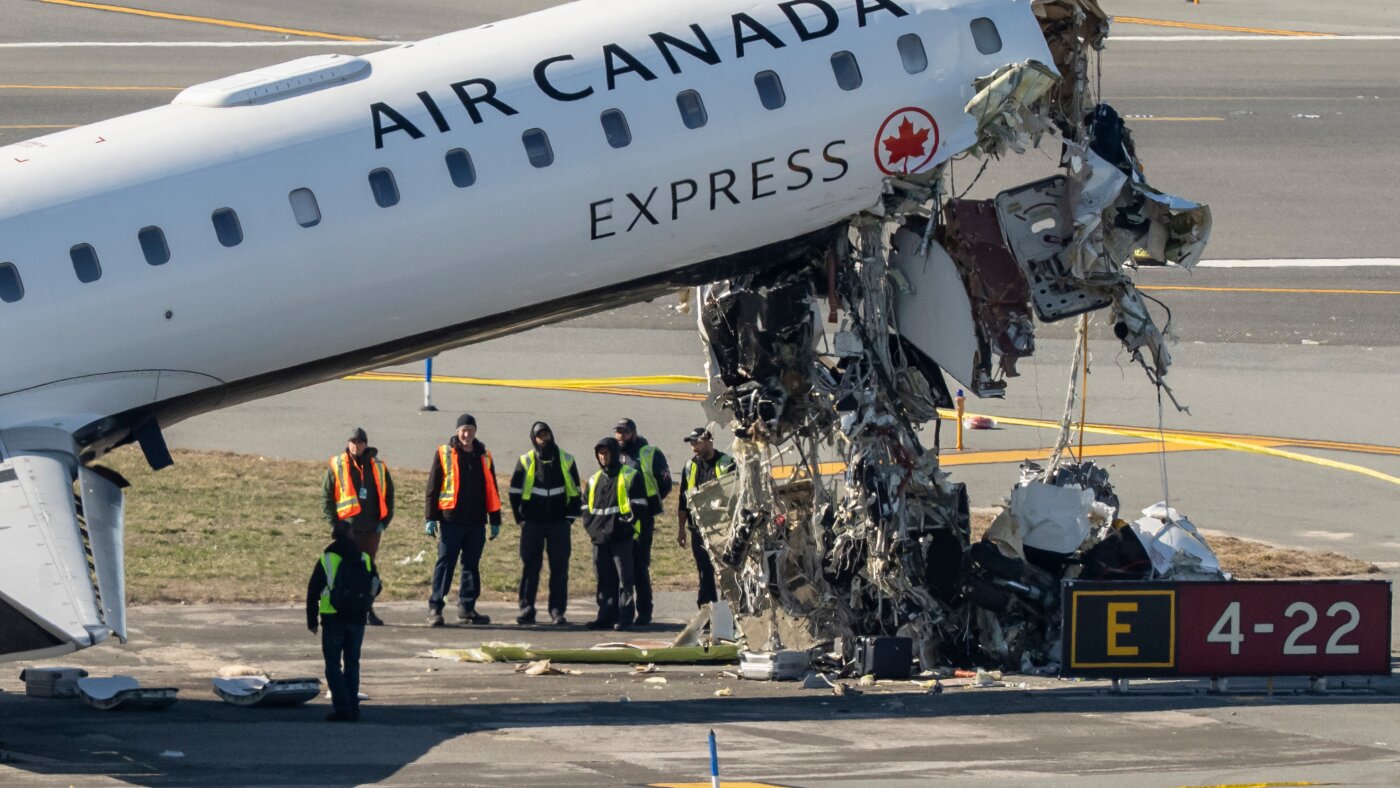
An air traffic controller was juggling extra roles during the LaGuardia plane crash

Video: LaGuardia Crash Survivors Recount Ordeal

Michigan ‘adventure seekers’ take flight at new experiential venues

Barricaded suspect in standoff with police in San Francisco’s Tenderloin neighborhood

Jack Hughes scores twice as Devils beat Stars 6-4, end Dallas streak with four-goal first period

Florida High School Football Rankings: Top 25 teams – Oct. 21

How old is Bo Nix? What to know about Oregon quarterback ahead of 2024 NFL Draft

Cleary's 21 help Le Moyne down Central Connecticut State 69-64 in OT

99th annual Pony Swim held in Virginia

Indiana Members Credit Union announced as new anchor tenant at Bottleworks District
An air traffic controller was juggling extra roles during the LaGuardia plane crash

Iran War: Pentagon set to send thousands of elite 82nd Airborne troops to region | BBC News

Video: Passengers Wait in Long Security Lines at LaGuardia After Deadly Crash

King Charles to address Congress in historic first state visit to Washington

Iran names successor to security chief killed in US-Israeli attack
-

 Detroit, MI6 days ago
Drummer Brian Pastoria, longtime Detroit music advocate, dies at 68
-

 Georgia1 week ago
How ICE plans for a detention warehouse pushed a Georgia town to fight back | CNN Politics
-

 Movie Reviews6 days ago
‘Youth’ Twitter review: Ken Karunaas impresses audiences; Suraj Venjaramoodu adds charm; music wins praise | – The Times of India
-

 Alaska1 week ago
Police looking for man considered ‘armed and dangerous’
-

 Education1 week ago
Video: Turning Point USA Clubs Expand to High Schools Across America
-

 Sports3 days ago
IOC addresses execution of 19-year-old Iranian wrestler Saleh Mohammadi
-
 Science1 week ago
Industrial chemicals have reached the middle of the oceans, new study shows
-

 New Mexico2 days ago
Clovis shooting leaves one dead, four injured