San Francisco, CA
A San Francisco neighborhood threw a mini-festival to celebrate a public toilet that cost $200,000 instead of $1.7 million

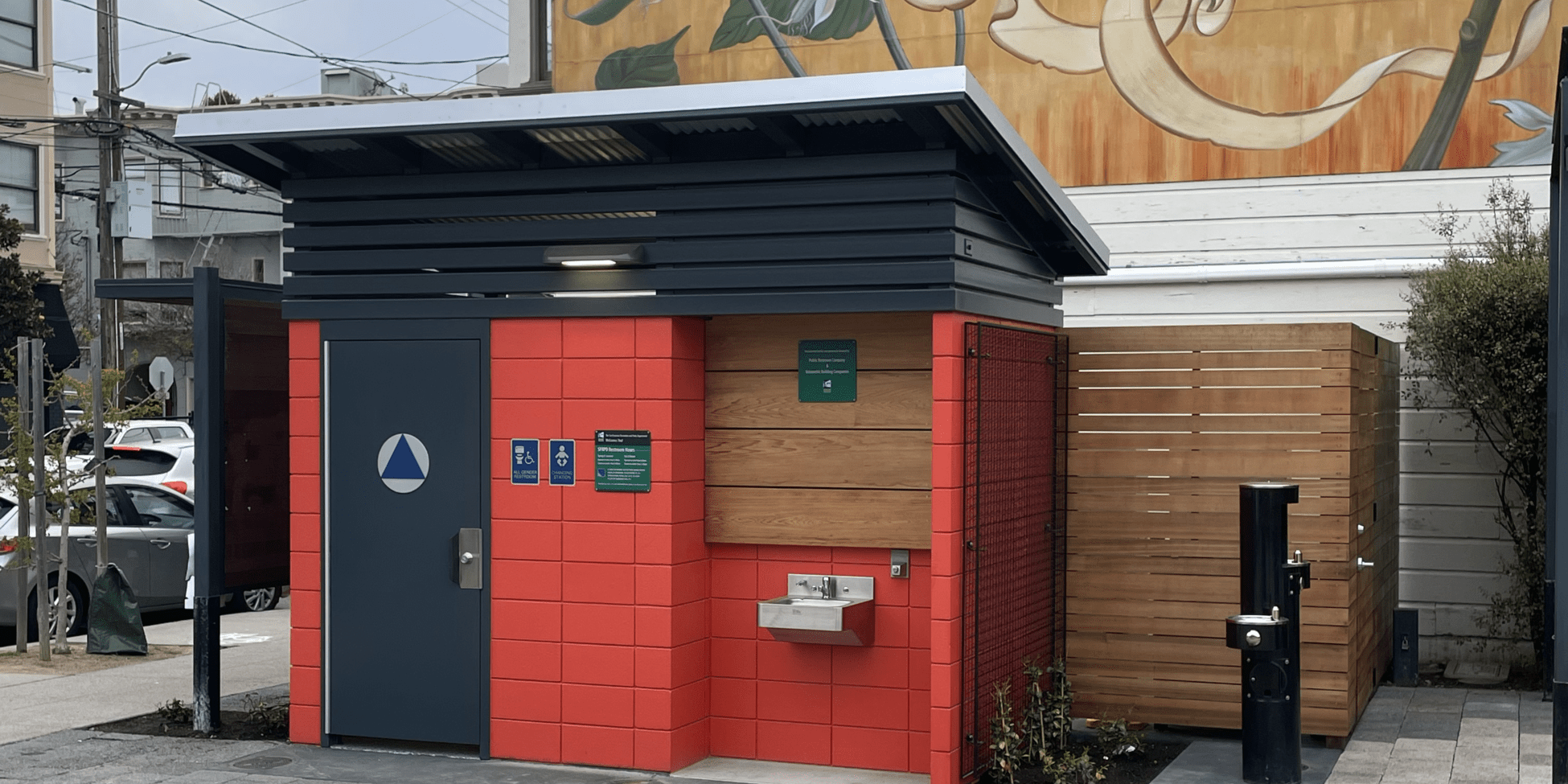
The scandal over a public toilet in San Francisco that cost $1.7 million has ended in celebration after the new loo opened on Monday with a much-discounted price tag of $200,000.
That’s according to The New York Times, CBS News, and The San Francisco Chronicle, who sent reporters down to the toilet’s launch in the Noe Valley Town Square.
Residents held a small festival next to the public potty, replete with a live band, toilet-themed carnival games, lemonade, and chocolate cupcakes decorated like poop. Three local politicians attended.
People took turns to try the new stainless steel toilet, and NYT interviewed a man dressed as a human-sized roll of toilet paper. CBS captured footage of a performer dressed as the “Super Mario” character Luigi dancing with a plunger.
“This whole thing got so ridiculous, so why not be ridiculous?” Leslie Crawford, who organized the event, told The SF Chronicle.
The over-the-top celebration reflects the yearslong controversy that emerged when people discovered in October 2022 that San Francisco planned to build the toilet over two years for $1.7 million — even after plumbing had already been laid.
People actually wanted the toilet in the plaza; an assembly member meant to celebrate the launch of the loo plans that month but canceled after the cost was revealed, per The SF Chronicle.
The expensive toilet was soon lampooned on national headlines, and became a lightning rod for concerns about wastage in US government projects and rising construction costs for public works.
City officials said they were weighed down by high construction costs in San Francisco, as well as the need for environmental reviews and checks from multiple commissions.
Under intense scrutiny, the plans for the toilet began to unravel. California Gov. Gavin Newsom pulled the $1.7 million from the city, telling officials to figure out how to reduce the toilet’s cost before they could touch the funds again.
Then Chad Kaufman, owner of the Nevada-based Public Restroom Company, offered to donate a modular toilet to the city, saying he would help pay for engineering and architecture work to install the loo. Per NYT, his friend Vaughn Buckley, CEO of Pennsylvania-based Volumetric Building Companies, chipped in.
With help from Kaufman and Buckley, the city only had to pay $200,000 to install the town square toilet.
With the toilet controversy drawing to a close, San Francisco Mayor London Breed is seeking to avoid a repeat event by announcing new legislation this month allowing city officials to pool small project budgets for group discounts on construction and equipment.
San Francisco has in recent years drawn attention for its quickly rising cost of living, with one modern wealth survey saying in 2022 that the average resident needs a net worth of $1.7 million to live comfortably in the city.


A run of late-summer performances brings Lettuce to SFJAZZ, where the Boston-born sextet continues touring its latest album Cook inside Miner Auditorium. Known for expanding from Berklee students into a tightly synchronized funk collective, the band threads together psychedelic grooves, brass-led arrangements, and extended improvisational passages that often stretch their sets into long-form explorations rather than fixed song cycles. Each performance draws on decades of collaboration and individual side work across jazz, pop, and hip-hop, giving the music a layered, studio-to-stage fluidity that rarely settles into repetition. The SFJAZZ setting frames that approach with concert-hall clarity, allowing rhythm sections and horn interplay to unfold with precision even at peak intensity. Across the run, the focus stays on sustained groove and ensemble chemistry, where variation emerges gradually through solos and shifting textures rather than abrupt changes in direction.

A man was being sought as the suspect in a double shooting in Bay Point that left one person dead and another injured early Friday morning.
The Contra Costa County Sheriff’s Office said deputies were dispatched at about 1:30 a.m. to an unknown problem on Olivia Lane, just east of Alves Lane and south of Delta de Anza Regional Trail, which later was reported to be “shots fired.”
While arriving at the scene, deputies were flagged down by several people who were injured at the location, the Sheriff’s Office said. Deputies found one person who was unresponsive and he was taken to a hospital. The victim was later pronounced dead at the hospital, the office said.
A second person was taken to the hospital; the victim’s condition was not disclosed. The victim who died has not yet been identified.
Sheriff’s detectives identified the suspect as 35-year-old Avery Alexander Gibbs, described by the Sheriff’s Office as a transient. Gibbs was still at large as of Friday afternoon
The Sheriff’s Office said Gibbs should not be approached, and anyone seeing him should call 9-1-1. People with information on the shooting were asked to contact Sheriff’s Office investigators at (925) 313-2600 dispatcher at (925) 646-2441.


Golden Gate Bridge fireworks will be a rare patriotic event
This year on July 4th, for the third time in history, an organized fireworks display will be held at San Francisco’s iconic Golden Gate Bridge. This only happned in twice before in 1987 and 2012 for the bridge’s 50th and 75th annivesary. Expect crowds to be massive and public transportation, ride shares and simply walking is highly recommended.
SAN FRANCISCO – San Francisco is preparing for its major July 4th fireworks display on Saturday night, an event expected to draw massive crowds as pyrotechnics are launched directly from the Golden Gate Bridge for only the third time in history.
Will crowds flood Marina?
What we don’t know:
To pull off the event, the Golden Gate Bridge, major roadways, and key parking lots at Marina Green and Crissy Field will be shut down.
Several neighborhood streets will also be blocked off, creating significant traffic hurdles. Officials are strongly advising spectators to utilize public transit due to severely limited parking.
Local residents in the Marina District have expressed concern over the impending chaos as crowds flood the neighborhood.
“I’m a little worried, yeah,” said nearby resident Michael Zoboski. “I think it’s gonna be definitely hectic. I don’t know where people are going to park, it seems like it’s taking up a large amount of the streets up here. I think it’s going to be a little crazy.”
To manage the influx, access to many surrounding neighborhoods will be strictly limited to local residents.
Checking IDs
What we know:
Law enforcement officers will be checking IDs and questioning drivers to verify residency. According to the district supervisor, there will be 10 police officers deployed per block in the Marina.
Road closures will stretch from Baker Street to Van Ness Avenue between 8 p.m. and 11 p.m.
Portions of Fisherman’s Wharf are scheduled to shut down even earlier, starting at 1 p.m. Saturday afternoon, with much of that neighborhood also restricted to local access. The Golden Gate Bridge itself will close to traffic starting at 9 p.m.
Additionally, roads will be closed in the Presidio and Richmond District. To encourage the use of public transportation, Muni is providing special shuttles to help transport spectators to the viewing areas.
The Source: Marina neighbors, Muni, San Francisco city website
-

 Dallas, TX2 minutes ago
Mistake avoided? Cowboys FA signing could’ve been drafted… but fate
-

 Miami, FL9 minutes ago
No Room For LB Ronnie Harrison In Miami?
-

 Boston, MA12 minutes ago
Celtics’ Jaylen Brown trade leaves Boston fans, community feeling bankrupt: ‘A huge void’
-

 Denver, CO17 minutes ago
Kalshi Promo Code DENVER: Claim $10 Bonus for July 4th World Cup, MLB Trades – Denver Stiffs
-

 Seattle, WA24 minutes ago
Experts release new WNBA predictions for Portland Fire vs. Seattle Storm tonight
-

 San Diego, CA27 minutes ago
Local bestselling author Jim Dutton to speak at DMCC in-person meeting in Del Mar
-

 Milwaukee, WI32 minutes ago
Game Discussion: Milwaukee Brewers (54-32) @ Arizona Diamondbacks (43-43)
-

 Atlanta, GA39 minutes ago
Braves look to make it two in a row as Chris Sale starts against Mets

