Science
What are the blue blobs washing up on SoCal beaches? Welcome to Velella velella Valhalla

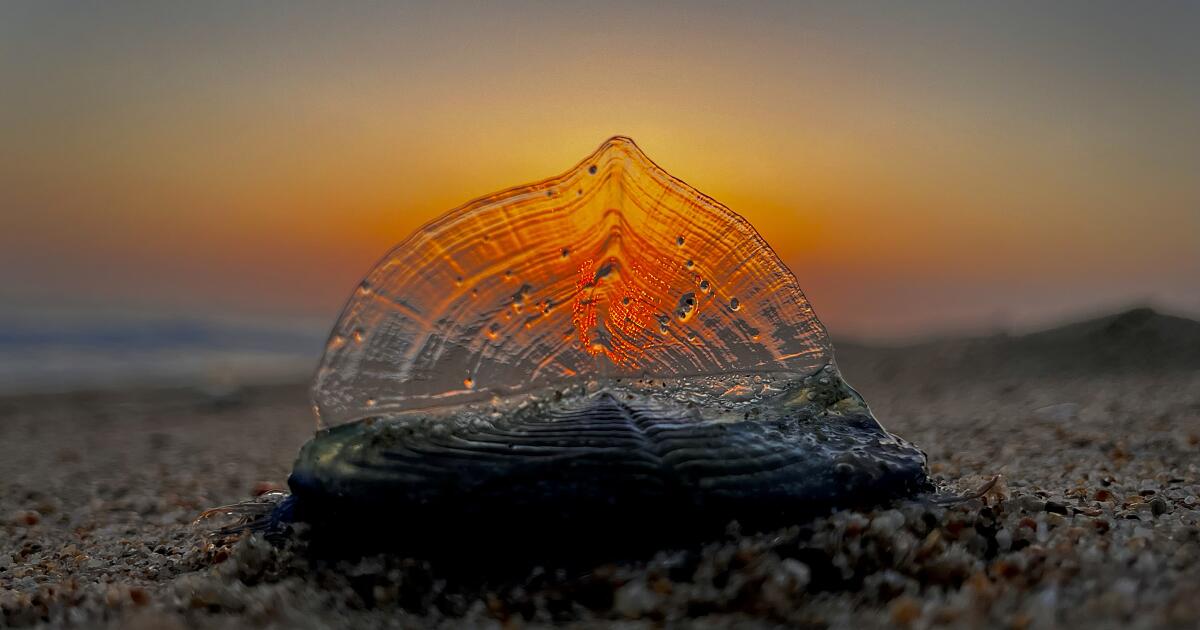
The corpses are washing up by the thousands on Southern California’s beaches: a transparent ringed oval like a giant thumbprint 2 to 3 inches long, with a sail-like fin running diagonally down the length of the body.
Those only recently stranded from the sea still have their rich, cobalt-blue color, a pigment that provides both camouflage and protection from the sun’s UV rays during their life on the open ocean.
Aggressive and impactful reporting on climate change, the environment, health and science.
These intriguing creatures are Velella velella, known also as by-the-wind sailors or, in marine biology circles, “the zooplankton so nice they named it twice,” said Anya Stajner, a biological oceanography PhD student at UC San Diego’s Scripps Institution of Oceanography.
A jellyfish relative that spends the vast majority of its life on the surface of the open sea, velella move at the mercy of the wind, drifting over the ocean with no means of locomotion other than the sails atop their bodies. They tend to wash up on the U.S. West Coast in the spring, when wind conditions beach them onshore.
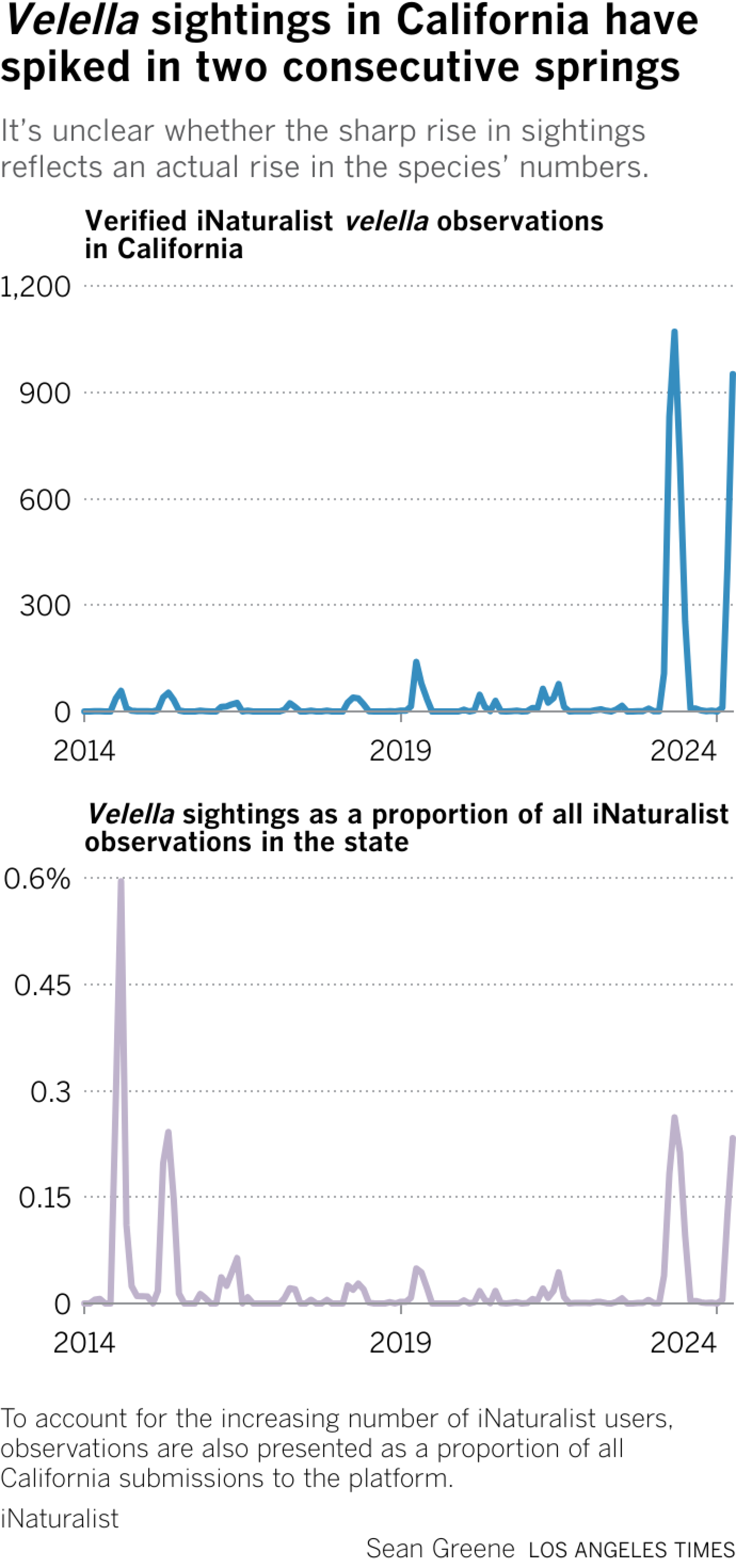
Springtime velella sightings documented on community science platforms like iNaturalist spiked both this year and last, though scientists say it’s too early to know if this indicates a rise in the animal’s actual numbers.
Velella are an elusive species whose vast habitat and unusual life cycle make them difficult to study. Though they were documented for the first time in 1758, we still don’t know exactly what their range is or how long they live.
These beaching events confront us with a little-understood but essential facet of marine ecology — and may become more common as the oceans warm.
“Zooplankton” — the tiny creatures at the base of the marine food chain — “are sort of this invisible group of animals in the ocean,” Stajner said. “Nobody really knows anything about them. No one really cares about them. But then during these mass Velella velella strandings, all of a sudden there’s this link to this hidden part of the ocean that most of us don’t get to experience.”
What looks like an individual Velella velella is actually a colony of teeny multicellular animals, or zooids, each with their own function, that come together to make a single organism. They’re carnivorous creatures that use stinging tentacles hanging below the surface to catch prey such as copepods, fish eggs, larval fish and smaller plankton.
Unlike their fellow hydrozoa, the Portuguese man o’ war, the toxin in their tentacles isn’t strong enough to injure humans. Nevertheless, “I wouldn’t encourage anyone to touch their mouth or their eyes after they pick one up on the beach,” said Nate Jaros, senior director of fishes and invertebrates at the Aquarium of the Pacific in Long Beach.
Velella that end their lives on California beaches typically have sails that run diagonally from left to right along the length of their bodies, an orientation that catches the onshore winds heading in this direction. As the organism’s carcass dries in the sun and the soft tissues decay, the blue color disappears, leaving the transparent chitinous float behind.
“The wind really just brings them to our doorstep in the right conditions,” Jaros said. “But they’re designed as open ocean animals. They’re not designed to interact with the shoreline, which is usually why they meet their demise when they come into contact with the shore.”
1
2
3
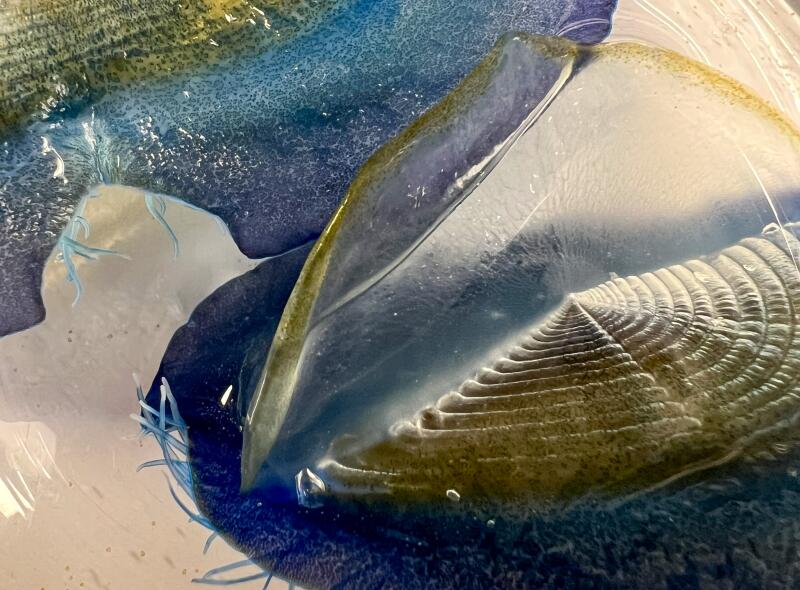
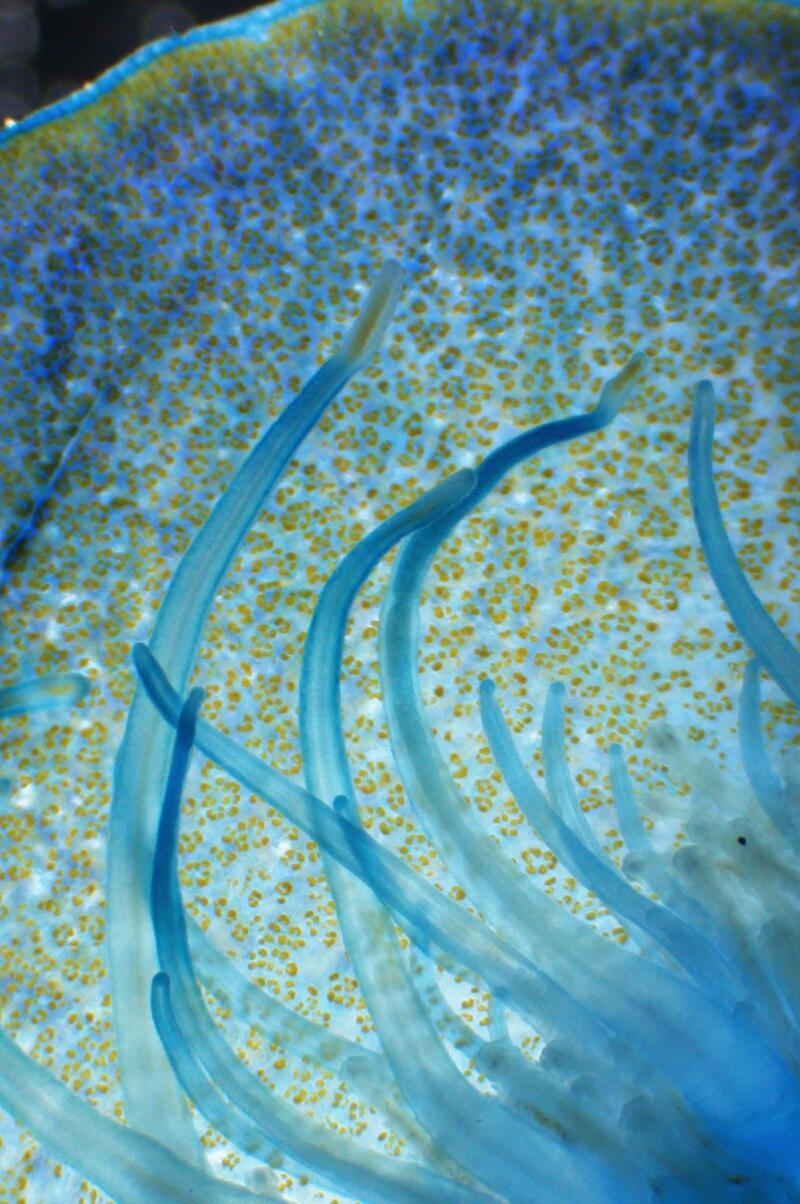
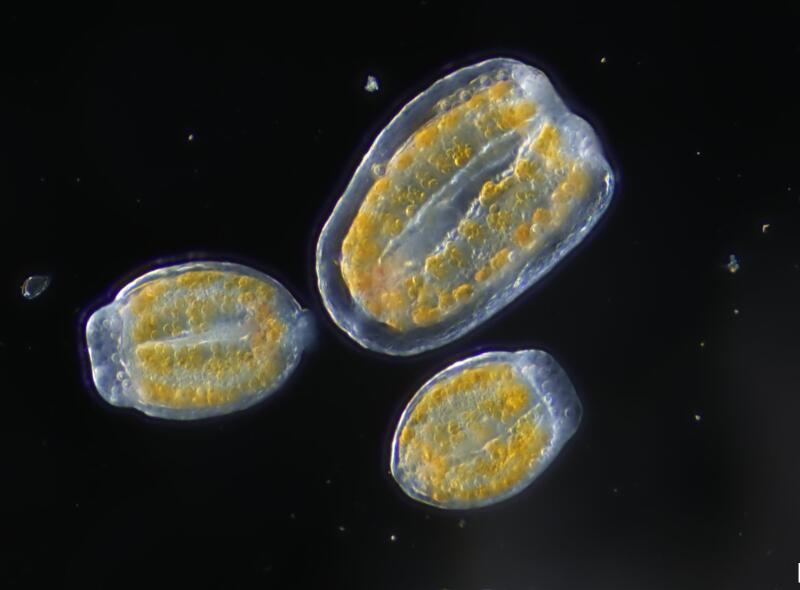
1. Anya Stajner put Velella velella under a microscope. 2. Magnified, you can see more than blue in the organism. “That green and brown coloration comes from their algae symbionts,” Stajner said. 3. Notice the tentacles too. (Anya Stajner)
Velella show up en masse when two key factors coincide, Stajner said: an upwelling of food-rich, colder water from deeper in the ocean, followed by shoreward winds and currents that direct the colonies to beaches.
A 2021 paper from researchers at the University of Washington found a third variable that appears to correlate with more velella sightings: unusually high sea surface temperatures.
After looking at data over a 20-year period, the researchers found that warmer-than-average winter sea surface temperatures followed by onshore winds tended to correlate with higher numbers of velella strandings the following spring, from Washington to Northern California.
“The spring transition toward slightly more onshore winds happens every year, but the warmer winter conditions are episodic,” said co-author Julia K. Parrish, a University of Washington biologist who runs the Coastal Observation and Seabird Survey Team community science project.
Given that sea surface temperatures have been consistently above the historical average every day since March 2023, the current velella bloom is consistent with those findings.
Previous research has found that gelatinous zooplankton like velella and their fellow jellyfish thrive in warmer waters, portending an era some scientists have referred to as the “rise of slime.”
Other winners of a slimy new epoch would be ocean sunfish, a giant bony fish whose individuals can clock in at more than 2,000 pounds and consume jellyfish — and velella — in mass quantities. Ocean sunfish sightings tend to rise when velella observations do, Jaros said.
“The ocean sunfish will actually kind of put their heads out of the water as they eat these. It resembles Pac-Man eating pellets,” he said. (KTLA-TV published a picture of just that this week.)
Though velella blooms are ephemeral, we don’t yet know how long any individual colony lives. The blue seafaring colonies are themselves asexual, though they bud off tiny transparent medusas that are thought to go to the deep sea and reproduce sexually there, Stajner said. The fertilized egg then evolves into a float that returns to the surface and forms another colony.
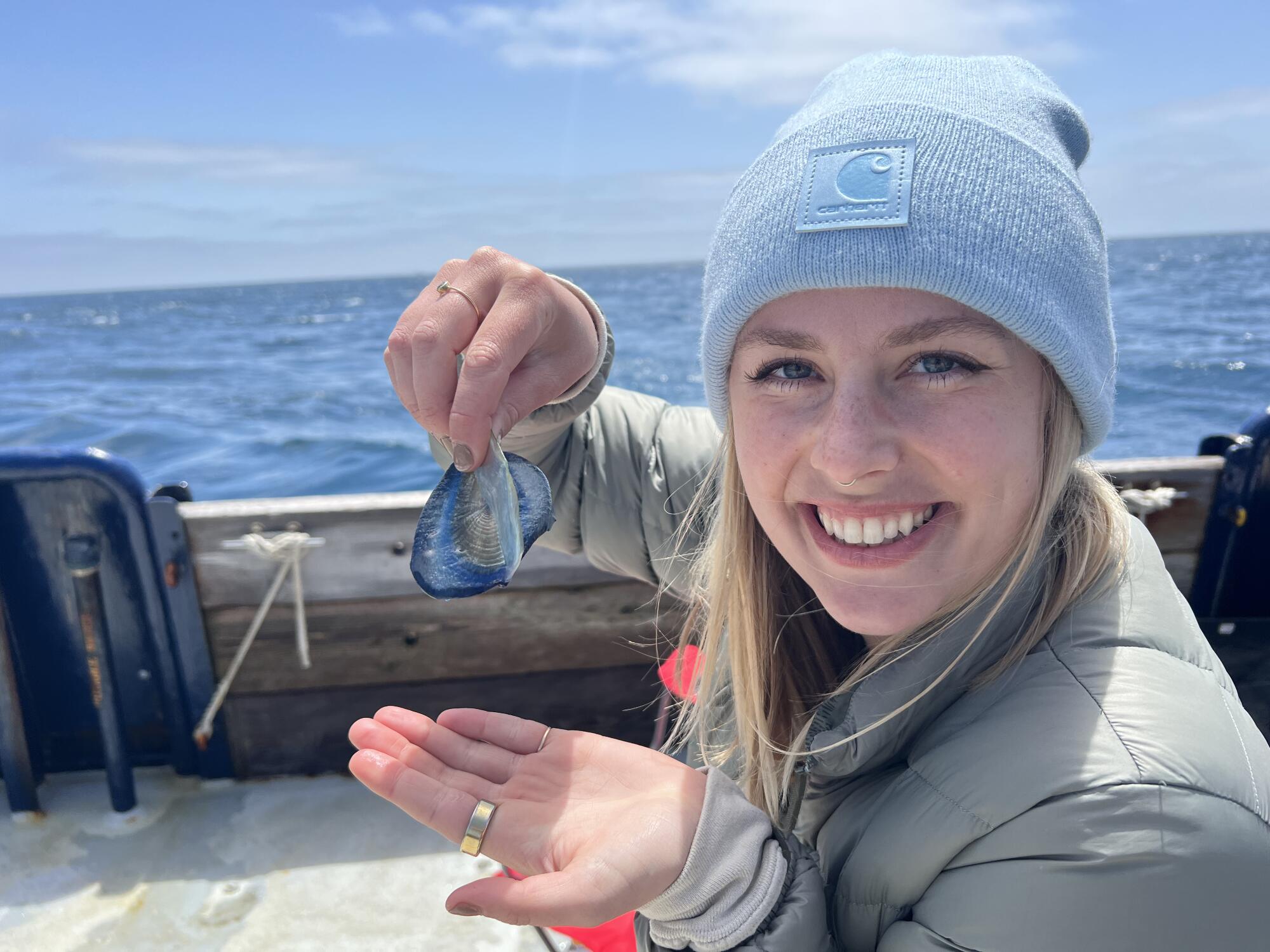
Anya Stajner, a PhD student at Scripps, collected by-the-wind sailors but was unable to keep them alive in a lab. “Rearing gelatinous organisms is pretty difficult,” she said.
“I was able to actually collect some of those medusae last year during the bloom, but rearing gelatinous organisms is pretty difficult,” Stajner said. The organisms died in the lab.
Stajner left May 1 on an eight-day expedition to sample velella at multiple points along the Santa Lucia Bank and Escarpment in the Channel Islands, with the goal of getting “a better idea of their role in the local ecosystem and trying to understand what these big blooms mean,” she said.


For the next five years, the Environmental Protection Agency has indicated it will not require public water utilities to test for microplastics or pharmaceuticals in drinking water, according to a proposed rule published in the Federal Register.
On Friday, the EPA submitted a list of chemicals it plans to test for under the Unregulated Contaminant Monitoring Rule, a mandatory testing program used to collect information about concerning chemicals in drinking water that could be harming human health. It did not include microplastics or pharmaceuticals.
The omissions come after announcements by EPA Administrator Lee Zeldin earlier this year that his agency was designating microplastics and pharmaceuticals priority contaminants for testing.
“This is a direct response to the concern of millions of Americans who have long demanded answers about what they and their families are drinking every day,” he said at an April news conference with Health and Human Secretary Robert F. Kennedy Jr. at EPA headquarters.
Zeldin’s announcement was seen at the time as a move to placate the increasingly disgruntled Make America Healthy Again contingent of Trump supporters.
Now the agency says it has no validated or standardized method to test for the plastic particles in drinking water, and wouldn’t be able to develop one before December, when testing is required to begin.
Among the 33 chemicals the EPA will require water utilities to test for are seven PFAS, or forever chemicals, and three pesticide residues.
It will be five years before the EPA proposes another list.
The EPA did not respond to a request for comment.
The agency noted in its proposed rule that it will collaborate with other federal agencies to “evaluate risks and exposures” of microplastics for future monitoring.
Environmentalists reacted with frustration and resignation. They pointed out that the European Union has developed methods to test for the tiny plastic particles, which have been found in people’s blood, brains and lung tissue. California has one in the works.
“The California water board has spent a lot of time and money on how to measure in drinking water,” said Judith Enck, a former EPA regional administrator and president of the anti-plastic environmental group Beyond Plastics. “EPA should give them a call.”
California was required by a 2018 state law to establish a protocol for local water utilities to test for the particles in drinking water. The state has not yet begun reporting its results, but protocols were established in 2021. Blair Robertson, a spokesman for the State Water Resources Control Board, said it’s not “a fully validated, end-to-end regulatory method” yet.
At the April meeting, Zeldin announced that he would place microplastics on what is known as the Contaminant Candidate List, which acts as a preliminary “watch list” of unregulated, priority contaminants in drinking water. Like the mandatory monitoring list, it is updated only every five years. The most recent list was published on April 2 — the day he made his announcement.
“Americans have been ignored as they sound the alarm about plastics in their drinking water,” Zeldin said during the announcement. “That ends today by placing microplastics on the contaminant candidate list for the first time ever. EPA will follow the science, will pursue answers and will hold ourselves to the highest standards to protect the health of Americans.”
There appears to be no clear association between these two lists, although the contaminant list is supposed to inform the monitoring list. Seventy-five chemicals and four chemical groups (microplastics, pharmaceuticals, PFAS chemicals, and disinfection byproducts) were listed on the 2026 contaminant list. Only seven of those chemicals were also on the proposed monitoring list (as well as seven PFAS chemicals).
When Zeldin announced microplastics as “‘a priority contaminant for regulation,’ and called it ‘a historic action on microplastics,’ he made it seem like the administration was going to take microplastics seriously,” said Mary Grant, water policy director for the environmental group Food & Water Watch.
“By not including them, they made it clear they don’t actually have plans to immediately address this crisis by getting the real-world monitoring data that we need right now to really start correcting ourselves,” she said.
Craig Davis, senior director of plastics chemistry at the American Chemistry Council — the nation’s largest trade group for chemical companies — said that while his organization supports microplastic research, it also agrees with the EPA’s decision not to include them in the monitoring list.
“National drinking water monitoring should be based on validated, standardized methods that can produce reliable and comparable data,” said Davis in a statement. He said “limited” national monitoring resources should be focused where data can produce “actionable public health information.”
The public has 60 days to comment once the plan is published in the Federal Register.

The number of Angelenos who went to the hospital with throat pain and concerns about smoke inhalation spiked as a fire burned through the massive Lineage cold storage warehouse in Boyle Heights this month, The Times has learned.
The blaze burned for eight days beginning June 17 and involved solar panels, insulation foam and other industrial materials.
During that time, more than three times as many people went to emergency departments within 10 miles of the warehouse mentioning the fire or smoke inhalation compared with the two weeks prior, according to data from the Los Angeles County Department of Public Health obtained through a public records request.
The agency also noted a near doubling of patients mentioning throat pain within five miles of the fire June 21 — 1.9 times the baseline levels.
Usually, fewer than 50 people go to the emergency room each day for throat pain, and fewer than 20 people for smoke inhalation, the department said.
The hospitalization data was tracked through the department’s syndromic surveillance project, which monitors trends in what people report when they come to emergency departments in L.A. County, as well as diagnosis codes noted by providers. The system is not as comprehensive as full patient health records, and clinicians may not always include key words about “fire,” “smoke” or other circumstantial information in their diagnoses, the public health department said.
As such, it “cannot capture the true number of [emergency department] visits related to symptoms from the fire and likely underestimates the true burden of fire related symptoms,” the department said.
Perhaps unexpectedly, the department said it did not note a substantial increase in asthma, acute respiratory symptoms or chronic obstructive pulmonary disease-related emergency department visits during the fire.
But even these preliminary findings are concerning, experts said. The fire is believed to have started on the solar array on the roof of the 500,000 square-foot building, which housed 85 million pounds of frozen food. It then reached an ammonia line, prompting two brief shelter-in-place orders for nearby residents.
Over the next week, the fire continued to burn through dense insulation foam within the building’s walls and other unknown industrial materials, blanketing much of L.A. in acrid smoke. Residents in downtown L.A., northeast L.A., Burbank, the San Gabriel Valley and many other parts of the city and county reported seeing and smelling the fumes.
The South Coast Air Quality Management District issued multiple warnings about unhealthy levels of PM 2.5, or fine particulate matter. The city and county opened two smoke respite shelters in the immediate area so that people could breath cleaner air.
It is still unclear what exactly was in the smoke that people breathed in. Industrial fires release far more materials than the burned wood smoke that is emitted during wildfires.
“The makeup of the smoke can include toxic chemicals, fine particles and other serious risks to lung health depending on fire conditions and what is burned,” Will Barrett, assistant vice president for nationwide clean air policy at the American Lung Assn., said as the fire was burning. Children and elderly people are particularly at risk.
David Eisenman, director of the UCLA Center for Public Health and Disasters, said urban industrial fires also can represent a hazard that standard PM 2.5 warnings don’t always address. Those advisories are “blunt instruments” that don’t adequately capture emissions from burning man-made goods — or convey that the source of pollution may include burning batteries or toxic refrigerants, he said.
The fact that initial numbers don’t show a spike in asthma attacks is “somewhat reassuring,” Eisenman said. But “people may have gone to their primary care doctors, which this would not capture. This data deserves follow up.”
The air district and the U.S. Environmental Protection Agency deployed air monitors to assess particulate matter, airborne toxic metals and other harmful compounds during the early days of the blaze. The air district said it didn’t find significant levels of air toxics during the first two days of the fire, although it did record significantly elevated concentrations of particulate matter within the plume downwind.
Some of the measurements it took with mobile monitors, which are five-minute snapshots, also showed increased bromine and chlorine, which often are found when buildings burn and were at levels “below short-term health-based exposure thresholds,” the air district said. It began continuous PM 2.5. monitoring at two nearby elementary schools on the third day.
The L.A. Fire Department said it detected low-levels of toxic hydrogen fluoride on the second day of the fire, which can be a byproduct of burning lithium-ion batteries.
Lineage, the tenant-operator of the warehouse, said no concentrations of ammonia were detected in the air at any time.
“There’s no doubt this fire has had a huge impact on the local community, and we are committed to showing up in every way we can,” company officials wrote in a statement last week. They said Lineage worked closely with the Fire Department during the blaze and delivered masks, air purifiers and other supplies to the community, and will work to ensure the fastest cleanup possible.
The long-term health effects of the fire and its smoke probably won’t be known unless researchers conduct a follow-up study, said Eisenman of UCLA.
For example, there may have been delayed pulmonary effects from the hydrogen fluoride and burning insulation foam that — when combined with the elevated PM 2.5 levels in a dense urban environment — produced health effects that didn’t show up in the emergency room data.
“They will show up in increased primary care office visits and exacerbations of chronic disease over the next few weeks,” he said. “So from a public health standpoint, this fire is not over.”

LOS ANGELES — All the water unleashed onto the warehouse fire in Boyle Heights — some of it 480 gallons at a time by helicopter — had to end up somewhere.
That somewhere is the Los Angeles River.
Los Angeles Fire Department crews ripped through 50-foot walls filled with foam insulation to get to the building’s steel skeleton and its storage racks.
Charred chunks of foam have been floating from the burn site, partially blocking storm drains. Now organizers from East Yard Communities for Environmental Justice are teaming up with scientists from UCLA and Columbia University to find out more about what’s in the runoff.
“The community here is really interested in knowing, ‘Are there any contaminants that are potentially making their way down to the L.A. River?’” said Yoshira “Yoshi” Ornelas Van Horne, UCLA assistant professor in environmental health sciences. “We really can’t answer that unless we actually have measures and samples analyzed.”
Water samples collected directly from the warehouse fire runoff have been shipped to Columbia‘s Multi-Element Trace Analysis Laboratory in New York, which has a spectrometer that can identify trace levels of elements. The lab also has relationships with researchers in Southern California.
2

1. Emmanuel Carrera Ruedas, left, and Casey Cooper prep containers to take water samples from the L.A. River. 2. Casey Cooper holds a water sample. (Christina House / Los Angeles Times)
The data will then come back to UCLA for analysis. For now, the scientists and community advocates only have the money to test for copper, lead and arsenic, Ornelas Van Horne said. Residents have expressed interest in testing for more contaminants.
As the water from the firefighting efforts trickles through the warehouse in rivulets, it forms a stream at the corner of S. Indiana and Noakes streets, that gushed into the storm drain. On a recent visit, the water traversed a smoky 10-foot canyon of charred foam and twisted wall panels on its way to the drain.
From there, the water flows to the L.A. River. Despite the fact that its concrete design is intended to whisk water out of the city as fast as possible, life stubbornly persists in the river and nearby. Recreational swimming is not permitted, yet anglers fishing for tilapia, largemouth bass and carp are a common sight along the rocky sides of the soft-bottom areas.
The L.A. River, and all it carries with it, meets the ocean in Long Beach.
The L.A. County Public Works Department said it has deployed three containment booms — floating barriers — on the L.A. River, and is continuing to monitor the water as it makes its way to the ocean.

Emmanuel Carrera Ruedas takes a water sample.
(Christina House / Los Angeles Times)
Before it gets there, the river passes through the Dominguez wetlands, where Public Works is removing some number of dead fish. The wetland has absorbed toxic runoff from a warehouse fire before, resulting in a fish die-off.
“For so long, the L.A. River has been used as a dumping ground for all kinds of chemicals,” said Emmanuel Carrera Ruedas, a community scientist and member of East Yard Communities for Environmental Justice.
Pollution has plagued the L.A. River, but it does have allies. In the 1980s, the Friends of the LA River pushed to address street runoff and trash that had made the water body infamous. Significant progress from advocacy and government initiatives improved water conditions, but these efforts have not been equally distributed.
Carrera said the samples represent “proof of what’s actually going on, and accountability, too, for the city, of not just what’s happening in our air, but what’s actually happening in our waterways.”
The first samples for the project were taken last Friday, the second day of the fire.
They were the first of 20 samples the research groups have agreed to test at no cost to see if any exceed regulatory standards and could pose a risk to people nearby.
The warehouse fire represents the latest environmental disaster for people in Boyle Heights and East L.A. Just four weeks ago, a telecommunications crew accidentally struck one of the many oil pipelines beneath the L.A. area, spilling 25,000 gallons of crude oil near Eastern and Cesar Chavez avenues — including into storm drains feeding to the L.A. River.
“I think it really is difficult to see disaster after disaster hit the communities here, with not a lot of talk about how we can move through these disasters together,” said Casey Cooper, a volunteer community scientist involved in the sampling. They were inspired, they said, by the response of neighbors, and how people were supporting one another.
Results from the laboratory analysis could be back to Ornelas Van Horne within a month.
-

 Movie Reviews4 minutes ago
‘Supergirl’ Movie Review
-

 World12 minutes ago
Map: 6.0-Magnitude Earthquake Shakes Off Mexico’s Coast
-

 News19 minutes ago
In the United States, Every World Cup Team Is a Home Team
-
 Lifestyle57 minutes ago
How does the Kennedy Center board make decisions? This legal filing sheds some light
-

 Technology1 hour ago
Meta is adding ridiculous ‘rate limits’ and a soft paywall to its smart glasses
-

 World1 hour ago
Boy, 2, pulled alive from rubble six days after Venezuela’s devastating twin earthquakes
-

 Politics1 hour ago
Socialism goes west as DSA-backed challenger ousts longtime Democrat
-

 Health1 hour ago
Americans are giving up multivitamins for a different daily health habit, study finds

