West
San Diego wildfires force mandatory evacuations amid dangerous wind conditions

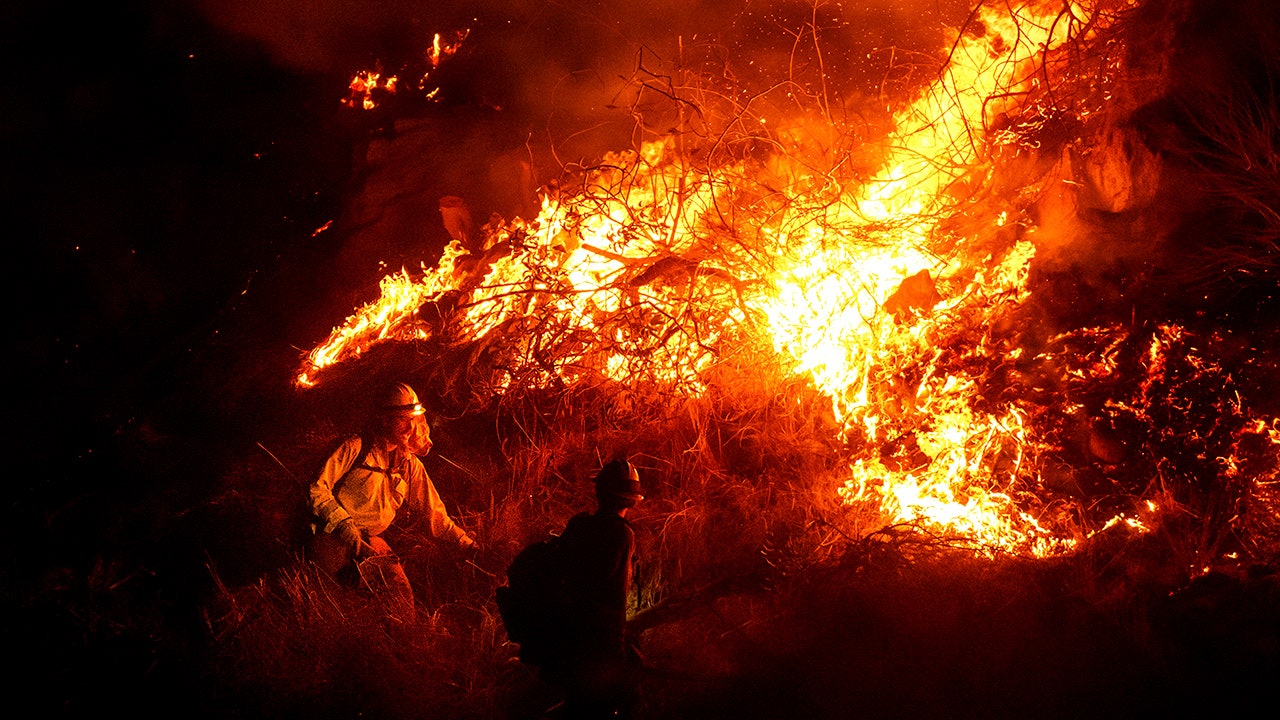
Mandatory evacuations are expanding in Southern California early Tuesday as two wildfires are burning in San Diego County, with powerful Santa Ana wind gusts creating “dangerous fire conditions,” officials say.
Both the Lilac Fire and Pala Fire, which started early this morning near Bonsall and Pala Mesa, respectively, are threatening homes and businesses, according to Cal Fire.
“Mandatory evacuation orders are in place, and I cannot stress enough the importance of evacuating immediately and listening to first responders,” San Diego County District 5 Supervisor Jim Desmond wrote on X.
“Santa Ana winds are creating dangerous fire conditions — please do not wait to leave if you are in an evacuation zone,” he added.
LOS ANGELES WATER CHIEF GIVEN POLICE SECURITY DETAIL FOLLOWING ‘THREATS’ AGAINST HER, EMPLOYEES
Firefighters battle the Lilac Fire along Interstate 15 near the Bonsall community of San Diego County, Calif., on Tuesday, Jan. 21. (AP/Noah Berger)
As of Tuesday morning, the Lilac Fire “has consumed 80 acres with 10% containment, 86 residents are displaced and two structures have been damaged,” the North County Fire Protection District said. “There are over 200 firefighters assigned to the incident.”
“Firefighters are making good progress on the fire. The fire activity has decreased significantly,” Cal Fire added.
The Pala Fire has consumed about 30 acres and has a “slow rate of spread,” the agency added.
Evacuation orders have been issued for communities in proximity to the Lilac Fire.
“Be prepared to evacuate should conditions change. If you feel you are in danger, GO!” the San Diego County Sheriff’s Office warned on X.
‘MILLION DOLLAR LISTING’ STAR SAYS UP TO 70% OF PALISADES RESIDENTS WILL NOT RETURN AFTER DEVASTATING LA FIRES
Vehicles pass through smoke from the Lilac Fire in Bonsall, Calif., on Tuesday. (AP/Jae C. Hong)
The causes of both fires remain under investigation.
FOX Weather Meteorologist Craig Herrera said “Right now, critical (fire weather) extends all the way down into San Diego County, and elevated (fire weather) goes into the high deserts.”
Firefighters walk up a ridge to battle the Lilac Fire. (AP/Jae C. Hong)
The National Weather Service said a top wind gust of 102 mph was recorded as of early this morning in San Diego County.
A firefighter pulls a hose while trying to keep the Lilac Fire from spreading near the Bonsall community of San Diego County, Calif., on Tuesday. (AP/Noah Berger)
The region has been placed under a High Wind Warning until later this afternoon and a Red Flag Warning until tomorrow night.
Read the full article from Here



The Arizona Republic. Here for it. Are you?
You can play a vital role in supporting local journalism that you and your community can trust. Subscribe today.
Arizona Republic
Flags were lowered in Arizona on Tuesday, June 30, in honor of the 19 Granite Mountain Hotshots who died fighting the Yarnell Hill Fire in 2013.
Gov. Katie Hobbs ordered flags be flown at half-staff from sunrise through sunset on Tuesday to honor them on the 13th anniversary of their death.
Sparked by a lighting strike, the Yarnell fire became nationally known as an emblem of tragedy. The crew, which was part of a unique municipal-level firefighting effort, was encircled by flames reaching 2,000 degrees with no way out. All but one of them died.
The blaze was the deadliest for U.S. firefighters since 1933 and the greatest loss of U.S. firefighter life since the Sept. 11, 2001 terrorist attacks.
“Hotshot crews take on dangerous and difficult firefighting to keep Arizona communities safe,” Hobbs wrote in her a statement. “We recognize and honor the sacrifice and bravery of the Granite Mountain Hotshots. This will always be a day we mark with mourning, reflection, and deep admiration for the members of this crew, their families, and the wildland firefighting community.”
Here’s when flags are traditionally lowered in the United States and the difference between half-mast and half-staff.
What is the difference between half-mast and half-staff?
The terms “half-mast” and “half-staff” both refer to lowering a flag to honor or mourn someone, but they are used in different settings.
“Half-mast” traditionally refers to flags flown on ships or at naval stations, while “half-staff” is used for flags flown on land. In the United States, “half-staff” is the term most commonly used for government buildings and public flag displays.
When are flags flown at half-staff in the US?
In the United States, flags are lowered to half-staff on certain national observances and following the deaths of notable public officials.
According to the Arizona state website, the U.S. flag is flown at half-staff on these days:
- Memorial Day, when the flag should be displayed at half-staff until noon only, then raised to the top of the staff.
- Peace Officers Memorial Day, unless that day is also Armed Forces Day.
- Patriot Day.
- National Pearl Harbor Remembrance Day.
- National Firefighters Memorial Day.
The president of the United States may also order flags to be flown at half-staff after the death of a notable public figure. In those cases, the length of time depends on the person’s role:
- 30 days from the death of the president or a former president.
- 10 days from the day of death of the vice president, the chief justice or a retired chief justice of the United States, or the speaker of the House of Representatives.
- From the day of death until the interment of an associate justice of the Supreme Court, a secretary of an executive or military department, a former vice president or the governor of a state.
- The day of death and the following day for a member of Congress.
The governor may also order flags lowered to half-staff after the death of notable current or former government officials or members of the armed forces who die while on active duty.
In Arizona, the governor can also require that the state flag be lowered at all state, institutional and educational buildings. The law also allows the state flag to be lowered on the death of an incumbent elected state officer for seven days beginning on the day following the death of the officer.
Arizona Republic reporter Laura Gersony contributed to this article.

WASHINGTON (TNND) — Residents in a neighborhood in Southern California said that their homeowners association has threatened to fine them if they don’t take down the American flags displayed outside their homes.
Amy and Chris Cooke and their neighbor Terri Collins live in San Marcos, which is located in San Diego County.
They said that they could potentially face a $100 fine if they keep the flags displayed outside their homes, according to the Daily Wire.
“I’m not taking my flag down,” Collins said. “They can fine me, $100, $200, $1,000, I’m not paying it.”
Collins said that the neighborhood is very patriotic because it is located close to the former Miramar Navy Air Station.
She said that “all the Top Gun pilots lived here.”
The neighbors said that ever since President Donald Trump won the 2024 election, the HOA has enforced the rule about flags.
“Once the members allow use of a common property by an owner to express what is essentially a political or affiliative view in a flag, other owners will want to do the same and the common area will degrade,” a letter from the HOA reads.
Homeowners were told that flags displayed in “exclusive use” areas like backyards.
An HOA attorney told the Daily Wire HOAs “count on the fact that homeowners don’t know better and might be scared.”
BE THE FIRST TO COMMENT
“I would tell these people to stand firm and under no circumstances should they remove that flag,” he told the outlet.

From towering red-rock formations and wildflower-filled meadows to waterfall hikes and rugged mountain scenery, the best Colorado state parks showcase the state’s geographic diversity.
Colorado’s national parks often get the spotlight, but many of Colorado’s top state parks are vying for attention, too, and offer just as memorable outdoor adventures, often with fewer crowds. Across the state’s 43 parks, visitors can hike or bike scenic trails, paddle lakes, spot moose and elk, rock climb world-class routes and camp beneath star-filled skies. Whether you’re planning a quick day trip to a park from Denver or a multi-day road trip to see multiple sites, Colorado’s state parks offer something for every type of outdoor traveler.
Colorado’s Top State Parks
Colorado is a top state for parks because of outdoor engagement. Many host programming, including guided wildflower hikes, yoga classes, wildlife talks and stargazing events. The state park system also showcases the beauty of Colorado, introducing travelers to lesser-known canyons, grasslands, reservoirs, rivers and prairies that often get overshadowed by the state’s famous mountain destinations.
Colorado’s largest state park is State Forest State Park, which encompasses 71,000 acres of rugged mountains, alpine lakes, wildflower-filled meadows and dense forests in the northern part of the state near the Wyoming border. Nicknamed the “Moose Viewing Capital of Colorado,” the park is home to an estimated 600 moose, making wildlife watching one of its most enticing draws. Meanwhile, the smallest park is Rifle Falls, which is just 48 acres and is the closest thing you’ll get to the tropics in this landlocked state. The park’s main draw is a triple waterfall, with the falls each cascading 60 feet.
For this list, parks were selected based on scenic value, recreation opportunities, accessibility, my experience as a long-time parks pass holder, uniqueness and their ability to appeal to different types of travelers.
1. Golden Gate State Park
A scenic landscape in Golden Gate Canyon State Park near Golden, Colorado.
Getty
Thirty miles west of Denver, Golden Gate Canyon State Park offers travelers an easy mountain escape without a long drive. Spanning more than 12,000 acres of forests, meadows and rocky peaks, the park is best known for its Panorama Point Scenic Overlook, where visitors can see the Continental Divide.
Established in 1960, the park offers more than 35 miles of hiking trails, including routes that wind through aspen groves, wildflower-filled meadows and dense pine forests.
Summer and fall are especially popular, with colorful wildflowers and autumn turns the Aspens a brilliant gold, drawing visitors and showing off why the state is nicknamed “Colorful Colorado.” Winter brings opportunities for snowshoeing, cross-country skiing, and sledding and hunting for the perfect Christmas tree.
The park’s proximity to Denver makes it ideal for day-trippers, while cabins, yurts, campgrounds, and backcountry campsites invite longer stays. Nearby, visitors can explore the historic mountain towns of Black Hawk, a casino destination, or check out Golden, which has shops, restaurants, Coors Brewery tours, and kayaking at the Clear Creek Whitewater Park. This is my go-to park that I take out-of-town friends and family members to because it gives them a nice snapshot of Colorado’s scenery, and we can take a quick day hike, ending in downtown Golden with happy hour or an early dinner.
2. State Forest State Park
Located northwest of Fort Collins near Walden and close to the Wyoming border, State Forest State Park is Colorado’s largest state park, spanning more than 70,000 acres. Nicknamed the “Moose Viewing Capital of Colorado,” it’s one of the best places in the state to spot wildlife, with an estimated 600 moose calling the area home.
Established in 1938 through a land exchange between the state of Colorado and the U.S. Forest Service, the park remains a haven for outdoor enthusiasts seeking wide-open spaces and fewer crowds. Visitors can hike to alpine lakes, drive scenic mountain roads, fish, camp, horseback ride and watch for moose, elk, black bears, river otters and bald eagles.
Summer and early fall are ideal for hiking and wildlife viewing, while winter brings snowmobiling, snowshoeing and cross-country skiing. Campgrounds, cabins, yurts, and nearby lodging in Walden make it easy to extend a stay. The park also pairs well with a trip to nearby Rocky Mountain National Park, offering a quieter and more remote complement to one of Colorado’s most visited destinations.
3. Ridgway State Park
Sunset on the Uncompahgre River at Ridgway State Park, Colorado with the snow capped San Juan Mountains.
Getty
Travelers looking to combine lake recreation with mountain adventures will find plenty to love here. In southwestern Colorado, Ridgway State Park pairs the dramatic peaks of the San Juan Mountains with one of the state’s top recreation reservoirs. Opened to the public in 1989, the park is known for boating, paddling, fishing and camping.
Centered around Ridgway Reservoir, the park offers swimming, paddleboarding, sailing, water skiing and excellent fishing for trout. Or, fly fish along the Uncompahgre River in the fall for a chance to catch Kokanee Salmon.
More than 14 miles of trails wind through the park, while wildlife watchers may spot elk, deer, foxes, osprey, bald eagles and other bird species. Summer is the busiest season, but the park serves as a year-round base camp for exploring nearby Ouray (15 miles away), famous for its hot springs, ice climbing and via ferrata routes and nicknamed “Switzerland of America.” Park visitors can camp in tent and RV sites, stay in one of the park’s heated yurts or book a hotel in Ouray.
4. Chatfield State Park
One of Colorado’s most popular state parks, Chatfield State Park sits just 20 miles south of Denver, where a sprawling reservoir draws boaters, water skiers, paddlers and anglers. Its easy access and wide range of outdoor activities make it a favorite escape for both locals and visitors seeking nature close to the city.
Established in 1975, the park sits where the South Platte River emerges from the foothills at the mouth of Waterton Canyon. The U.S. Army Corps of Engineers built the dam after a flood 10 years earlier. Today, the mix of prairie, wetlands and reservoir habitat makes Chatfield a standout for wildlife viewing and birdwatching, with more than 345 documented bird species, including bald eagles, American white pelicans and burrowing owls. Visitors can enjoy 26 miles of hiking, biking and horseback riding trails, and a large off-leash dog park, boat rentals, a marina and campgrounds.
With a sandy beach, Chatfield is a popular spot to cool down in the warmer months. Summer is by far the busiest season for water recreation, with paddleboarding available at both the reservoir and a nearby “Gravel Pond,” which is my favorite spot in the park. I love bringing my dog here, putting a life jacket on him, and renting a dog-friendly paddleboard that he can captain. I suggest going on a weekday summer evenings when the crowds thin out.
5. Roxborough State Park
Sunset at Roxborough State Park in Colorado.
Getty
Roxborough State Park is best known for its towering red-rock formations that rival those at nearby Red Rocks Amphitheatre. Its dramatic sandstone fins, abundant wildlife and scenic trail network make it one of Colorado’s premier day-trip destinations for hikers, birdwatchers and photographers.
Established as a state park in 1975, Roxborough protects nearly 4,000 acres where the Great Plains meet the foothills of the Rocky Mountains. That unique landscape supports a rich diversity of plant and animal life, including mule deer, foxes and more than 140 bird species.
Hiking is the main draw, with trails ranging from easy nature walks to the 6.2-mile round-trip climb to Carpenter Peak, which rewards visitors with sweeping Front Range views. Spring brings vibrant wildflowers, while fall offers crisp temperatures and golden grasslands that beautifully complement the park’s red-rock scenery.
To protect its fragile ecosystem, Roxborough limits recreation more than many Colorado parks. Pets are not allowed on trails, rock climbing is prohibited and bicycles are restricted to designated routes. The result is a remarkably peaceful natural setting that feels far removed from the city, despite being less than an hour from downtown Denver.
6. Eldorado Canyon State Park
Eldorado Canyon State Park is best known for its world-class rock climbing, with more than 500 routes scaling the park’s steep sandstone walls. Just nine miles south of Boulder (the new home of the Sundance Film Festival) the dramatic canyon also attracts hikers, photographers and wildlife watchers drawn to its towering cliffs and scenic beauty.
The state park is in the same area as one of my favorite swimming spots in Colorado: The historic Eldorado Springs Pool. If you’re visiting between Memorial Day and Labor Day, I recommend an afternoon at the pool after a morning in the park. The swimming destination, which first opened in 1905, is spring-fed and has gorgeous mountain views.
Established as a state park in 1978, Eldorado Canyon protects a landscape shaped by more than 1.6 billion years of geologic history. While climbers come from around the world to tackle iconic formations like the Bastille, Wind Tower and Whale’s Tail, the park’s 17 miles of trails offer plenty for non-climbers, too. Visitors can hike among soaring sandstone cliffs, fish in South Boulder Creek, spot mule deer and golden eagles or enjoy a picnic beside the water. Summer is the busiest season, particularly on weekends, while spring and fall bring pleasant temperatures for hiking and climbing.
Because of its popularity and limited capacity, timed-entry reservations are required on weekends and select holidays from May through September. The park is day-use only, but if you’re looking to camp you could do so in metro area parks such as Golden Gate Canyon State Park or St. Vrain State Park.
Tips For Visiting Colorado And Its State Parks
Ready to visit a state park in Colorado? Plan ahead for reservations, be ready for the state’s high altitude and changing weather, and follow Leave No Trace principles to help protect Colorado’s landscapes for future visitors.
Here are some tips for making the most of your visit:
1. Give yourself time to adjust to the altitude: Many visitors arrive from lower elevations and are surprised by how quickly Colorado’s high altitude can affect them. To adjust to the altitude, drink plenty of water, take it easy on your first day and limit alcohol.
2. Pack for changing weather: It’s not uncommon to experience sunshine, wind, rain and even snow (well into late spring!) on the same day, especially in the mountains. Layers are a good idea year round.
3. Reserve campsites early: Popular parks such as Chatfield, Ridgway and Golden Gate Canyon can book up far in advance during the busy summer and fall months. Colorado’s state parks let you book campsites up to six months in advance.
4. Pack your sunscreen: Colorado’s high elevation means stronger UV exposure. Sunscreen and sunglasses are must-haves when you’re venturing into the parks. Consider a wide-brimmed hat, too.
5. Respect wildlife: Watch animals from a safe distance, and never feed or touch them. Here’s some more tips for what you should do if you encounter wildlife while in the parks.
6. Stay on designated trails: Many parks protect fragile ecosystems and remaining on designated trails helps preserve the landscape.
7. Check conditions before you go. Weather, wildfire activity, seasonal road closures and trail conditions can prompt closures or affect your travel plans.
8. Consider a state park pass. If you’re planning to visit multiple parks, an annual park pass can save money on entrance fees.
9. Pair parks with nearby destinations: Many state parks are close to mountain towns, hot springs, scenic byways and national parks, making them easy additions to a larger Colorado road trip.
10. Know the pet rules: Policies vary by park. While many parks welcome dogs on trails others like Roxborough prohibit them to protect sensitive wildlife habitat.
Whether you’re looking for a wildflower-filled hike, a red-rock adventure, world-class rock climbing, a chance to spot wildlife or a reservoir packed with water sports, Colorado’s state parks offer an impressive variety of outdoor experiences. Better yet, they often deliver the same scenery and recreation as national parks, but with fewer crowds.
Frequently Asked Questions (FAQs)
-

 Arizona6 minutes ago
Flags are at half-staff today in Arizona. Here’s who is being honored
-

 Arkansas10 minutes ago
What Is The Arkansas Razorbacks Toughest Stretch of the 2026 Season?
-

 California15 minutes ago
Southern California residents say HOA made them take down American flags
-

 Colorado22 minutes ago
Colorado’s Most Beautiful State Parks, Ranked By A Colorado Local
-

 Connecticut25 minutes ago
CT poised to invest again in childcare, pay down pension debt
-

 Delaware30 minutes ago
Delaware on Main Street Program Grows as 17 Communities Earn National Designations – State of Delaware News
-

 Florida37 minutes ago
Fast-growing South Florida wildfire consumes over 4,000 acres
-

 Georgia40 minutes ago
Aleks Arwood named runner-up at Miss Georgia – Thomasville Times-Enterprise

