San Diego, CA
Debate over how to use money awarded to San Diego region for migrant services


SAN DIEGO (KGTV) — There is a debate about how to spend federal funds from FEMA, awarded to San Diego County, which was meant to provide humanitarian services to migrants once they were released from custody.
According to organizations that help asylum seekers, 23,000 people have been released on San Diego streets in the last month alone.
The San Diego region received more than 39 million dollars in funding, with about $19.5 million going directly to the County and the other half to Catholic Charities. The combined total is four million dollars more than the region received last year.
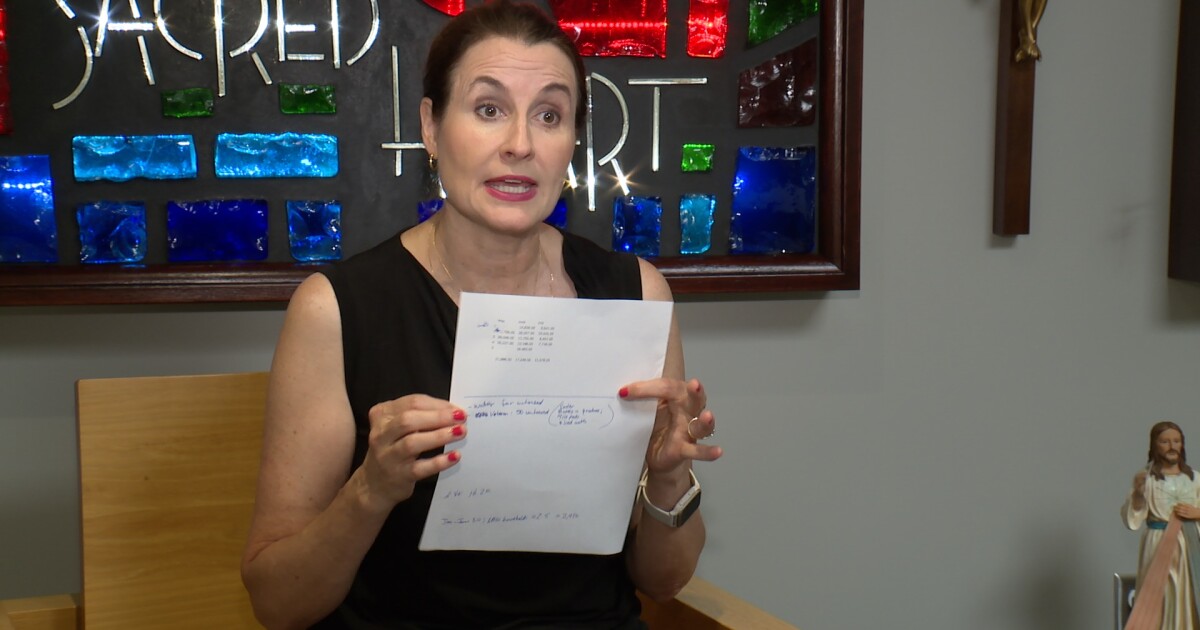
“Which is really a lifeline from the federal government, now importantly the county of San Diego is a new recipient,” Kate Clark, the Senior Director of Immigration Services at Jewish Family Service of San Diego, said.
The organizations who work with the migrants directly, like Jewish Family Service, say they have ideas on how that money can be distributed. The County has until Friday at noon to present its plan to spend the funds to FEMA, but the organizations say they’ve heard nothing about a plan and they want a seat at the table.
“Our concern is that really the plan that is submitted is not going to be reflective of the work that’s being done on the ground,” Clark said.
The County t



The Padres have a serious issue in their starting rotation.
That reality brazenly slapped them in the face again Tuesday.
And then it became a side story, at least for the night.
That is how crazy things got at Petco Park.
The Padres beat the Braves 7-6 when Mason Miller worked two scoreless innings and Manny Machado grounded a walk-off single up the middle to score Jackson Merrill in the 10th inning.
“I think the most important part is just how the team fought today,” Machado said. “I think that was impressive, being down four and then coming back and winning that ball game and fighting to the end. I think that shows a lot about the team. We picked up each other. We picked Griff. Bullpen came in and did their job too.”
The game was decided eight innings after the Braves took a 4-0 lead and the Padres took a 5-4 lead.
That is correct. The craziness commenced when for the second time in five games the Padres were part of a runaway inning.
They were on the wrong side of an 11-run inning Friday in Texas when the Rangers responded with six runs in the bottom of the first inning after the Padres scored five at the start of what ended up a 9-7 loss.
On Tuesday, the Padres came out on top of a nine-run second inning.
Griffin Canning jogged in from the bullpen to start that inning after Wandy Peralta worked a scoreless first as the Padres’ opener.
Canning would get just two outs, allow four hits, hit a batter, walk another and allow three runs before he departed.
His 40th pitch completed a walk that loaded the bases. That drew more than a few boos from the seats and brought Craig Stammen from the dugout.
The game didn’t really get wild until a little bit after that.
Kyle Hart walked the next batter to make it 4-0 before ending the top of the second on a groundout.
That is how the bottom of the second began for the Padres as well.
And then six consecutive batters reached base, and they scored five runs against Braves starter JR Ritchie.
The comeback began with walks by Xander Bogaerts and Will Wagner before singles by Rodolfo Durán and Sung-Mun Song cut the Braves’ lead in half and a double by Fernando Tatis Jr. got the Padres to 4-3 and got Song to third base.
An infield single by Samad Taylor flipped the lead.
Song easily scored on Taylor’s grounder up the middle, and when Braves shortstop Mauricio Dubón bounced a throw that got past first baseman Matt Olson, Tatis raced around third and beat a throw home by Olson.
The Braves tied the game 5-5 in the fourth and retook the lead in the fifth.
Michael Harris II singled, went to second on a wild pitch by Hart and scored on Ozzie Albies’ double in the fourth. Dubón homered in the fifth off Yuki Matsui, who had come in to get the final out of the fourth and ended up working through the sixth, leaving the bases loaded in that inning.
Jackson Merrill missed a game-tying home run by a foot and instead got a double leading off the fifth inning when his fly ball to right field hit the top of the wall and bounced back to right fielder Mike Yastrzemski.
Merrill finished the inning at second after a fly ball out by Machado and strikeouts by Gavin Sheets and Bogaerts.
Tatis did not miss a home run as the first batter in the seventh, sending a sinker from Carlos Carrasco 406 feet to center field to tie the game 6-6.
David Morgan worked the seventh and Adrian Morejón the eighth before Miller threw just 11 pitches in the ninth and went back out for the 10th.
“One, we didn’t have a ton of bullpen left,” Stammen said of the decision to have Miller work a second inning . “And he’d been kind of asking me over the course of the season: ‘Hey, I got another one, come on, let me have it.’”
Austin Riley began the 10th by hitting a long fly ball to right field that moved the automatic runner from second to third before Miller struck out Rowdy Tellez and ended the inning by getting a groundout from Eli White.
“It definitely goes a long way,” Miller said, “when you empty everybody out early and you have another game tomorrow, being able to carry two innings there and keep two guys fresh for tomorrow and give us a chance to win again tomorrow as well.”
Merrill was the runner on second to start the bottom of the 10th after he made the final out in the ninth. Machado walked to the plate against Raisel Iglesias, the Braves closer, who had also worked the ninth.
“Looking for a strike,” Machado said. “He’s a strike thrower, one of the best in the game right now. So just trying to be aggressive on that first pitch, something I can drive. Don’t really need much, just just a base hit to score Jackson. So just trying to hit it hard somewhere.”
No matter the result, the Padres are left to figure out what to do about Canning, whose ERA swelled to 7.38 after he yielded his ninth multi-run inning among the 45 innings he has begun for the Padres this season.
He is but one of the flat tires on the rotation bus.
The Padres got seven shutout innings from Michael King in a 1-0 victory over the Braves on Monday. It was the first time a Padres starter went seven innings since King did it on May 18 and just the third quality start by a Padres pitcher in 24 games.
The members of the starting rotation, including the two times Canning has worked after an opener and the two times Lucas Giolito has done so, have a combined 4.76 ERA over the past 25 games.
But the Padres figured out how to win Tuesday, just the second time in a month they have won consecutive games.
“Griffin didn’t have his stuff like he wanted to,” said Taylor, who finished 3-for-4 with a walk. “But we fought. We’re going to keep fighting until the game is over. We fought. Got back in the game. Good at-bats, good pitching. And you leave it into Manny’s hands, he’s going to take over and win the game for us.”

SAN DIEGO (CNS) – San Diego Unified School District leaders Tuesday announced an effort to better integrate technology in classrooms and reduce excessive media consumption, to be voted upon by the school board Tuesday evening.
If the Board of Education approves the proposed resolution at Tuesday evening’s meeting, the first changes would go into effect on Aug. 10, the first day of the 2026-27 school year.
The proposed changes include:
— Prohibiting video-streaming platform use such as YouTube on individual devices;
— Prohibiting non-instructional gaming platform use on individual devices; and
— Removing computer carts from Transitional Kindergarten classrooms, while still allowing for access to devices for students with needed accommodations.
“Technology has expanded educational opportunities for students in ways we could not have imagined a generation ago,” Board President Richard Barrera said. “But our responsibility is to ensure technology serves students – – not the other way around. This resolution takes thoughtful, research-based steps to reduce passive screen time and create more opportunities for students to engage with their teachers, collaborate with their peers, and develop the communication, problem-solving, and critical-thinking skills that will serve them throughout their lives.”
Other facets of the proposal, which would be phased in over the course of the next year, include:
— Developing age-appropriate device usage guidance;
— Limiting screen time outside established time frames;
— Expanding family resources and parent controls;
— Strengthening digital citizenship instruction;
— Reviewing instructional software annually; and
— Continuing evaluations of emerging technologies such as artificial intelligence.
District leaders said that while technology remains an important learning tool, excessive screen time and passive digital media consumption can “negatively impact attention, academic performance, sleep, social-emotional development, and overall student well-being.”
The impetus of the resolution is not to remove technology from classrooms, its proponents say, but to instead support diverse learning needs while “creating more opportunities for meaningful human interaction, student engagement, creativity, collaboration, and critical thinking.”
“One of the strengths of this resolution is that it recognizes these decisions should not be made in isolation,” Board Trustee Shana Hazan said. “Families, educators and community partners have helped elevate this conversation, and their voices will continue to guide this work. Technology remains an important educational tool, but it should never replace the relationships, creativity, collaboration, and human connection that are at the heart of a great education.
“This resolution creates a framework for bringing diverse perspectives together to determine what is best for students at every stage of their development,” Hazan added.
District leaders say if the resolution passes, staff will work with advisory groups such as the Community Advisory Committee, District Advisory Council and District English Learner Advisory Committee to further refine ideas.

Here’s who is playing in the 2026 men’s World Cup on Tuesday, June 23.
MORE: 2026 men’s World Cup standings, scores, brackets
World Cup TV Schedule June 23
Group Stage
Group K: Portugal vs. Uzbekistan, 1 p.m. ET, 10 a.m. PT, Houston Stadium (FOX, Telemundo, Peacock)
Group L: England vs. Ghana, 4 p.m. ET, 1 p.m. PT, Boston Stadium (FOX, Telemundo, Peacock)
Group L: Panama vs. Croatia, 7 p.m. ET, 4 p.m. PT, Toronto Stadium (FOX, Telemundo, Peacock)
Group K: Colombia vs. Congo DR, 10 p.m. ET, 7 p.m. PT, Estadio Guadalajara (FS1, Telemundo, Peacock)
Note: Matches on Telemundo and Peacock are in Spanish.
-

 Dallas, TX23 seconds ago
Reports: Mavericks acquire Sergio De Larrea in four-team Draft night trade
-

 Miami, FL7 minutes ago
Miami Gardens police make arrest in cold case murder from 2019
-

 Boston, MA10 minutes ago
Woman killed in Mattapan carjacking crash honored at vigil
-

 Denver, CO15 minutes ago
Nuggets trade 26th pick in NBA Draft to Spurs, moving out of first round
-

 Seattle, WA22 minutes ago
NBA Commissioner says Las Vegas, Seattle remain expansion targets for 2028-29 season
-

 San Diego, CA25 minutes ago
Padres cap wild game against Braves with extra-innings win
-

 Milwaukee, WI30 minutes ago
Bucks draft Burries, Ament after Giannis trade: 'We're building'
-

 Atlanta, GA37 minutes ago
Sports with Sam: Hawks draft Kingston Flemmings & Zuby Ejiofor

