West
Oakland elementary school garden, funded by Stephen and Ayesha Curry, vandalized

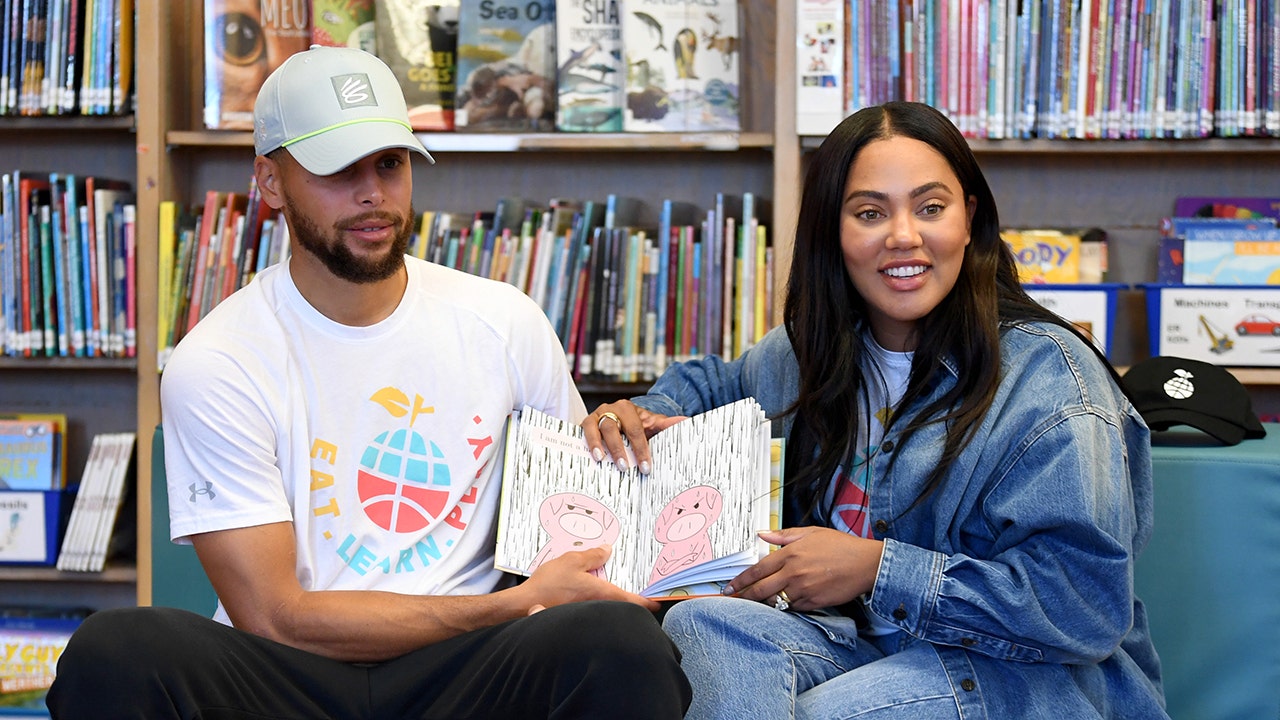
A garden at an elementary school that was funded by Stephen and Ayesha Curry was found vandalized earlier this week.
Staff at Global Family Elementary School in Oakland discovered the garden was destroyed on Monday.
The irrigation system had been ripped out, wooden benches were broken, and planters were torn apart, among other damages.
Stephen Curry and Ayesha Curry attend the launch of Stephen & Ayesha Curry’s Eat. Learn. Play. New Movement while visiting Lockwood STEAM Academy on Sept. 6, 2023 in Oakland, California. (Noah Graham/Getty Images for Eat. Learn. Play.)
“It’s going to take a lot of time, effort, and resources to repair the school’s garden and return it to its previous pristine condition,” the Oakland Unified School District said in news release Tuesday. “It’s unfortunate that anyone would think that causing this kind of damage anywhere would be fun, funny, or a good idea. It only served to hurt the students and staff at the school.”
The Currys’ Eat. Learn. Play. Foundation helped make the garden during the 2022-23 school year. The foundation was founded in 2019.
“When we launched Eat. Learn. Play. in 2019, we saw the tremendous need that existed in our adopted hometown of Oakland and set out to use our platform and resources to work to unlock the full potential of the kids in our community,” the husband and wife say on the foundation’s site.
School was not in session, so students did not see the garden get destroyed.
Stephen Curry and Ayesha Curry attend the world premiere of Universal Pictures’ “NOPE” at TCL Chinese Theatre on July 18, 2022 in Hollywood, California. (JC Olivera/Getty Images)
CELTICS STAR JAYSON TATUM TAKES SHOT AT CRITICS AFTER NBA FINALS VICTORY: ‘WHAT THEY GONNA SAY NOW?’
The school is less than three miles away from Oracle Arena, the former home of Curry’s Golden State Warriors. The organization has since moved across the bay to San Francisco at the Chase Center.
The Currys welcomed their fourth child, and second son, last month. Caius Chai Curry was born on May 11, one day before Mother’s Day.
Their first daughter, Riley, was born in 2012, and they welcomed a second daughter, Ryan, three years later. In 2018, their first son, Canon, was born.
The four-time NBA champ and Ayesha got married in 2011, having known each other since the two were teenagers. They met at their church while growing up in Charlotte, North Carolina, while Stephen’s father, Dell, played for the Hornets.
Ayesha Curry and Stephen Curry attend the launch of Stephen & Ayesha Curry’s Eat. Learn. Play. New Movement while visiting Lockwood STEAM Academy on Sept. 6, 2023 in Oakland, California. (Noah Graham/Getty Images for Eat. Learn. Play.)
Curry’s Warriors missed the playoffs this season after getting eliminated in the play-in tournament. They won the NBA title in 2022, which was Curry’s fourth.
Follow Fox News Digital’s sports coverage on X, and subscribe to the Fox News Sports Huddle newsletter.
Read the full article from Here

The Montana Lottery offers multiple draw games for those aiming to win big. Here’s a look at Jan. 10, 2026, results for each game:
Winning Powerball numbers from Jan. 10 drawing
05-19-21-28-64, Powerball: 14, Power Play: 3
Check Powerball payouts and previous drawings here.
Winning Lucky For Life numbers from Jan. 10 drawing
17-24-36-38-43, Lucky Ball: 17
Check Lucky For Life payouts and previous drawings here.
Winning Lotto America numbers from Jan. 10 drawing
06-15-20-22-25, Star Ball: 10, ASB: 02
Check Lotto America payouts and previous drawings here.
Winning Big Sky Bonus numbers from Jan. 10 drawing
03-07-20-23, Bonus: 13
Check Big Sky Bonus payouts and previous drawings here.
Winning Powerball Double Play numbers from Jan. 10 drawing
10-19-39-47-67, Powerball: 18
Check Powerball Double Play payouts and previous drawings here.
Winning Montana Cash numbers from Jan. 10 drawing
06-12-17-18-25
Check Montana Cash payouts and previous drawings here.
Feeling lucky? Explore the latest lottery news & results
When are the Montana Lottery drawings held?
- Powerball: 8:59 p.m. MT on Monday, Wednesday, and Saturday.
- Mega Millions: 9 p.m. MT on Tuesday and Friday.
- Lucky For Life: 8:38 p.m. MT daily.
- Lotto America: 9 p.m. MT on Monday, Wednesday and Saturday.
- Big Sky Bonus: 7:30 p.m. MT daily.
- Powerball Double Play: 8:59 p.m. MT on Monday, Wednesday, and Saturday.
- Montana Cash: 8 p.m. MT on Wednesday and Saturday.
Missed a draw? Peek at the past week’s winning numbers.
Winning lottery numbers are sponsored by Jackpocket, the official digital lottery courier of the USA TODAY Network.
Where can you buy lottery tickets?
Tickets can be purchased in person at gas stations, convenience stores and grocery stores. Some airport terminals may also sell lottery tickets.
You can also order tickets online through Jackpocket, the official digital lottery courier of the USA TODAY Network, in these U.S. states and territories: Arizona, Arkansas, Colorado, Idaho, Maine, Massachusetts, Minnesota, Montana, Nebraska, New Hampshire, New Jersey, New York, Ohio, Oregon, Puerto Rico, Washington D.C., and West Virginia. The Jackpocket app allows you to pick your lottery game and numbers, place your order, see your ticket and collect your winnings all using your phone or home computer.
Jackpocket is the official digital lottery courier of the USA TODAY Network. Gannett may earn revenue for audience referrals to Jackpocket services. GAMBLING PROBLEM? CALL 1-800-GAMBLER, Call 877-8-HOPENY/text HOPENY (467369) (NY). 18+ (19+ in NE, 21+ in AZ). Physically present where Jackpocket operates. Jackpocket is not affiliated with any State Lottery. Eligibility Restrictions apply. Void where prohibited. Terms: jackpocket.com/tos.
This results page was generated automatically using information from TinBu and a template written and reviewed by a Great Falls Tribune editor. You can send feedback using this form.

Corey Camper Jr. put on a shooting clinic and helped Nevada get back in the win column.
Nevada beat Wyoming 92-83, on Saturday in front of an announced crowd of 8,906 fans at Lawlor Events Center.
Camper Jr., playing for the third time after missing a month with a back injury, scored a career-high 31 points as Nevada improved to 4-1 in the Mountain West Conference, 12-4 overall. He was 10-of-13 from the field including 5-of-7 from 3-point range, and 6-of-8 from the free throw line, playing 32 minutes. He had seven rebounds.
Elijah Price had a double-double with a career-high 20 points and 16 rebounds, in 34 minutes, while Tayshawn Comer, Amire Robinson and Peyton White each added 10 points. Comer had 10 assists as Nevada had 21 as a team. Vaughn Weems returned to the court after missing the San Diego State game on Tuesday with the flu. He played 12 minutes and scored nine points.
The Wolf Pack shot 61 percent from the field (31-51) and made 10-of-16 from the arc.
Nasir Meyer led Wyoming with 27 points as the Cowboys dropped to 2-2 in conference, 11-5 overall.
Nevada coach Steve Alford said the Wolf Pack’s defense was better against the Cowboys than it was in the loss to San Diego State.
But still not to the level he would like it.
He cited communication and players’ stances while both guarding the ball and off the ball as a few of the many fundamentals the Pack needs to improve.
“We had slippage in the (San Diego) State game and we didn’t have a whole of improvement in this game, from a defensive standpoint,” Alford said Saturday night.
Nevada’s offense was much better, though, than in the loss to the Aztecs. The Pack took better shots and eliminated bad shots.
Alford said Price played more of a complete game than he has most of the season.
Price said the Pack’s defense was not good, but played better in the second half and that as why the Pack won.
“We’re a lot better defensively than what we’ve been showing the past two games,” Price said. “We know if were going to beat Utah State on the road, we’re going to have to get some stops, so that’s what we’re focused on.”
More Key Stats
Nevada outrebounded Wyoming, 38-32. Both teams had nine offensive boards.
Nevada had eight turnovers and Wyoming had six.
The Pack outscored the Cowboys, 38-32, in the paint.
Wyoming’s bench outscored the Pack’s, 31-29.
Out
Nevada’s Joel Armotrading and Tyler Rolison did not play. Armotrading was injured against Washington on Nov. 27 and has not played since. Rolison has a back injury.
Half
Wyoming led, 39-38, at the half. Camper Jr. had 19 points in the first half.
Nevada shot 14-of-27 from the field and 5-of-10 from the ac.
The Cowboys outscored the Wolf Pack in the paint, 22-14.
Up Next
Nevada travels to play at State at 7 p.m. Wednesday.
The Aggies dominated Boise State on Saturday, taking a 93-68 win to improve to 14-1 overall, 5-0 in conference.
Nevada will travel to Logan, Utah on Tuesday, and stay on the road for the following game, at Air Force on Saturday.
“(Utah State) has one of the best crowds in the Mountain West , so we know it’s going to be a very difficult game for us,” Alford said. “We needed to get this one, to get that momentum before we go on the road.”
Alford said if Indiana wins that game, and finished 16-0, it means Indiana will have the only two undefeated season in college major sports as the Hoosiers 1976 basketball team was undefeated.
Alford’s Alma Mater
Alford played college basketball at Indoana.
The Hoosiers are playing Miami for the national football championship on Jan 19.

Steve Alford discusses Nevada’s 92-83 win over Wyoming on Saturday
Nevada men’s basketball coach Steve Alford discusses the Wolf Pack’s 92-83 win over Wyoming on Saturday
Nevada’s Remaining Schedule
- Wednesday, Jan. 14, 7 p.m. at Utah State (TV: CBS Sports Network/Radio: 95.5 FM)
- Saturday, Jan. 17, 1 p.m. at Air Force (TV: MW Network, Ch. 21/Radio: 95.5 FM)
- Tuesday, Jan. 20, 7 p.m. vs. San Jose State (TV: KNSN, MW Network, Ch. 21/Radio: 95.5 FM)
- Saturday, Jan. 24, 5 p.m. at New Mexico (TV: CBS Sports Network/Radio: 95.5 FM)
- Tuesday, Jan. 27, 7:30 p.m. vs. Grand Canyon (TV: FS1/Radio: 95.5 FM)
- Friday, Jan. 30, 7 p.m. vs. UNLV (TV: CBS Sports Network/Radio: 95.5 FM)
- Tuesday, Feb. 3, 5 p.m. at Boise State (TV: MW Network, Ch. 21/Radio: 95.5 FM)
- Saturday, Feb. 7, 7 p.m. vs. Fresno State (TV: KNSN, MW Network, Ch. 21/Radio: 95.5 FM)
- Saturday, Feb. 14, 7 p.m. at San Diego State (TV: CBS Sports Network/Radio: 95.5 FM)
- Tuesday, Feb. 17, 7 p.m. at San Jose State (TV: MW Network, Ch. 21/Radio: 95.5 FM)
- Saturday, Feb. 21, 7 p.m. vs. Utah State (TV: FS1/Radio: 95.5 FM)
- Tuesday, Feb. 24, 8 p.m. vs. New Mexico (TV: CBS Sports Network/Radio: 95.5 FM)
- Saturday, Feb. 28, 7 p.m. at UNLV (TV: CBS Sports Network/Radio: 95.5 FM)
- Tuesday, March 3, TBD at Wyoming (TV: MW Network, Ch. 21/Radio: 95.5 FM)
- Saturday, March 7, 7 p.m. vs. Air Force (TV: KNSN, MW Network, Ch. 21/Radio: 95.5 FM)


Commentary: Trump can be hard to take. But his tariffs keep this fisherman afloat

Conservation, not courts, should guide Maine’s fishing rules | Opinion

Maryland Lottery Powerball, Pick 3 results for Jan. 10, 2026
Michigan Lottery Daily 3, Daily 4 results for Jan. 10, 2026

Massachusetts gas prices slightly declined from last week. Here’s how much.

Florida High School Football Rankings: Top 25 teams – Oct. 21

Cleary's 21 help Le Moyne down Central Connecticut State 69-64 in OT

How old is Bo Nix? What to know about Oregon quarterback ahead of 2024 NFL Draft

99th annual Pony Swim held in Virginia

Video: ‘It Didn’t Have to Happen This Way:’ U.Va. Faculty Call for Review of Police Response to Protests

Trump says Venezuela has begun releasing political prisoners ‘in a BIG WAY’

Somali minister says Israel plans to displace Palestinians to Somaliland

Slow-moving prisoner releases in Venezuela enter 3rd day after government announces goodwill effort

Video: Raising a Baby in Altadena’s Ashes

Trump signs order to protect Venezuela oil revenue held in US accounts
-

 Detroit, MI1 week ago
2 hospitalized after shooting on Lodge Freeway in Detroit
-

 Technology5 days ago
Power bank feature creep is out of control
-

 Dallas, TX2 days ago
Anti-ICE protest outside Dallas City Hall follows deadly shooting in Minneapolis
-

 Dallas, TX6 days ago
Defensive coordinator candidates who could improve Cowboys’ brutal secondary in 2026
-

 Delaware2 days ago
MERR responds to dead humpback whale washed up near Bethany Beach
-

 Iowa5 days ago
Pat McAfee praises Audi Crooks, plays hype song for Iowa State star
-

 Health7 days ago
Viral New Year reset routine is helping people adopt healthier habits
-

 Nebraska4 days ago
Oregon State LB transfer Dexter Foster commits to Nebraska