West
Oakland elementary school garden, funded by Stephen and Ayesha Curry, vandalized

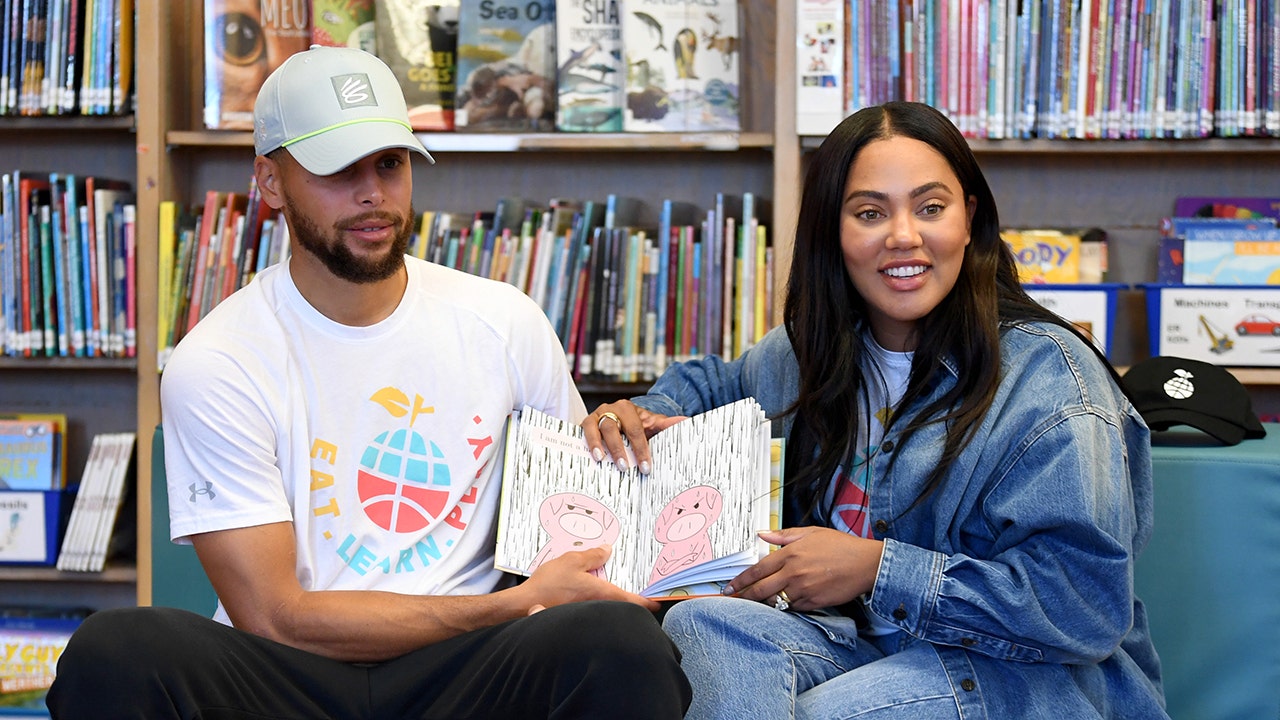
A garden at an elementary school that was funded by Stephen and Ayesha Curry was found vandalized earlier this week.
Staff at Global Family Elementary School in Oakland discovered the garden was destroyed on Monday.
The irrigation system had been ripped out, wooden benches were broken, and planters were torn apart, among other damages.
Stephen Curry and Ayesha Curry attend the launch of Stephen & Ayesha Curry’s Eat. Learn. Play. New Movement while visiting Lockwood STEAM Academy on Sept. 6, 2023 in Oakland, California. (Noah Graham/Getty Images for Eat. Learn. Play.)
“It’s going to take a lot of time, effort, and resources to repair the school’s garden and return it to its previous pristine condition,” the Oakland Unified School District said in news release Tuesday. “It’s unfortunate that anyone would think that causing this kind of damage anywhere would be fun, funny, or a good idea. It only served to hurt the students and staff at the school.”
The Currys’ Eat. Learn. Play. Foundation helped make the garden during the 2022-23 school year. The foundation was founded in 2019.
“When we launched Eat. Learn. Play. in 2019, we saw the tremendous need that existed in our adopted hometown of Oakland and set out to use our platform and resources to work to unlock the full potential of the kids in our community,” the husband and wife say on the foundation’s site.
School was not in session, so students did not see the garden get destroyed.
Stephen Curry and Ayesha Curry attend the world premiere of Universal Pictures’ “NOPE” at TCL Chinese Theatre on July 18, 2022 in Hollywood, California. (JC Olivera/Getty Images)
CELTICS STAR JAYSON TATUM TAKES SHOT AT CRITICS AFTER NBA FINALS VICTORY: ‘WHAT THEY GONNA SAY NOW?’
The school is less than three miles away from Oracle Arena, the former home of Curry’s Golden State Warriors. The organization has since moved across the bay to San Francisco at the Chase Center.
The Currys welcomed their fourth child, and second son, last month. Caius Chai Curry was born on May 11, one day before Mother’s Day.
Their first daughter, Riley, was born in 2012, and they welcomed a second daughter, Ryan, three years later. In 2018, their first son, Canon, was born.
The four-time NBA champ and Ayesha got married in 2011, having known each other since the two were teenagers. They met at their church while growing up in Charlotte, North Carolina, while Stephen’s father, Dell, played for the Hornets.
Ayesha Curry and Stephen Curry attend the launch of Stephen & Ayesha Curry’s Eat. Learn. Play. New Movement while visiting Lockwood STEAM Academy on Sept. 6, 2023 in Oakland, California. (Noah Graham/Getty Images for Eat. Learn. Play.)
Curry’s Warriors missed the playoffs this season after getting eliminated in the play-in tournament. They won the NBA title in 2022, which was Curry’s fourth.
Follow Fox News Digital’s sports coverage on X, and subscribe to the Fox News Sports Huddle newsletter.
Read the full article from Here


Paramount has made repeated entreaties to Bonta to strike a deal that would allow its merger with Warner Bros. to close.
The studio proposed a firm commitment, via a consent decree, to produce 30 films annually, with a 45-day theatrical release window and a 90-day streaming window, alongside promises to keep both Paramount and Warner Bros. lots open in California, the people said.
Privately, Ellison and other Paramount executives have expressed frustration at Bonta’s refusal to engage, and have pointed to the commitments around content spending — some $30 billion annually — and employment that would flow into California. Already, the region has faced a production exodus to other states — even to Canada — with thousands of entertainment jobs lost in recent years. Ellison and his executives have said that the combined Warner Bros.-Paramount would create jobs in California, helping to stymie that outflow.
But Paramount believes Bonta’s office has rebuffed its overtures, creating what one Ellison adviser said is an “inhospitable” environment for Paramount to operate in. If Bonta sues, the adviser said, the state’s hostility would push the company over the edge.
Bonta’s office did not respond to a request for comment. Last month, he told MSNOW that there were “red flags in the air everywhere,” and that he was “concerned about job loss and prices being increased.”
In a statement, Paramount said, “We continue to engage constructively with the remaining few regulators around the world still considering the merger, including State Attorneys General, and are prepared to address any legitimate antitrust issues.” It added: “We are confident this transaction raises no such concerns, as demonstrated by the dozens of antitrust authorities around the world that have carefully reviewed the transaction.”

A new wildfire sparked Sunday in northern Colorado’s mountains, forcing evacuations near Stagecoach State Park in Routt County, according to county officials.
The Green Ridge fire was discovered Sunday near the Stagecoach Reservoir, according to Routt County officials. That’s roughly 17 miles south of Steamboat Springs.
As of Sunday afternoon, mandatory evacuations had been ordered for an area bordered to the west by Stagecoach Reservoir, to the south by Woodchuck Hill, to the east by Service Creek and to the north by Blacktail Mountain, according to the Routt County evacuation map.
Pre-evacuations were also in place at that time for an area west of the mandatory evacuation zone. That area was bordered to the north by Stagecoach Reservoir, to the west by Routt County Road 16 and to the south by Routt County Road 212 and Cheyenne Trail.
The wildfire was last mapped at 7 acres with no containment, according to the National Interagency Fire Center. Information on the cause of the fire was not immediately available.
This is a developing story and may be updated.
Get more Colorado news by signing up for our Mile High Roundup email newsletter.


Here’s what you need to know about the University of Arizona
UA was established in 1885, and its main campus is in Tucson. The Wildcats once had a live bobcat named Rufus as a mascot.
The Republic
If point guard JJ Mandaquit’s job at Arizona next season looks tricky and challenging, having to glue together a lineup full of potential NBA draft picks under the pressure of playing for a returning Final Four team, it might be worth considering what his grandfather and father have been up to.
They’ve been running a roofing company … in Hilo, Hawaii. The rainiest city in the country, on the windward side of the Big Island. Where some 130 inches of rain hit buildings every year, creating slick working conditions, and where, even in drier moments, there’s high humidity and trade winds to deal with.
“I had to go on the roof a couple of times,” Mandaquit said, chuckling. “But not in the rain.”
He had other things to do. With his basketball skills overshadowing the local level of play since his elementary school years, Mandaquit left Hilo as a sixth-grader to begin a higher-level basketball journey that put him in Tucson this year.
His family came with him to Oahu, where he transferred to the Iolani School of Honolulu. His father, Jason Sr., commuted back and forth between Oahu and the Big Island while still roofing, though his mother was able to transfer from Hilo to Honolulu within her job at Hawaiian Electric.
Everyone thought that was the plan for a while.
“It was a better opportunity, better education and more opportunity,” Mandaquit said. “When we left from Big Island to Oahu, that was a huge move for my family, a lot of sacrifice that went into it. I’m super grateful to my parents. When we made that move in the sixth grade, we thought that was going to be the move, that it was just going to end there, I’d go to high school there.”
It still wasn’t enough. Mandaquit outgrew the basketball scene again. By ninth grade, he moved on to Real Salt Lake Academy, which turned into Utah Prep.
In Hawaii, he found players have also been kept from high-profile West Coast clubs because of a quirky club-ball residency rule in which players are typically allowed to play only for a club in their state or a bordering one — and Hawaii borders only an ocean. So Mandaquit said he and other locals started their own “Sons of Hawaii” club to play on the “MADE Hoops” circuit.
It still wasn’t enough. Utah was next.
“We felt it was best to get out of Hawaii and chase this dream,” Mandaquit said. “It wasn’t an easy choice to leave home, but we felt looking at the big picture, if I want to play at the high Division I level, we almost felt that it was a necessity to get out of the islands, surround myself with better competition, be somewhere that allows me to be more exposed.”
That move paid off. Mandaquit grew into a high-major prospect at Utah Prep and became a mainstay with USA Basketball junior teams. He won three gold medals at FIBA events: At the 2023 U16 AmeriCup, the 2024 U17 World Cup and, on a team led by UA coach Tommy Lloyd, the 2025 U19 World Cup.
Only a secondary recruiting target of Arizona’s before he committed to Washington in November 2024, Mandaquit jumped out at Lloyd while playing for USA Basketball last summer. Mandaquit averaged 6.1 points and 5.4 assists — with nearly a 4-to-1 assist-turnover ratio — while hitting 6 of 10 3-pointers over USA’s seven-game romp.
“I had only seen him play a few times before (last summer), but I was just so impressed with his character, but also his tenacity and the effort he played with. Just how he impacted winning,” Lloyd said. “So obviously, when we saw his name on the transfer portal, it piqued my interest right away.”
Lloyd said he considered Mandaquit out of high school, but the Wildcats were also pursuing Brayden Burries and had Jaden Bradley projected to stay through last season. Lloyd said he also took a cautious recruiting approach in 2025 because “you just didn’t know” how rev-share and NIL were going to work out, since 2025-26 was the first year schools could pay players.
So Mandaquit chose the Huskies over USC and Creighton. He started the Huskies’ first five games but wound up playing off the bench for most of his 22 appearances, averaging 5.2 points and 2.1 rebounds while shooting 28.2% from 3-point range.
Mandaquit struggled with a foot issue in the preseason and eventually missed the Huskies’ last 11 games because of it, though he has since had corrective surgery and returned to the court at Arizona.
“It was a great learning experience,” Mandaquit said of Washington. “I didn’t have the year that I wanted to have, but just going through that experience is gonna be huge for me and my future. I’ve got one year of college basketball under my belt, and the Big Ten was awesome last year.”
After he left Seattle, SI’s Huskies website wrote that UW coach Danny Sprinkle “has to be reeling by Mandaquit’s departure,” saying Mandaquit’s playing style “seemed to match Sprinkle’s hard-nosed personality.”
Instead, Mandaquit will be playing for the same coach he said he loved playing under last summer in Switzerland. Mandaquit joined a team that included former UA forward Koa Peat, incoming UA freshman Caleb Holt and No. 1 NBA Draft pick A.J. Dybantsa, among others.
They were all stars, forced together to play team ball during the world’s highest-profile junior tournament.
Gold was the expectation.
“What he was able to do with our group in such a short amount of time, I just loved,” Mandaquit said of Lloyd. It was “just the culture that he was able to build. Obviously, it’s not the easiest job as a coach to be able to manage all of the star players and egos that we had. It was just the way that he was able to get everyone to just buy in and focus on a common goal, and ultimately go and reach that goal.
“It was amazing. It was the most fun I ever had playing basketball.”
Despite their bond, Mandaquit said he couldn’t have a recruiting conversation with Lloyd until after he entered the portal this spring. But that might have been a formality anyway.
Both Lloyd and Mandaquit knew plenty about each other at that point.
“This time it was fast,” Lloyd said. “We both knew what we wanted on both sides.”
Lloyd needed a true point guard to join North Carolina transfer Derek Dixon and Holt in a reloaded backcourt that lost NBA Draft picks in Burries and Bradley.
Mandaquit wanted to be under Lloyd for more than a few weeks.
Official elapsed time between Mandaquit’s early April entry into the transfer portal and his commitment to Arizona: Ten days.
“When this opportunity came back around, I couldn’t pass it up,” Mandaquit said. “I knew this is the place that I wanted to be, and I knew I wanted to be coached by Tommy.”
During an interview at McKale Center last month, Mandaquit said he’s since arrived at Arizona to find high-character guys around him, and that coaches are pushing him the way he wants to be pushed.
“I’m loving it so far,” Mandaquit said.
As a bonus, Mandaquit’s first season with the Wildcats will also take him nearly full circle. Not to Hilo and the Big Island, but to the Maui Invitational, the prestigious early-season event that Mandaquit said he routinely watched on television even if the inter-island hop and high ticket prices kept him out of the Lahaina Civic Center to watch in person.
This time, he’ll be in the building — and soaking up the atmosphere outside it. His parents, now living back in Hilo, can make the easy flight over to watch, too.
It probably won’t rain much, if at all, Lahaina being on the leeward side of Maui and all.
But, for Mandaquit, it’s still home.
“Hawaii means everything to me,” Mandaquit said. “I try to get back there as much as possible, and I feel the support of the state behind me. I feel their love, so it pushes me to work harder.”
-

 California6 minutes ago
Exclusive: Paramount weighs leaving California over Warner Bros. rift
-

 Colorado12 minutes ago
New Colorado wildfire sparks evacuations south of Steamboat Springs
-

 Connecticut18 minutes ago
Cyclosporiasis outbreak prompts food safety concerns in Connecticut
-

 Delaware24 minutes ago
Delaware still in drought despite heavy rainfall
-

 Florida30 minutes ago
Florida leaders react to Sen. Lindsey Graham’s death, remembering his legacy of public service
-

 Georgia36 minutes ago
Georgia leaders remember Sen. Lindsey Graham after longtime South Carolina lawmaker’s death
-

 Hawaii42 minutes ago
Hawaii’s JJ Mandaquit took roundabout route to reunite with Tommy Lloyd
-

 Idaho48 minutes ago
Idaho leaders mourn the sudden passing of Senator Lindsey Graham

