Montana
The Trump-Class Battleship Might Just Be Another Montana-Class Battleship


Key Points and Summary – Trump’s newly announced Trump-class “Golden Fleet” recalls the U.S. Navy’s never-built Montana-class battleships: huge, heavily armed ships overtaken by changing strategy.
-In 1940, Montanas were conceived as super-battleships, but World War II quickly proved carriers, submarines, and escorts were more decisive, and the program was canceled before keels were laid.
Trump-Class Battleship. Image Credit: Creative Commons/White House.
-Today, Trump’s vision faces different but parallel constraints: hyper-partisan politics, tight shipbuilding capacity, and a fast-moving shift toward missiles, drones, and distributed fleets.
-The article argues the real lesson of Montana is that strategy and technology can outrun prestige platforms before they ever reach the water. History may be repeating itself.
Trump-Class Battleship Golden Fleet: Another Montana-Class?
In 1940, as war spread across Europe and tensions with Japan continued to rise in the Pacific, the U.S. Navy was still planning for a conflict in which heavily armed surface fleets would play a decisive role. Battleships remained central to American naval thinking, and Congress had just approved a significant expansion of the fleet under the Two-Ocean Navy Act.
Within that framework, Navy planners authorized a new class of battleships that would be larger, more heavily protected, and more powerfully armed than any the United States had previously built.
Designated the Montana-class, the ships were intended to represent the next step in battleship technology and capability at a moment when naval strategy itself was about to change significantly.
The program, however, never worked out as planned. In fact, none of the five planned Montana-class ships ever saw steel laid on a dock. The program was canceled before construction began, and the class never entered service. But why?
The answer isn’t precisely simple: it was a combination of shifting priorities, politics, and a total transformation in naval warfare that effectively made battleships strategically obsolete before they could even be built.

Trump-Class Battleship. Image Credit: Creative Commons/White House Photo.
As U.S. President Donald Trump announces plans for an entirely new class of battleships to form what he calls the “Golden Fleet,” the story of the Montana-class is well worth revisiting today.
The Montana-Class Vision and World War II
In the late 1930s and into the early 1940s, the U.S. Navy’s battleship force was undergoing its most ambitious expansion since World War I. Battleships like the North Carolina, South Dakota, and Iowa classes were designed or authorized after treaties capped armament and displacement. With treaty restrictions effectively ended and global conflict looming, the Navy chose to pursue a new class of super battleships – designated BB-67 through BB-71 – that would surpass even the formidable Iowa-class in terms of size and firepower.
The Montana-class was set to displace more than 60,000 tons, measure more than 920 feet in length, and carry twelve Mark 7 guns in four triple turrets – significantly more heavy guns than the nine on an Iowa-class ship. Armor protection was also made thicker and more extensive.
Congress authorized construction of the Montana-class as part of the Two-Ocean Navy Act of July 1940, which aimed to expand U.S. naval capabilities as war engulfed Europe and Asia. The intention was for these battleships to serve as the centerpiece of a powerful surface fleet capable of countering German and Japanese warships.
However, even as the designs were being confirmed and contracts authorized, larger strategic shifts were underway. The Japanese attack on Pearl Harbor in December 1941 and the Pacific campaign that followed accelerated the prominence and demand for aircraft carriers. The Navy began to allocate resources differently, and shipyard capacity, steel, and manpower became limited during wartime. Ultimately, the need for Essex-class aircraft carriers, destroyer escorts, landing craft, and anti-submarine vessels became more urgent.
Battleship construction, even for the existing Iowa-class hulls, began to compete with these new priorities. And while the Montana design was impressive on paper, it was also slower than the Iowa class and incapable of keeping pace with fast carrier forces that were increasingly defining U.S. naval operations in the Pacific. That made the Montana less suitable for the evolving (and now primary) mission of fleet air defense and power projection.

Montana-Class Battleship vs. Iowa-Class. Image Credit: Creative Commons.
Recognizing those realities, the Navy suspended work on the Montana project in mid-1942 before any keels were laid. At that point in the war, aircraft carriers had already proven decisive in major battles like Coral Sea and Midway, and naval planners were under intense pressure to prioritize ships that could be delivered quickly and used immediately in combat. Large battleships that would not enter service until 1945 or later no longer made any strategic sense.
By July 1943, the decision was made official, and the Montana class was formally cancelled.
The steel, manpower, and shipyard space allocated initially for the super battleships were instead redirected toward aircraft carriers, destroyers, submarines, and amphibious ships – platforms that were directly shaping the outcome of the war in both the Pacific and Atlantic theaters.
The cancellation, however, didn’t necessarily reflect a failure of the Montana design – though a case could be made that its speed was an issue – but rather a recognition that the role battleships had once played was disappearing faster than the ships could be built.

Image of Iowa-class battleship compared to Montana-class battleship that was never built. Image Credit: Creative Commons.

Image is of an Iowa-class battleship. Image Credit: Creative Commons.
In 2025, as President Trump promises an entirely new class of battleships that the U.S. Navy itself acknowledges it needs, there are different issues to contend with.
Trump faces an uphill battle in terms of political partisanship, which threatens to veto (or at least rename) the ships if a Democrat wins in 2028.
In parallel, the changing nature of global combat and the increasing reliance by adversaries on automated systems, drones, and long-range missiles means that strategies and priorities seem to be changing by the year.
About the Author:
Jack Buckby is a British author, counter-extremism researcher, and journalist based in New York. Reporting on the U.K., Europe, and the U.S., he works to analyze and understand left-wing and right-wing radicalization, and reports on Western governments’ approaches to the pressing issues of today. His books and research papers explore these themes and propose pragmatic solutions to our increasingly polarized society. His latest book is The Truth Teller: RFK Jr. and the Case for a Post-Partisan Presidency.



Miley Cyrus recalls ‘Hannah Montana’ casting journey
Miley Cyrus thanks Disney for taking a “chance” on her in “Hannah Montana” as the show celebrates its 20th anniversary with a new special.
Hannah Montana once sang that “Nobody’s Perfect,” a sentiment fans are echoing regarding Starbucks’ new drink honoring the fictional pop star ahead of her iconic Disney TV show’s 20th anniversary special.
Thought to be a drink that Hannah Montana would order at Starbucks, the coffee chain launched the Secret Popstar Refresher on March 23 as a celebration ahead of the “Hannah Montana 20th Anniversary Special”, set to be released on Disney+ on March 24. The drink consists of a grande Strawberry Acai Refresher with raspberry cold foam, two pumps of raspberry syrup and no strawberry inclusions – the dried strawberries typically in the refresher, according to the Starbucks app.
However, fans were quick to point out that the beloved TV show’s main character, Miley Stewart (Miley Cyrus), who lives a double life as teen pop star Hannah Montana, notoriously hates raspberries. Her disdain for raspberries was established in Season 1 of the show.
Stewart’s disgust is rooted in a childhood experience, during which she got sick after eating too much raspberry pie. Her hate for the fruit is exacerbated when Hannah Montana has to advertise a raspberry-scented perfume.
Now, fans of the show have taken to social media to speculate on Starbucks’ inclusion of raspberry.
Fans react to the raspberry Hannah Montana drink
Fans on social media quickly caught the raspberry reference after the drink’s launch on March 23, which many felt was an oversight by Starbucks, as they seemingly did not take Hannah Montana’s past into account.
Multiple comments on Starbucks’ Instagram post announcing the drink question the product’s flavor, including messages like “Why raspberry tho…didn’t Miley/Hannah hate raspberry,” “but she hates raspberry,” and “brooo there’s an episode in Hannah Montana (the perfume ad) where she doesn’t like raspberry!!!!”
The post’s caption appears to poke fun at the episode, reading: “For the fans who remember the raspberry saga, this one’s for you.”
Other comments under the post from Disney accounts also seem to acknowledge the raspberry inclusion as intentional, with the official Disney+ account commenting, “This completes the circle,” and the official Disney Channel account commenting, “the raspberry lore lives on!”
How to order a Hannah Montana drink at Starbucks
The Secret Popstar Refresher will be available for order through the Starbucks mobile app until April 5, according to a Starbucks statement obtained by USA TODAY.
The drink is a “secret menu exclusive,” meaning it is not on the official Starbucks menu in stores or drive-thru. Customers who know the recipe or use the Starbucks mobile app can order the refresher variation.
However, like any drink variation at the coffee chain, the refresher can be ordered at any time, as long as Starbucks has the required ingredients.
How to watch ‘Hannah Montana 20th Anniversary Special’?
The “Hannah Montana 20th Anniversary Special” became available to stream on Disney+ on March 24.
Reflecting on the past two decades, the special is an intimate sit-down interview with Miley Cyrus and “Call Her Daddy” podcast host Alex Cooper. The interview was filmed in front of a live audience in a recreation of the iconic Stewart ranch-style home.
Contributing: Greta Cross, USA TODAY
Montana
Now a true pop star, Miley Cyrus returns to her ‘Hannah Montana’ roots to fete anniversary special

LOS ANGELES (AP) — Sporting that “Hannah Montana” blonde hair and bangs, Miley Cyrus went back to her roots — celebrating 20 years of the TV show that launched the career of a real-life pop star.
Cyrus reunited with cast members of “Hannah Montana” in Los Angeles Monday evening for the premiere of the “Hannah Montana 20th Anniversary Special.”
Cyrus told The Associated Press that the milestone has given her a chance to see the character and series from “a new perspective.” Cyrus, who began the Disney Channel show at age 13, played Miley Stewart, a tween and middle-schooler hiding her secret life as a famous pop singer.
“Getting to be on the outside now, getting to be grown and be a part of it in a way that I couldn’t when I was in the middle of it before, and all the chaos and the schedule and the performing of it all,” Cyrus said, “now it just gets to be a celebration. So it is a new perspective. I love that.”
The anniversary special, which started streaming Tuesday on Disney+ and Hulu, celebrates 20 years since the show’s premiere. Filmed in front of a live audience, it features music, archival footage and an interview with Cyrus — now 33 and a genuine pop star — conducted by podcast host Alex Cooper.
Addressing the audience at the premiere, Cyrus paid tribute both to fellow cast members and fans. “Without you all, this show would have never been what it is, and I love saying what it is, not what it was,” she said.
“Tonight isn’t about looking back into the past, but it’s about what it means to us still tonight,” she said.
Jason Earles, who played Miley’s brother Jackson, told the AP that watching the show now highlights how much time has passed.
“I think if you go back and you watch the episodes, there’s enough dated references like old flip phones and stuff that you go, ‘Oh no, no, this show was a little while ago,’” he said.
Cody Linley, who played Miley’s on-and-off boyfriend Jake Ryan, reflected on the impact of portraying a teen heartthrob.
“It’s hard to believe that there were girls that had pictures of me with my shirt off in their locker and they would have me sign it,” Linley said. “And it’s hard not to let it go to your head, because you have to remember that it’s an image that they are seeing. It’s not you.”
Also attending the premiere was country singer Lainey Wilson, who recalled working as a “Hannah Montana” impersonator early in her career.
“From 8th grade to 12th grade, five years of my life, I would open up the show as Lainey Wilson, I would run behind a tree and put on my ‘Hannah Montana’ get-up,” the singer said. “I did birthday parties, fairs, festivals … I was hitting the roads.”

Why Vanderbilt football’s Cole Adams transferred from Alabama, ready to prove himself

Eastern Alaska Range Avalanche Center creates professional position to monitor conditions

What is the Arizona Cardinals biggest need heading into the 2026 NFL Draft?

Arizona vs Arkansas prediction, analysis, Sweet 16 expert picks for men’s March Madness

Historic March Heat Wave Smashed Records From California To The East | Weather.com

Florida High School Football Rankings: Top 25 teams – Oct. 21

How old is Bo Nix? What to know about Oregon quarterback ahead of 2024 NFL Draft

Cleary's 21 help Le Moyne down Central Connecticut State 69-64 in OT

99th annual Pony Swim held in Virginia

Indiana Members Credit Union announced as new anchor tenant at Bottleworks District

LaGuardia Crash Timeline: Moments Before Air Canada Plane Collided With Fire Truck

Chicago alderwoman apologizes for ‘wrong place at the wrong time’ comment on slain student

Fake Euronews website targets Hungary election with false claims
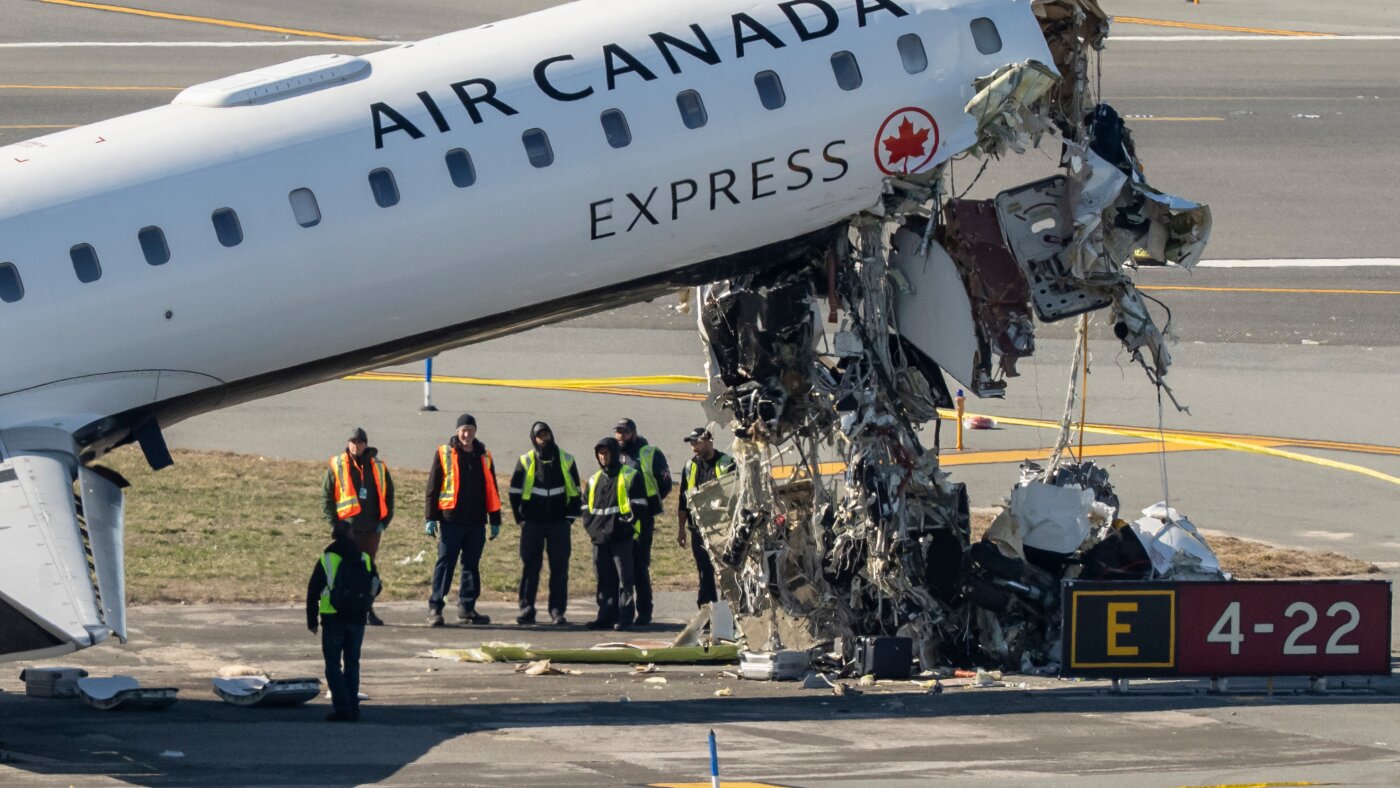
An air traffic controller was juggling extra roles during the LaGuardia plane crash

Iran War: Pentagon set to send thousands of elite 82nd Airborne troops to region | BBC News
-

 Detroit, MI6 days ago
Drummer Brian Pastoria, longtime Detroit music advocate, dies at 68
-

 Georgia1 week ago
How ICE plans for a detention warehouse pushed a Georgia town to fight back | CNN Politics
-

 Movie Reviews6 days ago
‘Youth’ Twitter review: Ken Karunaas impresses audiences; Suraj Venjaramoodu adds charm; music wins praise | – The Times of India
-

 Education1 week ago
Video: Turning Point USA Clubs Expand to High Schools Across America
-

 Sports4 days ago
IOC addresses execution of 19-year-old Iranian wrestler Saleh Mohammadi
-
 Science1 week ago
Industrial chemicals have reached the middle of the oceans, new study shows
-

 Science1 week ago
How a Melting Glacier in Antarctica Could Affect Tens of Millions Around the Globe
-

 Culture1 week ago
Test Your Memory of Great Lines From Classic Irish Poems