Denver, CO
LetsGoDU: DU Stacks Second Signature Win in a Week, Denver 78-70 Over North Dakota State


Denver men’s basketball (12-7, 2-1) traveled to Fargo to take on the North Dakota State Bison Thursday night. The Pioneers had not beaten NDSU on the road since a home-and-home sweep in 2018. Despite 15 turnovers and a tough night for Tommy Brunner (except for a huge game-breaking tray in the final 1:09), Denver rode a red-hot Touko Tainamo with 21 points and 5 rebounds along with Jaxson Brenchley with 15 points and 6 rebounds. Ultimately, it was Denver’s defense that kept the Bison from making a field goal and four free throw makes in the final 4:23 to clinch the win.
In the first five minutes, the teams played even-up until a Tommy Bruner assist and dunk by Isaiah Carr along with a Pedro Sanvicente three-point-make gave DU a 9-4 edge. Denver held a 16-10 advantage at the official timeout spurred by four forced Bison turnovers. Denver held a five-point edge at the midway point of the half, led by Touko Tainamo’s 9 points. At 6:55, the Bison took their first lead, 23-22, on a looping shot over Isaiah Carr. An Isaiah Addo-Ankrah tray put DU up 29-25 with five minutes left following a Denver scoring run. NDSU’s Boden Skunberg kept NDSU close with several step-in jumpers near the paint with 10 points but Denver held back the Bison. As time ran down, NDSU got a defensive stop and bucket in the final seconds but Denver still led at the break, 37-34.
Denver shot 53.6% for the half to 44.8% for the Bison. Denver had 6 turnovers to 7 for the Bison.
Both teams came out cold from the field to start the second half and DU held a 5-point lead at the 17:51 media timeout. Two minutes later, the Bison cut the lead to one point, 41-40, with a step-back jumper by Thomas Wheeler. At 14:46 the Bison got their second lead 44-43 but Isaiah Carr countered with a dunk from a feed from Tommy Bruner. The teams exchanged buckets as Denver led by four, 53-49, at the nine-minute mark following a Tainamo hook. Fourteen turnovers by DU kept NDSU in the game and DU eventually trailed by one, 61-60, with five minutes left. At 3:16 Tyson Garff nailed a tray to give DU the lead, 65-64, to cap a 7-0 Pioneer run. A huge Bruner three-point dagar put DU up by four with one minute to go and followed that with two free throws to essentially salt the game, 74-68. NDSU missed their final shots and Pedro Lopez-Sanvicente finished with a dunk, 78-70, DU. Ultimately, it was the defensive effort down the stretch that ensured the win.
Denver shot 54% from the field with 9 steals, 6 blocks and 15 assists. Tyson Garff hit big shots (6 pts., 4 assists), Deandre Craig (5 pts., 5 assists) ran the offense for extended minutes and Isiah Carr (8 pts., 3 reb.) stuffed the middle and made key blocks. While Tainamo and Brenchley were Denver’s best players on the night, it was Tommy Bruner’s 15 points which included his three-point make at 1:09 that gave Denver breathing room down the stretch.
Next up is North Dakota on Saturday at 11:00 am MT at Grand Forks.


A year ago, the Denver Broncos had some questions about the future of their center position. However, during the bye, the Broncos answered those questions by extending one their starter.
Even with that extension, the Broncos still have some questions about the position’s future, partly due to the structure of the deal they granted and the position’s depth.
Our last installment in this positional series was at offensive guard, where the Broncos are very strong and deep. As we continue breaking down each position on the Broncos’ roster ahead of training camp, let’s examine where things stand at center.
Starter
Luke Wattenberg
Wattenberg is the starter and will remain so after the big extension Denver gave him in November 2025. Before the extension, his play was solid, but afterward, he looked like a top 10 center in the NFL — then he suffered a shoulder injury.
Wattenberg’s long-term place with the Broncos will depend entirely on his play, as his four-year, $48 million deal is structured so that Denver can get out of it after the 2027 season. It’s essentially a two-year deal for about $25 million.
If Wattenberg isn’t cutting it or can’t stay healthy, the Broncos could move on and save themselves $23 million. He’s missed six games to injury since becoming the starter in 2024, so the Broncos’ depth could be tested with Wattenberg as the guy.
Backup
Alex Forsyth
The backup spot is held by Forsyth, a solid run blocker who struggles in pass protection. He has seen the field some over the last two years. When Forsyth stepped in for Wattenberg late last season, he looked much the same as he did in the same role in 2024.
There are still questions about Forsyth, not only with his play but also with the fact that he is entering the final year of his rookie deal as a 2023 seventh-round draft pick. Denver could be looking for a new backup center after this season, as he could decide he wants a chance to start elsewhere and walk in free agency, especially with six career starts on his resume.
Wattenberg will be the starter for 2026 and 2027, so long as he avoids the injury bug. He hasn’t been able to stay on the field since taking over for Lloyd Cushenberry III as the starter in 2024, so if the best predictor of future outcomes is past outcomes, the Broncos had better be prepared for Forsyth to see the field at some point in 2026.
The Others
Gavin Ortega and Michael Deiter
Oretega is an undrafted rookie the Broncos brought in, and he has a chance to compete for a practice squad spot. The Broncos brought Deiter in last year after injuries to Wattenberg and Forsyth.
There isn’t a spot for either of these players on the 53-man roster, barring preseason injuries, and it can be tough to keep two centers on the practice squad, even if the players have guard versatility.
The Takeaway
While the Broncos have the starting job locked up with Wattenberg for the next two years, their depth is still questionable. Forsyth hasn’t shown the development you want to see, and will be a free agent after this season.
Denver could find itself looking for a center in the 2027 NFL draft to develop in case Wattenberg’s play drops off, or if he isn’t able to sustain the high level of play he displayed after getting his extension late last year.
Sign up for our free Denver Broncos On SI newsletter, and get breaking Broncos news delivered to your inbox daily!
 Add us as a preferred source on Google
Follow
Denver, CO
Denver Transplant Games sets Guinness World Record for mos living donors, recipients in one place at one time

DENVER (KMGH) — The biennial Transplant Games wrapped up in Denver this week, bringing hundreds of organ donors and recipients together to compete in everything from cycling and swimming to darts and trivia at venues all over the city.
In fact, the games set a Guinness World Record for most living donors and recipients in one place at one time, with 966 gathering at the Colorado Convention Center.
Angela Laino, who used to live in Boulder, came back to Colorado to compete in the games. She donated a kidney to a stranger in January before running in the 5K event.
“I’m what they call a non-directed living kidney donor, which means that I don’t know who my recipient was,” she explained. “So I just said, ‘Whoever needs my kidney, I’m sure they’ll find the best match for it.’”
Laino said she was inspired by her job, working “on and off” as a dialysis social worker for 17 years.
“I really saw the challenges that my patients faced,” she said. “I saw what they had to go through to get on the [transplant] wait list… I know what transplant means for people. I’ve seen it firsthand. And to be able to see them come out here, compete, they’re doing basketball, they’re doing badminton, they’re swimming, they’re cycling, they’re running. They are living their full lives, and that’s really what transplant can do for people.”
Laino said the games unite the community and show off its resilience.
“When you go through the transplant process, sometimes you feel alone, you feel like you’re the only one going through this,” Laino said. “And then you come to an event like this and you literally see thousands of people. You see recipients, living donors, donor families coming together for the same cause. It’s really inspiring, because it really helps to get the word out, spread awareness about the organ shortage, and it shows people what recipients and donors can do after they have the surgery.”
Dr. Michael O’Shea — a nephrologist, a doctor who cares for kidney disease patients and the kidneys in general — agrees. But he said more needs to be down to support patients and spread the word about the need for organ donations.
The National Kidney Foundation estimates 37 million Americans have Chronic Kidney Disease, which occurs when kidneys cannot filter the blood properly, leading to serious health issues. Because symptoms can be minimal in early stages of the disease, many patients don’t realize they have it.
“I think education about kidney transplant, both on the patient side as well as on the potential donor side, could be markedly ramped up and improved,” Dr. O’Shea said. “It’s struggles with communication between transplant centers, patients, and community nephrologists. No one’s fault. It’s just a very complicated delivery system.”
In the case of kidneys, people can become diseased donors — who register to donate in the case of their sudden death — or living donors, who donate one kidney will relying on the other. Dr. O’Shea said both are critical to meet nationwide demand for life-saving transplants, though the living donations tend to have a longer lifespan — around roughly 20 years — for recipients.
“A number of folks get transplanted every year off this list,” O’Shea explained. “It is also true that a greater number of folks get added to the list every year.”
To register to become a deceased donor, Coloradans can visit their local Department of Motor Vehicles office or visit registerme.org.
O’Shea said those considering living donations face an “exceedingly small” medical risk for end-stage kidney disease, but should consult with their doctor about the decision.
Even as the games leave Denver, a reminder will stick around through the summer. Denver Parks and Recreation, the Downtown Denver Partnership and DaVita have partnered to set up a basketball court in Skyline Park near Arapahoe and 17th Streets, in order to keep the spirit of the games alive and honor the resilience of organ donors, recipients and their families.

Getty
Denver Broncos star Pat Surtain II is navigating uncertainty on and off the field.
Pat Surtain II and the Denver Broncos could already have to overcome not having outside linebacker Jonathon Cooper for an indeterminate length of time amid his ongoing legal matters, and the 2024 Defensive Player of the Year is now facing another hurdle.
This one affects Surtain off the field, and personally.
It will be but a footnote on his 2026 season, but the standout defender’s recent experiences are reminders about how quickly things can change in the NFL.
Broncos’ Pat Surtain II Gets More Bad News
GettyPat Surtain II could have forced to make a difficult decision about one of his ventures off the field.
In addition to his award-winning play on the field for the Broncos, Surtain has also taken on podcasting during his spare time. He co-hosts the “Closed on Sundays” podcast with fellow Alabama alum and current Detroit Lions cornerback Terrion Arnold.
The duo’s joint venture is in imminent danger.
“#Broncos star Pat Surtain II has a successful podcast with Arnold,” The Denver Post’s Troy Renck posted on X on June 24. “Now, Arnold is facing some serious charges.”
According to NFL.com’s Grant Gordon on June 24, “Detroit Lions cornerback Terrion Arnold has been arrested in connection with a February robbery and kidnapping in Tampa, Florida, the Hillsborough County State Attorney announced late Wednesday night.
“Arnold, 23, turned himself in at Orient Road Jail (Florida) on Wednesday and is facing eight total felony charges — four for robbery with a firearm or deadly weapon and four for kidnapping, the Hillsborough County Sherriff’s Office told NFL.com. Arnold is being held with no bond and is due in court Thursday at 1:30 p.m. ET, per the Sherriff’s office.”
Arnold’s charges “carry a potential life sentence in prison,” per Gordon.
Gordon also noted that prosecutors will request he remain in custody until his trial. That is in addition to his current no-bond status.
The matter all stems from an alleged retaliation attempt after Arnold and several friends had their property stolen from an AirBNB they were staying in. Arnold is the alleged mastermind of the plot, which targeted individuals police say were not involved with the initial theft.
Broncos Navigating Distractions
GettyPat Surtain II and the Denver Broncos are navigating legal issues with a player on their roster.
Surtain and Arnold last put out an episode of the podcast in February. Moreover, the Lions corner’s status and their podcast must come after Surtain’s commitment to the Broncos, who are once again expected to be one of the top teams in the NFL.
They face an internal threat to that, with Cooper.
Broncos head coach Sean Payton said they are following the NFL’s lead on handling the matter, while Surtain expressed support for his teammate.
“He’s our brother at the end of the day, and we all rally behind Coop,” Surtain told reporters on June 16 when asked directly. “We just wish him the best with everything, but just keeping him in good spirits.”
Cooper’s situation, obviously, affects the Broncos–and, by default, Surtain–directly.
Still, the star corner could need a new podcast partner, lest he prefer to sunset the endeavor entirely, as well as hope Denver can replace a key piece in Cooper if necessary.
Josh Buckhalter covers the NBA and NFL for Heavy.com. He has covered both leagues since 2016, including bylines at FanSided, Last Word on Sports and Clocker Sports. He’s based in Villa Park, Illinois. Follow Josh on Twitter and Instagram: @JoshGBuck More about Josh Buckhalter
-

 Technology8 minutes ago
It’s the last day of Prime Day — here are over 140 great deals to choose from
-

 World13 minutes ago
Rubio announces framework deal between Israel and Lebanon as experts warn Iran will fight to sabotage it
-

 Politics20 minutes ago
Lawyer who beat Hawaii gun law calls state’s reliance on Black Code ‘disgraceful’
-

 Sports28 minutes ago
2026 World Cup Group Scenarios: What Remaining Teams Need To Advance To Round of 32
-

 Technology35 minutes ago
Ohio robot cop retires after zero arrests
-
 Business38 minutes ago
Commentary: Puncturing the myth of Alan Greenspan, whose policies gave us the Great Recession
-
 Entertainment43 minutes ago
On 10th anniversary, Boleros de Noche’s legacy is celebrated by L.A. City Hall
-
 Lifestyle50 minutes ago
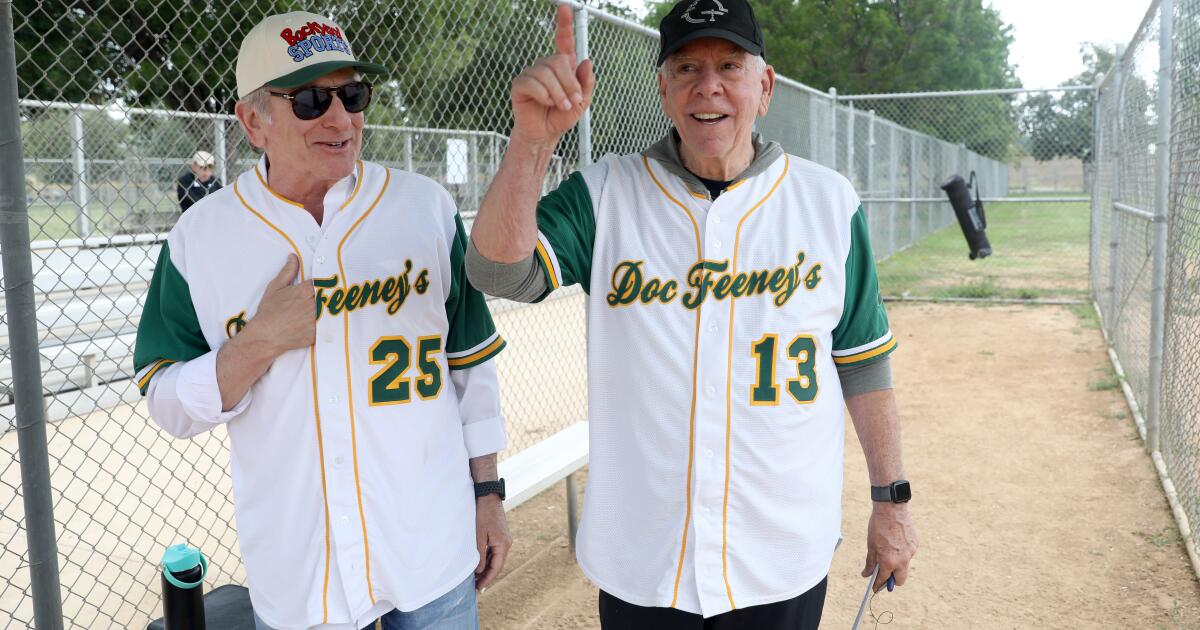
They started playing L.A. Municipal softball 50 years ago. They’re still at it

