Denver, CO
Broncos analysis: What we’ve learned about Sean Payton’s team in Week 1 of free agency and what questions remain


A week’s worth of free agency is in the books for the Broncos.
They’ve added a trio of defenders in safety Brandon Jones, defensive tackle Malcolm Roach and inside linebacker Cody Barton. They’ve retained several more from Sean Payton’s first year in Denver.
They’ve explored several options at quarterback but haven’t come away with a transaction to show for it.
In the process, the Broncos cleared a significant amount of cap space and committed, officially, to using $53 million of it to pay down the first big chunk of former quarterback Russell Wilson’s $85 million in dead salary cap charges.
General manager George Paton predicted at the NFL combine last month that the Broncos would be “strategic” rather than aggressive and that word fits the bill so far. Denver has proceeded clearly set against overspending in an offseason that is shaping up to look like a re-set.
Here’s what we’ve learned and what questions remain.
Three things we learned
The identity of Vance Joseph’s defense is going to be different
By sheer numbers, the Broncos may not actually have much turnover on defense. By leadership, though, this group is going to look markedly different in 2024.
In and of themselves, the departures of safety Justin Simmons and Josey Jewell aren’t shocking, though seeing Simmons released in the days before free agency was a surprise. Taken together, that pair represented the central nervous system of Denver’s defense for years, a guiding force across several head coaches and coordinators.
Jewell relayed the defensive calls from Joseph on the sideline. Then Simmons served as the quarterback from the back end, ensuring the secondary communicated coverage with the linebackers, corners and nickel Ja’Quan McMillian.
Now the two communication hubs — and two of Denver’s defensive leaders — are gone. It won’t be entirely new, of course. Alex Singleton called the defense when Jewell was out. P.J. Locke has played a lot. ILB Jonas Griffith and S Caden Sterns have been around and are hoping to stay healthy.
“I feel good about the young core on defense, and we will just continue to add depth,” Paton said at the combine before the team signed Jones and Roach in free agency and got Locke back on a two-year deal.
Still, if a football defense is something like a baseball defense — you want to be strong up the middle at every level — then Denver is doing the rough equivalent of replacing its shortstop and center fielder.
This is now a group led by cornerback Pat Surtain II, defensive lineman Zach Allen and others like outside linebacker Baron Browning and Singleton. Familiar names, but also a new look and feel in the locker room.
The shakeup may have been anticipated, but it’s still massive
Aside from releasing Simmons rather than trading him or finding a way to extend his deal and lower his cap hit, none of the Broncos’ moves went down as stunners.
All the same, it is worth taking a step back and considering what’s happened this month.
Draw up a list of the most notable Broncos from the 2023 team. How far down the list do you get before you’ve added Russell Wilson, Jerry Jeudy and Simmons? Five or six, maybe? Jewell’s not far down the list from them, either.
Consider that seismic change and then think back to the middle of the season when Payton summarized his regular conversations with Paton in the lead-up to the trade deadline.
“We’ve got a good handle on this current roster and our vision for the roster a year from now,” Payton said then.
Denver could have worked on several veteran contracts before the 2023 season or during — it now infamously did try to do so with Wilson — but proceeded in a way that allowed the team to make whichever decision it wanted on a host of its most expensive players.
The first wave of moves on that front played out over the last 10 days. The string of goodbyes and thank-yous on social media is a good reminder that, while sentimentality exists in the NFL, it gets blocked out when making roster decisions.
The enduring trio
Despite the churn, left tackle Garett Bolles and receivers Tim Patrick and Courtland Sutton endure. They’re now the longest-tenured trio of Broncos.
Patrick reworked his deal to stay for 2024, while the contracts for Sutton and Bolles remain unchanged. Sutton is due a $2 million roster bonus Sunday.
It’s quite possible that 2024 could be the last hurrah for any one or all of them, but overall the Broncos like Patrick’s leadership and the way Sutton responded in a 10-touchdown season under Payton in 2023. Bolles played steadily in 2023.
Denver cleared enough salary cap space in other ways that it can comfortably move forward with all three on the roster for 2024. The Broncos don’t have to look to trade Sutton or Bolles — they have not been in recent weeks, sources have indicated — though the possibility of moving either can’t be entirely ruled out if the right deal comes along.
Perhaps the draft will change the equation, either for Denver or another team. Bolles and Patrick are entering the final year of their contracts and the Broncos aren’t meaningfully committed to Sutton in terms of guaranteed money, either.
For now, this is the group that looks like 2024-and-then-we’ll-see.
Three questions that remain unanswered
The big one
The Broncos have been knee-deep in quarterback evaluation — free agency, trade market and next month’s draft — but have made no moves thus far.
Perhaps the most logical candidates from each of the first two categories were Sam Darnold and Sam Howell, respectively. Darnold got a one-year, $10 million deal from Minnesota, more than double what Baker Mayfield got last year as a former top draft pick trying to engineer a career resurgence. Washington got the equivalent of a late third-round draft pick from Seattle in exchange for Howell. Those are pretty strong prices and, in each case, the Broncos were clearly not willing to match or exceed.
The Broncos started the offseason looking for a player to add to their current mix of Jarrett Stidham and Ben DiNucci in addition to a potential rookie. That they haven’t found that player so far might be just fine by them, but when you don’t have your answer at the game’s most important position, every move (or non-move) gets extra scrutiny.
Just how ready is Sean Payton to let the kids play?
Many of the Broncos’ moves this offseason signal a team getting younger and cheaper. Lloyd Cushenberry’s gone on a four-year, $50 million deal to Tennessee? Either second-year man Alex Forsyth or third-year Luke Wattenberg to replace him. Jeudy traded? In steps Marvin Mims, Jr. Denver views corner Riley Moss as a starting-caliber player but he only saw 23 defensive snaps as a rookie. Safety JL Skinner? One defensive snap
The players who got the most run as rookies were Mims (384 snaps or 35.4%) and linebacker Drew Sanders (23.8%).
The fact that the Broncos had a lack of immediate impact from its 2023 draft class may not come as a big shock since they didn’t pick until the last selection of the second round, but the Year 1 to Year 2 jump for this group — plus college free agents like Jaleel McLaughlin, Nate Adkins and several offensive linemen — is going to be critical. And where Denver was reluctant to put Sanders, Moss and Mims into big roles right away as rookies, the coaching staff may not have the same luxury with its 2024 draft class.

You’ve got $67 million in dead salary cap so far. You’ve cleared some big contracts off the books by release and trade. Roll with the kids. Let them play, make mistakes and learn. A Los Angeles Rams team in a similar situation (except at quarterback) took that route in 2023 and ended up making a surprise run toward the playoffs after looking like a mess during a 3-6 start.
What’s the best use of remaining cap space?
The Broncos have somewhere between $22.6 million in cap space to work with before Barton’s deal is official, according to OvertheCap data. Their current slate of draft picks projects to take up about $4 million more, though that will change slightly depending on how much the team moves around in the draft.
So for estimate’s sake let’s say Denver has $16 million to work with now. They’ll sign more players, though big, splashy contracts at this point would be a surprise.
Here’s one path forward: Stuff most of the rest in your pocket and don’t even think about it until 2025. The NFL allows teams to roll cap space over. Denver had been at about $10 million in rollover until having less than $1 million this year.
Get back on that track. Take $10 million and treat it as if you’re actually paying down $63 million of Wilson’s dead cap rather than $53 million. If you surprise and you’re in contention mid-season, go ahead and deploy some of that flexibility for the here and now.
Otherwise, save as much of it as you can and spend it next year on mega-extensions for Pat Surtain II and Quinn Meinerz. Prepare for bigger cap hits from 2023 free-agent additions like Mike McGlinchey, Ben Powers and Zach Allen. After converting all of their salaries to bonuses for 2024, their combined cap charges this year are a paltry $21.65 million. Currently for 2025, the trio combines to charge $61.03 million.
Denver only has 27 players currently under contract for 2025 (28 once Surtain’s fifth-year option is exercised between now and May 2). Play this year right with the remaining cap space, and the team could have ample room to work, a curbed Wilson dead cap figure to clear his money entirely off the books and perhaps, finally, a full draft class to work with on top of the cap flexibility.
Want more Broncos news? Sign up for the Broncos Insider to get all our NFL analysis.



Denver, CO
Victor Marx wins GOP primary for Colorado governor, defeating veteran lawmaker after unorthodox campaign

Victor Marx, a first-time candidate and nonprofit leader with a controversial personal history that’s drawn intense scrutiny, has edged out his more establishment opponent and will be Colorado Republicans’ gubernatorial nominee in November.
The Associated Press called the race for Marx late Thursday afternoon, nearly nine days after polls closed. He led the runner-up, state Sen. Barb Kirkmeyer, 39.9% to 39.4%, with 99% of ballots counted, according to the AP.
Marx had taken his first narrow lead over Kirkmeyer the day after the June 30 primary, and though the race remained close, he never lost the advantage. While outstanding deficient and overseas ballots helped delay a final call on the race, those votes only served to expand Marx’s margin. He led by 2,524 votes at 5:30 p.m. Thursday, out of about 522,000 ballots cast.
State Rep. Scott Bottoms was a distant third, with 20.8% of the vote.
A veteran lawmaker and former Weld County commissioner, Kirkmeyer had jumped to an early advantage on the strength of early ballot returns. But as votes returned on Election Day began to filter in, her lead thinned and collapsed. Within 48 hours of polls closing, and with few ballots left to count in Kirkmeyer’s Front Range strongholds, her path to retake the lead had all but vanished.
Marx will next face Democratic Attorney General Phil Weiser in November. No Republican has been elected to the governor’s office in more than 20 years. Four months out, Weiser appears to be heavily favored to continue Democrats’ electoral dominance.
In an email to supporters after the race was called, Marx said he was humbled to be the nominee and that the victory was “the starting line.”
“My team and I have put together this special message that I want every Coloradan to hear — Republicans, independents, unaffiliated voters, and Democrats who are open to a better way,” he said. “Because what we’re building now is bigger than a primary victory.”
In a video, he appealed to Coloradans who are frustrated with the status quo and don’t think things can change — citing his victory as proof they can.
“Now Phil Weiser, he’s a smart fella — but he represents the current system, because he is part of it,” Marx said. “And that current system has made Colorado more expensive, less safe and harder for regular families to trust government.”
In a separate statement, Kirkmeyer said she was proud of the race that she had run and the “clear vision” she had laid out for the Republican Party here.
“While we came up short in what appears to be the closest Republican gubernatorial primary in Colorado history, I’m grateful for every voter who placed their trust in us,” she wrote.
Echoing the pledge she’d made before Election Day, she pointedly did not endorse Marx. She said only that she hoped voters “choose the path that is best for Colorado” in November.
Kirkmeyer also threw a final jab at Marx, who declined in late May to tell 9News how many people he’d killed as an adult.
Kirkmeyer wrote that, “for the record, I still haven’t killed anyone.”
First-time candidate shrugged off questions
Marx’s primary win is a remarkable result for the embattled Colorado GOP and for Marx, a former Marine, martial arts instructor and nonprofit leader whose extensive and much-scrutinized personal history had drawn national headlines. It’s also attracted sharp criticism from other Republicans.
In his video, Marx appealed to Republican primary voters, saying there was room in his campaign for those who supported his opponents.
Marx had entered the fray last fall with no political profile and no experience as a political candidate. But by the time voters began receiving ballots last month, he’d ridden an atypical — if thoroughly modern — campaign to fundraising dominance and front-runner status.
Kirkmeyer’s support largely flowed from northern Front Range counties, nudging her ahead initially. But Marx picked up bigger margins among Election Day voters — meaning those more conservative voters skeptical of mail-in balloting.
He also won ruby-red El Paso County while racking up smaller wins in rural counties and grabbing enough in the Front Range to edge Kirkmeyer.
Map: Where did the votes come from in the Colorado primary races for governor?
In a pitch reminiscent of President Donald Trump, the arch-dealmaker, Marx has cast himself as a solutions-focused negotiator disinterested in partisan squabbles. In 2003, he founded All Things Possible Ministries, a Christian nonprofit that has provided stuffed animals and trauma support to people. It has also done work in conflict areas in Syria and Iraq, where Marx primarily worked away from the front lines as a funder and facilitator.
By 2024, the nonprofit’s annual revenue had surpassed $7.5 million, and Marx has said the group — from which he has resigned — now primarily works to help law enforcement.
Despite his outsider status, Marx was considered the likely winner in the weeks before Election Day. His narrow victory, then, came as something of a surprise, and, on election night, he speculated that Bottoms — a conservative pastor from Colorado Springs — had pulled votes from him. In El Paso County, Bottoms earned more than 20,000 votes, or 24% of the county’s Republican total.
Though Marx out-raised and out-spent both Kirkmeyer and Bottoms, it was Kirkmeyer who had been perceived as the expected nominee when she entered the race last year. Marx had never run for office before, and the stories he’s told about his life — that he’d killed a man at age 7, been involved in “high-risk humanitarian” operations across the globe and could free people from demonic possession — drew intense scrutiny and national punchlines.
But he repeatedly shrugged off questions about his background and said he stood by all that he had said and written.
Through his personality-heavy, direct-to-voter campaign, he encouraged Colorado Republicans to shrug it off, too. He spent heavily on direct mailers, which provided a boost to both his fundraising and name recognition.
Marx eschewed policy discussions and skipped nearly every debate. When he did participate in one, he spent part of the event leaning on the lectern, with his dog at his feet. Rather than deliver a closing statement, he prayed.

Campaigning his own way
Though he leaned into his outsider status, the aw-shucks appeal belied a careful campaign shaped by Marx’s emergence from a political environment forged by Trump: He skipped one debate after a moderator pressed him about his background, and he held a rally instead; his campaign later highlighted how many more people attended the rally than the debate.
His media operation was led by a former Turning Points USA staffer, and his campaign touted its social media posts’ views at Marx’s watch party last week. He was comfortable as a podcast guest, regularly released videos of himself and repeatedly assured voters that he was no politician.
Though Marx had little backing — or trust — from institutional Republican forces, the PAC that supported his campaign was established by a former senior official from Gov. Bill Owens’ administration. Marx also was endorsed by U.S. Rep. Lauren Boebert, the most nationally visible Colorado Republican.
His approach proved to be enough for Colorado Republicans to back him. But his next task will be far harder.
In November, he will face a surging Weiser, who last week dismantled U.S. Sen. Michael Bennet on his way to the Democratic nomination. Weiser proved an adept fundraiser and campaigner with statewide appeal, and he will look to lead a restless Democratic base that elected progressive candidates up and down the ballot.
In a statement Thursday, Weiser said Marx’s “views and style are far out of step with Coloradans, and his nomination for governor is a threat to our state’s values and our future.”
Republicans’ last statewide win was in a University of Colorado at-large regent’s race in 2016. The state GOP has had four elected party chairs since the last Republican gubernatorial bid in 2022, which ended with a culture war-focused Heidi Ganahl — who had won that at-large regent seat — losing by nearly 20 percentage points to Gov. Jared Polis.
Simultaneously, Marx may also have to contend with an independent candidacy from Greg Lopez, a former Republican congressman and gubernatorial candidate who is gathering signatures to make the fall ballot.
Stay up-to-date with Colorado Politics by signing up for our weekly newsletter, The Spot.

If you use Santa Fe Drive as a part of your daily commute, you will notice full closures this weekend on a popular section, from Florida Avenue to Evans Avenue, for the installation of a pedestrian bridge.
Once the 370-foot pedestrian bridge is completed, it will connect the east and west portions of Denver’s Overland neighborhood. This bridge will be used by pedestrians and bicyclists.
The Denver Department of Transportation and Infrastructure says this closure is needed to keep the traveling public safe. Large cranes will be used to set the two spans in place. Each one weighs about 215,000 pounds and is 180 feet long.
Once the bridge is completed in 2027, it will create a safer connection for pedestrians and bicyclists. It will link neighborhoods to trails, transit, parks, and local businesses without requiring residents to cross heavy traffic.
“Our neighborhood is quartered by transportation routes, so having a safe pedestrian bridge that can take people from one side to the other is an amazing development that neighbors have been asking for for years,” Jenn Greiving, President, Overland Park Neighborhood Association, said.
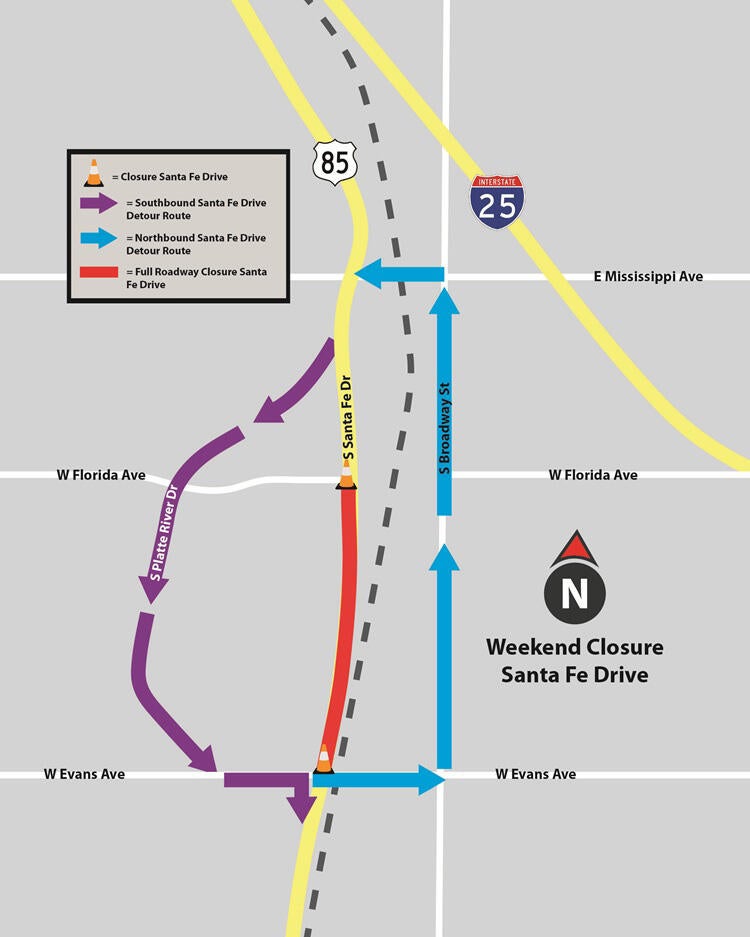
The Santa Fe Drive closure will begin at midnight on Saturday, July 11, and end on Monday, July 13, at 5 a.m. There will be detours in place. This includes:
- Southbound Santa Fe Drive Detour: Traffic will be routed to Platte River Drive to reenter southbound Santa Fe Drive at the West Evans Avenue on-ramp.
- Northbound Santa Fe Drive Detour: Access to northbound Santa Fe Drive will be at Mississippi Avenue via South Broadway Street.
- On-Ramp Closure: The West Evans Avenue on-ramp to northbound Santa Fe Drive will close at noon on Friday, July 10, to prepare for the full weekend closure and will remain closed until 5 a.m. on Monday, July 13. Traffic will be detoured to South Broadway Street to re-enter northbound Santa Fe Drive via Mississippi Avenue.
- Off-Ramp Closure: The southbound Santa Fe Drive off-ramp to West Evans Avenue will close for the full weekend period and remain closed until Friday, Sept. 11, while crews build new sidewalks and perform other concrete work at the southwest corner of the project. Detours will be posted to West Florida Avenue, West Dartmouth Avenue or West Hampden Avenue to bypass the ramp closure
During this closure, DOTI will reopen the underpass on Iowa Avenue. This is a new ADA accessible pathway that will be available between Santa Fe Drive and Acoma Street.

DENVER (KDVR) — Two officers, one now formerly of the Denver Police Department, face multiple charges relating to separate incidents in the past two months.
According to a release, now-former Denver Police Officer Gabriel Lucero was issued a citation for third-degree assault, official misconduct and false reporting, while Officer Javon Leach was cited for reckless driving and eluding.
The incident involving Lucero reportedly occurred on May 22 just before 1 a.m. in the 500 block of 16th Street. According to a release, Lucero was involved in an assault at a business, as he allegedly assaulted a person and walked away as others continued to assault the victim.
Security guards and an off-duty officer escorted him and the group out; however, Lucero reportedly identified himself as a Denver police officer and attempted to re-enter by using his police badge.
Lucero reportedly provided a false name without any other information, and further investigation verified Lucero as the person involved. Lucero was hired in 2025 and, due to his current probationary status, was fired as of Wednesday.
The incident involving Leach occurred around 1:41 a.m. on June 21, when Leach was reportedly pulling out of a parking lot on Larimer Street, attempting to drive against traffic.
Leach reportedly refused commands to stop as he left the area. Officials said he was found just seven minutes later, traveling at high speeds northbound on Park Avenue West.
He reportedly fled a traffic stop and continued to drive away, and officials deemed Leach to be the suspect following an investigation. He was placed in an off-line assignment while the case progresses, as they are considered misdemeanors.
“The Denver Police Department’s administrative review of Leach’s incident will begin once the criminal case is adjudicated, and that process includes the Denver Department of Safety and the Office of the Independent Monitor, a civilian oversight agency,” the release said.
-

 World5 minutes ago
Burnham on course to become next UK PM with backing of 322 Labour MPs
-

 News32 minutes ago
Trump fires last members of election commission, inciting fears of midterm ‘chaos’
-

 Los Angeles, Ca2 hours ago
California teen e-biker baiting police to chase tracked by drone, arrested
-

 Detroit, MI2 hours ago
Our picks for state\nSenate from Wayne Co. | Endorsements
-

 San Francisco, CA2 hours ago
Man reported missing in San Francisco
-

 Dallas, TX2 hours ago
How to buy France World Cup semifinal soccer tickets in Dallas
-

 Miami, FL3 hours ago
Miami-Dade Schools names six semifinalists for superintendent
-

 Boston, MA3 hours ago
Lawsuit: ICE detained East Boston father despite legal status

