West
Defendant in Cash App founder's death found guilty of second-degree murder

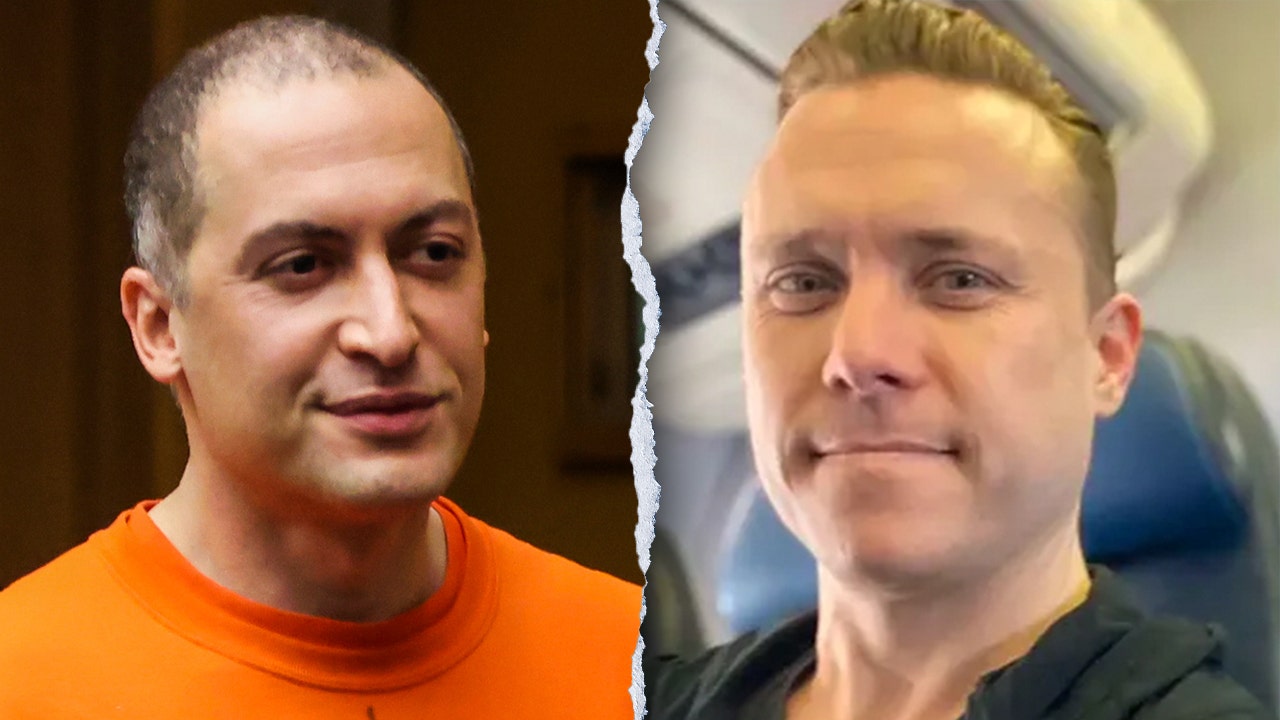
A San Francisco jury found Nima Momeni, the man accused of killing Cash App founder Bob Lee last year, found guilty of second-degree murder Tuesday.
Momeni was found not guilty of first-degree murder. The verdict was read out in San Francisco Superior Court on Tuesday morning local time.
The jury reached their verdict Monday afternoon after seven days of deliberations. He faces 16 years to life in prison.
Prosecutors alleged that Momeni, 40, a self-described tech entrepreneur, stabbed Lee three times with a knife he took from Momeni’s sister’s kitchen set in April 2023.
14 DETAINED IN ARMED AURORA, COLORADO HOME INVASION ARE LIKELY ILLEGAL GANG MEMBERS: POLICE
Nima Momeni, left, was accused of fatally stabbing Cash App founder Bob Lee, right. (Nima Momeni/LinkedIn, Bob Lee/Facebook)
After the verdict was read, Momeini gave no visible reaction, though one of his attorneys put a hand on his shoulder, according to KTVU’s Henry Lee, who was inside the courtroom as the verdict was read.
Bob Lee’s brother, Oliver Lee, praised prosecutors at a press briefing immediately afterward.
“I think it was a very difficult case to prove in this day and age and I think [prosecutors were] up against the wrath of lawyers and a very high-powered defense team that was very expensive and very media friendly… and I think they did a great job,” Oliver Lee said.
He said he wished that the jury had come back with first-degree murder, but conceded: “It is what it is.”
“I know for a fact I’m never going to have my brother back, but this is the best of all worst of outcomes, right? So this is where we are today,” Oliver Lee said.
Asked about how he felt when the verdict was read out, Oliver Lee said: “I thought I was having a heart attack.”
Momeni’s mother, Mahnaz Tayarani Babai, who attended every day of the trial, said defiantly that her son plans to appeal the decision.
“I know my son and he never does (sic) that,” she said. “But this is not a fair trial and we will stand and we will continue. We are strong. We have been in difficult times together.”
Nima Momeni, the man charged in the fatal stabbing of Cash App founder Bob Lee, makes his way into the courtroom for his arraignment in San Francisco on May 2, 2023. (Gabrielle Lurie/San Francisco Chronicle via AP, Pool, File)
San Francisco District Attorney Brooke Jenkins praised her prosecutors and said that the case was about two men in a private fight and not about the general crime rates in San Francisco.
She noted that Elon Musk had drawn nationwide attention to the killing at the time and connected it to crime in the city.
“After Bob Lee was murdered, Elon Musk took to Twitter to make an effort to really shame San Francisco and to make it seem like this was about lawlessness in San Francisco and about what’s going on in our streets,” Jenkins said.
“And we knew it was something different. And I think today proved once again that we are a city committed to accountability. We are a city committed to public safety, and that when something bad happens, which we can’t always control, that law enforcement at every level will respond to make sure that there is justice and accountability in each and every situation.”
SURVEILLANCE VIDEO SHOWS CASH APP FOUNDER USING KNIFE TO SNORT COCAINE BEFORE DEATH, DEFENSE ALLEGES
Prosecutors claimed that Momeni planned and carried out the killing after hearing that the Cash App founder had introduced Momeni’s sister to a drug dealer who she says gave her GHB (Gamma-Hydroxybutyric acid) and other drugs before sexually assaulting her at his apartment. GHB acts as a nervous system depressant.
Momeni lured Lee to an isolated spot by the Bay Bridge where he stabbed him before driving away in his car, prosecutors said. The prosecution said Lee’s blood was found on the blade and that Momeni’s DNA was found on the handle, per KTVU FOX 2.
Bob Lee’s ex wife, Krista Lee, is embraced by Rick Lee, Bob Lee’s father, at the Hall of Justice following Nima Momeni’s murder trial, on Dec. 17, 2024, in San Francisco. (AP Photo/Benjamin Fanjoy)
Momeni’s defense attorney said that he stabbed Lee in an act of self-defense as he tried to fend off an attack by Lee, who snapped over a bad joke. They say Lee was on a multi-day cocaine and alcohol bender and attacked Momeni with the knife over the joke, forcing Momeni to defend himself.
He testified during trial that Lee later walked away, showing no signs he was injured.
Attorneys for Momeni played bombshell surveillance video during closing arguments that they say shows Lee using a knife to snort cocaine hours before his death. They argued it was the same knife that Lee used to confront their client over the joke which led to the altercation.
Momeni testified he stopped his car after going over a pothole that caused Lee to spill the beer he was holding. Momeni said he then cracked a joke suggesting Lee should spend the last night of his visit with family instead of trying to find a strip club to keep the party going.
That’s when he says Lee pulled out the knife from his jacket pocket and attacked.
Bob Lee’s brother, Oliver Lee, praised prosecutors at a press briefing immediately afterward. (AP Photo/Benjamin Fanjoy)
Surveillance video showed the two men leaving the condo of the defendant’s sister, Khazar Momeni, around 2 a.m. on April 4, 2023, and getting into Momeni’s BMW.
Other surveillance footage showed them getting out of the car near the Bay Bridge, where the stabbing took place.
Lee was found staggering on a deserted downtown San Francisco street at 2:30 a.m., dripping a trail of blood and calling for help. He later died at a hospital.
Lee lived in Miami but was visiting the Bay Area when he was killed.
“I made a bad joke. I said if it was my last night in town, I’d go hang out with my family instead of f—— around in strip clubs. It set him off. He just blew up in front of me. He went from zero to one hundred. He was very angry,” Momeni said, according to KRON.
A courtroom sketch depicts Nima Momeni blotting his eyes as the verdict is read in on Dec. 17, 2024. Momeni was found guilty of second degree murder in the 2023 stabbing death of Cash App founder, Bob Lee. (Vicki Behringer)
However, the prosecution has mocked Momeni’s story, pointing out that he never called police to report Lee’s alleged attack or even after he learned Lee had died of stab wounds on the street where he had last seen him.
Lee created the mobile payment service Cash App in 2013 while he was working at Block, formerly known as Square. The app is a digital wallet which allows users to send, receive or save money.
Fox News’ Greg Norman and The Associated Press contributed to this report.
Read the full article from Here



Golden Gate Bridge fireworks will be a rare patriotic event
This year on July 4th, for the third time in history, an organized fireworks display will be held at San Francisco’s iconic Golden Gate Bridge. This only happned in twice before in 1987 and 2012 for the bridge’s 50th and 75th annivesary. Expect crowds to be massive and public transportation, ride shares and simply walking is highly recommended.
SAN FRANCISCO – San Francisco is preparing for its major July 4th fireworks display on Saturday night, an event expected to draw massive crowds as pyrotechnics are launched directly from the Golden Gate Bridge for only the third time in history.
Will crowds flood Marina?
What we don’t know:
To pull off the event, the Golden Gate Bridge, major roadways, and key parking lots at Marina Green and Crissy Field will be shut down.
Several neighborhood streets will also be blocked off, creating significant traffic hurdles. Officials are strongly advising spectators to utilize public transit due to severely limited parking.
Local residents in the Marina District have expressed concern over the impending chaos as crowds flood the neighborhood.
“I’m a little worried, yeah,” said nearby resident Michael Zoboski. “I think it’s gonna be definitely hectic. I don’t know where people are going to park, it seems like it’s taking up a large amount of the streets up here. I think it’s going to be a little crazy.”
To manage the influx, access to many surrounding neighborhoods will be strictly limited to local residents.
Checking IDs
What we know:
Law enforcement officers will be checking IDs and questioning drivers to verify residency. According to the district supervisor, there will be 10 police officers deployed per block in the Marina.
Road closures will stretch from Baker Street to Van Ness Avenue between 8 p.m. and 11 p.m.
Portions of Fisherman’s Wharf are scheduled to shut down even earlier, starting at 1 p.m. Saturday afternoon, with much of that neighborhood also restricted to local access. The Golden Gate Bridge itself will close to traffic starting at 9 p.m.
Additionally, roads will be closed in the Presidio and Richmond District. To encourage the use of public transportation, Muni is providing special shuttles to help transport spectators to the viewing areas.
The Source: Marina neighbors, Muni, San Francisco city website

There have been many great offensive linemen in Denver Broncos history, so this list is likely going to vary greatly from person to person. In fact, my take might be a little too bold, but I’m sticking with it.
At the top spot, I think Garett Bolles has earned it. Since coming into the league as a first-round pick in 2017, he has grinded through one of the worst periods in Broncos’ history and grown from beleaguered oft-penalized first-round bust into a perennial All-Pro caliber left tackle. Even more, he has stayed a Bronco through his entire career. The rest of my list speaks for itself and is a throwback to Super Bowl greatness.
Here’s where our Mile High Report staff landed on the top five for offensive line:
Scotty Payne: Tom Nalen was the leader of Mike Shanahan’s offensive line, Ryan Clady was a top LT on a Hall of Fame career before injury and Stink was a key member of the Broncos Super Bowl winning OL back in the 90s. I included Bolles and Meinerz since both will be on this list once their successful careers are over with.
Chris Hart: This position group was one of the toughest to come up with a top five. Denver has an incredible history of top-tier offensive lineman. There are several players I left off who were certainly deserving. I posted Tom Nalen as my top guy because he was a stalwart at the pivot for many years for the franchise. We all know what Gary Zimmerman and Mark Schlereth provided on the field and they are both Super Bowl champions. The last two spots go to two recent Broncos, left tackles Garret Bolles and Ryan Clady. Bolles, a decade into his career, continues to play at a high level and Clady was a fantastic blindside protector whose career ended earlier than it should due to injury.
Ian St. Clair: For the first time in Elway’s career, he had a blind-side protector. And Zimmerman is one of the best to ever do it. Same for Nalen, who should be in the HOF. Clady was special. Bishop was the first Broncos offensive lineman in franchise history to get a Pro Bowl invite and provided one of the best in-game quotes ever when he said in Denver’s endzone at old Cleveland Stadium before hiking the ball at the 2-yard line in what would become The Drive, “We got ‘em right right where want ‘em.” And Schlereth helped lock down the left side of the line that was one of the best in league history.
Sadaraine: The top 3 are largely indisputable, other than maybe swapping Schlereth and Zimmerman. Ken Lanier started 178 consecutive games, which is nuts for an OT, and appeared in 3 Super Bowls. Garret Bolles has crafted himself into an all-time great at tackle and may move up the list.
Ross Allen: The Hall-of-Famer Gary Zimmerman was everything you could ever ask for in a left tackle and was a huge reason why John Elway and that 1997 team was so dominant. Schlereth also gets his credit as he was a massive contributor to Denver’s Super Bowl successes. There’s a strong case for Tom Nalen deserving a spot in the Hall of Fame too. And for the past two years I’ve become a huge spouter of Bolles being destined for the Ring of Fame. He’s an incredible talent as has been the cornerstone of this team for a while now. I just hope he gets his Super Bowl.
Joe Mahoney: Top 3 are a no-brainer. Bolles will finish his career with more starts on the OL than any other Bronco. The man he will pass is Ken Lanier. Since stats from Lanier’s era don’t exist we only have starts to go off, but Lanier was an iron man. He started 167 NFL games and 165 were for the Broncos.
There is a bit of variation here, but a general consensus of who should be in the Top 5. I loved the throwback to Keith Bishop who was a big part of the John Elway fourth quarter magic back in the day.
Who gets into your top five offensive lineman list?

SEATTLE — Fireworks are set to light up the sky above Lake Union on Saturday night as Seattle marks America’s 250th birthday on the Fourth of July.
Crews are preparing more than 7,000 pounds of fireworks for the Seafair show over the water, with hundreds of thousands of spectators expected at Gas Works and Lake Union parks.
This year’s festivities come as visitors from around the globe are in Seattle ahead of another World Cup match featuring Team USA on Monday.
One major change for this year’s celebration is that Gas Works Park will be gated off and will require tickets for entry. Seafair organizers say the new system is intended to help manage the expected increased capacity and keep spectators safe.
RELATED | Boom! Here’s where to catch 4th of July fireworks in and around Seattle
Planned activities during the day on Saturday include an interactive Seafair coloring wall and all-American games, where people can compete in a pie-eating contest, sack races, and a water balloon toss. Musical performances are scheduled to start at 5 p.m.
Free parking is available in the surrounding Gas Works Park neighborhood, but finding a spot is expected to be difficult. Organizers are urging people to give themselves extra time and consider rideshare, carpooling, or public transportation.
Fireworks sales and setting off fireworks are illegal in many areas of western Washington, making large public shows a safer option for many people.
Spectators at Gas Works Park will notice some changes this year. The city recently removed ladders, catwalks, and platforms from the structures there after the death of a 14-year-old last summer.
The teen’s family said the city failed to address dangerous conditions around the park’s towers despite years of warnings and several injuries.
BE THE FIRST TO COMMENT
The Lake Union fireworks are expected to start at roughly 10:15 p.m. Saturday.
-

 Videos37 minutes ago
Iran gets ready for Khamenei’s funeral • FRANCE 24 English
-

 Los Angeles, Ca49 minutes ago
2 arrested after 3 LASD deputies injured during East L.A. World Cup celebration
-

 Detroit, MI1 hour ago
Ex-girlfriend in custody after Taylor man found fatally stabbed, police say
-

 San Francisco, CA1 hour ago
Marina braces for Golden Gate Bridge fireworks show, massive crowds
-

 Dallas, TX1 hour ago
Maradona’s ‘Hand of God’ ball heads to auction in Dallas
-

 Miami, FL1 hour ago
Miami-Dade sheriff urges residents to celebrate Fourth of July safely
-

 Boston, MA2 hours ago
Jaylen Brown says Celtics showed ‘lack of respect’ after trade to 76ers – The Boston Globe
-

 Denver, CO2 hours ago
Who are the Top 5 offensive linemen in Denver Broncos history?

