Connect with us

California

Closer look at early voting numbers on eve of Election Day in California

Published

on

Closer look at early voting numbers on eve of Election Day in California


SACRAMENTO — On election eve, early voting was pointing to historic turnout numbers. The picture is becoming clear of who is voting ahead of Election Day and who is not. 

Paul Mitchell with Political Data Incorporated crunched the numbers, which show that there is a wide gap between younger and older early voters. 

“We’re still getting data in, so we just got another little update,” Mitchell said. “Seniors are up to 58% turnout and young voters are at 18% turnout.” 

In California, 31% of registered voters have already cast their ballots as of the day before Election Day. 

Advertisement

Michelle Macey cast her ballot in Sacramento County, becoming one of the thousands to take part in early voting here. 

“I have to get my vote in,” Macey said. “I’m just nervous because it’s coming down to the wire.”

By county, Sacramento was also at 31%, while San Joaquin and Stanislaus were at 29%. 

“We still have an environment where older voters vote early and young voters vote late, and that means that campaigns right now are knocking on doors,” Mitchell said. 

Bill O’Neill, the El Dorado County registrar of voters, has watched his county’s early numbers thrive. 

Advertisement

“I think, right now, based on the number of ballots we’re processing, we’ll be number one pretty soon,” O’Neill said. 

The top three California counties for voter turnout so far were Amador at 52%, Nevada at 52%, and El Dorado at 48%. 

In El Dorado County, 70% of registered voters 65-plus have already cast their ballots. 

For those who are waiting until Election Day to cast their ballots, the political competition poses a different challenge. 

“There’s a saying, particularly on the Democratic side of races, that the opposition is not the Republican on the other side of the ticket. The opposition is the couch. It’s Kamala Harris versus the couch,” Mitchell said. 

Advertisement

So far, the numbers show Lake County has reported the fewest ballots returned so far with 13%.


Source link

California

Central California Women’s Facility Hosts Groundbreaking Film Festival, Showcasing Incarcerated and Formerly Incarcerated Filmmakers – News Releases

Published

on

Central California Women’s Facility Hosts Groundbreaking Film Festival, Showcasing Incarcerated and Formerly Incarcerated Filmmakers – News Releases


WHAT YOU NEED TO KNOW: CDCR hosted a first-ever film festival celebrating the work of incarcerated and formerly incarcerated filmmakers inside a women’s correctional facility. The San Quentin Film Festival held its first event outside of San Quentin Rehabilitation Center on March 28, bringing the festival to Central California Women’s Facility (CCWF) in Chowchilla. The event featured screenings of award-winning short films from the 2025 San Quentin Film Festival, followed by a filmmaker panel moderated by comedian and television host W. Kamau Bell. Awards were presented for a Narrative and Documentary Pitch Competition, open exclusively to incarcerated women at CCWF and the California Institution for Women. The event also included a “Women in Film” panel and Q&A, providing incarcerated women insight into the entertainment industry and an opportunity to interact with working professionals in the industry.

____________________________________________________________________________________________________

“San Quentin Film Festival at CCWF offers incarcerated participants a powerful platform for self-expression and storytelling, and valuable exposure to the film industry and potential career pathways.”

CDCR Secretary Jeff Macomber

Advertisement

_______________________________________________________________________________________________________

BIGGER PICTURE: The California Department of Corrections and Rehabilitation (CDCR) is committed to rehabilitation and reentry, providing incarcerated people with the tools they need to successfully and safely reenter their communities. The San Quentin Film Festival is an example of this commitment, offering incarcerated filmmakers mentorship and an opportunity to be recognized for their work. Since its inception, participants have leveraged their media experience gained at the festival to pursue careers in the film industry after release, including earning internships and job opportunities.

FILM FESTIVAL DETAILS: The San Quentin Film Festival was created in 2024 by award-winning playwright, screenwriter and author Cori Thomas (Lockdown, When January Feels Like Summer) and formerly incarcerated filmmaker, podcaster and writer Rahsaan “New York” Thomas (Friendly Signs, What These Walls Won’t Hold).

_________________________________________________________________________________________________________

“We are deeply moved to be playing a small part in helping to even the playing field for these women. We hope the experience will empower them to tell their own stories and bring their unique perspectives to the table, and that today’s event will lead to additional industry engagement.”

Advertisement

Cori Thomas, SQFF Co-founder and Artistic Director

___________________________________________________________________________________________________________

Narrative Pitch Competition winner Untitled (Amber) Krysten Webber

Narrative Pitch Competition Winner
Untitled (Amber)
Krysten Webber

Diana Lovejoy, filmmaker of Desert Blossoms

Documentary Pitch Competition Winner
Desert Blossoms
Diana Lovejoy

AVAILABLE FOR DOWNLOAD 

Photos       

B-roll 

Advertisement

CONTACT: CDCR PRESS OFFICE OPEC@CDCR.CA.GOV

FOR IMMEDIATE RELEASE


Source link

Advertisement
Continue Reading

California

The race to drop César Chávez’s name has begun. These experts have advice

Published

on

The race to drop César Chávez’s name has begun. These experts have advice


Ten days since sexual abuse allegations were disclosed in a chilling New York Times investigation against farmworkers rights advocate César Chávez, the race to erase his name and likeness from public life is moving at a breakneck pace.

Municipal governments and agencies from the Bay Area to Phoenix, Denver and Texas are removing statues, renaming his holiday (March 31) and cutting mentions from history classes and beyond.

While action has been quick in removing Chávez’s name, there has been plenty of debate on how best to move forward.

A similar process played out a few years back in Burbank, when a student-led investigation propelled the changing of David Starr Jordan Middle School to, coincidentally, farm labor leader Dolores Huerta.

Advertisement

Four years removed, the school’s former principal, Jennifer Meglemre, and a former Burbank Unified Board of Education member, Steve Frintner, have advice for those not sure how to navigate a controversial name change.

Burbank name change background

In early 2018, Jordan student Ixchel Sanchez Jimenez investigated her school’s namesake as part of a class project.

What she found led her and her mother, Laura Jimenez, to push for a name change in May 2018.

Jordan was known for being the founding president of Stanford University and a famed ichthyologist, or fish scientist.

But he was also a believer and supporter of eugenics, a system of controlled breeding and separation of certain people to increase the chances for desirable heritable characteristics. It was a belief espoused by the Nazis.

Advertisement

University of Vermont associate professor and historian Lutz Kaelber estimated that roughly 20,000 people in California deemed undesirable were forcibly sterilized until 1964 due to eugenics policies. Most were sterilized because they were believed to be mentally ill or mentally deficient.

The name-changing process

Burbank Unified set up committees to debate the topic, first to decide whether there should be a name change, and then what the new name should be.

The committees took input from students, teachers, administrators and community members.

Frintner said it was critical not to rush the decision and allow for thorough conversations.

“It’s important to make sure you’re giving people in the community a voice because they want to feel a part of this process,” Frintner said.

Advertisement

After agreeing to drop Jordan, Burbank Unified’s renaming process centered on a few considerations: should the school replace David Starr with another notable Jordan (Texas lawmaker Barbara Jordan), should the school be named after another individual or something less contentious like a tree or a street.

Those decisions mirror the current Chávez debate. Los Angeles is changing César Chávez Day to Farm Worker’s Day, while some advocates, including former farmworkers, are asking that Chávez be replaced with Dolores Huerta, the civil rights leader who fought alongside the man who allegedly raped her.

Resistance to change

Meglemre said resistance to the school name change came from all sides: from those not wanting to drop Jordan and others who did not want the school renamed for a living person.

“The discussions were about how people are flawed and we don’t want to get into a situation where something is named after a person still alive and something terrible ends up happening,” Meglemre said.

After three years of debate, hampered in part by COVID-19, the committee settled on Dolores Huerta. (César Chávez was never a top contender.)

Advertisement

“Almost all the schools in Burbank are named after a person and we wanted to continue that tradition,” Meglemre said.

Frintner said the district committees wanted to choose someone with Southern California ties and was either a minority or a woman.

Last piece of advice

Meglemre said that while there was heated debate and pushback from community members, after a couple of years, most people “moved on with their lives.”

Frintner believes more research is always a positive.

“My advice is make sure you’re doing as much background as possible,” he said. “You do want to honor people but you don’t want to be in a position where you’re having a hard time defending your decisions.”

Advertisement

The week’s biggest stories

(Carlin Stiehl/For The Times)

No Kings Protests

Animal encounters

Theft, fraud allegations

Crime, courts and policing

What else is going on

Must reads

Other meaty reads

For your downtime

 Alfonso "Poncho" Martinez and Evelyn Gregorio of Lugya'h stand for a portrait.

(Juliana Yamada/Los Angeles Times)

Going out

Staying in

L.A. Timeless

A selection of the very best reads from The Times’ 143-year archive.

Have a great day, from the Essential California team

Jim Rainey, staff reporter
Hugo Martín, assistant editor, fast break desk
Kevinisha Walker, multiplatform editor
Andrew J. Campa, weekend writer
Karim Doumar, head of newsletters

Advertisement

How can we make this newsletter more useful? Send comments to essentialcalifornia@latimes.com. Check our top stories, topics and the latest articles on latimes.com.


Source link

Continue Reading

California

Eye-biting black flies are ‘like little demons’ in San Gabriel Valley, residents say

Published

on

Eye-biting black flies are ‘like little demons’ in San Gabriel Valley, residents say


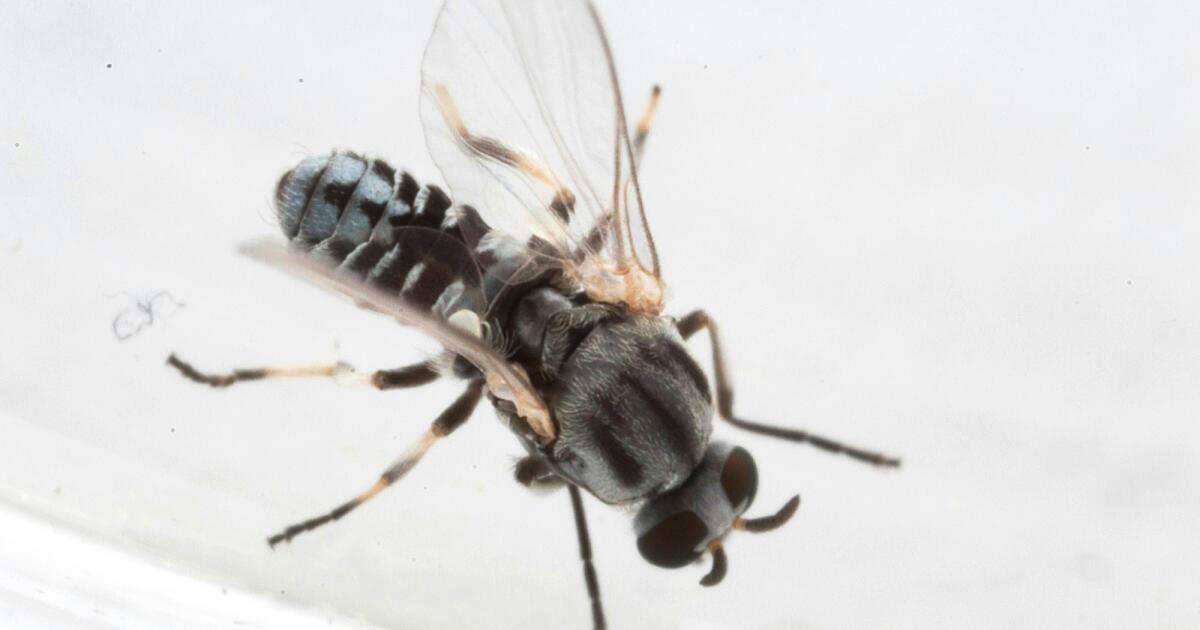
Residents in the San Gabriel Valley are contending with a dramatic surge in black flies, a painful little pest known for biting around the eyes and necks of people and pets.

The San Gabriel Valley Mosquito and Vector Control District issued a warning this week advising residents of a spike in black fly activity in foothill communities including Altadena, Azusa, Bradbury, Duarte, Glendora, Monrovia, San Dimas and Sierra Madre. The flies develop quickly in flowing waters, where females will lay 200 to 500 fertilized eggs at a time.

“Black flies are currently very active in the San Gabriel Valley, and many residents are feeling overwhelmed,” the district said in a statement. “Right now, populations are increasing due to favorable conditions, and black flies can travel up to five miles from where they emerge, which is why they’re being seen throughout the community.”

The district is treating river breeding sites to reduce populations, but warns this might take several weeks to take effect.

Advertisement

In the meantime, residents are advised to take protective measures such as wearing long pants and long sleeves and using protective netting over one’s face. People should also consider using DEET-containing repellent on exposed skin and turning off personal water features such as decorative fountains for 24 hours once a week, according to the district.

The bugs, measuring two to three millimeters, are so small they can be hard to see. Still, their bite can pack a painful punch.

Azusa resident Constance Yu described the persistent bugs as “like little demons but tiny,” while she swatted away the critters during an interview with CBS News this week.

Though the flies cause discomfort, they are not known to transmit diseases in L.A. County, according to the vector control district.

Spikes in black fly activity are often caused by scheduled water releases from upstream dams, which are necessary for the region’s water management but also create ideal breeding conditions for the pests.

Advertisement

The district monitors and sprays pesticides at breeding sites — including local rivers, streams and locations such as Morris Dam — and sets traps in foothill communities to track the population size and minimize the effects on residents.

This time last year, surveillance traps had single-digit counts of black flies. Now they are capturing more than 500 flies at a time, district spokesperson Anais Medina Diaz told LAist.

Diaz also said it is usual to see such so much fly activity this time of year, noting that the uptick is probably connected to the recent record-setting heat wave. Southern California is experiencing the hottest March on record, leading to a surge in snow runoff from the mountains.

“We are experiencing them now because of the warmer temperatures we’ve been having,” Diaz said. “And of course, all the water that’s going down through the river, we have a high flow of water that is not typical for this time of year.”

The black flies are not the only troublesome creature acting up during the unseasonably warm weather.

Advertisement

The Southland has also seen more rattlesnakes, with two recent human fatalities, as the early heat draws more serpents onto hiking trails. Toasty ocean temperatures have been linked to a great white shark sighting in Newport Beach that prompted a temporary beach closure Thursday.


Source link

Continue Reading

Trending