Lifestyle
How one man in East L.A. ended up with the world's most famous feet


In an overstuffed workshop in East L.A., Chris Francis reached out a heavily tattooed arm and pulled a single shoe box from one of the floor-to-ceiling shelves lining the walls.
“Anjelica Huston,” the shoemaker and artist said. “Let’s see what’s in here.”
Removing the top of the box, he revealed two carved wooden forms known as shoe lasts that cobblers use to make their wares. Beneath those were strips of yellowing shoe patterns and a tracing of the actor’s foot with a note written in loopy cursive:
To Pasquale
My happy feet shall thank you
— Anjelica Huston
The Di Fabrizio collection includes shoe measurements for stars like Nancy Sinatra, Kim Novak, Joe Pesci and Madeline Kahn, all adorned with green, white and red striped ribbon.
(Allen J. Schaben / Los Angeles Times)
“Cool, huh?” Francis said, gazing reverently at the box’s contents. “Every time I open one it’s amazing. It’s like Christmas all the time.”

-
Share via
For the last three years, Francis has been surrounded by a sprawling archive of famous feet originally amassed by Pasquale Di Fabrizio, the late shoemaker to the stars. From the early ‘60s to the early 2000s, Di Fabrizio created custom footwear for the rich, famous and notorious out of his humble shoe shop on 3rd Street.
The shoes went to his customers, but his voluminous collection includes shoe lasts, patterns, drawings, correspondences, leather samples and handwritten notes from thousands of clients, all stored in cardboard shoe boxes that the Italian immigrant trimmed with green, white and red striped ribbon.
The names, written in bold Magic Marker on the front of each box are a who’s who of entertainers from the ‘60s, ‘70s, ‘80s and beyond: Liza Minnelli, Tom Jones, Richard Pryor, Robert De Niro, Sarah Jessica Parker, Bea Arthur, Arsenio Hall, Nancy Sinatra, Ace Frehley. The list goes on and on.

Francis found foot measurements, wooden shoe lasts and a shoe in progress that Pasquale Di Fabrizio made for Ginger Rogers in a box marked with her name.
(Allen J. Schaben / Los Angeles Times)

“Shoe Machine” is one of Chris Francis’ art pieces that he has shown at museums.
(Allen J. Schaben / Los Angeles Times)
“So many great people stood on these pieces of paper,” Francis said, looking at the stacks of boxes around him. “Roy Orbison. Eva Gabor. Stella Stevens. Lauren Bacall. I could pull these down all day.”
Francis never met Di Fabrizio, who died in 2008, but in 2022 he traded two pairs of his sculptural shoe-art pieces to Di Fabrizio’s friend and fellow shoemaker Gary Kazanchyan for the entirety of the Italian shoemaker’s archive. Three years later, Francis is still making his way through it all.
The amount of material is overwhelming, but he is committed to preserving Di Fabrizio’s legacy. Ultimately, he wants to find a space where he can share it with others.
“I never want to be without it, but I’m realistic that it deserves to be appreciated by more than just myself,” he said. “If my life’s work ended up in somebody’s hands, I don’t think I’d want them to just keep it for themselves forever.”
A shoemaker’s journey
Francis isn’t just cataloging L.A.’s shoemaking history, he’s helping to keep it alive.
Over the last decade and a half he’s made a name for himself as a custom shoemaker, creating handmade bespoke footwear for rockers like former Runaways guitarist Lita Ford and Steve Jones of the Sex Pistols, as well as sculptural art shoes that are displayed in museums like the Craft Contemporary, the Palm Springs Art Museum and SCAD FASH in Atlanta.

Wooden shoe lasts hang from the ceiling as Chris Francis works on a shoe for the singer Lita Ford in his garage.
(Christina House / Los Angeles Times)
In his East L.A. workshop, he eschews modern technology, focusing instead on traditional methods of shoemaking, often with hand tools.
“The handmade shoe is alive and well in this shop,” he said, dressed in pressed black slacks and tinted sunglasses, chunky gold rings gleaming on his fingers. “There’s no computer here, and even the records half the time are vinyls or 78s.”
Making shoes by hand is time-consuming and expensive work — Francis doesn’t sell a pair of shoes for less than $1,800 — but for his mostly musician clientele, a sturdy, custom-made, comfortable shoe that also boasts over-the-top style is well worth the price.
“At my price point, my customers are buying something that’s really a tool,” he said. “It’s part of their look, but it also has to hit 27 guitar pedals, keep all of its crystal, be beautiful, last multiple tours and they have to be able to stand in it all night.”
Francis, who has a certain aging-rocker swagger himself, never expected to become a shoemaker.
After going to art school and hopping freight trains for several years, he moved to Los Angeles in 2002 originally to join the Merchant Marines. Instead he found work hanging multi-story graphics and billboards on the side of hotels and high-rises on the Sunset Strip and at casinos in Las Vegas. “That gave me the same thrill of riding a freight train,” he said. “Being on a high-rise building and rappelling down.”

Francis found fabric samples and designs for shoes that Pasquale Di Fabrizio made for a Broadway production of the musical “Marilyn: An American Fable.”
(Allen J. Schaben / Los Angeles Times)

Shoemaker and artist Chris Francis makes shoes the traditional way in his workshop in East Los Angeles.
(Allen J. Schaben / Los Angeles Times)
He discovered he had a knack for pattern making in 2008 when he began creating hand-stitched leather jackets to wear to the Hollywood parties he had started attending with his now-fiancee. One day a stranger approached him and said she knew someone who would appreciate a jacket like the ones he was making. She was a stylist for Arnel Pineda, the lead singer of Journey. Commissions from Mötley Crüe and other rock bands followed.
A few years later he became interested in making shoes, but although he knocked on the door of several shoe shops in town, he couldn’t find a mentor.
“They didn’t have time, or they’d say, ‘You belong in a rock and roll band, you’re not one of us,’” he said. “But I would say, ‘Just teach me one thing, one trick.’ And everyone had time to teach one trick.”
It was an education in much more than shoemaking.
“Almost every shoemaker I met had immigrated to the country,” he said. “So I learned how to make shoes from the Italians, from guys from Armenia, Iran, Iraq, Russia, Syria, from everybody. And while doing so, I learned about all these different cultures.”
‘He was the king’
As Francis dove deeper into the history of shoemaking in Los Angeles, one name kept coming up again and again: Pasquale Di Fabrizio.

The late Pasquale Di Fabrizio, a cobbler to the Hollywood elite, photographed in front of his collection of shoe lasts, circa 1982.
(Bret Lundberg / Images Press / Getty Images)
“I started asking other makers about him, and they were like, ‘Oh yeah, we remember him,’” Francis said. “He was the king.”
For more than 50 years Di Fabrizio was the most sought after shoemaker in Los Angeles. He made Liberace’s rhinestone-encrusted footwear and shod Mickey Mouse, Goofy and Donald Duck for touring productions of Disney on Parade. He was the go-to shoemaker for country western stars, Vegas showgirls, Hollywood movie stars, gospel singers and casino owners. The Rat Pack helped put him on the map.
“My best customer is Dean Martin,” Di Fabrizio told The Times in 1972. “He buys 40 pairs a year.”
Sporting a thick, bristled mustache and oversize glasses, Di Fabrizio had a tough reputation. He once kicked a movie star out of his shop because the star brought back a pair of patent leather shoes that he claimed were defective. Di Fabrizio accused him of missing the urinal and peeing on them at the Oscars.
“Never come back here again,” he said in his thick Italian accent.
The shoemaker occasionally made house calls, but his customers mostly came to him. In his workshop on 3rd Street near Crescent Heights, he would trace their bare feet on a piece of paper and measure the circumference of each of their feet at the ball, around the arch, the heel and the ankle. Then he would customize a pre-carved wooden last from Italy, adding thin pieces of leather 1 millimeter at a time to more perfectly mimic the unique shape of the client’s foot.
The size and shapes of the lasts varied wildly. He once told a reporter that it took “half a cow” to make shoes for Wilt Chamberlain, who wore a size 15. In his archives, Francis found a petite high heel shoe last roughly the length of his hand.

Francis holds a foot tracing and shoe lasts made for Robert De Niro by Pasquale Di Fabrizio.
(Allen J. Schaben / Los Angeles Times)
“Di Fabrizio did lots of shoes for little people,” Francis said. “He really offered an important service for that community. They could have formal footwear rather than having only the option of wearing kids shoes.”
The same lasts could be used over and over again to make several pairs of shoes, as long as the heel height was the same. Each last went in its own box decorated with a ribbon in the colors of the Italian flag.
“It’s so simple, but he claims his territory with that ribbon,” Francis said. “He cared enough to take one extra step. It’s what really made that collection iconic.”
A legacy preserved
Francis first encountered Di Fabrizio’s archives in 2010 when Kazanchyan offered him a job at Andre #1 Custom Made Shoes on Sunset Boulevard. Kazanchyan inherited the shop from his uncle, Andre Kazanchyan, who once worked with Di Fabrizio and became his good friend.
Gary Kazanchyan and Di Fabrizio were close as well. When Di Fabrizio retired in the early 2000s, Kazanchyan hired all of the guys who worked at his shop. Di Fabrizio was at Kazanchyan’s wedding and when the older shoemaker was in a nursing home at the end of his life, Kazanchyan visited him every day.
For years Kazanchyan stored as many of the ribbon-trimmed boxes as he could fit in his Hollywood shop, but just before COVID he moved his shop to his garage in Burbank and transferred Di Fabrizio’s archives to his backyard. “At one point, my whole backyard was this mountain of shoe lasts,” he said.

Chris Francis, left, and Gary Kazanchyan at Palermo’s Italian Restaurant in Los Feliz.
(Deborah Netburn / Los Angeles Times)
Kazanchyan started a renovation on his house in 2022 and could no longer store Di Fabrizio’s archive in his backyard. He’d sold some of the most famous shoe lasts at auction — a bundle of Di Fabrizio’s shoe lasts for Frank Sinatra, Dean Martin and Sammy Davis Jr. went for $4,375 in 2013 — but he still had several tons of material stacked on pallets and covered in tarps. He remembered that Francis loved the collection, so he called him and asked if he wanted it. Francis did.
Francis didn’t have the money to purchase the collection in cash, but he offered Kazanchyan two art pieces that he’d exhibited and Kazanchyan accepted. The first carload of boxes Francis took to his studio included lasts for Wayne Newton, Paula Abdul, Ginger Rogers, Burt Reynolds and Sylvester Stallone.
“My excitement was on fire,” he said.
Francis spent a few weeks sorting through the archive and discarding lasts and shoe boxes that were too covered in mold or deteriorated to be worth keeping. Just before a rainstorm threatened the rest of the collection, he brought thousands of shoe lasts to his studio but even now regrets that he was unable to save it all.
“I tried to grab the big names, but there was so much I couldn’t keep,” he said. “It was heartbreaking.”
The boxes hold stories — and life lessons
Living and working among the Di Fabrizio collection has taught Francis a lot more than just the art of making shoes.
“I’m constantly seeing the obituary of a celebrity who has passed and I go to the workshop and there’s their box,” he said. “It really lets you know that life is for the living. It’s up to you to be responsible and live your life when you’re alive. Be yourself, teach others, leave something behind.”
Hanging onto the collection has not been easy — but Francis believes he was chosen from beyond to care for Di Fabrizio’s archive and to share it with others responsibly.
He’s still not sure what that will look like, but he’s determined to try.
And in the meantime, he is also determined to keep the traditional art of shoemaking alive in Los Angeles.
If you look around his workshop, you’ll spot several boxes adorned with red, white and blue striped ribbon.
Francis is making those boxes his own.

Working with hand tools, Chris Francis makes a custom pair of shoes for musician Lita Ford.
(Christina House / Los Angeles Times)



In central London’s Waterloo Place, a life-size statue that emerged overnight in late April has been creating a stir. When I visited a few weeks after it was erected, local authorities had already set up protective barriers around it.
The installation — signed by the famed street artist Banksy — depicts a man in a suit hoisting a flag as he strides over a precipice. As he marches on, the flag blows backward to cover his face, leaving him unaware he’s only a step away from a perilous fall.
Set among grand monuments celebrating Britain’s past, the “flag man” takes on a particular visual irony at a time when the country — and much of the world — is debating its path forward.
Like many viewers there, I found myself wondering whether this statue is Banksy’s warning about the consequences of uncritical nationalism, or simply a reflection on human shortsightedness. Or, perhaps, it is just prompting us to ponder a broader question: What happens when devotion to a symbol prevents us from seeing what lies ahead?
Whatever the message, the work feels remarkably attuned to the current moment.
For more Far-Flung Postcards, click here.
Lifestyle
Wait, it’s a candle? Her beeswax fruit and veggie ones look so real, you’ll want to take a bite
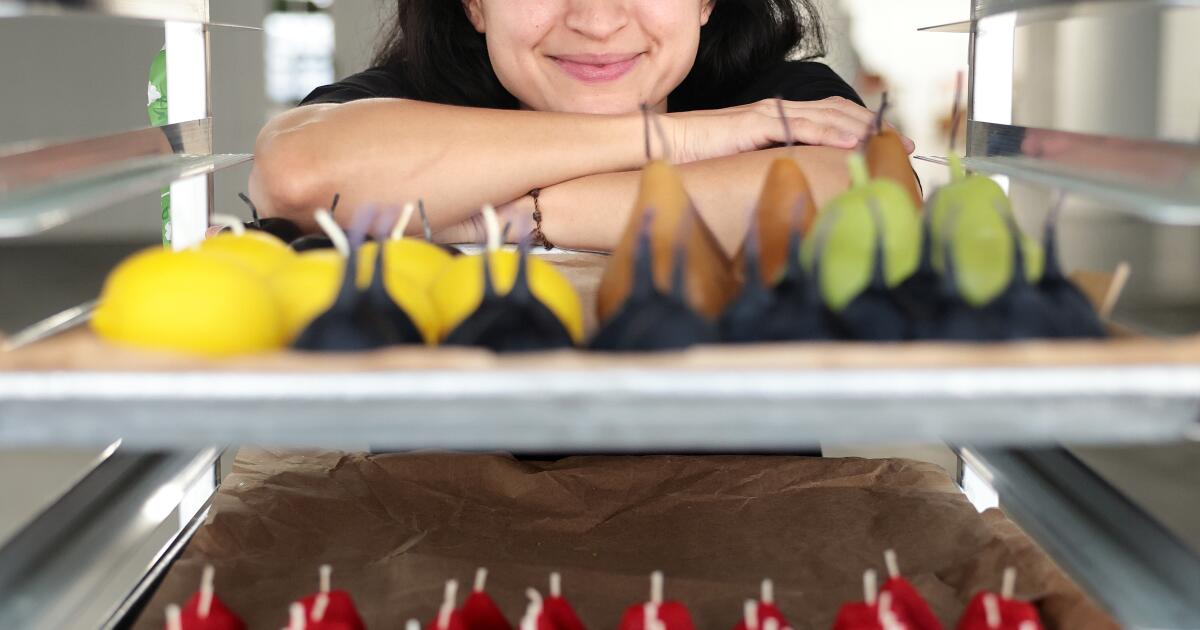
Jessica Gonzalez hustles behind her booth at the recent Renegade Craft Fair, frantically ringing up sales, answering questions and packaging her beeswax candles.
It’s hot on the grounds of the Los Angeles State Historic Park in April, but 35-year-old Gonzalez and her fiancé, Jordan Colindres, keep their cool as a crowd gathers to admire her Happy Organics candle collection, a homage to her family’s produce company in the Central Valley that looks like real fruits and vegetables.
“I love doing in-person events because it’s so fun to see people’s reactions,” she said a few months later. “It makes me feel good to see other people finding joy in my candles. They often say, ‘Oh, that’s really funny.’ And it is funny to have a cherry candle on top of your birthday cake.”

3

1. A staff member pulls a beeswax corn candle, $26, out of its mold at Happy Organics’ studio in downtown Los Angeles. 2. Each Beeswax Mixed Berry Birthday Candles set is cast from real mixed berries — strawberries, raspberries, blackberries, blueberries and cherries. A set of 10 is $30. 3. Bartlett green pears and heirloom tomatoes, $24 to $40.
Judging by the smiles and charmed looks on shoppers’ faces, her produce-inspired candles are less about illuminating rooms and more about sharing the joy she sought when she first started the company in 2018.
In this series, we highlight independent makers and artists, from glassblowers to fiber artists, who are creating original products in and around Los Angeles.
But then, it’s hard not to smile at the playfully elegant Bosc pears, puckered mandarins and green-and-purple asparagus taper candles which range in price from $12 to $40. Some are molded into corn on the cob, celery and rhubarb shapes. Others are made to look like mushrooms, figs, tomatoes and snap peas. The most popular are the small birthday candles shaped like raspberries, cherries and blackberries, packed in molded-pulp baskets just like you’d find at the grocery store or farmers market.

-
Share via
Gonzalez didn’t start out as a designer. The youngest of nine children, she was born in 1991 in Salinas and later moved to Merced, where she grew up on a 10-acre farm. She studied computer science at Mills College, then worked in tech consulting in the Bay Area and eventually became the CTO of an ag-tech company. When her mother, Angela, became ill in 2016, she returned to Merced to be with her family.
When her mom died suddenly soon after she moved home, Gonzalez left the tech industry. “I wasn’t connected with what I was doing,” she said. “I wanted to find something more meaningful; something I loved. I didn’t want my ego to keep me stuck in what I studied in college. I decided to let myself try new hobbies and passions and look for joy again.”
After her mother’s death, she began working with her father, Salvador, and her uncles at the family’s apiary, where they managed more than 30 hives. (Her grandfather was also a beekeeper in Michoacán, Mexico.) Soon, she began selling their raw honey at local farmers markets. In a heartbreaking turn, her father was diagnosed with cancer a year later, so she started making cannabis-infused honey, balms and chocolates to help ease his pain.
When she saw that the beeswax candles, which last significantly longer than paraffin candles, were selling faster than the honey, she decided to focus on making candles from the leftovers from her uncles’ hives.
She was only 25, but it was a turning point. “It was one of those moments where I felt like I needed to change my path,” she said. “I needed to change everything in my life.”

Jessica Gonzalez and her father Salvador on their family farm in Merced. (Gonzalez family)

Gonzalez at Happy Organics’ studio in downtown Los Angeles. (Christina House / Los Angeles Times)
When her father died in 2018, she inherited his bees and started Happy Organics, although she hadn’t planned on starting a business. After experiencing so much loss, making candles became a kind of therapy. “It felt great to work with my hands again, something I thought I’d never have time for,” she said.
Her oldest sister, Sonia Gonzalez, said Gonzalez reminds her a lot of their father, who reinvented himself many times over the years.


The nopal cactus is cast from a real nopal and hand-poured in 100% pure beeswax in the Los Angeles studio.
“He grew up as a village boy in the rural mountains of Michoacán, Mexico, and went on to work in restaurants, cut down Christmas trees and pick strawberries and broccoli in the fields of Salinas,” she wrote in an email. “From there, he started selling produce door-to-door, then at flea markets and eventually built his own produce distribution business from the ground up. As the youngest of nine kids from a working-class family, Jessica’s always been incredibly resourceful, responsible, and amazing at reinventing herself.”
Like a lot of millennials, Gonzalez taught herself how to make candles by watching YouTube videos. She started with hand-dipped tapers, working in the garage on the farm that helped her feel safe and connected to her parents. “It was a really nice environment to try something new and creative,” she said.
Inspired by her family’s produce, she cast real corn, strawberries and cherries in plaster, then made a silicone mold to create copies. Even when using the same mold, color can vary from batch to batch, and how it cools also affects the result. “That’s just how handmade things are,” she said. “There’s always some variation.”

Cherry molds make cherry candles at Happy Organics’ studio in downtown Los Angeles.

A variety of fruit and veggie candles.
When she moved to Los Angeles in 2023 to be with Colindres, her business took off. “L.A. is a great place to grow,” she said. “There’s so much opportunity here. When I go to a farmers market, I never know who I’ll meet.”
She sold her candles in person at craft shows, the Hollywood Farmers’ Market and most recently, during a residency at the P.F. Candle Co. showroom in Echo Park.

2

3

1. A staff member trims the wicks on a pair of carrot birthday candles, $22. 2. Gonzalez passes by shelves of candles at Happy Organics’ studio in downtown Los Angeles. 3. Asparagus taper candles, $30.
“I have a lot of respect for her as a fellow candle maker (making molds is not easy), but getting to know her story more and how her choice of foods and wax is reflective of her family’s history gave it so much meaning,” P.F. Candle Co. founder and creative director Kristen Pumphrey said in an email. “It’s been a tough couple of years for L.A. businesses, so we gotta stick together — there’s this wonderful sense of community hosting a local brand that’s so passionate about their work.”
As her business has expanded, her products are now available at Terrain, Joan’s on Third and the MoMA Design Store in addition to her website. She has also had to source beeswax from other vendors across the country to keep up with demand.
Kimberly Curtis, owner of Hide & Seek Vintage in Studio City, said Gonzalez’s strawberry and cherry birthday candles “flew off the shelves last year” during the holidays. “Our customers love them,” she added.

Gonzalez holds a cabbage candle.
Still, Gonzalez stays connected to her Central Valley roots. Everything she and her small team make in downtown Los Angeles is handmade and “takes time,” she said, describing the steps involved in crafting quality candles. Right now, her favorite is the Nopal Cactus candle, which she made using a clipping from an employee’s yard. While others help her with production, wholesale management and packaging, she focuses on sales, content and all-new product development.
When asked if she has advice for others who want to start their own business, Gonzalez admits she sometimes feels overwhelmed.

In 2013, Gonzalez and her family gathered at their Merced ranch to celebrate her parents’ anniversary.
(Gonzalez family)
“The biggest thing that has gotten me through the toughest spots is my why or my reason for starting,” she said. “I think that has to be really strong. That’s what brought me a lot of comfort when I felt like quitting: going back to the beginning and remembering why I started this.”
For Gonzalez, her reason is always close to her heart. “I wanted to feel connected to my parents in some way,” she said. “This was a good representation of my upbringing.”
-

 Technology8 minutes ago
Apple’s entry-level MacBook Pro could be up for a redesign
-

 World15 minutes ago
Khamenei body in cold storage as feared Basij mobilizes ahead of historic Iran funeral
-

 Politics18 minutes ago
Coalition of 25 states sues Trump admin over Medicaid work rule designed to prevent fraud
-

 Health23 minutes ago
West Nile virus detected in southern state as health officials warn residents about mosquitoes
-

 Sports30 minutes ago
USA World Cup star Folarin Balogun receives controversial red card during Round of 32 match
-

 Technology33 minutes ago
A missing kitten rode under a car hood. AI brought her home
-
 Business38 minutes ago
As Trump reports $2.2 billion in 2025 income, ethics experts raise alarms
-
 Entertainment45 minutes ago
Danny Glover reveals Alzheimer’s diagnosis, says family has his back

