Politics
GOP senator blasts Schumer, Dems as 'forcing' shutdown while demanding price tag report


NEWYou can now listen to Fox News articles!
FIRST ON FOX: A Senate Republican wants to know the exact cost of a partial government shutdown as GOP and Democratic leaders are at an impasse to keep the government open.
Sen. Joni Ernst, R-Iowa, called on the Congressional Budget Office (CBO) to provide a detailed report on the sprawling impact that a partial government shutdown could have, including payments throughout the federal government and the possible broader economic impact.
The House GOP passed its short-term funding extension, known as a continuing resolution (CR) last week, but the bill was later blocked by Senate Democrats. For now, Republicans and Democrats in the upper chamber are at odds on a plan to keep the government open.
And the deadline to fund the government by Sept. 30 is fast-approaching.
TOP HOUSE DEM FIRES BACK AT TRUMP’S ‘UNHINGED’ SHUTDOWN REMARKS AMID COLLAPSE OF GOV FUNDING TALKS
Sen. Joni Ernst, R-Iowa, called on the Congressional Budget Office to produce a report on the economic impact that a possible government shutdown could have. (Kevin Dietsch/Getty Images)
Ernst, who chairs the Senate DOGE Caucus named after tech-billionaire Elon Musk’s Department of Government Efficiency, laid the fault of a potential shutdown on Senate Minority Leader Chuck Schumer, D-N.Y., in her letter to CBO Director Phillip Swagel.
“The same politicians who whined and complained about the Department of Government Efficiency laying off unnecessary bureaucrats just a few months ago are now forcing a government-wide shutdown themselves to expose who is and isn’t an essential employee,” she wrote.
Ernst requested a sweeping economic operational impact analysis from the agency, including how a shutdown could affect back pay costs for furloughed non-essential employees, military pay, congressional pay and the broader economic impact that the government closing could have on the private sector.
TRUMP CANCELS MEETING WITH SCHUMER, JEFFRIES OVER ‘RIDICULOUS DEMANDS’ AS FUNDING DEADLINE LOOMS
Senate Minority Leader Chuck Schumer speaks with reporters outside the Senate Chamber at the Capitol on Sept. 10, 2025, in Washington, D.C. (Kent Nishimura/Getty Images)
Specifically, she wanted to know how businesses could be impacted by a temporary stoppage of government services, like loans, permits and certifications, and how companies and businesses could recoup losses after a shutdown ended.
She also wanted information on lost efficiencies in the government and the costs that could accrue from unfulfilled procurements or allowing contracts to lapse, and whether the burden of keeping national parks open would fall onto the states or if they’d be shuttered, too.
The CBO did provide an analysis of the cost of the last time the government shuttered in 2019, when Schumer and President Donald Trump were at odds on providing funding to construct a wall at the southern border. That 35-day shutdown was the longest in U.S. history, and no funding for a border wall was granted.
The report, published in January 2019, found that the shutdown saw roughly $18 billion in federal spending delayed, which led to a dip in that year’s first quarter gross domestic product of $8 billion. The report noted roughly $3 billion of that would not be recovered.
THUNE SLAMS DEMOCRATS’ ‘COLD-BLOODED PARTISAN’ TACTICS AS FUNDING DEADLINE NEARS
President Donald Trump steps off Air Force One in Arizona after arriving for the memorial service for political activist Charlie Kirk at State Farm Stadium, on Sept. 21, 2025 in Glendale, Arizona. (Win McNamee/Getty Images)
It also found that federal workers who received delayed payments and private businesses were the hardest hit.
“Some of those private-sector entities will never recoup that lost income,” the report stated.
It remains unclear whether Senate Majority Leader John Thune, R-S.D., and Schumer can strike a deal. After Trump canceled a planned meeting Tuesday with Schumer and House Minority Leader Hakeem Jeffries, D-N.Y., both Democrats blamed the president for the looming shutdown.
However, Democrats’ asking price for a short-term funding extension is too high for Republicans.
They want permanent extensions to Affordable Care Act subsidies, a full repeal of the “big, beautiful bill”s health care title, which includes the $50 billion rural hospital fund, and a clawback of the canceled funding for NPR and PBS.
“Once again, Donald Trump has shown the American people he is not up to the job,” Schumer said. “It’s a very simple job: sit down and negotiate with the Democratic leaders and come to an agreement, but he just ain’t up to it. He runs away before the negotiations even begin.”



Politics
Hegseth announces joint task force with DOJ to prosecute leaks to journalists ‘with the full force of the law’

NEWYou can now listen to Fox News articles!
Pentagon chief Pete Hegseth on Monday announced the creation of a joint task force with the Department of Justice to identify and prosecute officials who leak “sensitive information” to the media.
Hegseth said the Pentagon’s Office of General Counsel (OGC) may request and receive all information, support and records across the department regarding news media leak investigations.
“To combat the dangers that leaks pose, effectively immediately, I have delegated tasking authority to the war department’s office of general counsel, empowering OGC to request and receive all information, records and support across the department concerning media leak investigations,” he said in a video shared on X.
“Leaked information risks lives, these new tools and processes will greatly assist us in protecting our joint force,” Hegseth continued. “The security of our nation cannot be a bargaining chip for those who seek momentary headlines, access to confidential and secret information is a sacred trust, and those who betray that trust will be met with the full force of the law.”
TRUMP ADMINISTRATION SUBPOENAS NY TIMES JOURNALISTS IN GRAND JURY LEAK PROBE TIED TO AIR FORCE ONE REPORT
Pentagon chief Pete Hegseth on Monday announced a joint task force with the Department of Justice to identify and prosecute leakers. (Reuters/Kevin Lamarque)
The secretary also thanked Acting U.S. Attorney General Todd Blanche for his support, adding that he was “proud that our departments are working together closer than we have ever before.”
Hegseth’s announcement comes just days after the DOJ issued subpoenas to four reporters at The New York Times, attempting to force them to testify before a federal grand jury after the newspaper reported on the security concerns involving the plane gifted to President Donald Trump by Qatar that he flew on to Turkey for a recent NATO summit.
The subpoenas were widely criticized by The New York Times, journalists at various news outlets and press freedom groups, arguing that the Trump administration is attempting to intimidate reporters conducting legitimate news-gathering about the government.
NEW YORKER SUING ICE AFTER OFFICERS WENT TO HIS HOME TO WARN HIM OVER CRITICISM OF AGENCY
The announcement comes just days after the DOJ issued subpoenas to four reporters at The New York Times. (Kevin Wolf/AP)
“The appearance of federal law enforcement agents on the doorstep of news reporters should shock the conscience of any American who believes in the Constitution and the press freedom it protects,” an attorney for the newspaper, David McCraw, said in a statement.
“Our journalists report the facts and advance the American public’s right to know how their government is operating and their taxpayer dollars are being used,” McCraw added. “This brazen act should be seen as nothing more than an attempt to prevent the public from knowing what is happening in their country by intimidating journalists from doing their jobs.”
Since taking over as head of the Pentagon last year, Hegseth has sought to crack down on leaks to the media.
Last year, the department opened investigations into those accused of leaking classified information to the press and threatened to conduct polygraphs to identify leakers.
The secretary thanked Acting U.S. Attorney General Todd Blanche for his support. (Kent NISHIMURA / AFP via Getty Images)
CLICK HERE TO DOWNLOAD THE FOX NEWS APP
Hegseth has also attempted to impose restrictions on reporters covering the Pentagon. He had forced them to sign a pledge stating that they would not solicit any unauthorized material, even if the information was unclassified. Most Pentagon reporters turned in their press badges rather than accept the department’s restrictions on news-gathering.
That policy is facing lawsuits, and a judge last month granted a preliminary injunction, ruling that the department’s requirement that journalists be accompanied by an official chaperone at all times violated the First Amendment in response to a case brought by The New York Times.
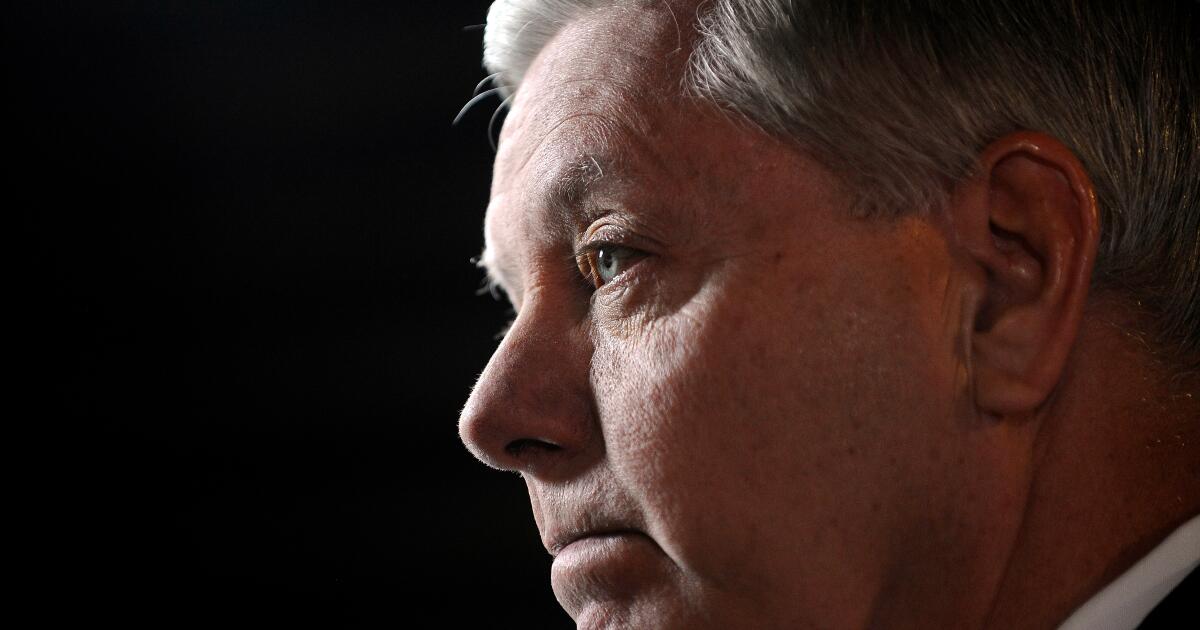
Sen. Lindsey Graham, the prominent Republican from South Carolina who served in the Senate for more than two decades, died after suffering an aortic dissection, his office said Sunday.
Graham died unexpectedly Saturday night, his office announced, shortly after he had returned to Washington after a trip to Ukraine.
In a statement, his spokesperson said a preliminary report from the medical examiner for the District of Columbia found that the 71-year-old senator died of aortic dissection due to arteriosclerotic cardiovascular disease. With aortic dissection, a tear occurs in the wall of the aorta.
According to the Mayo Clinic, aortic dissection is not very common, and its symptoms may be mistakenly attributed to other health conditions. It usually affects men in their 60s and 70s. If the blood from the dissection travels outside the artery, the condition is often fatal.
A former military lawyer who reached the rank of colonel in the Air Force, Graham ran for the Republican nomination for president in 2016. Initially a cutting, vocal critic of then-candidate Donald Trump during the election, Graham became one of the president’s staunchest allies after Trump’s election.
“Senator Lindsey Graham, one of the greatest people and Senators I have ever known, is dead!” Trump posted on his social media platform, Truth, on Sunday. “He was always working, and was a true American Patriot.”
Graham was known as a C student in high school, and was the first member of his family to attend college. His mother died while he attended the University of South Carolina, and his father died of a heart attack during Graham’s first semester of law school.
He served as a judge advocate in the Air Force, eventually becoming the chief prosecutor for the Air Force in Europe.
He was first elected to serve as senator for South Carolina in November 2002.
In a social media post on X, Vice President JD Vance described Graham as one of the most powerful lawmakers, and recalled an incident where he and Graham got into a shouting match over a funding bill for the war in Ukraine.
Later the same day, he wrote in the post, Graham was advocating for rail legislation that Vance supported.
“That was Lindsey Graham,” he wrote. “He fought like hell for the things he believed in, and he was just as willing to go to bat for you when it counted.”
Graham had been scheduled to appear on NBC’s “Meet the Press” on Sunday to discuss his trip to Ukraine. Instead, President Trump appeared in his stead, where he said the senator had been “like a member of the family.”
Trump called into several Sunday news programs to discuss Graham’s death, and said he had spoken to Graham on Saturday evening.
Trump told CNN’s Jake Tapper that the South Carolina senator had said he was “tired.”

NEWYou can now listen to Fox News articles!
President Donald Trump is pushing for an unexpected replacement to fill the vacancy left by the late Sen. Lindsey Graham, R-S.C., in the Senate.
Trump wants South Carolina Gov. Henry McMaster to tap Graham’s sister, Darline Graham Nordone, to be appointed to the lawmaker’s suddenly open seat for the remainder of his term.
“I recommended, to Governor Henry McMaster, Lindsey Graham’s wonderful sister, Darline, to serve as interim Senator from the Great State of South Carolina,” Trump said on Truth Social on Monday. “This would be a fabulous tribute to Lindsey, who loved her dearly!”
Graham and his younger sister, Darline, had a unique bond, given that, after their parents died, the lawmaker legally adopted and raised her.
GRAHAM’S DEATH IGNITES GOP SCRAMBLE FOR SENATE SEAT AS TRUMP HINTS HE ALREADY HAS A FAVORITE
President Donald Trump wants to see Lindsey Graham’s sister, Darline Graham Nordone, appointed to his vacant seat in the Senate to act as caretaker for the remainder of his term. (Justin Sullivan/Getty Images)
Trump’s announcement comes as a scramble behind the scenes is taking place to fill Graham’s spot, and further, find a new GOP nominee to run in November to keep his seat in the hands of Republicans.
McMaster is expected to announce his pick for the seat at 4 p.m. on Monday. He has so far kept quiet about who he would prefer. Fox News Digital did not immediately hear back from McMaster’s office on who he is eyeing in the interim.
Meanwhile, a key Republican, Sen. Tim Scott, R-S.C., also wants to see Graham’s sister get the nod for his seat.
GRAHAM REPORTEDLY REFUSED MEDICAL HELP BEFORE SCHEDULED TV APPEARANCE
“Lindsey Graham’s sister, Darline Graham Nordone, would be a fantastic pick to serve out the remainder of the Senate term,” Scott said on X. “After speaking with Darline, there is no one better who understands Lindsey’s love for family, our state, and our country.”
Scott, earlier in the day, floated both former Rep. Trey Gowdy and former Sen. Jim DeMint as possible replacements in the interim. He hoped that McMaster would “put a placeholder and let the voters decide” later during a forthcoming special election.
“I think in the next several hours or next day or so we’ll figure out who that person is,” Scott said. “I love Trey Gowdy and Jim DeMint has been in the conversation.”
“[Graham’s] sister would be a wonderful placeholder as well,” he continued. “So we’ve got lots of candidates who could hold the place so that the voters decide. And remember the election starts August the 11th in South Carolina, three weeks from now, we’ll have a primary process.”
FROM ‘DISGRACE’ TO ‘FAMILY’: TRUMP’S REMARKABLE JOURNEY WITH LINDSEY GRAHAM
Sen. Lindsey Graham speaks with reporters aboard Air Force One with President Donald Trump and Secretary of Commerce Howard Lutnick on the way back to Washington, D.C., on Jan. 4, 2026. (Jim Watson/AFP via Getty Images)
Both Gowdy and DeMint have served in Congress — Gowdy in the House and DeMint in the Senate, preceding Scott. Graham Nordone, however, has never held public office.
Multiple sources close to Scott, who chairs the National Republican Senatorial Committee (NRSC) told Fox News Digital that he is pushing McMaster to choose one of the three to effectively be a placeholder and not seek a six-year term in the Senate.
CLICK HERE TO DOWNLOAD THE FOX NEWS APP
While the appointment race nears its conclusion, the race for the GOP nomination to run in South Carolina is still wide open.
Reps. Nancy Mace, R-S.C., and Ralph Norman, R-S.C., are already hinting at leaping into the special election, which is set for Aug. 11. Rep. Joe Wilson, R-S.C., said that he would stay in the House, but the rest of the Palmetto State’s GOP congressional delegation have not said what their plans are.
-

 Arkansas5 minutes ago
Arkansas Game and Fish Commission: Celebrate America 250 with responsible boating | Northwest Arkansas Democrat-Gazette
-
 California11 minutes ago
The fierce competition to get married at California’s most popular public buildings
-

 Colorado17 minutes ago
Colorado’s Front Range Passenger Rail eyes stops at future Broncos, Summit stadiums
-

 Connecticut23 minutes ago
Why Connecticut’s flag is blue and what its symbols stand for
-

 Delaware30 minutes ago
A Delaware taste of summer since 1957 is now being sold in Hockessin
-

 Florida36 minutes ago
Skunks, warthogs & monkeys, oh my! Here’s what Florida records reveal about 140+ captive animal escapes since 2022
-

 Georgia41 minutes ago
Georgia football defensive depth chart entering fall camp
-

 Hawaii47 minutes ago
Hilo woman killed in Kona traffic crash – West Hawaii Today

