California
California's inmate firefighter crews are dwindling just as the state starts to burn


Two wet winters followed by repeated record-breaking heat waves in recent months have set California on a path to a fiery summer.
And though firefighters with the California Department of Forestry and Fire Protection will be on the front lines against the flames, behind them in the trenches are hundreds of California inmates, digging, chopping and chainsawing containment lines for crews to gain an advantage. And there are fewer of them than ever.
Peppered throughout the state’s 35 conservation camps — minimum-security facilities — they perform crucial fuel-reduction projects year-round and are occasionally placed in the path of advancing flames. Sometimes, at the cost of their own lives.
But prison reform and the COVID-19 pandemic have shrunk the pool of inmates eligible to attend the camps — operated by the California Department of Corrections and Rehabilitation, Cal Fire or the Los Angeles County Fire Department — for fire training and assignments. At the same time that the camp sizes have shrunk — from a peak of 4,250 to fewer than 1,800 today — California has experienced its biggest and deadliest fires, with this summer off to a bad start.
Despite that, Cal Fire and state corrections officials say their strategy of using younger inmates, leaning on seasonal crews longer and partnering with the California Conservation Corps and California Military Department will get them through the year and eventually bring inmate firefighter numbers back to pre-pandemic levels.
“I know there’s been other articles that have painted a picture of doom and gloom and despair,” said Jarrod Clinkenbeard, staff chief of the hand crew program for Cal Fire. “I don’t feel like that’s where we are.”
An inmate fire crew mops up the Kanan fire in Agoura Hills last July.
(Brian van der Brug / Los Angeles Times)
In 2005, at the peak of the inmate firefighter program, officially known as the Conservation (Fire) Camp Program, there were 192 crews, or 4,250 inmate firefighters, according to the state corrections department. Participants of the program include support staff such as cooks, orderlies and maintenance workers. Four years ago, as prisons shut down and inmate populations declined, the corrections department winnowed the camps down to 1,821 participants. As of July 2, there were about 83 hand crews, or 1,760 participants.
Depending on the year, inmate fire crews account for as much as 30% of the state’s wildfire force and are typically paid $5.80 to $10.24 per day by the corrections department, earning an additional dollar per hour from Cal Fire when responding to a disaster. Inmate fire crews are made up of 12 to 17 firefighters, led by a fire captain. Inmates who have been convicted of violent crimes, such as rape, lewd acts with a child under 14 or any felony punishable by death or life in prison, or who have a history of escaping or arson, are automatically disqualified.
In a letter to Gov. Gavin Newsom on June 21, Los Angeles County Supervisors Lindsey Horvath and Kathryn Barger voiced concerns about deeper cuts to the program that would’ve shuttered five camps in the county, affecting more than 200 inmate firefighters.
“The implications of such cuts are dire,” the letter read in part. “As you are aware, California faces a critical shortage of wildland firefighting hand crews, a situation that has been exacerbated by the increasing frequency and severity of wildland fires due to climate change.”
Indeed, the loss of hand crews has occurred nationwide but the labor crisis is particularly acute in California, where 14 of the 15 largest fires on record have occurred since 2007. This year the state has seen 90,000 acres burn, significantly more than the average at this point in the season.
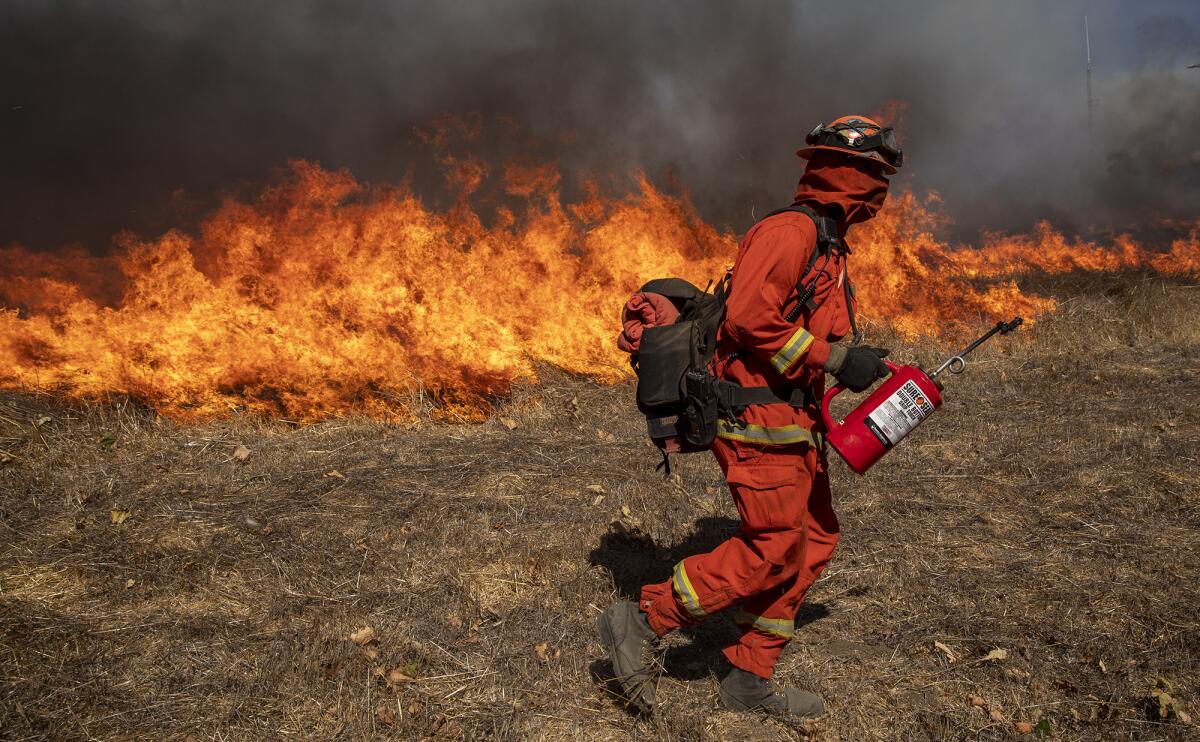
Inmate crews set backfires to heavy brush near Thousand Oaks in 2019.
(Brian van der Brug / Los Angeles Times)
The governor recently took the five L.A. County fire camps off his list of cuts this year, as Horvath and Barger had requested, but other efforts to increase inmate firefighting have been months or years in the making.
In August, the corrections department launched the Youthful Offender Program’s Conservation Camp, a pilot program that allows eligible young incarcerated adults to become firefighters and that is set to expire next year unless it is made permanent.
The program is an offshoot of the corrections department’s Youthful Offender Program established in 2014 and allows eligible inmates ages 18 to 25 to receive fire training before being housed at Growlersburg Conservation Camp in Georgetown, a mountain community northeast of Sacramento.
All inmate firefighters receive the same training that seasonal wildland firefighters receive, including a week of classroom instruction and a week of field exercises. Once inmates graduate from the program, they are eligible to be placed at a camp.
There are currently 113 total camp volunteers at Growlersburg. Of those, 30 are part of the pilot program and 18 are inmates who are certified mentors. The young adult firefighters responded to their first fire May 10 in El Dorado County.
Corrections officials said that the program is showing promising results and that the number of hand crews may slowly inch back to 2019 levels, when there were 1,975 inmate firefighters and support staff at the department’s fire camps.
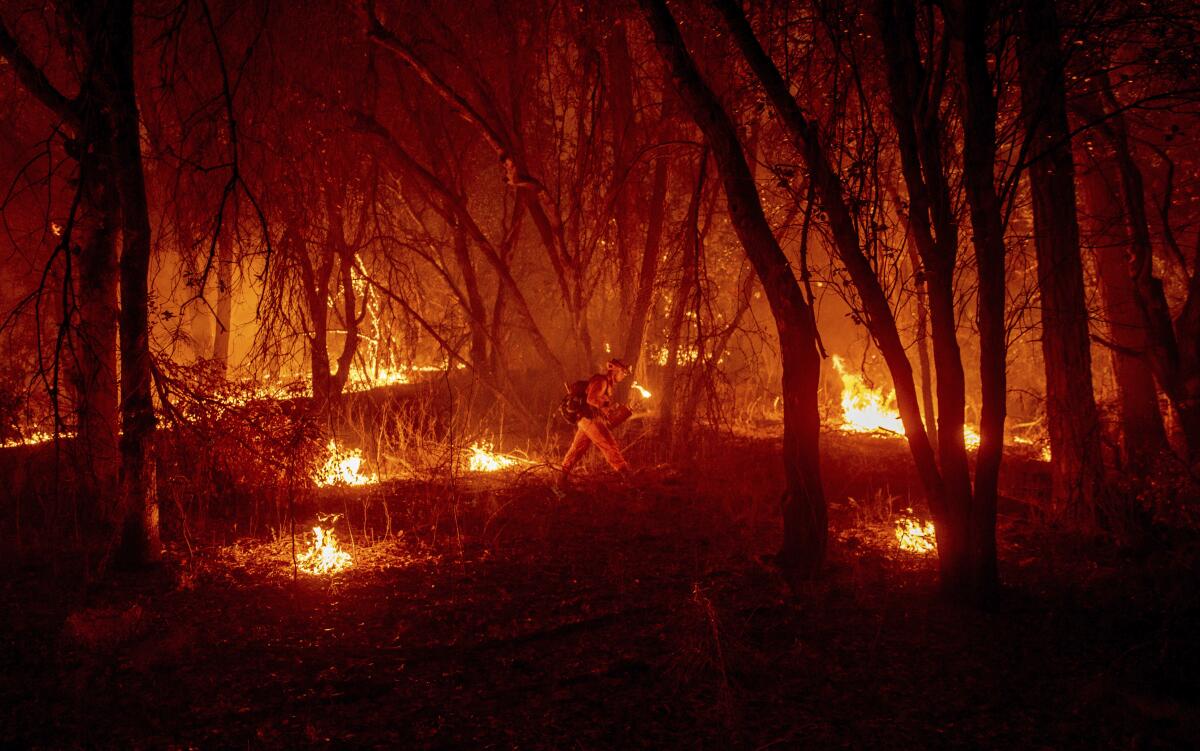
An inmate firefighter from the Trinity River Conservation Camp uses a drip torch to slow a fire burning north of Redding in 2021.
(Ethan Swope / Associated Press)
It took years for California to reach this point, and it will take years to find a reliable solution, officials said.
Hand crew cuts have occurred in waves as penalties for some crimes were reduced, Clinkenbeard said. The first wave came in 2011 with California’s realignment law that mandated some nonviolent inmates serve time in county jails instead of prisons.
Then Californians in 2014 approved Proposition 47, which allowed the courts to reduce penalties for some nonviolent theft crimes and drug possession offenses that were reclassified as misdemeanors.
Three years later, voters approved Proposition 57, allowing inmates convicted of nonviolent crimes to be considered for early release or parole.
In 2020, the pandemic led the state to release more inmates to allow more distancing among those behind bars.
Then two years ago, the California Correctional Center in Susanville, which doubles as a firefighting training center for inmates, closed. Another one is expected to close next year.
Despite the reductions, Clinkenbeard said, Cal Fire still has a healthy number of hand crews for the fire season. He said the agency also has mutual aid agreements with other states that can be called upon to help boost its firefighting force.
As of July 2, Cal Fire had 149 hand crews, 65 of which were state inmate crews; 38 were seasonal firefighters, 32 were participants with the California Conservation Corps and 14 were from the California Military Defense.



SAN FRANCISCO — The man accused of trying to kill OpenAI CEO Sam Altman by throwing a Molotov cocktail at his San Francisco home is set to make an initial court appearance Tuesday.
Daniel Moreno-Gama, of Spring, Texas, traveled to San Francisco last week and hurled the incendiary device at Altman’s home Friday, setting an exterior gate on fire before fleeing on foot, authorities said. Less than an hour later, Moreno-Gama went to OpenAI’s headquarters about 3 miles (5 kilometers) away and threatened to burn down the building, they said.
No one was injured at Altman’s home or the company’s offices.
Authorities said Moreno-Gama, 20, expressed hatred of artificial intelligence in his writings, describing it as a danger to humanity and warning of “impending extinction,” according to court filings.
“This was not spontaneous. This was planned, targeted and extremely serious,” FBI San Francisco Acting Special Agent in Charge Matt Cobo said during a news conference Monday.
Moreno-Gama is charged in California state court with two counts of attempted murder and attempted arson, San Francisco District Attorney Brooke Jenkins said. He tried to kill both Altman and a security guard at Altman’s residence, she alleged. Officials have not said whether Altman was home at the time.
Online state court records do not yet show whether Moreno-Gama has an attorney who can speak on his behalf.
Craig Missakian, U.S. Attorney, Northern District of California, middle, speaks during a news conference Monday, April 13, 2026, in San Francisco. Credit: AP/Jeff Chiu
Jenkins said the state charges carry penalties ranging from 19 years to life in prison.
On Monday morning, FBI agents went to Moreno-Gama’s home in a Houston suburb where they spent several hours before leaving. He has also been charged by federal prosecutors with possession of an unregistered firearm and damage and destruction of property by means of explosives. Those charges carry respective penalties of up to 10 years and 20 years in prison.
“We will treat this as an act of domestic terrorism, and together with our partners, prosecute him to the fullest extent of the law,” U.S. Attorney Craig Missakian said when announcing the federal charges Monday.
The federal court documents do not list an attorney for Moreno-Gama, and he has not yet had his first appearance in federal court.
The document in which Moreno-Gama discussed his opposition to AI also made threats against Altman and executives at other AI companies, officials said.
“If I am going to advocate for others to kill and commit crimes, then I must lead by example and show that I am fully sincere in my message,” Moreno-Gama wrote, according to authorities.
Advocacy groups that have issued grave warnings about AI’s risks to society condemned the violence.
Anthony Aguirre, president and CEO of the Future of Life Institute, said in a written statement Friday that “violence and intimidation of any kind have no place in the conversation about the future of AI.”
Another group, PauseAI, said in a statement that the suspect had no role in the group but joined its forum on the social media platform Discord about two years ago and posted about 34 messages there, none containing explicit calls to violence but one that was flagged as “ambiguous.”
Discord said Monday that it has banned Moreno-Gama for “off-platform behavior.”

Dad charged with incest after allegedly assaulting daughter
Makayla Rene Settles moved to California to chase her dreams. Two days later, her family says her biological father sexually assaulted her. She was 18. She died five months later. Now her family is fighting to make sure her accused attacker faces trial.
VENTURA COUNTY, Calif. – When Makayla Rene Settles turned 18, she left Raleigh, North Carolina, for a fresh start. She moved to Moorpark, California, to live with her biological father, Stephen Vincent Chavez, with plans to attend college and build a new life. Two days after she arrived, her family says she called terrified and asking for help.
“It was just the fear in her voice, her crying. I didn’t need details. I knew something was wrong, and I said, ‘I’m on the way,’” said Carolina Sandoval, Makayla’s mother.
Carolina says she rushed to Chavez’s home. When she saw her daughter, she was devastated.
“She’s barely walking,” Carolina said. “My brother picks her up and hugs her.”
Makayla was taken to a hospital, where a rape kit was performed. According to the family, the results came back positive for Stephen Vincent Chavez’s DNA. He was arrested that same night and charged with incest, taking advantage of a position of trust, and providing alcohol to a minor.
Her cousin, Crystal Sandoval, was in disbelief. She said, “I was screaming, I was crying. I just kept thinking, why would he do that to her? This is something she could not come back from.”
Crystal was right. Five months later, Makayla Rene Settles died by suicide.
“If I’m being honest, it feels like I handed my daughter to the devil,” said Carolina.
On the night Makayla was taken to the hospital, Sandoval says Chavez sent her a text message. It read, “I’m never drinking liquor again. I don’t want that blackout to happen again.”
Now, the family says they’ve been dealt another devastating blow. According to Crystal Sandoval, the Ventura County DA’s Office has told them the case may not go to trial because Makayla is no longer alive to testify.
“The DA was essentially saying, ‘We don’t know if we have a case because she’s no longer here,’ and when she told me that, I immediately said, ‘No, we’re not going to let that slide,’” said Crystal.
Determined to get justice, Crystal took to social media. Her videos went viral, drawing widespread outrage and prompting hundreds to promise to show up to Chavez’s next court hearing, scheduled for April 21 at the Ventura County Courthouse.
“It was like he took her sunshine away and just kind of broke her soul,” Crystal said.
The Ventura County District Attorney’s Office issued the following statement:
“We have seen the posts online and want to let the public know that our Sexual Assault Unit continues to prosecute the defendant for this extremely serious crime. This case has been filed since July 2025, when the evidence supported the filing of felony charges. As with any case, prosecutors filed charges based on the evidence. The court sets bail. Our office successfully moved to increase bail to $250K in July 2025 when the case was filed. The defendant requested that bail be reduced, but we successfully argued against that. The defendant has since posted $250K bail and is out of custody. With respect to the upcoming hearing, the April 21 date is an early disposition conference. This is a standard pretrial proceeding where the court and parties address the status of the case and set future dates as appropriate.”
Despite that statement, the family says they have already been told a trial is not guaranteed, and they are not backing down. Chavez has pleaded not guilty. His next court hearing is April 21 at 8:30 a.m. in Courtroom 14 at the Ventura County Courthouse.
California
California’s leading GOP candidate for governor reacts to Swalwell’s exit from race | CNN Politics

California’s leading GOP candidate for governor reacts to Swalwell’s exit from race
Republican Gov. candidate Steve Hilton joins CNN’s Dana Bash after one of his opponents, Rep. Eric Swalwell, exited the California governor’s race amid sexual misconduct allegations. “We desperately need change. And no Democrat can provide that,” Hilton says.

Shepherd confirmed as federal judge in Arkansas’ Western District – Talk Business & Politics

Suspect in Molotov attack at Sam Altman’s California home set to appear in court

Every Colorado Buffaloes First-Round Pick In NFL Draft History

Justice Department sues Connecticut over sanctuary policies

Federal judge says Delaware labor officials must give data to ICE

Florida High School Football Rankings: Top 25 teams – Oct. 21

How old is Bo Nix? What to know about Oregon quarterback ahead of 2024 NFL Draft

Cleary's 21 help Le Moyne down Central Connecticut State 69-64 in OT

99th annual Pony Swim held in Virginia

Indiana Members Credit Union announced as new anchor tenant at Bottleworks District

Video: How Stephen Miller Is Adjusting Trump’s Immigration Agenda

Biden DOJ weaponized FACE Act against pro-life Americans, 882-report alleges

Mass drone warfare is Europe’s rising security threat
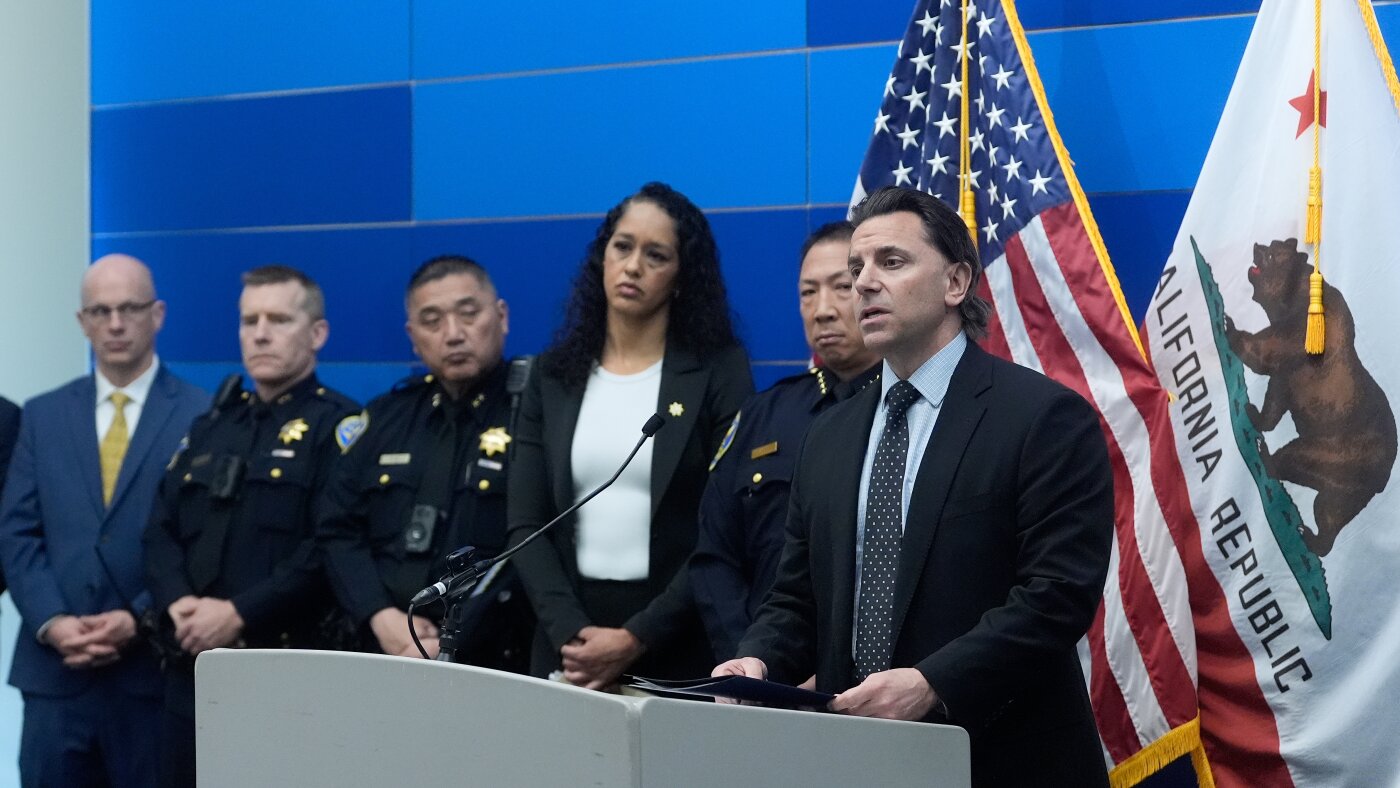
Man accused in Molotov cocktail attack of OpenAI CEO’s home charged with attempted murder

Embattled Rep Tony Gonzales announces plans to resign amid sexual misconduct allegations
-

 Atlanta, GA1 week ago
1 teenage girl killed, another injured in shooting at Piedmont Park, police say
-

 Georgia1 week ago
Georgia House Special Runoff Election 2026 Live Results
-

 Arkansas4 days ago
Arkansas TV meteorologist Melinda Mayo retires after nearly four decades on air
-

 Pennsylvania1 week ago
Parents charged after toddler injured by wolf at Pennsylvania zoo
-
 Milwaukee, WI1 week ago
Potawatomi Casino Hotel evacuated after fire breaks out in rooftop HVAC system
-

 Austin, TX7 days ago
ABC Kite Fest Returns to Austin for Annual Celebration – Austin Today
-

 World1 week ago
Zelenskyy warns US-Iran war could divert critical aid from Ukraine
-

 World1 week ago
Indonesia receives bodies of peacekeepers killed in southern Lebanon