California
California's inmate firefighter crews are dwindling just as the state starts to burn


Two wet winters followed by repeated record-breaking heat waves in recent months have set California on a path to a fiery summer.
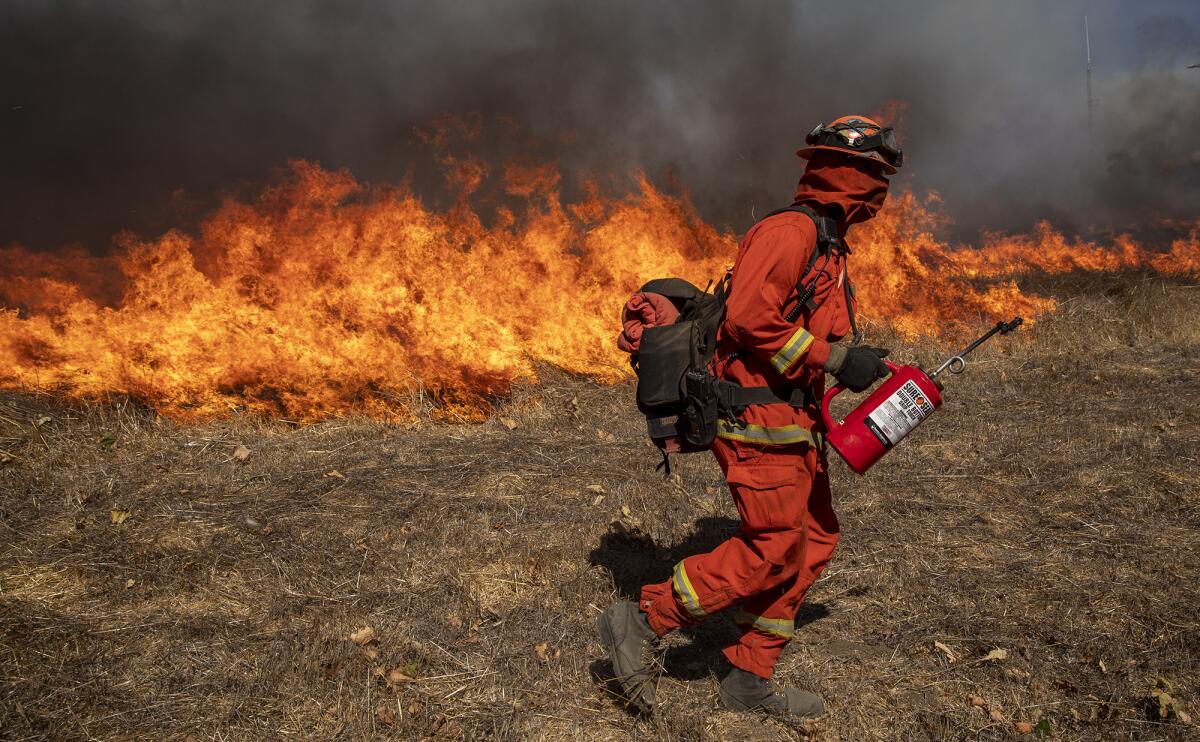
And though firefighters with the California Department of Forestry and Fire Protection will be on the front lines against the flames, behind them in the trenches are hundreds of California inmates, digging, chopping and chainsawing containment lines for crews to gain an advantage. And there are fewer of them than ever.
Peppered throughout the state’s 35 conservation camps — minimum-security facilities — they perform crucial fuel-reduction projects year-round and are occasionally placed in the path of advancing flames. Sometimes, at the cost of their own lives.
But prison reform and the COVID-19 pandemic have shrunk the pool of inmates eligible to attend the camps — operated by the California Department of Corrections and Rehabilitation, Cal Fire or the Los Angeles County Fire Department — for fire training and assignments. At the same time that the camp sizes have shrunk — from a peak of 4,250 to fewer than 1,800 today — California has experienced its biggest and deadliest fires, with this summer off to a bad start.
Despite that, Cal Fire and state corrections officials say their strategy of using younger inmates, leaning on seasonal crews longer and partnering with the California Conservation Corps and California Military Department will get them through the year and eventually bring inmate firefighter numbers back to pre-pandemic levels.
“I know there’s been other articles that have painted a picture of doom and gloom and despair,” said Jarrod Clinkenbeard, staff chief of the hand crew program for Cal Fire. “I don’t feel like that’s where we are.”
An inmate fire crew mops up the Kanan fire in Agoura Hills last July.
(Brian van der Brug / Los Angeles Times)
In 2005, at the peak of the inmate firefighter program, officially known as the Conservation (Fire) Camp Program, there were 192 crews, or 4,250 inmate firefighters, according to the state corrections department. Participants of the program include support staff such as cooks, orderlies and maintenance workers. Four years ago, as prisons shut down and inmate populations declined, the corrections department winnowed the camps down to 1,821 participants. As of July 2, there were about 83 hand crews, or 1,760 participants.
Depending on the year, inmate fire crews account for as much as 30% of the state’s wildfire force and are typically paid $5.80 to $10.24 per day by the corrections department, earning an additional dollar per hour from Cal Fire when responding to a disaster. Inmate fire crews are made up of 12 to 17 firefighters, led by a fire captain. Inmates who have been convicted of violent crimes, such as rape, lewd acts with a child under 14 or any felony punishable by death or life in prison, or who have a history of escaping or arson, are automatically disqualified.
In a letter to Gov. Gavin Newsom on June 21, Los Angeles County Supervisors Lindsey Horvath and Kathryn Barger voiced concerns about deeper cuts to the program that would’ve shuttered five camps in the county, affecting more than 200 inmate firefighters.
“The implications of such cuts are dire,” the letter read in part. “As you are aware, California faces a critical shortage of wildland firefighting hand crews, a situation that has been exacerbated by the increasing frequency and severity of wildland fires due to climate change.”
Indeed, the loss of hand crews has occurred nationwide but the labor crisis is particularly acute in California, where 14 of the 15 largest fires on record have occurred since 2007. This year the state has seen 90,000 acres burn, significantly more than the average at this point in the season.
Inmate crews set backfires to heavy brush near Thousand Oaks in 2019.
(Brian van der Brug / Los Angeles Times)
The governor recently took the five L.A. County fire camps off his list of cuts this year, as Horvath and Barger had requested, but other efforts to increase inmate firefighting have been months or years in the making.
In August, the corrections department launched the Youthful Offender Program’s Conservation Camp, a pilot program that allows eligible young incarcerated adults to become firefighters and that is set to expire next year unless it is made permanent.
The program is an offshoot of the corrections department’s Youthful Offender Program established in 2014 and allows eligible inmates ages 18 to 25 to receive fire training before being housed at Growlersburg Conservation Camp in Georgetown, a mountain community northeast of Sacramento.
All inmate firefighters receive the same training that seasonal wildland firefighters receive, including a week of classroom instruction and a week of field exercises. Once inmates graduate from the program, they are eligible to be placed at a camp.
There are currently 113 total camp volunteers at Growlersburg. Of those, 30 are part of the pilot program and 18 are inmates who are certified mentors. The young adult firefighters responded to their first fire May 10 in El Dorado County.
Corrections officials said that the program is showing promising results and that the number of hand crews may slowly inch back to 2019 levels, when there were 1,975 inmate firefighters and support staff at the department’s fire camps.
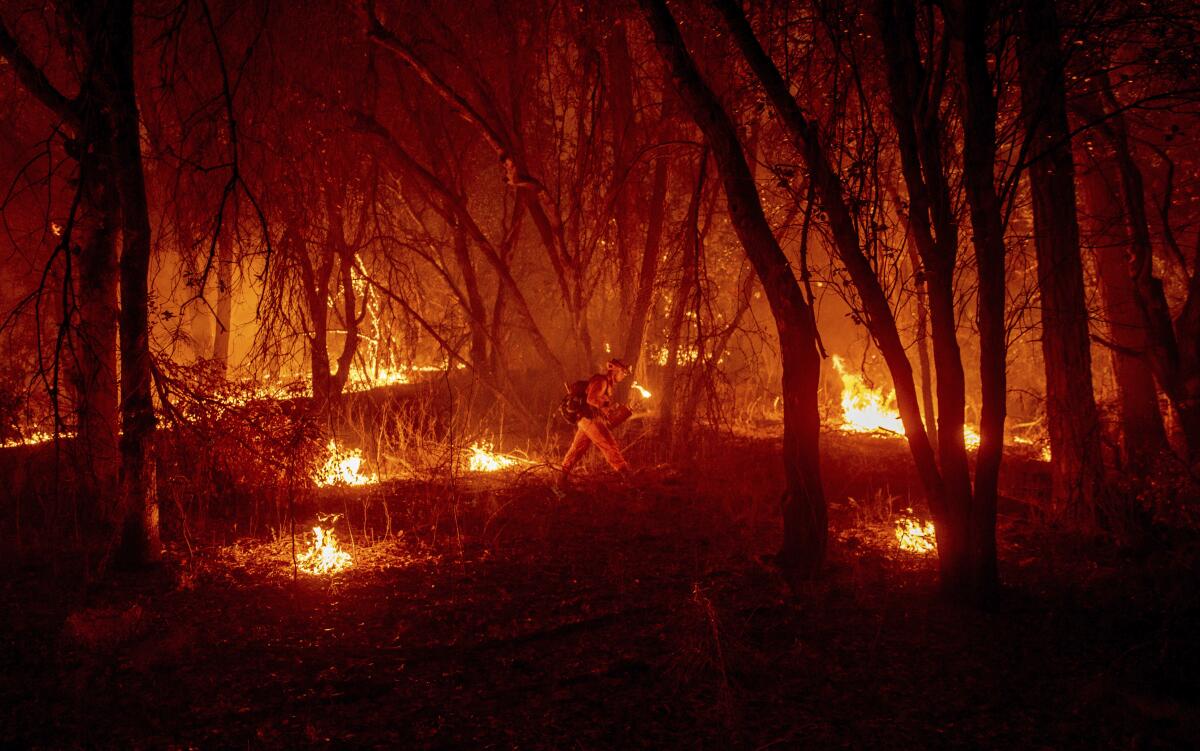
An inmate firefighter from the Trinity River Conservation Camp uses a drip torch to slow a fire burning north of Redding in 2021.
(Ethan Swope / Associated Press)
It took years for California to reach this point, and it will take years to find a reliable solution, officials said.
Hand crew cuts have occurred in waves as penalties for some crimes were reduced, Clinkenbeard said. The first wave came in 2011 with California’s realignment law that mandated some nonviolent inmates serve time in county jails instead of prisons.
Then Californians in 2014 approved Proposition 47, which allowed the courts to reduce penalties for some nonviolent theft crimes and drug possession offenses that were reclassified as misdemeanors.
Three years later, voters approved Proposition 57, allowing inmates convicted of nonviolent crimes to be considered for early release or parole.
In 2020, the pandemic led the state to release more inmates to allow more distancing among those behind bars.
Then two years ago, the California Correctional Center in Susanville, which doubles as a firefighting training center for inmates, closed. Another one is expected to close next year.
Despite the reductions, Clinkenbeard said, Cal Fire still has a healthy number of hand crews for the fire season. He said the agency also has mutual aid agreements with other states that can be called upon to help boost its firefighting force.
As of July 2, Cal Fire had 149 hand crews, 65 of which were state inmate crews; 38 were seasonal firefighters, 32 were participants with the California Conservation Corps and 14 were from the California Military Defense.


BAKERSFIELD, Calif. (KBAK/KBFX) — The California Highway Patrol is urging drivers to stay focused on the road as they head out for Fourth of July celebrations.
The holiday weekend can be a dangerous time on our roads as millions of drivers are expected to travel.
CHP Officer Jorge Toro joined Eyewitness News Mornings to share how drivers can stay safe behind the wheel.
Officer Toro also highlighted the importance of sober driving over the holiday.
BE THE FIRST TO COMMENT
He says anyone hosting a party should make sure all of their guests get home safely, ensuring anyone who may be impaired doesn’t drive.

California is returning a stretch of rugged Mendocino County coast to the Indigenous nations whose ancestors once stewarded its shores.
State transportation officials recently approved the transfer of Blues Beach and the surrounding bluffs to Kai Poma, a nonprofit founded by representatives of the Sherwood Valley Band of Pomo Indians, Round Valley Indian Tribes and Coyote Valley Band of Pomo Indians.
The transfer of 136 acres just south of the community of Westport will mark the first time land managed by the California Department of Transportation has been returned to Indigenous tribes.
“This is beyond huge,” said J. Carlos Rivera, tribal chairman of the Sherwood Valley Band of Pomo Indians. “It’s enormous from our tribal perspective that we are basically obtaining the land that our people once lived on before colonization.”
California purchased the swath of rocky cliffs and windswept shoreline in the 1960s to expand the construction of Highway 1 and create a scenic viewpoint for highway travelers, according to a California Coastal Commission report.
More recently, public access has been largely unregulated, and summer weekends and holidays have drawn large groups who camp and party on the beach, at times driving through sensitive areas, damaging cultural sites and leaving behind trash, the report states.
Kai Poma plans to conduct cultural and archaeological resource studies and environmental surveys and then prepare a resource management plan for the property, according to planning documents. The nonprofit and the Coastal Commission have drafted a public access management plan that states the land will be open from sunrise to sunset.
Rivera described the entire property as a sacred site. The coastal waters are used by tribal people for seaweed and abalone gathering, and the shores host youth cultural camps, he said. “Protecting the land, it has a deeper meaning for us because we’re connected to the land,” he said.
The effort to acquire the land took years — and required a change in state law. Caltrans lacked the ability to transfer land to tribal governments until 2021, when Gov. Gavin Newsom signed a bill sponsored by state Sen. Mike McGuire (D-Healdsburg) that enabled the transfer, according to a news release issued at the time. The law also bars commercial activity on the property and requires public access be maintained.
“With 136 acres now officially transferred into tribal stewardship, one of the most spectacular stretches of the Mendocino Coast will be forever protected,” McGuire said in a statement.
“This agreement, the first of its kind in California, gives these three dynamic Native American tribes the rightful opportunity to reclaim sacred lands and cultural traditions on this special piece of earth. And it’s about damn time.”
The land transfer cleared its last regulatory hurdle June 26 with the approval by the California Transportation Commission, said Neil Thapar, an attorney who works as an advisor and legal consultant to Kai Poma. Caltrans staff will next record the deed transferring the title from the state of California to Kai Poma, which is expected to happen any day, he said.


Fireworks Safety Guide
Essential safety tips for buying, handling, and watching fireworks to ensure a safe celebration.
With July 4 falling on a Saturday this year, many businesses and organizations are taking the day off Friday, July 3, to mark America’s 250th birthday. From banking to mail service, here’s what’s open and closed for the holiday weekend.
Most federal offices closed, mail service to continue
Non-essential federal offices will be closed on July 3. However, mail service will continue as normal, and post offices are scheduled to remain open.
Most California government offices to remain open
Most California government offices will be open on July 3, with some exceptions.
DMV offices throughout the state will be open. However, the Employment Development Department will be closed.
DMV offices that offer Saturday hours will be closed on July 4.
Private parcel services to remain open
UPS and FedEx are both scheduled to operate normally on July 3, but will suspend service on July 4.
Stock markets closed
Both the New York Stock Exchange and Nasdaq will be closed on July 3.
Most banks to stay open
While most banks were expected to operate normally on July 3, some may operate under modified holiday hours. All banks will be closed on July 4.
Online banking services should remain operational.
Grocery stores
Most major grocery chains will be open on both July 3 and July 4. Trader Joe’s locations will be open for regular business on July 3 but will close early at 5 p.m. on the Fourth of July.
Retailers
Many major retail stores, such as Walmart and Target, plan to operate under normal business hours on both July 3 and 4. All Costco warehouse stores operate under normal business hours on July 3, but will close on July 4.
Restaurants
Most major restaurant chains remain open on July 4, but some will have limited hours. All Raising Cane’s locations will close on July 4.
-

 Colorado3 minutes ago
Thousands forced to evacuate in Colorado as wildfire spreads
-

 Connecticut8 minutes ago
AGANORSA Leaf Aniversario Connecticut Tubo Ships
-

 Delaware15 minutes ago
Gov. Matt Meyer kicks off July 4th weekend with ice cream treat
-

 Florida18 minutes ago
US Coast Guard saves 8, including infant and child, after vessel capsizes off Fort Myers Beach
-

 Georgia23 minutes ago
Comparing Mark Richt’s NFL Georgia stars since 2006 to Kirby Smart’s
-

 Hawaii30 minutes ago
State parks superintendent accused of having 2 million secret nude recordings of employees
-

 Idaho33 minutes ago
Idaho Falls Chamber of Commerce CEO resigns amid podcast allegations – East Idaho News
-

 Illinois38 minutes ago
Illinois legislation to regulate cannabis market

