Sports
Will Jayden Maiava and Husan Longstreet remain USC’s top quarterbacks?


During each of his last two Decembers at USC, Lincoln Riley faced a critical decision at quarterback: Pursue a new passer in the portal or trust the one who’s next in line?
In each case, Riley has opted to keep the known quantity. But as his fourth regular season at USC comes to a close Saturday against UCLA, the coach could face a more complicated conundrum at the position this offseason.
Run it back with Jayden Maiava, who statistically has been one of the more accomplished passers in college football this season? Or turn the page to electric five-star freshman Husan Longstreet, who might not be willing to wait much longer for his shot as USC’s starting quarterback?
It’s a question that has confounded many college football coaches during the transfer portal era, as the notion of a top quarterback prospect patiently waiting his turn to be named a starter has become increasingly rare. Of the top dozen quarterbacks in the class of 2024, six have already transferred. From 2023, it’s seven of the top 12. From 2022, it’s eight. And of those who do stay, only a handful were still waiting to start as sophomores.
USC quarterback Jayden Maiava looks for an open receiver during a win over Michigan at the Coliseum on Oct. 11.
(Gina Ferazzi/Los Angeles Times)
It’s not clear yet if that’ll be the case with Longstreet. But this week, Riley made a clear plea for the young passer’s patience when asked about the challenge of convincing a top prospect to stick around in a reserve role.
“For any player, especially a quarterback, I don’t know if this would be the right time to leave this place,” Riley said. “This thing is getting pretty good. And I think a lot of people recognize that, both in what we have now and what we’re bringing in, where this thing is going.”
Speaking to Longstreet’s situation, Riley pointed to his track record with quarterbacks who waited their turn.
“Other than Jalen Hurts, we haven’t had any quarterback that’s come in and was the guy right away,” Riley said. “Every one of them, all the guys that did all the things, they all had that time. And if you ask them now, maybe then they wanted to be playing of course, the competitor in them. But if you ask them now, they’re all damn happy they had time and it made a big difference. Because when it became their time, they were ready.”

USC quarterback Husan Longstreet scores a touchdown against the Missouri State at the Coliseum on Aug. 30.
(Luke Hales/Getty Images)
Maiava, of course, has been more than just a mere caretaker. After all, he leads the Big Ten in passing yards per game this season (3,174), while also leading USC in rushing touchdowns (6). With Maiava and his cannon arm at the helm, USC’s offense has returned to its right place as one of college football’s most explosive outfits, producing 51 plays of 20-plus yards this season, fourth-most in the nation.
On paper, there’s no reason to think Riley would be eager to replace Maiava, who has rejuvenated both the read-option game and the downfield aspect of his offense since taking over for Miller Moss last season. But the conversation about USC’s future at the position was complicated by the second half of the season, during which Maiava stumbled against stiffer competition.
During the Trojans’ first six games, Maiava appeared to have taken a major step forward. He was completing 72% of his passes, up 12% from the previous year. He was averaging an eye-popping 11 yards per attempt, two yards better than Caleb Williams in his Heisman-winning season. Plus, after vowing to cut down on turnovers, Maiava had only thrown two interceptions over those six games, showcasing a much better grasp of the game and Riley’s offense.
“A very high percentage of our plays, he knows what to do and where to go with the ball,” Riley said. “He’s very comfortable with what we’re doing. Very focused, confident on his reads. That’s why he’s been so efficient all year.”
The strong start garnered serious NFL interest. Pro Football Focus just recently ranked Maiava as the No. 5 draft-eligible quarterback in the upcoming draft. But his second half of the season has begged some questions — not just about whether Maiava is ready to declare for the draft, but whether he’s the right quarterback for Riley to prioritize heading into next season.
Up against three of the nation’s top 11 defenses in pass yards allowed — Oregon, Iowa and Nebraska — Maiava keeps up the same consistency from the season’s first half. His completion rate, through his last five outings, sits just above 59% — lower than it was during his 2024 stint as USC’s starter. Maiava’s turnovers have also tripled during that stretch (6), while he’s averaging more than three yards fewer per attempt (7.64)
Riley said Tuesday that Maiava’s inconsistencies of late were due to the caliber of defenses he’s faced — and circumstances that forced USC’s offense to be aggressive downfield.
“We’ve continued to score points and win games and have one of the best offenses in the country, and he’s been a big part of that,” Riley said. “He’s still learning. He can play better. But he’s continuing to give us chances to win every week.”

USC quarterback Jayden Maiava gestures to teammates during a win over Iowa on Nov. 15.
(Mark J. Terrill / Associated Press)
He’ll also have the chance in the coming weeks to consider if he wants to enter the NFL draft.
In the meantime, Longstreet will continue to watch dutifully as the No. 2 quarterback. He’s appeared in four games, completing 13 of 15 passes, on his way to a redshirt season. That time waiting, Riley said, has been essential.
“This has been such a valuable year for him — to serve as a backup quarterback, to learn, to just kind of be there to see all of these things transpire,” Riley said. “These are just things you can’t simulate. It gives you an opportunity to watch these different situations, how they happen, be able to go back, like, ‘What would you do? How would you handle it?’
“The hope is maybe you learn, ‘All right, I wasn’t the one playing, but when I am, I know exactly what I need to do or what I don’t need to do.’ It might be about on the field. It might be about leadership. It might be about a number of different things.”

USC quarterback Husan Longstreet is pushed out of bounds by Illinois’ Miles Scott at Memorial Stadium on Sept. 27 in Champaign, Ill.
(Justin Casterline / Getty Images)
When Longstreet will get a chance to put that knowledge to use remains to be seen. But his teammates at USC have been impressed so far by what they’ve seen from the freshman.
“Husan is a machine, for real,” said freshman Tanook Hines. “He throwing that thing about 80 [yards], then turn around and run 4.3, 4.2.”
Others were even more encouraging of the quarterback they hope stays a part of USC’s plans.
“He’s destined for greatness,” guard Kaylon Miller said of Longstreet. “Every single time I see him out there, I tell him, keep doing your thing. You keep going on the route you are right now, you’re going to be great.”

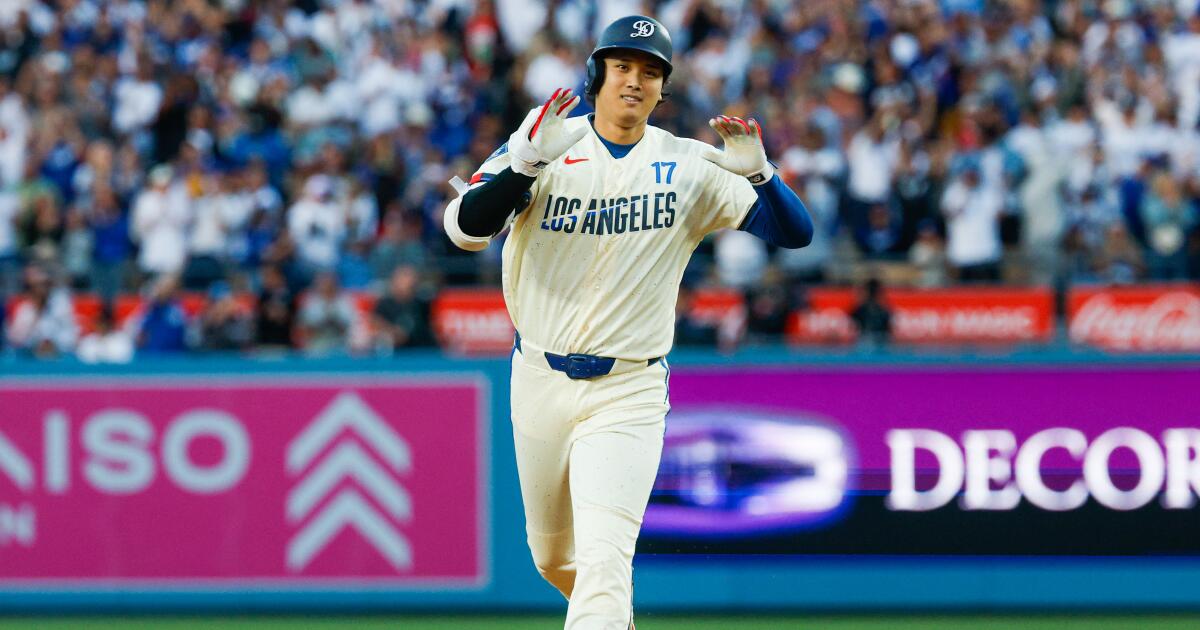
The Dodgers spent so long racking up an insurmountable lead in the first inning that starting pitcher Yoshinobu Yamamoto resorted to throwing a ball against the back of the dugout to stave off rust.
He also went to the batting cages to keep his arm moving, tossing weighted PlyoCare balls.
As he worked, the Dodgers scored all of the runs they would need and more to defeat the Angels 9-2 on Saturday at Dodger Stadium. The chasm between the Freeway Series rivals was on display.
“That’s a lot of fun,” Dodgers rookie Ryan Ward said of the first-inning onslaught. “You can feel them start to speed up a little bit, and we’re starting to calm down and enjoy it. And it’s easy to pass it along when you have a lot of runners on, and then just keep it going.”
The one-run lead the Angels (24-41) had jumped out to in the top of the inning — when a leaping center fielder Andy Pages couldn’t quite reel in Oswald Peraza‘s deep line drive for an RBI triple — was long forgotten after the Dodgers rallied for nine runs in the first.
Andy Pages celebrates with teammates in the dugout after hitting a two-run home run as part of a nine-run first inning for the Dodgers.
(Ronaldo Bolaños / Los Angeles Times)
It was the most runs the Dodgers scored in a single inning in nearly five years, matching their seventh-inning rally against the Nationals on July 2, 2021.
The Dodgers (42-23) helped themselves with a show of power. Pages drove in the first two runs by crushing a center-cut changeup from Angels starting pitcher Jack Kochanowicz over the left-field wall.
Judging by his stroll out of the batter’s box, Pages seemed to know it was a homer on contact.
The ball had so much loft that reliever Blake Treinen parked under it in the bullpen and caught it with his hat. His fellow relievers mobbed him in an impromptu mosh pit.
“The homer by Andy to answer back was big, kind of put to bed any type of momentum they had at the top of the first,” manager Dave Roberts said. “And then after that, just the hits kept coming, just good at-bats.”
Later in the same inning, after the lineup turned over, Shohei Ohtani also notched a two-run homer, for his second hit. In between, rookie Ryan Ward hit a two-run double off the wall.
The Dodgers brought 12 batters to the plate and recorded six hits in a row — seven total.
The Angels’ shoddy defense exacerbated the scoring spree. They had a chance to get out of it just four runs into the rally.
Kochanowicz had faced eight hitters and only recorded one out when Angels manager Kurt Suzuki turned to his bullpen.
Veteran left-hander Brent Suter jogged in with the bases loaded. Immediately, Suter got Alex Freeland to hit a ground ball to shortstop Zach Neto, for what should have been an inning-ending double play.
Instead, Neto’s throw across his body sailed past second and into foul territory on the other side of the diamond. By the time Angels right fielder Jo Adell collected the ball and threw to the cutoff man, three runs had scored.
“We always say, you can’t give good teams extra outs,” Roberts said. “And so, to give us extra outs just makes us really tough to beat.”

Ohtani was up next. And in a two-strike count, he stayed inside a sinker to launch his two-run blast to left-center field.
The Angels’ defense didn’t fare much better in the second, although Suter navigated a pair of misplays — Neto muffed a one-hopper up the middle, which was ruled a single, and third baseman Donovan Walton overthrew first on a chopper — to escape without the Dodgers extending their lead.
Yamamoto retired 22 straight en route to eight innings of two-hit ball.
“I was given a big lead,” Yamamoto said through interpreter Yoshihiro Sonoda. “So what I was trying to do was focus on my execution and also be fine, precise with my location, the height and location of my pitches.”

Dodgers pitcher Yoshinobu Yamamoto delivers against the Angels in the first inning Saturday at Dodger Stadium.
(Ronaldo Bolaños / Los Angeles Times)
The lead also gave him a chance to experiment.
“You get up big like that, you don’t want to get too cute to an extent,” catcher Dalton Rushing said. “But you also want to understand and see what he’s capable of. … For him, it’s so easy, because he has eight pitches that he can throw wherever he wants. Obviously it’s fun to work with him. We tried a few new tricks, and we’ll carry them over into his next one.”
While Yamamoto gave the Dodgers bullpen a rest, Roberts used the early blowout to give first baseman Freddie Freeman some rest.
Freeman, who has played in 62 of the Dodgers’ 65 games, left after the top of the fourth inning, replaced by Miguel Rojas.
The Angels had time to chip away, but they didn’t score again until Neto’s solo homer off Dodgers reliever Jack Dreyer in the ninth inning.
The contrast was glaring.

Rams defensive end Myles Garrett throws out the ceremonial first pitch Saturday at Dodger Stadium.
(Ronaldo Bolaños / Los Angeles Times)
Smith scratched
Dodgers catcher Will Smith was scratched from the lineup because of a stiff neck, Roberts said. The issue “came out of nowhere,” Roberts said, pointing to a “bad night’s sleep or a bad pillow.”
“He was going to play two out of three [against the Angels] regardless,” Roberts said. “So it’s nice that we could kind of tap Dalton on the shoulder and get him in there.”
Roberts said he expects Smith will return to the lineup Sunday.
Injury update
Right-handed reliever Brock Stewart (left foot bone spur) is progressing after a setback a week and a half ago stymied his throwing progression.
The last time Stewart threw live batting practice, he aggravated the injury by running afterward. But throwing to hitters Saturday went better. He’s scheduled to throw one more live BP session before going out on a minor-league rehab assignment, Roberts said.
Roster moves

Dodgers pitcher Tyler Glasnow smiles on the field before the Dodgers’ 9-2 win Saturday against the Angels at Dodger Stadium.
(Ronaldo Bolanos / Los Angeles Times)
The Dodgers added right-hander Nick Frasso to the 40-man roster and transferred right-hander Tyler Glasnow (back spasms) to the 60-day injured list.
The team originally expected Glasnow to avoid the IL altogether, but his back issues have persisted. He remains shut down from throwing after a flare-up.
“He wants to get cranking again,” Roberts said, “but the doctors just aren’t allowing it and the body is not allowing for it right now.”
The Dodgers also traded left-hander Antoine Kelly, whom they signed to a minor-league deal in November to the Cubs.

NEWYou can now listen to Fox News articles!
It’s a two of a kind for Golden Tempo.
The winner of last month’s Kentucky Derby, who sat out the Preakness Stakes, forfeiting a shot at the Triple Crown, took home the victory at the 158th Belmont Stakes in New York on Saturday.
Renegade opened up as the morningline 2-1 favorite, similar to the Derby, followed by Chief Wallabee at 3-1 and Golden Tempo at 9-2.
The racing post is pulled down the front stretch for a race at Saratoga Race Course. (Gregory Fisher/Imagn Images)
Just like the Derby, Golden Tempo was well at the back of the pack but began to make his move at the final turn. At one point, Golden Tempo was neck-and-neck with Commandment, but Golden Tempo was able to get away from the pack in the final stretch.
This was the second consecutive year in which the Derby winner skipped out on the Preakness to tune up for the Belmont. Last year, Sovereignty won the Kentucky Derby before not traveling to Pimlico Race Course and then taking home the Belmont.
Golden Tempo (9) with Jockey Jose Ortiz crosses the finish line to win the 158th running of the Belmont Stakes horse race, Saturday, June 6, 2026, in Saratoga Springs, New York. (AP Photo/Yuki Iwamura)
CHERIE DEVAUX REFLECTS ON MAKING KENTUCKY DERBY HISTORY AS FIRST FEMALE TRAINER TO WIN THE RACE
“We made our decision, he won today, and we’re happy about that,” trainer Cherie DeVaux said after the race.
Saturday’s Belmont Stakes marked the third consecutive, and final, year in which the race took place at Saratoga Race Course in Upstate New York, as Belmont Park finishes up renovations.
Due to the change in course since 2024, the race ran at 1 ¼ miles instead of its usual mile-and-a-half. Saratoga is home to the annual Whitney, Travers, and Jim Dandy Stakes.
A sign at Saratoga Race Course for the 2026 Belmont Stakes. (Will Waldron/Albany Times Union via Getty Images)
This year’s Belmont did not feature any horses from the Preakness Stakes three weeks ago and just four from the Kentucky Derby in early May: Renegade, Commandment, Chief Wallabee, and Golden Tempo.
All four of them finished in the top four.
Follow Fox News Digital’s sports coverage on X, and subscribe to the Fox News Sports Huddle newsletter.
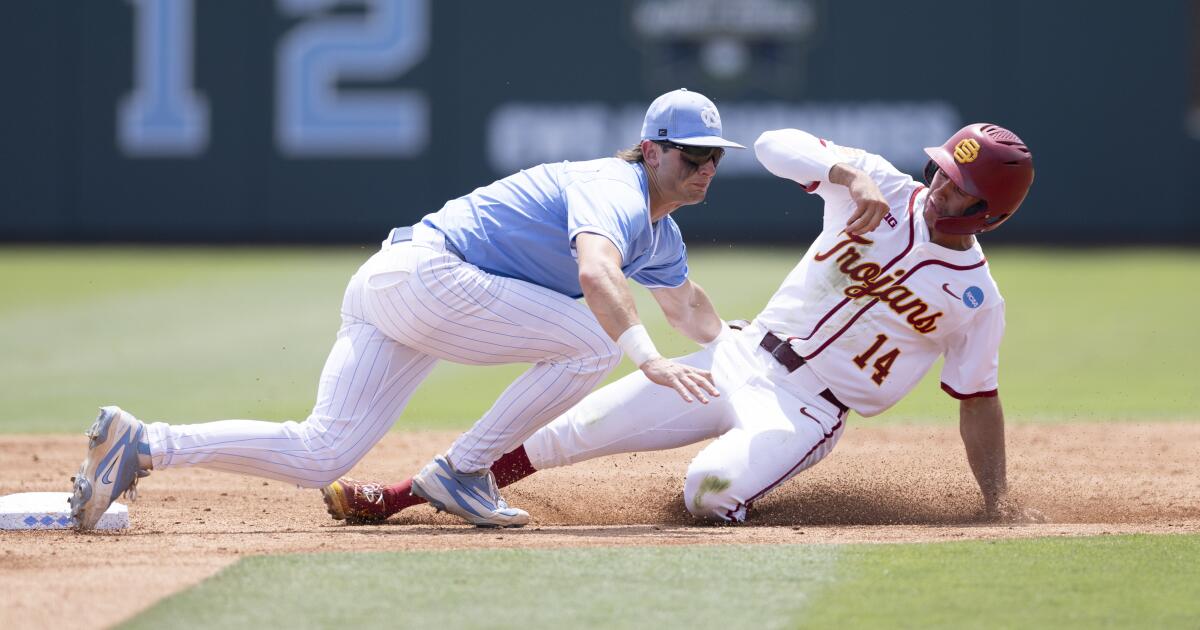
CHAPEL HILL, N.C. — Grant Govel was good, but Jason DeCaro was almost perfect.
USC baseball lost 4-0 in Game 2 of the NCAA Chapel Hill Super Regional, meaning its quest to break a 25-year College World Series drought will come down to a single game on Sunday.
North Carolina (49-12-1) turned to DeCaro with its season on the line, the seventh career NCAA tournament start for the veteran right-hander. DeCaro delivered a complete-game masterpiece, allowing just two hits — singles in the first and fifth innings — with eight strikeouts and one walk on a career-high 117 pitches.
“Obviously it was all about Jason DeCaro,” USC coach Andy Stankiewicz said. “He threw a heck of a game. He spotted his fastball and his breaking ball, we couldn’t get inside of it and couldn’t get through it. A very nice performance obviously by him, but the good thing is, we have tomorrow.”
Outside of giving up a solo home run to Colin Hynek in the second inning, Govel had a strong performance for USC (48-17). After throwing 153 pitches across two appearances in the NCAA regionals, including 64 pitches in Monday’s clinching win over Texas A&M, he gave up just five hits and struck out three over five innings and 83 pitches.
His final pitch was a crucial one, inducing an inning-ending double play with runners on the corners to hold the game at 1-0.
“Physically good,” Govel said when asked how he felt after making 236 pitches over a nine-day span. “I think having a good defense around me the entire time was very helpful. The solo shot didn’t really affect me. I’ve had a lot of homers hit off me this whole entire year. Competing with their guy — hats off to him, he pitched a hell of a game — felt good. The game just didn’t fall where we wanted it to.”
But for all of Govel’s great work, the day was all about DeCaro’s dominance.
North Carolina pitcher Jason DeCaro delivers against USC in Game 2 of the NCAA Chapel Hill Super Regional on Saturday.
(Kara Durrette / For The Times)
North Carolina found success against the Trojans’ bullpen in the sixth. Erik Paulsen hit a 339-foot home run over the left-field corner wall to double the Tar Heels’ lead, just the second home run given up by USC’s Sax Matson all season. The Tar Heels added two more on sacrifice flies in the sixth and seventh innings, but failed to drive in more with the bases loaded in the seventh and ninth innings.
“We pitched well enough to keep ourselves close and give ourselves a shot,” Stankiewicz said. “But at the end of the day, it was just all about DeCaro.”
DeCaro got better as the game continued, retiring the final 10 USC batters. It was a dominant pitching performance, but thanks to USC’s comeback win Friday, the Trojans still have life.
North Carolina coach Scott Forbes confirmed either Folger Boaz or relief ace and National Collegiate Baseball Writers Assn. Stopper of the Year Award finalist Caden Glauber will start Game 3. Stankiewicz did not name a starting pitcher for the decisive game.
Regardless, it will be all hands on deck.
“We’ll need everybody,” Stankiewicz said. “We can’t go too long with too many.”
The game will start at noon PT on ESPN. The Trojans won four elimination games last weekend and they’ll need one more to complete its mission to Omaha.
“We tell our guys Sundays are always important,” Stankiewicz said. “This is probably the most important Sunday that they’ll ever play.”
The biggest afternoon of Trojans baseball in a quarter of a century awaits.
-
 Lifestyle13 seconds ago
How to have the best Sunday in L.A., according to Randall Park
-
 Politics7 minutes ago
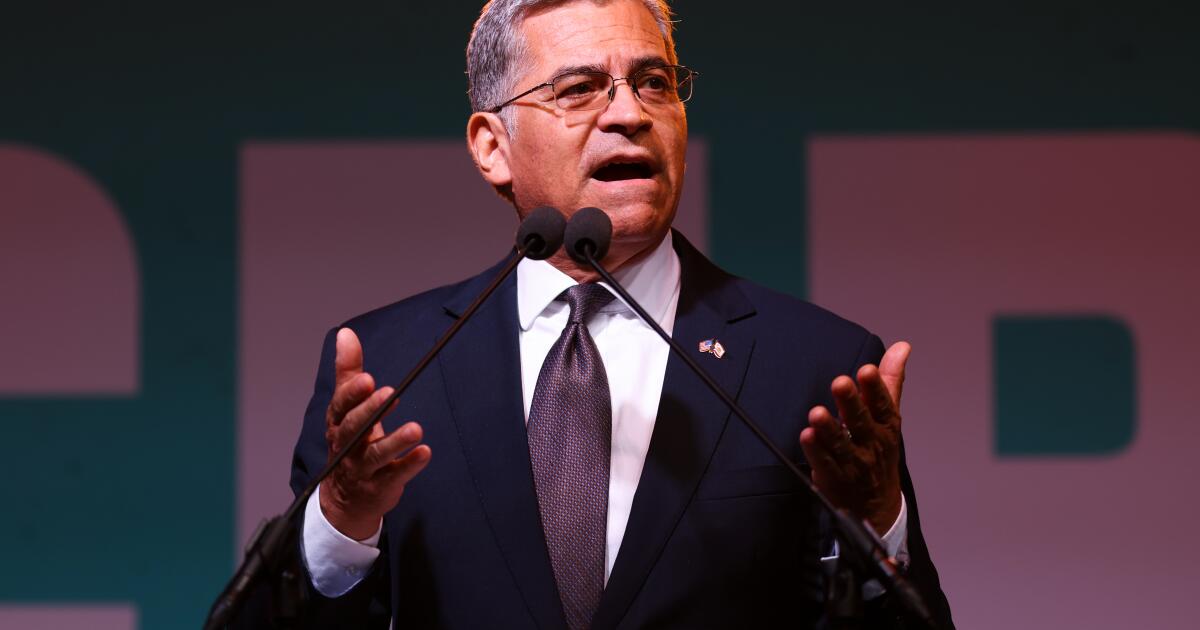
Becerra advances to November, moves closer to becoming California’s first elected Latino governor
-
 Science10 minutes ago
L.A. region begins the year with the smoggiest first 5 months in a decade
-
Sports15 minutes ago
Dodgers go on scoring spree before Yoshinobu Yamamoto shuts down Angels
-

 World25 minutes ago
Pakistan official visits Iran with ‘special letter’ for supreme leader
-

 News52 minutes ago
Multiple people shot near street festival in Toledo, Ohio, authorities say
-

 Los Angeles, Ca2 hours ago
Protests mark 1-year anniversary of federal agents storming L.A.’s Fashion District
-

 Detroit, MI3 hours ago
Hundreds gather for rally against gun violence on Detroit’s east side

