Sports
Why Iga Swiatek’s doping case being kept secret is bad for tennis


Iga Swiatek’s one-month suspension for unintentionally taking the banned substance trimetazidine (TMZ) comes down to picograms. World No. 2 Swiatek’s positive test, recorded August 12 and communicated to her alongside a provisional suspension September 12, detected 50 picograms of TMZ per milliliter of urine, which doping experts call a trace amount.
A picogram is 1,000th of a nanogram; there are one billion nanograms in a gram. Not the sort of usage that would provide any advantage in a tennis match.
Combined with Swiatek submitting her medications and supplements to independent laboratories alongside hair samples, those numbers led the International Tennis Integrity Agency (ITIA) to accept her explanation that she had taken a contaminated dose of melatonin, which she had used to help her sleep to combat jet lag.
Here are some more numbers.
On September 20, 15 days after Jessica Pegula knocked her out of the U.S. Open and eight days after being told she had tested positive, Swiatek announced she was going to skip one of the top tournaments of the year.
“Due to personal matters, I’m forced to withdraw from the China Open in Beijing,” Swiatek said in a statement. “I’m very sorry as I had an amazing time playing and winning this tournament last year and was really looking forward to being back there. I know that the fans will experience great tennis there and I’m sorry I won’t be a part of it this time.”
The announcement came after Swiatek spent the end of the summer rightfully talking about how exhausted she was following the Olympic Games in July and August, at which she took the bronze medal after an intense period that included winning her fourth French Open in five years, competing at Wimbledon, and not winning a gold medal for which she was viewed as champion-in-waiting. Skipping a tournament due to “personal matters” seemed to fit with that narrative. Fatigue. A medical issue. Burnout. Family stuff.
Iga Swiatek at the Olympics earlier this year. (Dimitar Dilkoff / AFP via Getty Images)
Under the broadest definition, “personal matters” does cover just about anything. That said, when someone uses that phrase, the immediate understanding generally involves some sort of health or family issue. It’s personal, and generally separate from something that’s either public or professional.
There’s also an implicit boundary request in the phrase: What’s going on is my own business.
But positive doping tests and provisional suspensions handed down by an anti-doping authority are not personal matters. Those are professional matters, in a profession that is very public.

GO DEEPER
Explaining Iga Swiatek’s doping ban, why it was kept secret and what it means for tennis
The ITIA holds off on announcing any positive test for 10 days so the player has the right to appeal the provisional suspension. If the player decides to appeal, the agency keeps the findings secret, and the player generally does, too. Then the process of testing, litigation and judging unfolds behind closed doors. In Swiatek’s case, her successful appeal allowed her to play the WTA Tour Finals and the Billie Jean King Cup Finals while that process was going on.
Swiatek’s team’s statement says that she “was unable to inform the public about the ongoing investigation”. The ITIA’s code subjects its officials, employees and associates to confidentiality, but nothing explicitly prohibits a player who has tested positive and is serving a provisional suspension during an appeal from explaining what’s going on.
So, if you feel that you have been misled the past few months, then join the club. “Personal matter” doesn’t begin to describe a positive doping test and the process that ensued, and in the the long run, that less-than-transparent explanation for her absence may end up harming Swiatek more than the positive test for unintentionally taking a performance-enhancing substance that likely had no effect on her performance.
Whose decision was it to describe this as a “personal matter”? Was any consideration given to saying something else?
On Friday, Paula Wolecka, a spokesperson for Swiatek, stated in an email that Swiatek had experienced great distress because she knew she was innocent of intentionally doping and had taken contaminated medicine.
“The decisions were made with the best intentions at every stage of the process, step by step, according to current knowledge of the team and circumstances,” Wolecka wrote.
“Iga did everything in her power to act fair, to follow the ITIA’s procedures and requirements and after the decision was officially published by the ITIA, provide everyone with as many details of the process as possible to be fully transparent. Being a good human being with a strong core of values is crucial to her and she does her best to act in line with it, on and off the court.”
In a video statement Thursday, Swiatek said, “The whole thing will definitely stay with me for the rest of my life.”
Both Swiatek’s one-month suspension and the decision not to ban Jannik Sinner for his two positive tests for clostebol, an anabolic steroid, have been conducted according to ITIA protocol. Both cases have also revealed deep wells of mistrust and anger within tennis from fans and players alike, confused at players being allowed to play while under investigation. Everything has been done by the book. The book appears in need of a rewrite.
There are also plenty of hard-nosed anti-doping officials who believe the science has gotten ahead of the rulebook. Swiatek tested negative multiple times before the positive test and then again after. That would indicate that she was not in the middle of a doping cycle, and the trace amount of TMZ suggested an unintentional use as well.

Iga Swiatek playing in Riyadh, Saudi Arabia on November 3. (Robert Prange / Getty Images)
So perhaps provisional suspensions are not the way to go when the science says the athlete didn’t receive any benefit.
On a conference call with reporters Thursday, the ITIA’s chief executive, Karen Moorhouse, said the rules are in place to be fair to the players. “We’ve been absolutely transparent once they’ve reached an outcome,” Moorhouse said.
But is that transparent enough?
It’s true that players may not see much incentive for going public amid a period of uncertainty; that as soon as they announce they have tested positive for a banned substance and are under investigation, everyone will brand them as a cheater. Some no doubt would.
But a player is going to have to answer for the positive test eventually anyway. Would Swiatek, the ITIA and tennis be better off had they jointly come clean about this in September, rather than announcing it as done and dusted now, after Swiatek had spent the fall giving other explanations for her absence from competitive tennis?
It’s hard to not think so.
Now she has both tested positive and opted not to be “absolutely transparent” for two months. That’s not a very good combination.
It’s impossible to consider the Swiatek case without comparing it to that of Sinner, the world No. 1 in the men’s game.
Sinner tested positive for clostebol on March 10 this year at the BNP Paribas Open in Indian Wells, Calif, and again on March 18, out of competition. The independent tribunals of the ITIA determined the now 23-year-old Italian bore “no fault or negligence” for the positive tests, and therefore wasn’t deserving of a ban. But all this only became public at the conclusion of the ITIA’s investigations and hearings in mid-August.
There wasn’t much transparency there either, and the World Anti-Doping Agency (WADA) has since challenged and appealed the ruling to the Court of Arbitration of Sport (CAS), arguing that Sinner’s level of culpability should be upgraded to “no significant fault or negligence”, which would leave him facing a ban of up to two years.
GO DEEPER
Jannik Sinner’s doping case explained: What WADA appeal means and what is at stake for tennis
Through it all though, Sinner never explained anything to the public. He didn’t have to. He successfully appealed two provisional suspensions quickly enough to avoid missing any tournaments. Still, when the ITIA announced the details of the Sinner investigation and its ruling, much of the tennis-watching public felt like people had put one over on them.
That’s not good for anyone.
Swiatek repeatedly talked about the matter coming to a close in her video statement. Yet it’s hard to believe it has.
She will absolutely face more questions when the 2025 season begins in Australia in late December — about the doping violation, but also about why she didn’t tell us what was really keeping her off the court. So too will tennis authorities, about how a system which they say is working as designed can create situations in which so many people feel left in the dark.
(Top photo: Robert Prange / Getty Images)



NEWYou can now listen to Fox News articles!
Ask anyone who is favored to win Young Player of the Tournament for the upcoming 2026 World Cup, and presumably, you would struggle to hear a name other than Lamine Yamal.
The Spanish sensation, at only 18, is already viewed as one of the game’s greatest players — and he hasn’t even come close to his prime.
With that, let’s check out the odds for who will win Young Player of the Tournament as of July 12.
This page may contain affiliate links to legal sports betting partners. If you sign up or place a wager, FOX Sports may be compensated. Read more about Sports Betting on FOX Sports.
Young Player of the Tournament odds
Lamine Yamal: +130 (bet $10 to win $23 total)
Desire Doue: +280 (bet $10 to win $38 total)
Pau Cubarsí: +380 (bet $10 to win $48 total)
Nico O’Reilly: +850 (bet $10 to win $95 total)
Here’s what to know about this oddsboard:
The Race: Lamine Yamal has been the favorite since before the tournament began and has not moved from the top of the oddsboard. Statistically, Yamal has only one goal and no assists in this World Cup, but his presence on the field has clearly opened up things for Spain on numerous occasions en route to its semifinal berth. Doue has a goal and an assist in three starts for France.
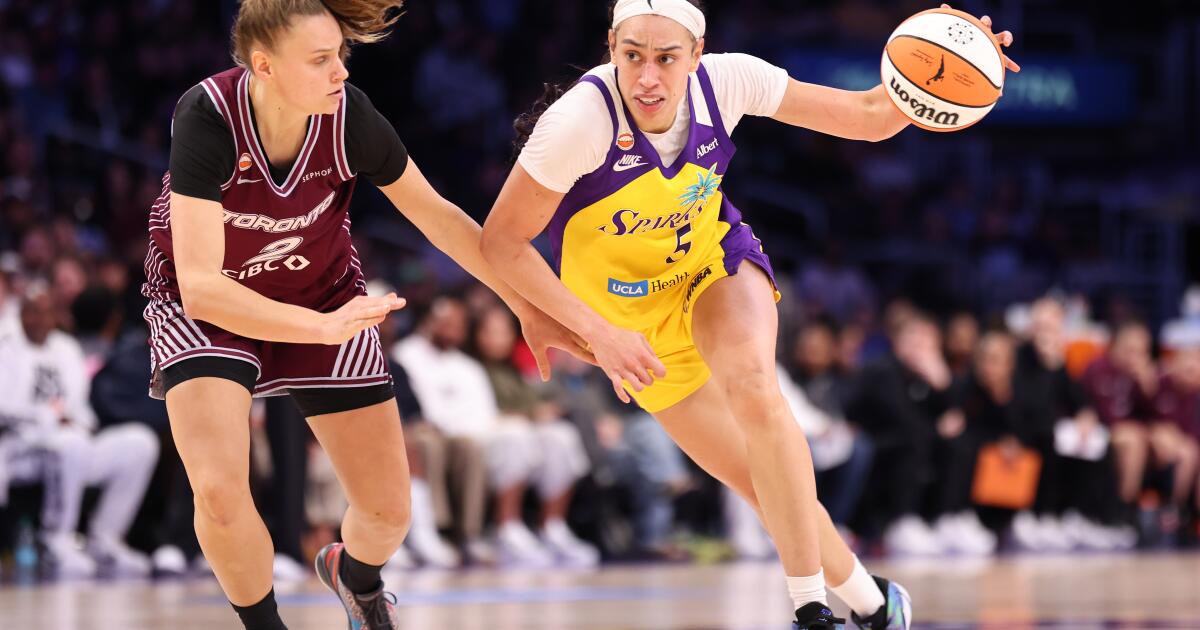
It was never actually in doubt. Dearica Hamby was going to stay a member of the Sparks. That was just how she worked.
Even when Nneka Ogwumike came into the fold and the frontcourt became crowded, Hamby didn’t doubt her decision to return to the organization that traded for her four years ago.
Loyalty mattered more than anything else.
“That’s who I am,” she said. “I don’t run away from things. I wanted to stay here and help L.A. get back to where it was and is capable of being.”
In a loaded frontcourt, the 32-year-old Hamby has still found ways to shine. Hamby has led the Sparks in scoring four times and led or tied for rebounding 16 times this season after signing a three-year, $3.5-million contract.
She ranks in the top 20 in the league in rebounds and field-goal percentage (plus 25th in scoring) and is eighth in offensive rebounds in establishing herself as an essential piece to the Sparks’ “win now” attempt.
“I think it’s the challenge, because we are so good and we have so much talent,” said Hamby, who is averaging 14.8 points, 7.7 rebounds and 2.3 assists while shooting 52.8% from the field. “You’re forced to produce, but it’s also a blessing. I know it’s probably hard for coach to manage the three’s playing time and stuff like that, but it’s a beautiful problem.”
Hamby was in the headlines when the Aces traded her after she was pregnant. In September of that year, she filed a federal discrimination complaint against the team and league, claiming she was traded because she was pregnant. The two sides resolved matters before trial.
The new CBA this year created a new rule that requires a pregnant player’s consent to be traded.
“I feel like she’s such an anomaly,” said forward Rae Burrell. “I remember when she had her son, and it was crazy because everybody was saying she was coming back so early, I thought that was insane, but now being her teammate, I see it, she’s just kind of a freak of nature, like she’s so athletic, she can do all types of things on the court that you think looks unorthodox, but she makes it happen, but also just love being her teammate. She’s just good people.”
Since that trade, she has been a regular in the Sparks’ starting lineup while averaging double-digit scoring and around eight rebounds per game. She’s one of the most efficient scorers in the league, too.
But Hamby’s games have been all over the board. Against the Aces, she missed all seven of her shots. Against Dallas and Indiana, she made six of eight shots. She’s had eight games with a shooting percentage above 60% and four games under 40%.
Sparks forward Dearica Hamby, left, tries to steal the ball from Mercury forward DeWanna Bonner during a game in Phoenix.
(Christian Petersen / Getty Images)
Having the three frontcourt players has been an adjustment for coach Lynne Roberts to find how to implement them all in the offense.
“I’m trying to implement the new offense, we’re plugging pieces into play, and things that I may have been able to do last year as freely I’m not as able to do this year,” Hamby said. “So just adjusting for sure, but I think that’s across the board for everybody.”
Before the season, Roberts said that Cameron Brink would come off the bench and Hamby would start. Brink, the only natural center on the team, averages just 17.5 minutes per game primarily because of her 3.7 fouls.
“She’s my vet,” Brink said of Hamby. “I think she’s just such a grounding force for us, and she’s someone that does everything, so I just really feel like I learn from her every day, and I’m just very thankful to be in her presence.”
Hamby averages 3.2 fouls per game and has expressed frustration about the new officiating norms this season, but has avoided true foul trouble. She and Ogwumike work as two fours instead of a team with a traditional five.
“She has a lot of energy,” Ogwumike said. “I think she does a really good job of just having a high motor and going out there and kind of like doing the dirty work. I feel like it’s beneficial to have a loaded frontcourt, to be able to have so many different types of players and a depth where anytime one of us is in, there’s no letdown.”
The Sparks have been the worst defensive team in the league this season and struggled to score when point guard Kelsey Plum was out of the lineup with an ankle injury. Ogwumike might be the other veteran leader, but Hamby has stayed with this Sparks team the past two seasons while Ogwumike was in Seattle.
Now her role has changed, even with that loyalty. She’s playing just over a minute less and they’re asking for better defense and efficiency.
Hamby chose to come back. Now she’s choosing to help build the Sparks up.
“I know my usage is a lot lower,” Hamby said. “A goal of mine the last two seasons was to have those numbers, so to have the same numbers just at a more efficient rate, and so I mean offensively, but with like two fewer shots a game, that’s pretty impressive.”
Sports
Conor McGregor’s long-awaited Octagon return cut short by apparent knee injury seconds into UFC 329

NEWYou can now listen to Fox News articles!
Nearly five years after his last walk to the Octagon, Conor McGregor made his long-awaited UFC return Saturday night against fellow MMA star Max Holloway in the main event of UFC 329 in Las Vegas.
McGregor opened aggressively, attempting a running kick before throwing a head kick moments later. He appeared to slip on both tries. Holloway quickly capitalized after the second, taking top position and landing a right hand before McGregor was able to work his way back to his feet.
Moments later, McGregor hit the canvas again after trying to throw a kick with his right leg, which appeared to buckle underneath him.
CLICK HERE FOR MORE SPORTS COVERAGE ON FOXNEWS.COM
Conor McGregor of Ireland participates in the walkout before facing Max Holloway of the United States in their welterweight bout during UFC 329 at T-Mobile Arena in Las Vegas. (Ian Maule/Getty Images)
The official inside the Octagon waved off the fight moments later, giving Holloway a TKO victory.
During the broadcast, UFC CEO Dana White pointed to a first-round replay that appeared to show the moment McGregor suffered the injury. The apparent injury was not to the same leg McGregor broke during his 2021 fight against Dustin Poirier, which led to a lengthy absence from the Octagon.
The loss extended McGregor’s long winless drought, with his last UFC victory coming by first-round TKO against Donald “Cowboy” Cerrone in January 2020.
JAKE PAUL’S BUSINESS PARTNER GIVES TIMELINE ON RETURN TO RING AFTER CAREER-THREATENING INJURY
McGregor earned a unanimous decision over Holloway in a featherweight clash in 2013, when neither was an MMA megastar. In the blink of an eye, McGregor’s star rose.
Conor McGregor and Max Holloway face off during the UFC 329 ceremonial weigh-in at T-Mobile Arena in Las Vegas, Nevada, on July 10, 2026. (Chris Unger/Zuffa LLC)
On Wednesday, he admitted he got caught up in his own stardom after winning UFC belts in two weight classes and becoming one of the biggest names in combat sports.
“I launched an Irish whiskey,” McGregor said. “I didn’t drink heavily, if at all, at that time of my life. I was an athlete at the top of my game. Next thing you know, thousands upon thousands of bottles (are) in my garage.
RONDA ROUSEY REVEALS WHAT INSPIRED HER TO END NINE-YEAR MMA HIATUS FOR ONE FINAL FIGHT
“‘Sell this, Conor.’ OK, I’d leave my property with two bottles under my arm, and that was it. I was caught. And I wasn’t used to it. And that’s it. God gave me these lessons. That’s it. I was trapped and caught, and it is what it is.”
Conor McGregor jumps into the air for a kick as he fights Max Holloway in a welterweight bout at UFC 329 in Las Vegas, Nevada. (John Locher/AP)
CLICK HERE TO DOWNLOAD THE FOX NEWS APP
Easier said than done, perhaps, as the controversial former champion has been embroiled in multiple controversies and legal issues over the past several years.
The Associated Press contributed to this report.
-

 Los Angeles, Ca38 minutes ago
Rare, corpse flower double bloom underway at Huntington Library
-

 Detroit, MI1 hour ago
Around 400 pairs of shoes intended for charity giveaway stolen from Detroit nonprofit, organization says
-

 San Francisco, CA1 hour ago
How to watch San Francisco Giants vs. Colorado Rockies
-

 Dallas, TX1 hour ago
3 unanswered questions before training camp: Dallas Cowboys edition
-

 Miami, FL1 hour ago
“Love & Hip Hop: Atlanta” star Tommie Lee among 6 arrested during World Cup match in Miami, sheriff says
-

 Boston, MA2 hours ago
‘More than just a cyclist’: Hundreds mourn Boston transit planner killed while biking – The Boston Globe
-

 Denver, CO2 hours ago
Nuggets sign former Denver West basketball player Alpha Diallo out of EuroLeague
-

 Seattle, WA2 hours ago
Portland aims to top Seattle’s 405 e-bikes with 2-mile Guinness record ride and party

