Sports
U.S. Open final analysis: Jannik Sinner beats Taylor Fritz to win second Grand Slam title


NEW YORK — Jannik Sinner beat Taylor Fritz in the U.S. Open final at the Billie Jean King National Tennis Center, 6-3, 6-4, 7-5 on Sunday, in two hours, 15 minutes.
The No. 1 seed prevailed over the No. 12 seed in a comfortable win, bar a few games of excitement in the third set. It was ultimately decided by Fritz struggling to win points behind his serve, Sinner’s tactical adjustment of his return position, and Fritz’s still-developing variety in his game not quite being enough.
It is Sinner’s second Grand Slam title of his career and his second of 2024. He joins Aryna Sabalenka in holding both the Australian and U.S. Open titles for the year, and cements his position as men’s world No. 1.
The Athletic’s writers, Charlie Eccleshare and Matt Futterman, analyze the final and what it means for tennis.
Why did Taylor Fritz’s serving performance dip?
In the very first game of the match, Fritz saved a break point with a forehand winner, after some excellent Sinner defence. It was a short-term win for the American, but having to win points like that behind a serve that regularly clears 120mph is not a path to winning a match. To stand any chance, Fritz would have to serve well enough to nullify Sinner’s defensive prowess.
Fritz couldn’t manage this in the first set, during which time he was broken in three of his five service games, including the first. In that game, he sent down a 127mph serve on break point, which Sinner sliced up in the air. Fritz missed the put-away shot and went behind immediately.
His low first-serve percentage (38 per cent) was a factor in losing the first set 6-3, but even more important was the proportion of points won behind those serves. Fritz won just 55 per cent, way down on the 81 per cent he had averaged for the rest of the tournament.
Fritz was missing the lines with his first serve, and when he got them in, Sinner was able to get the ball back deep and put the American on the back foot. Fritz struggled to bring his forehand into play early in points as a result, and the struggles he had on his serve meant that, despite a pretty good returning day, he was too often behind the eight ball.
GO DEEPER
Wimbledon day 10: How Lorenzo Musetti sliced out Taylor Fritz, Krejcikova wants respect
Charlie Eccleshare
How did Sinner sweep Fritz’s feet from under him?
Just when it looked like Fritz had gotten his feet under him, straightening out his first-set serving problems and staying even with Sinner through the second, the wheels came off.
The first player to break the other’s serve was likely to win the match, and Fritz had gone from landing just 38 per cent of his first serves in the first set, to nearly 90 per cent in the second set, through his first four service games.

Jannik Sinner dragged Fritz into long rally exchanges that he couldn’t sustain. (Kena Betancur / AFP via Getty Images)
Then came the fifth and most crucial service game at 4-5, in which Fritz made only three out of five first serves, and the points stretched longer — the kind of situation in which Fritz’s less reliable ground game can break down.
Three unforced errors gave Sinner two set points. He only needed one, moving into the court and sending a forehand deep that Fritz couldn’t get back.
All points and games are supposed to be equal in tennis. They’re not. Lose your serve in the first game of a set and you have several more chances to draw even. Lose it when you’re a set down and 4-5 behind, and you’ve lost at least 40 per cent of a match.
Beating Sinner from ahead or while staying even is hard enough. Climbing out of a two-set hole to do it is nearly impossible.
Matt Futterman
How did the crowd feed off scraps — and then burst into life?
As well as the serve, the main weapon Fritz had on Saturday was the crowd.
Broadly speaking, there are two main ways to get the fans going. One is having a Frances Tiafoe-like ability to work a crowd; the other is keeping the scoreboard close enough that they get properly engaged.
Fritz is never going to be a guy who connects with supporters like Tiafoe, it’s just not in his nature — so he needed to create some tension by putting Sinner under pressure, much like the similarly understated Jessica Pegula did with Aryna Sabalenka in Saturday’s women’s final.

When Taylor Fritz sparked into life, the crowd did too. (Kena Betancur / AFP via Getty Images)
Fritz really struggled to do this for the most part, for which his opponent also deserves a lot of credit. Sinner has such a good poker face that he gives a crowd very little to work with.
Finally in the third set, Fritz and the crowd started working together in harmony. First, after Fritz held for 3-3 having saved break points, they properly erupted for the first time. Buoyed by this, Fritz gave them a couple of big celebrations in the next game, which sent the crowd wild. They started getting on Sinner’s case, cheering when he missed a serve and willing a double fault into existence to give Fritz the break and what looked like the set.
Then Sinner came back again and, although the crowd remained engaged, they couldn’t help their guy over the line.
Charlie Eccleshare
As Sinner figures out his losses, who will figure out how to beat him?
There simply aren’t many ways to beat Jannik Sinner these days, other than hoping that he is having something off an off-day, especially on his serve. Sinner is now 55-5 in 2024, with a 35-2 record on hard courts, losing to Andrey Rublev in Montreal and Carlos Alcaraz in Indian Wells.
Alcaraz appeared to be onto something at Indian Wells in March. Down 1-6, he made a mid-match adjustment and started varying the height of his groundstrokes, jumping the ball up and down to break Sinner’s rhythm. The Italian prefers to plant his feet just behind a baseline, firing back forehands and backhands on a wire all afternoon.
Since then, a whole line of players have tried the tactic, and Sinner now sees it from a mile (or 80 feet) away — especially against someone like Fritz, who can’t get the trajectory and revolutions to make things awkward. Sinner straightens up and hops back as soon as he spots some elevation, and turns a high ball into a belt-high forehand.
He has also started making mid-match tactical adjustments of his own. The best example Sunday afternoon was drifting back near the back wall, changing his return position deep into the second set after Fritz had pinned him back for the majority of it.

Jannik Sinner spent most of his time returning in the green behind the court. (Frank Franklin II / Associated Press)
Suddenly, Sinner became Daniil Medvedev. He knew that he could hit long, loopy returns against Fritz — a player who rarely serves and volleys, and is still incorporating variety and advanced net play into his game. By extending the length of rallies, he played Fritz’s service games on terms favorable to him.
It was a good, low-risk place to start changing things up — or in Sinner’s case on Sunday, to finish them.
At 4-5 30-30, Fritz was serving to win the third set and turn Arthur Ashe Stadium into a cauldron. He launched into one of his best serves of the day, a 133mph serve down the T. Sinner’s return position gave him time to send a return onto a pixel square in Fritz’s backhand corner. Somehow, the Italian had gained the upper hand in a point he had no business winning. He did it on that one, and the next one and the next one. Suddenly it was all even at 5-5, and the crowd’s hopes had diminished. Another break two games later, and it was done.
Matt Futterman
What did Jannik Sinner say after the final?
On court:
“The last period of my career was really not easy,” Sinner said, before dedicating the title to his aunt who is unwell.
“I don’t know how much I still have her in my life … She was a very important person in my life.”
What did Taylor Fritz say after the final?
On court:
“I know we’ve been waiting for a champion for a long time. I’m sorry I couldn’t get it done this time, but … I’m gonna keep working, and hopefully I’ll get it done next time.”
In his press conference:
On his serve not working for much of the match
“My plan A is not working. The plan B that I fall back on would normally be being a little bit safer, grinding it out.
That works, along with my serve, against a lot of other players, but against him, he’s just gonna bully me a little bit too much.”
On the feeling that Grand Slams are more open now
“I don’t think you have to, I don’t know, play unbelievable to go deep in tournaments and contend.”
Recommended reading
(Top photo: Angela Weiss / AFP via Getty Images)



Sports
Golf star records lowest round in LPGA major history with astounding performance at Evian Championship

NEWYou can now listen to Fox News articles!
There are good days on the golf course, and then there is what Haeran Ryu just did on Saturday.
Ryu, 25, recorded the lowest round in LPGA major history on Saturday with an 11-under 60 at the Evian Championship. With the South Korean golfer’s historic round, she holds a three-stroke lead.
Ryu’s round comes just two weeks after winning her first major at the Women’s PGA Championship. On the 18th hole, Ryu left a 30-foot eagle putt a few inches short, and instead settled for a birdie.
CLICK HERE FOR MORE SPORTS COVERAGE ON FOXNEWS.COM
Haeran Ryu of South Korea reacts on the 18th green after the third round of The Amundi Evian Championship at Evian Resort Golf Club in Evian-les-Bains, France, on July 11, 2026. (Stuart Franklin/Getty Images)
She said after the round that she had no idea what she had done until she counted up her scorecard.
“But after the putt and I counted my score with my caddie,” she said. “Oh my God, it’s 11-under par today. It was so amazing. My caddie says, ‘Yep.’ I’m so happy right now.”
If Ryu had made the eagle putt on the 18th hole, she would have been just the second player to shoot a 59 in LPGA history.
ZERO BS. JUST DAKICH. TAKE THE DON’T @ ME PODCAST ON THE ROAD. DOWNLOAD NOW!
Haeran Ryu of South Korea celebrates a birdie on the 15th green during the third round of The Amundi Evian Championship at Evian Resort Golf Club on July 11, 2026, in Evian-les-Bains, France. (Stuart Franklin/Getty Images)
Her 60 broke the record for the lowest round in an LPGA major by one shot. Leona Maguire and Jeungeun Lee6 in 2021, and Hyo Joo Kim in 2014, each shot 61 at the Evian Championship, which was designated as an LPGA major in 2013.
The lowest round in a men’s major is 62, which is shared by four players — Branden Grace at Royal Birkdale in the 2017 British Open, Xander Schauffele and Rickie Fowler in the 2023 U.S. Open at Los Angeles Country Club, and Schauffele and Shane Lowry in the 2024 PGA Championship at Valhalla.
CLICK HERE TO DOWNLOAD THE FOX NEWS APP
Haeran Ryu of South Korea and Lottie Woad of England interact after their round on the 18th green during the third round of the Amundi Evian Championship at Evian Resort Golf Club in Evian-les-Bains, France, on July 11, 2026. (Stuart Franklin/Getty Images)
Ryu hopes her historic third round can help propel her to a second major win in three weeks.
“That is amazing, amazing dream,” Ryu said. “So I just want that one to come true, but we have one more day.”
The Associated Press contributed to this report.
Follow Fox News Digital’s sports coverage on X, and subscribe to the Fox News Sports Huddle newsletter.
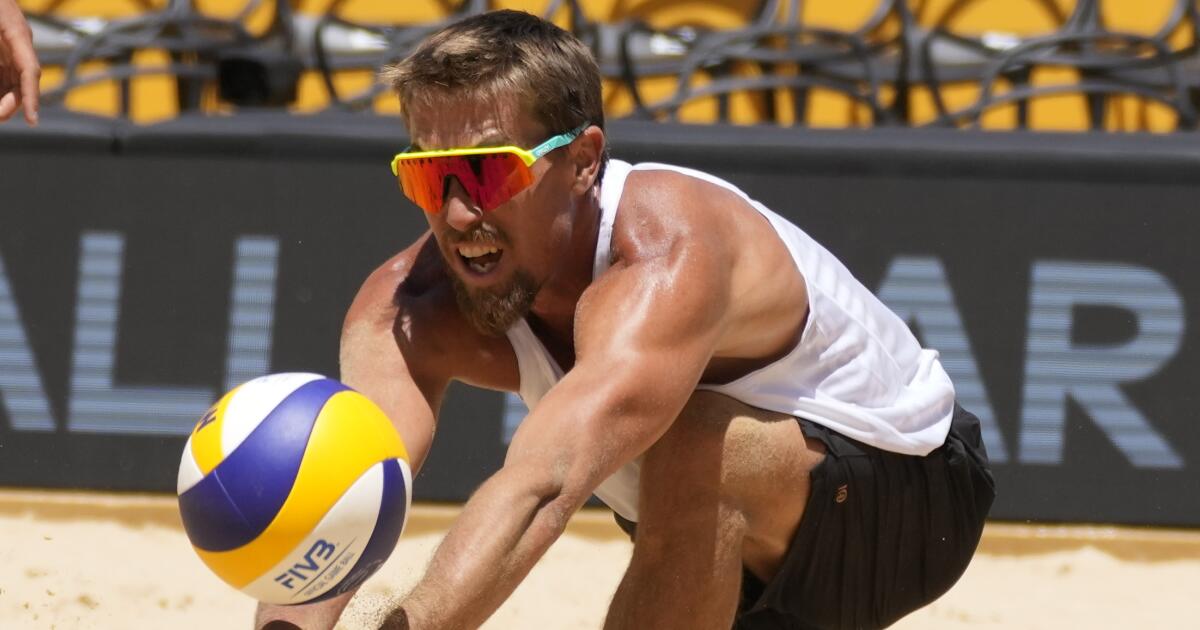
Taylor Crabb is no stranger to South California beaches. The Long Beach State alum returns home this weekend to compete in AVP League matches.
It marks the first time AVP will compete in Long Beach since 2020 and allows players to compete at the 2028 Olympics beach volleyball venue.
Crabb, 34, made his AVP debut in 2013 with his brother, Trevor, and advanced from the qualifier in Manhattan Beach before finishing 25th in his first tournament.
After years of competing with various different partners, Taylor Crabb and Andy Benesh have delivered the top performances this AVP season.
The following interview with Crabb has been edited for clarity and length.
Are you excited to compete in this weekend’s event at Long Beach?
Crabb: Very excited. A lot of my college teammates and part of the school have reached out, saying that they’re gonna come. So I’m excited to get a chance to play in front of them again.
When was the last time you were in Long Beach?
Crabb: I always try to go down there for alumni events or any big games they have. I went to UCLA against Long Beach last year, when it was No. 1 versus No. 2, so I always try to get down there and support them.
You missed out on the chance to compete in the 2020 Olympics because of COVID-19 restrictions and chose not to pursue a spot at the 2024 Olympics. Are you fired up to try to compete in the 2028 Olympics, knowing that Long Beach will host the competition?
Crabb: Yeah, it’s definitely an exciting time having the Olympics in Long Beach, and we kind of get to break it in this weekend. As you said, Tokyo didn’t go the way I wanted, but I’m going full force now. I have a great partner in Andy Benesh, who obviously went to the Paris Olympics, and if it weren’t for the Olympics being in Long Beach, and me getting a partner like Andy, I’m not even sure I’d be going for it, but because of those two things, I want to make the most of it.
You mentioned that if it wasn’t for a partner like Andy, you wouldn’t be going for it. What do you mean by that?
Crabb: I didn’t feel motivated by playing in all the international events, but now, I think, sitting out kind of lit the fire under me, and I’m really motivated now.
You’ve had different partners throughout your time. What other motivation does Andy give you?
Crabb: He’s been, in my mind, the top blocker for the U.S. the last four or five years. Seeing the professionalism he brings every day to practice, on and off the court, while traveling and when showing up to tournaments, it rubs off on you and that’s really motivating to see. And I just want to make him proud.
Why do you love volleyball?
Crabb: A lot of reasons, but it’s just a feeling I have when I’m out there on the court. It feels natural. It feels like home. I was born into a volleyball family. I had a volleyball in my hands my entire life, so I’ve always just enjoyed it.

NEWYou can now listen to Fox News articles!
CM Punk appeared on “Friday Night SmackDown” ready to take on any challenger that was ready to step to him after winning the Undisputed WWE Championship against Sami Zayn.
Punk entered the ring in Oklahoma City and called back to the “Monday Night Raw” after WrestleMania 42 when he told Cody Rhodes he’d be ready to deliver if a championship opportunity fell “out of the sky.”
COMPLETE PRO WRESTLING COVERAGE ON FOX NEWS DIGITAL
Cody Rhodes and CM Punk face off during SmackDown at Paycom Center in Oklahoma City, Okla. (Craig Ambrosio/WWE via Getty Images)
“When championship opportunities fall out of the sky, CM Punk catches them,” he said.
Punk named potential SmackDown superstars he’d think might come for the title, including Gunther, Finn Balor, Royce Keys, Damian Priest and Trick Williams. He even said that Zayn could come back around and get his rematch if he wanted. He didn’t mention Rhodes’ name, but the “American Nightmare” came out uncalled and marched his way down to the ring.
“I don’t think you and I can run away from each other anymore,” Punk told Rhodes.
Cody Rhodes looks on during SmackDown at Paycom Center in Oklahoma City, Okla., on July 10, 2026. (Craig Ambrosio/WWE via Getty Images)
Rhodes agreed and mentioned that Punk would want a match with him, just “say when.” It was a quick retort from Punk, who said, “when.” SmackDown general manager Nick Aldis, who was in the ring for the segment, booked the match for SummerSlam.
Punk will defend the Undisputed WWE Championship at SummerSlam, which takes place Aug. 1 and 2 at U.S. Bank Stadium in Minneapolis.
First, however, Punk and Rhodes will be involved in a tag team match at Saturday Night’s Main Event in New York City next week. Aldis made the match after Gunther demanded that Aldis put him in a match against Punk. Gunther was hoping it would be for the championship. Instead, Gunther will tag with Zayn.
Gunther didn’t take too kindly to that and attacked Aldis. Rhodes came back out to break up the calamity. He wanted to take on Gunther after the show went off air but Gunther walked away.
Gunther makes his entrance during SmackDown at Paycom Center in Oklahoma City, Okla., on July 10, 2026. (Rich Wade/WWE via Getty Images)
CLICK HERE TO DOWNLOAD THE FOX NEWS APP
Punk definitely has his hands full as he moves to SmackDown to become a fighting champion.
-

 Austin, TX3 minutes ago
Man shot and killed by police after pointing gun at people in Austin, Texas
-

 Alabama10 minutes ago
Alabama has Talent returns with local connection
-

 Alaska13 minutes ago
Alaska Sports Scoreboard: July 11, 2026
-

 Arizona18 minutes ago
Cardinals Mailbag: Latest on Jacoby Brissett, Carson Beck, and Arizona’s QB Future
-

 Arkansas25 minutes ago
Arkansas tips its hat to blues pioneer Larry “Totsie” Davis in England dedication
-

 California28 minutes ago
‘Explosive diarrhea’ parasite surfaces in California as health officials fear statewide surge
-

 Colorado33 minutes ago
This Quiet Colorado Town Is An Underrated Gem For Nature Lovers
-

 Connecticut40 minutes ago
Car catches fire in Trumbull

