Sports
The wisdom of crowds: Tricolores, trumpets, and truculence at Roland Garros


Let’s start with the brass band.
That’s what caught Ben Shelton off guard when he walked onto court Sunday to face Hugo Gaston of France. The venue was Court 14: a sunken stage that can very quickly become a suffocating cauldron of noise and mayhem when the opponent is a native son.
“This is the first time that I’ve come out to a tennis match and had a band playing in the stands on my court,” said Shelton. Shelton, the 15th seed at this year’s French Open, is no stranger to rowdy crowds; he played two years of college tennis at the University of Florida. Away matches at Kentucky Tennessee and Georgia were especially nasty, he said.
“You play in the SEC (Southeastern Conference) all bets are off.”
If the bets are off on campus, then at Roland Garros, they’re somewhere in the Seine. All match long, the band played on, a bass drum thumping and summoning the rhythmic clapping, the trumpets and horns tooting and rousing the standing-room-only crowd of thousands to its feet to shake Shelton into as many faults and errors as it could.
This is how tennis rolls at the French Open, turning a genteel sport known for its etiquette-obsessed fans into the frenzies of soccer matches.
It’s not everyone’s cup of tea. The lords of Wimbledon would have none of it, and the All England Club has long set the standards for much of the sport. But these are two of just a handful of weeks during the tennis season when a tournament reminds a sport that it does not have to abide by the norms of Victorian-era Great Britain.
Raucous crowds have headlined this year’s tournament (Richard Callis/Eurasia Sport Images/Getty Images)
Players and fans alike might enjoy themselves a tad more.

“They’re really into it and I felt like they really love tennis,” said Denis Shapovalov, a Canadian who got similar treatment later that evening when he took on France’s Luca Van Assche a few hours later on the same court. Shapovalov, a massive Toronto Maple Leafs fan, is no stranger to the boozy and brazen throngs at sporting events — just not the ones he’s playing in.
“Pretty fun as a tennis player, even though it was against me.”
After a series of pressure-cooker clashes in the early rounds, tennis players and fans are being forced to re-engage with the current rules of the game. At its best, tennis is a sport that inspires uncontrollable emotions, from awe and ecstasy to desolation and pain. Fans going through those emotions are expected not to show them — at least until a point is over — and even then, not to show them too much.
Lines do get crossed and in Paris, players not from France bear the brunt. Belgium’s David Goffin was plenty salty after his five-set win over France’s Giovanni Mpetshi Perricard on Tuesday night, taunting the crowd with a cupped ear for mere seconds after it spent more than three and a half hours taunting him.
The Parisians have form. Taylor Fritz ran around the court with his finger on his lips after toppling Arthur Rinderknech of France last year, screaming, inaudibly beneath the din of boos, that he wanted them to “let me hear it!”
Goffin was a little more unnerved.
“It goes too far, it’s total disrespect,” the mild-mannered Belgian told reporters from his country following the match. He claimed a fan had spit gum at him.
“Soon there will be smoke bombs, hooligans and fights in the stands.” He compared that behaviour to that of soccer fans — the implication that it simply has no place in tennis.

Goffin gave some back (Benoit Doppagne/Belga Mag/AFP via Getty Images)
World No 1 Iga Swiatek then gently scolded the Court Philippe-Chatrier crowd on Wednesday for making noise in the middle of points as she prevailed in three sets over Naomi Osaka in a gripping duel.
Swiatek understands the enthusiasm of the French crowds, she said, but there is decorum in tennis, an expectation of silence in the audience, though plenty of her peers, namely Frances Tiafoe, think that concept should have gone away long ago. Reading between the lines, Swiatek, though addressing the topic in general, was only really talking about one point: as she moved on to a regulation drive forehand volley deep in the third set against Osaka, someone screamed out as she addressed the ball. She missed the volley.
If tennis players were constantly exposed to noises of varying pitch and intensity, mapped to the contours of their rallies — just like in almost every other sport — this kind of thing wouldn’t be a problem.
When a gasp emerges from a vacuum, it is much more jarring.
“I just wanted to point out that it’s not easy for us,” Swiatek said. “French crowds can be kind of harsh, so I don’t want to be under the radar right now. I don’t know if that was a good decision or not, but I hope they can treat me as a human.”
This has all caused quite the stir at the French Open, and tournament director Amelie Mauresmo said Thursday that she would no longer permit spectators to drink alcohol in the stands. Umpires and security officials have been put on alert to snuff out unruly behavior.
But fans getting emotional in the middle of a point, as long as it’s not intentionally done to put off a specific player, is not a punishable offense.
“If you throw something at a player, that’s black and white, you’re out,” Mauresmo said. “Expressing emotions, during a point, isn’t the same thing.”
Given the singular nature of the French Open, it’s also hard to tell whether all this is a genuine referendum on the nature of spectatorship, or more of an occupational hazard of being in the City of Light for a fortnight. Home advantage is as old as sports and warfare, and there is something inherently unfair about it in tennis. Players from only four countries — Australia, France, the United Kingdom and the United States — can experience a home-court advantage in the Grand Slams, the most important events in the sport.

Home favorite Caroline Garcia even got a portrait last year (Robert Prange/Getty Images)
Everyone else has to make do with the extra oomph of a home crowd (and its proven effects on umpires and referees) at tournaments that don’t mean nearly as much and offer far less prize money. The circumstances at this year’s tournament are also a little strange.
Rafael Nadal vs Alexander Zverev and Swiatek vs Osaka aren’t your typical first- and second-round matches; they’re the kinds of occasions fans are used to seeing in semi-finals and finals, when the jeopardy is at its peak and emotions run highest. When Andy Murray won his first Wimbledon final against Novak Djokovic in 2013, the entire Centre Court crowd let out a pealing screech on match point, when Djokovic’s first ball flew high and deep in the air, and an awed gasp when it landed not out, but in. He sent the ball back to Murray. Murray returned the favor.
Djokovic put the next ball in the net.
The venue exploded.

Murray in the crowd after his Wimbledon triumph in 2013 (Julian Finney/Getty Images)
Petar Popovic, the coach of Corentin Moutet, put house money into full effect for a first-round match against Nicolas Jarry, a powerful Chilean coming off a run to the final in Rome. In February, a partisan crowd in Chile, where they do rowdy tennis as well as anyone, had made life fairly miserable for Moutet. Popovic told the press he wanted the French crowd to exact some revenge. And they did, razzing Jarry for every fault and error, breaking his concentration and his spirit, turning Court Simonne-Mathieu into a Roman amphitheatre. Moutet prevailed in four sets, including 6-0 in the last.
This rousing support can also only do so much. The last French woman to win the French Open was Mary Pierce in 2000. A French man hasn’t won since Yannick Noah in 1983. Other players are simply better.
Let’s get back to the band.
They are part of La Banda Paname, a collection of roughly 50 musicians who provide spirit and entertainment at various sports events throughout the region. BNP Paribas, the international bank that is one of the biggest sponsors of tennis and the French Open, has them on the payroll here, under the name “We Are Tennis”. They are decked out in all white, with matching logoed polo shirts.
“We started at Queen’s Club for the Davis Cup against Great Britain in 2015,” said Vincent Raymond, who was part of the five-man crew on Tuesday.
“Andy Murray punished us.”

Striking up a tune (AP Photo/Jean-Francois Badias)
Raymond was joined by bandmates, Julian, Brice, Nicholas and Yohann: two trumpets, drums, a trombone, a flugabone, and an emcee/conductor. Their mandate, he said, is to create noise, support France and support the sport. They have seats reserved all over the grounds, so they can bounce from court to court.
The way it’s been going for French tennis, that means going wherever France needs them during the first week. Generally, the French players are out of the tournament after that. “Then we shift our strategy,” Raymond said. “We want to provide a fair play atmosphere. It’s tennis after all. The key is to stop playing before the umpire says no more.”
The band, however, can only control what they can control. Once they get the crowd going, all bets are off, especially on Court Suzanne-Lenglen, the 10,000-seat gem of an arena, where Argentina’s Tomas Martin Etcheverry took on Arthur Cazaux, the rising 21-year-old Frenchman in the first round.
Cazaux won the first set in a hurry then fell off a cliff, losing the next two. He was still getting pounded midway through the third, down a service break and seemingly minutes from defeat. His shoulders slumped, his legs dragged.
Then, as Cazaux, came back out onto the court after a change-over, the crowd grew louder than it had been all day, with plenty of help from that band. A collection of Cazaux’s friends, seated just above the back of the court, traded chants and arm pumps with fans on the other side of the stadium, like they had been practicing for months.
Etcheverry took a few deep breaths, and served.
Fault.
More chants. More screams. A brief chorus.
Another fault.
Within minutes, the crowd had manifested a break for Cazaux. He couldn’t hold his serve, so they manifested another for him.
“I had a second breath due to the crowd, so thanks to them,” Cazaux said later. “I love this kind of atmosphere.”
Then that refrain: “It’s like a football match.”
Etcheverry said the atmosphere was as tough as it gets.
“I play a lot of times against French guys,” he said. “It’s tough, every moment.”
Alas, it was not tough enough. Cazaux fell in four sets, the crowd screaming until the dying moment, and then for a few more after.
The band checked the schedule, and moved to another court.
(Top photo: AP Photo/Jean-Francois Badias)



Sports
Golf star records lowest round in LPGA major history with astounding performance at Evian Championship

NEWYou can now listen to Fox News articles!
There are good days on the golf course, and then there is what Haeran Ryu just did on Saturday.
Ryu, 25, recorded the lowest round in LPGA major history on Saturday with an 11-under 60 at the Evian Championship. With the South Korean golfer’s historic round, she holds a three-stroke lead.
Ryu’s round comes just two weeks after winning her first major at the Women’s PGA Championship. On the 18th hole, Ryu left a 30-foot eagle putt a few inches short, and instead settled for a birdie.
CLICK HERE FOR MORE SPORTS COVERAGE ON FOXNEWS.COM
Haeran Ryu of South Korea reacts on the 18th green after the third round of The Amundi Evian Championship at Evian Resort Golf Club in Evian-les-Bains, France, on July 11, 2026. (Stuart Franklin/Getty Images)
She said after the round that she had no idea what she had done until she counted up her scorecard.
“But after the putt and I counted my score with my caddie,” she said. “Oh my God, it’s 11-under par today. It was so amazing. My caddie says, ‘Yep.’ I’m so happy right now.”
If Ryu had made the eagle putt on the 18th hole, she would have been just the second player to shoot a 59 in LPGA history.
ZERO BS. JUST DAKICH. TAKE THE DON’T @ ME PODCAST ON THE ROAD. DOWNLOAD NOW!
Haeran Ryu of South Korea celebrates a birdie on the 15th green during the third round of The Amundi Evian Championship at Evian Resort Golf Club on July 11, 2026, in Evian-les-Bains, France. (Stuart Franklin/Getty Images)
Her 60 broke the record for the lowest round in an LPGA major by one shot. Leona Maguire and Jeungeun Lee6 in 2021, and Hyo Joo Kim in 2014, each shot 61 at the Evian Championship, which was designated as an LPGA major in 2013.
The lowest round in a men’s major is 62, which is shared by four players — Branden Grace at Royal Birkdale in the 2017 British Open, Xander Schauffele and Rickie Fowler in the 2023 U.S. Open at Los Angeles Country Club, and Schauffele and Shane Lowry in the 2024 PGA Championship at Valhalla.
CLICK HERE TO DOWNLOAD THE FOX NEWS APP
Haeran Ryu of South Korea and Lottie Woad of England interact after their round on the 18th green during the third round of the Amundi Evian Championship at Evian Resort Golf Club in Evian-les-Bains, France, on July 11, 2026. (Stuart Franklin/Getty Images)
Ryu hopes her historic third round can help propel her to a second major win in three weeks.
“That is amazing, amazing dream,” Ryu said. “So I just want that one to come true, but we have one more day.”
The Associated Press contributed to this report.
Follow Fox News Digital’s sports coverage on X, and subscribe to the Fox News Sports Huddle newsletter.
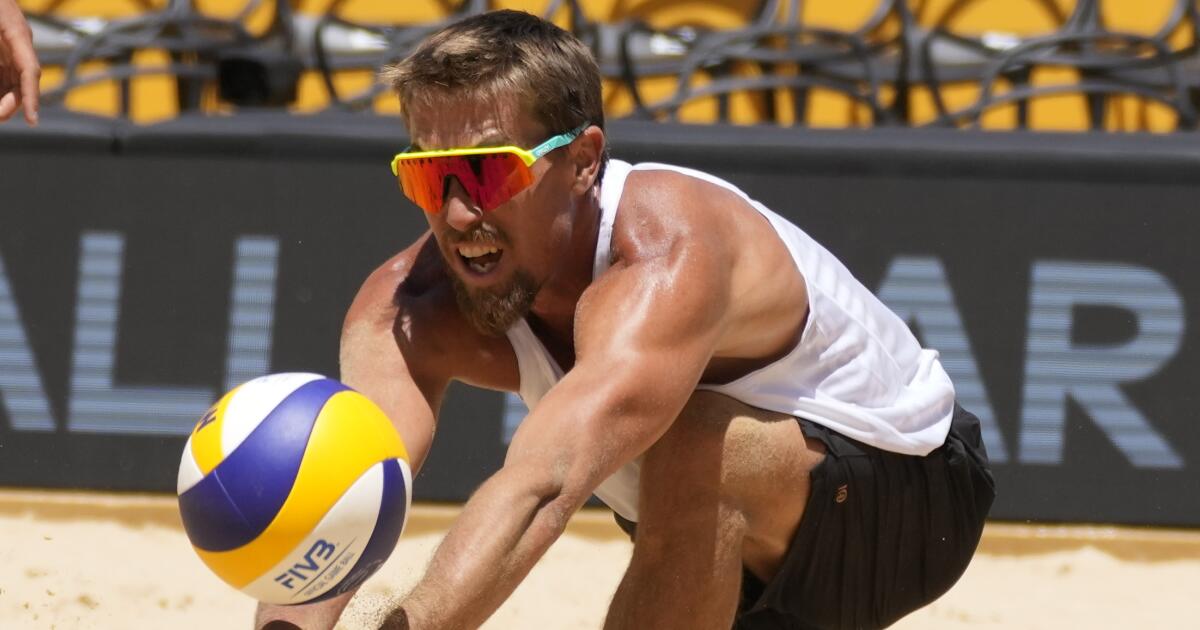
Taylor Crabb is no stranger to South California beaches. The Long Beach State alum returns home this weekend to compete in AVP League matches.
It marks the first time AVP will compete in Long Beach since 2020 and allows players to compete at the 2028 Olympics beach volleyball venue.
Crabb, 34, made his AVP debut in 2013 with his brother, Trevor, and advanced from the qualifier in Manhattan Beach before finishing 25th in his first tournament.
After years of competing with various different partners, Taylor Crabb and Andy Benesh have delivered the top performances this AVP season.
The following interview with Crabb has been edited for clarity and length.
Are you excited to compete in this weekend’s event at Long Beach?
Crabb: Very excited. A lot of my college teammates and part of the school have reached out, saying that they’re gonna come. So I’m excited to get a chance to play in front of them again.
When was the last time you were in Long Beach?
Crabb: I always try to go down there for alumni events or any big games they have. I went to UCLA against Long Beach last year, when it was No. 1 versus No. 2, so I always try to get down there and support them.
You missed out on the chance to compete in the 2020 Olympics because of COVID-19 restrictions and chose not to pursue a spot at the 2024 Olympics. Are you fired up to try to compete in the 2028 Olympics, knowing that Long Beach will host the competition?
Crabb: Yeah, it’s definitely an exciting time having the Olympics in Long Beach, and we kind of get to break it in this weekend. As you said, Tokyo didn’t go the way I wanted, but I’m going full force now. I have a great partner in Andy Benesh, who obviously went to the Paris Olympics, and if it weren’t for the Olympics being in Long Beach, and me getting a partner like Andy, I’m not even sure I’d be going for it, but because of those two things, I want to make the most of it.
You mentioned that if it wasn’t for a partner like Andy, you wouldn’t be going for it. What do you mean by that?
Crabb: I didn’t feel motivated by playing in all the international events, but now, I think, sitting out kind of lit the fire under me, and I’m really motivated now.
You’ve had different partners throughout your time. What other motivation does Andy give you?
Crabb: He’s been, in my mind, the top blocker for the U.S. the last four or five years. Seeing the professionalism he brings every day to practice, on and off the court, while traveling and when showing up to tournaments, it rubs off on you and that’s really motivating to see. And I just want to make him proud.
Why do you love volleyball?
Crabb: A lot of reasons, but it’s just a feeling I have when I’m out there on the court. It feels natural. It feels like home. I was born into a volleyball family. I had a volleyball in my hands my entire life, so I’ve always just enjoyed it.

NEWYou can now listen to Fox News articles!
CM Punk appeared on “Friday Night SmackDown” ready to take on any challenger that was ready to step to him after winning the Undisputed WWE Championship against Sami Zayn.
Punk entered the ring in Oklahoma City and called back to the “Monday Night Raw” after WrestleMania 42 when he told Cody Rhodes he’d be ready to deliver if a championship opportunity fell “out of the sky.”
COMPLETE PRO WRESTLING COVERAGE ON FOX NEWS DIGITAL
Cody Rhodes and CM Punk face off during SmackDown at Paycom Center in Oklahoma City, Okla. (Craig Ambrosio/WWE via Getty Images)
“When championship opportunities fall out of the sky, CM Punk catches them,” he said.
Punk named potential SmackDown superstars he’d think might come for the title, including Gunther, Finn Balor, Royce Keys, Damian Priest and Trick Williams. He even said that Zayn could come back around and get his rematch if he wanted. He didn’t mention Rhodes’ name, but the “American Nightmare” came out uncalled and marched his way down to the ring.
“I don’t think you and I can run away from each other anymore,” Punk told Rhodes.
Cody Rhodes looks on during SmackDown at Paycom Center in Oklahoma City, Okla., on July 10, 2026. (Craig Ambrosio/WWE via Getty Images)
Rhodes agreed and mentioned that Punk would want a match with him, just “say when.” It was a quick retort from Punk, who said, “when.” SmackDown general manager Nick Aldis, who was in the ring for the segment, booked the match for SummerSlam.
Punk will defend the Undisputed WWE Championship at SummerSlam, which takes place Aug. 1 and 2 at U.S. Bank Stadium in Minneapolis.
First, however, Punk and Rhodes will be involved in a tag team match at Saturday Night’s Main Event in New York City next week. Aldis made the match after Gunther demanded that Aldis put him in a match against Punk. Gunther was hoping it would be for the championship. Instead, Gunther will tag with Zayn.
Gunther didn’t take too kindly to that and attacked Aldis. Rhodes came back out to break up the calamity. He wanted to take on Gunther after the show went off air but Gunther walked away.
Gunther makes his entrance during SmackDown at Paycom Center in Oklahoma City, Okla., on July 10, 2026. (Rich Wade/WWE via Getty Images)
CLICK HERE TO DOWNLOAD THE FOX NEWS APP
Punk definitely has his hands full as he moves to SmackDown to become a fighting champion.
-

 Arkansas1 minute ago
Arkansas tips its hat to blues pioneer Larry “Totsie” Davis in England dedication
-

 California4 minutes ago
‘Explosive diarrhea’ parasite surfaces in California as health officials fear statewide surge
-

 Colorado9 minutes ago
This Quiet Colorado Town Is An Underrated Gem For Nature Lovers
-

 Connecticut16 minutes ago
Car catches fire in Trumbull
-

 Delaware19 minutes ago
Power outage number tops 13,000 in Delaware County as storm hits
-

 Florida24 minutes ago
Florida top-ranked signee selected in Round 4 of MLB draft
-

 Georgia31 minutes ago
3 Georgia baseball players taken in MLB Draft opening day
-

 Hawaii34 minutes ago
Hiker airlifted from Diamond Head Crater Trail

