Sports
Saudi Arabia’s coveted Masters 1000 tennis tournament has stalled as Six Kings arrives in Riyadh


One by one, they pull up at the St Regis Hotel in Riyadh.
Jannik Sinner, Carlos Alcaraz, Rafael Nadal, Daniil Medvedev and Holger Rune have arrived — only Novak Djokovic is yet to join the biggest stars in men’s tennis in accepting flowers, taking tea and talking with Turki Alalshikh, chairman of Saudi Arabia’s General Entertainment Authority (GEA).
They are the show and they are here in the Saudi capital for another. One of the richest exhibitions in tennis history, a $15million (£11.9m) bonanza the kingdom has called the ‘Six Kings Slam‘. The winner will take home $6m. Just being there earns over $1m.
Two weeks later, the WTA Tour will arrive for its season-ending finals, another $15million payday for the top eight women’s singles players of the year and the best women’s doubles teams. The ATP Next Gen Finals, an event featuring the top eight men in the rankings aged under 21, will come to Jeddah, Saudi Arabia’s second biggest city and commercial center, in December.
For the rest of the season, this Gulf nation will assume the role of the heart of the tennis universe, as unlikely as that might seem for a country where people barely play the sport and important tournaments have never taken place. After years of pushing, everything looks ready for Saudi Arabia’s billion-dollar move to become a major force in tennis to take off — with one major hitch.
After months of back-and-forth negotiations and due diligence between the kingdom and the entities that control tennis, the proposal for a major, mixed, 1000-level tournament (one rung below the four Grand Slams) to be held in Saudi Arabia in January or February is still at least three seasons away, a loose gesture at seismic change only slightly more fleshed out than it was a year ago when it set the sport aflame.
GO DEEPER
Saudi Arabia’s new $1billion proposal and the battle to control tennis
The biggest asset of Saudi Arabia’s three-headed push into tennis remains just an idea, with uncertainty on both sides over the tournament’s size, timing and financing. There remains no guarantee it will come to fruition. There has been no decision on who will participate or how much it will all cost, according to people briefed on the discussions who remain anonymous because they are not authorized to speak publicly about them.
The proposal has become such a question mark that it barely figured in meetings between the ATP and WTA Tours and the four tennis associations that control the Grand Slams at this year’s U.S. Open. Months of discussions between Saudi sports leaders and ATP executives — closely watched by WTA leaders — have failed to bring an agreement on even the most basic tenets of a tennis tournament:
- When should such an event take place?
- Will it be for just the top 56 men, or will it be a larger draw?
- Will it be a mixed event, as the Saudis would prefer, bringing the tournament on par with other 1000-level tournaments, such as Indian Wells, Madrid and Rome — some of the most prestigious of their kind?
Mounting complaints from players about the length and logistics of the sport’s current schedule have further complicated the discussions. Tour officials know this is not the moment to announce a new mandatory tournament, especially one that could shorten an off-season that most agree is already too brief.
Moreover, the answers to the questions above will significantly affect how much money the event might produce, and how much Saudi Arabia’s Public Investment Fund (PIF) wants to invest in the venture through its sports unit, SURJ Sports Investment. The grand promises of 12 months ago have contracted.

The PIF has partnered with the ATP and WTA Tours on large sponsorship deals. (PIF / Getty Images)
“It wasn’t at the forefront of the discussions because it doesn’t make sense,” said one of the people involved in the Grand Slam meetings at the U.S. Open. “We’re making the assumption that this is nothing to worry about.”
With their coup de grace still up in the air, the Saudis have opted for a more considered approach, people familiar with their plans say — an approach that lends this next month or two of tennis an air of provisionality. Saudi officials are resistant to talking about any grand plans they might have for tennis because they don’t know where those plans might go.
They will test the waters with their biggest and most expensive exhibition — the Six Kings Slam offers one of the biggest monetary prizes in tennis history.
Then the women will arrive for their tour finals, allowing the country to gauge interest and help determine how hard the kingdom should push to invest in tennis during the next decade. The Saudi contract with the WTA runs through 2026, allowing all parties to feel out each other’s strengths and weaknesses.
How many people will attend? Will the infrastructure hold? Will the media impressions roll in? The plan is to see how these events unfold, before pressing ahead with commitments for new ones.
That stance is starkly different from the Saudis’ actions this year. In rapid succession, the nation’s various sports and entertainment units announced new initiatives that made it one of the largest investors in tennis.
Three separate entities have pursued tennis investments without much coordination, though outsiders often lump them together.
In rapid succession during the past year, the GEA unveiled this Six Kings Slam, and the PIF announced major new sponsorship deals with the men’s and women’s tours, which included naming rights to the official rankings. The Ministry of Sport of Saudi Arabia, the Saudi Tennis Federation (STF) and the WTA Tour then announced a three-year deal to host the tour finals. Nadal was announced as an STF ambassador, helping promote tennis in the country and add legitimacy to its tennis interests in the eyes of the rest of the world.
Representatives of the PIF held talks with executives of Sinclair Broadcast, which owns the Tennis Channel, about acquiring a major stake in the network. According to people involved with those talks, who spoke anonymously to protect relationships, negotiations broke down when Sinclair raised the asking price from $750million to more than $1billion.
These moves raised Saudi Arabia’s tennis profile, but its potential new tournament at the start of the season was seen as the most important of its tennis investments — and its most divisive. It bid for that event through PIF and SURJ, but the financial ramifications almost paled compared to the existential angst coursing through tennis at the news of the kingdom’s pursuit of the tournament. It would cement Saudi Arabia’s place at the center of the sport, bringing with it an extensively criticized human rights record.
Upon the spring announcement of the country’s deal to host the WTA Finals, Human Rights Watch said, “Torture and imprisonment of peaceful critics of the government continues. Courts impose decades-long imprisonment on Saudi women for tweets.”
Former players, including Chris Evert and Martina Navratilova, publicly criticized “partnering a country with a history of repressive laws against women, that criminalizes homosexuality and free speech, and that in 2018 murdered Jamal Khashoggi, a dissident journalist who had travelled to the Saudi consulate in Istanbul, Turkey, to get documents he needed for a marriage license,” as The Athletic wrote in April.
When Saudia Arabia’s pursuit of tennis first came to light, at Wimbledon last year, it prompted the Grand Slams to pursue a counter-offensive that amounted to an attempted takeover of the sport.

Saudi Arabia’s moves into tennis have roiled the organisations behind the Grand Slam tournaments. (Henry Nicholls / AFP via Getty Images)
Tennis Australia had the most to lose. Any tournament in the early part of the year would significantly impact tuneup events in Australia and New Zealand before the Australian Open.
Led by Tennis Australia, the Grand Slams banded together to propose a new format for the entire season, with roughly 14 tournaments included in a so-called ‘premium tour’ for roughly the world’s top 100 players.
The move was an attempt to cleave the biggest non-Grand Slam tournaments from the men’s and women’s tours. The Grand Slams’ organisers also aimed their efforts at players, who have long complained about their arduous schedule’s duration.
In response, the ATP and the WTA pushed ahead with their lucrative sponsorships with Saudi Arabia. Those deals produced hundreds of millions of dollars in much-needed revenue for the tours, some of which will filter down to the players as prize money and bonus payments. Then, at this year’s Indian Wells, the Grand Slams moved to present their plan to the power brokers of tennis, but could not deliver something fully fleshed out. That idea too stalled, smothered by the inertia and fragmentation at the heart of tennis’ corridors of power.

GO DEEPER
Inside tennis’ corridors of power: A fractured hall of mirrors where nothing is as it seems
Since then, top players have been airing their complaints about the schedule again, especially the tours’ decision to extend the length of several of the mandatory Masters 1000 tournaments from seven to 12 days, essentially making them two-week events.
Those complaints have ratcheted up in recent weeks. Iga Swiatek, the world No. 1, complained of exhaustion throughout the summer. Carlos Alcaraz, the sport’s biggest young star, predicted the current schedule “is going to kill us in some way” in a news conference at the Laver Cup, another exhibition event.
Adding another event before the Australian Open would leave players feeling obliged to hit the ground running rather than playing themselves into form in Australia and New Zealand, where they can adjust to the time zone and climate in the weeks leading up to one of the year’s four most important tournaments.
With the tours unable to deliver what the Saudis were hoping for, plans for the new event and the Saudis’ biggest foothold in the sport remain a work in progress. That has allowed sports officials in the kingdom to approach the upcoming tennis events as a lab experiment.
What happens beyond that remains a mystery.
What happens during the next month, however, from how the players experience the event to whether locals and tourists fill the stadium, will dictate what happens down a still-unfinished road.
(Top photo: Adam Pretty / Getty Images)



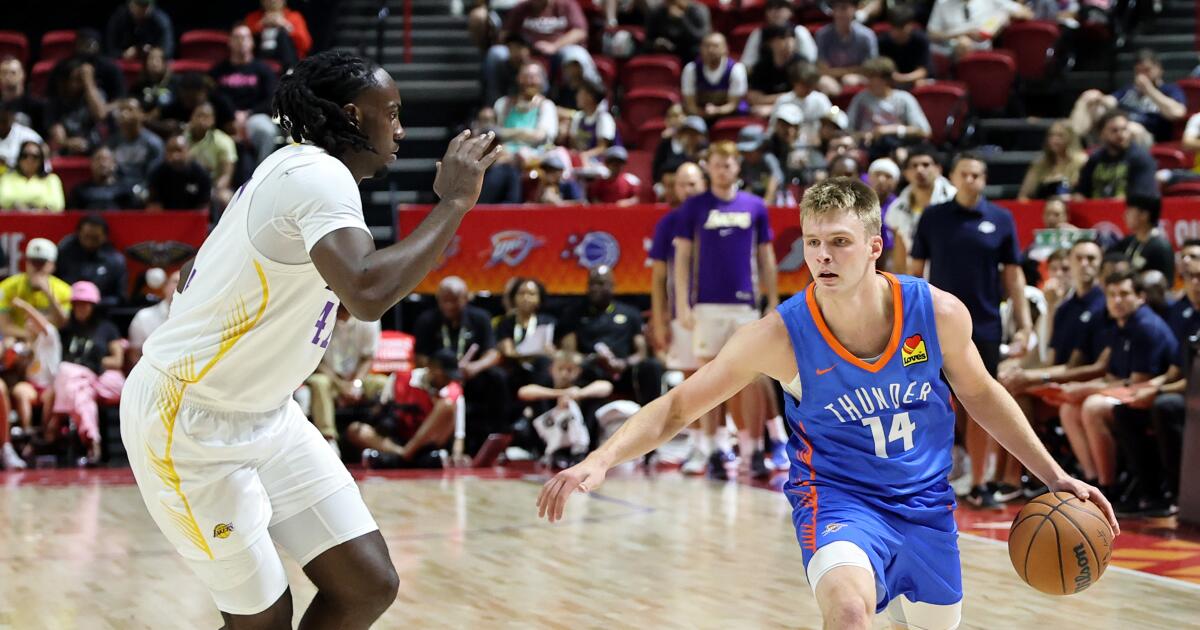
LAS VEGAS — The door opened for Arthur Kaluma to show his worth for the Lakers in the NBA Summer League on Saturday night.
He did so in a big way.
Kaluma had 34 points and five rebounds during the Lakers’ 91-70 win over the Dallas Mavericks at the Thomas & Mack Center.
He was 11 for 16 from the field and six for 10 from three-point range.
With Lakers rookie guard Cameron Carr unable to play because of a right thumb contusion, Kaluma took over the scoring role. Carr, the 24th pick in the NBA draft, is averaging 17 points per game.
“Cam doesn’t play tonight, so he gets a little bit more minutes, gets a couple more touches,” said Lakers Summer League coach Ty Abbott about Kaluma. “But he’s done a really good job of making the most of it when he doesn’t have actions run for him. So the way that he’s been able to stay ready, find windows for himself has kept him in a rhythm. So, on a night like tonight, when we can run some actions for him, he knocks them down and just plays out of his mind. It was great.”
Kaluma said he was “a little nervous” but his three-point shooting said otherwise.
“When [teammate] Jon Elmore came down and he pitched it back to me for a three … I just knew when it came off my hand it was cash,” Kaluma said. “So I said, ‘Yeah, I’m hot.’ It went on from there.”
Late in the fourth quarter, Kaluma lined up a three-pointer, setting his feet and scoring from 29 feet out. He flashed three fingers and smiled. His teammates on the bench stood and cheered, as did the fans.
“We have such a great group of guys this year at Summer League and going through this it’s hard to get that camaraderie with a group,” Kaluma said. “But I feel like everybody wants to see everybody succeed and I felt that tonight. I’m not going to lie to you. They tell me to shoot the ball. I passed up a couple of shots and they were mad at me the other day.”
Kaluma played for the South Bay Lakers in the G League last season. He averaged 14.6 points per game, 4.9 rebounds and shot 55% from the field, 37% from three-point range.
“The G can get grimey, you know what I’m saying? It’s a time where everybody is trying to fight for a position and there is a certain hunger that you have to have in order to be successful in the G,” Kaluma said. “And I feel like that drive that I had my first year in it pushed me into this summer to really get better and work on my game and come here and have the opportunity to perform.”
Kaluma wasn’t alone in helping the Lakers improve to 2-0 in Summer League play.
Adou Thiero ran the court, took a lob pass from Chris Mañon and threw down a two-handed dunk. He had another solid outing with 15 points and four rebounds. He shot just four for 12 from the field, but was a plus-15.
But the night belonged to Kaluma.
“I pride myself on the defensive end,” he said. “I know I got hot offensively, but the shot was just falling today, you know what I’m saying? My game is three-and-D. I lock-up on defense and I know I can hit open shots. I just got hot today and I’m not going to try to let it get to my head.”
Sports
Golf star records lowest round in LPGA major history with astounding performance at Evian Championship

NEWYou can now listen to Fox News articles!
There are good days on the golf course, and then there is what Haeran Ryu just did on Saturday.
Ryu, 25, recorded the lowest round in LPGA major history on Saturday with an 11-under 60 at the Evian Championship. With the South Korean golfer’s historic round, she holds a three-stroke lead.
Ryu’s round comes just two weeks after winning her first major at the Women’s PGA Championship. On the 18th hole, Ryu left a 30-foot eagle putt a few inches short, and instead settled for a birdie.
CLICK HERE FOR MORE SPORTS COVERAGE ON FOXNEWS.COM
Haeran Ryu of South Korea reacts on the 18th green after the third round of The Amundi Evian Championship at Evian Resort Golf Club in Evian-les-Bains, France, on July 11, 2026. (Stuart Franklin/Getty Images)
She said after the round that she had no idea what she had done until she counted up her scorecard.
“But after the putt and I counted my score with my caddie,” she said. “Oh my God, it’s 11-under par today. It was so amazing. My caddie says, ‘Yep.’ I’m so happy right now.”
If Ryu had made the eagle putt on the 18th hole, she would have been just the second player to shoot a 59 in LPGA history.
ZERO BS. JUST DAKICH. TAKE THE DON’T @ ME PODCAST ON THE ROAD. DOWNLOAD NOW!
Haeran Ryu of South Korea celebrates a birdie on the 15th green during the third round of The Amundi Evian Championship at Evian Resort Golf Club on July 11, 2026, in Evian-les-Bains, France. (Stuart Franklin/Getty Images)
Her 60 broke the record for the lowest round in an LPGA major by one shot. Leona Maguire and Jeungeun Lee6 in 2021, and Hyo Joo Kim in 2014, each shot 61 at the Evian Championship, which was designated as an LPGA major in 2013.
The lowest round in a men’s major is 62, which is shared by four players — Branden Grace at Royal Birkdale in the 2017 British Open, Xander Schauffele and Rickie Fowler in the 2023 U.S. Open at Los Angeles Country Club, and Schauffele and Shane Lowry in the 2024 PGA Championship at Valhalla.
CLICK HERE TO DOWNLOAD THE FOX NEWS APP
Haeran Ryu of South Korea and Lottie Woad of England interact after their round on the 18th green during the third round of the Amundi Evian Championship at Evian Resort Golf Club in Evian-les-Bains, France, on July 11, 2026. (Stuart Franklin/Getty Images)
Ryu hopes her historic third round can help propel her to a second major win in three weeks.
“That is amazing, amazing dream,” Ryu said. “So I just want that one to come true, but we have one more day.”
The Associated Press contributed to this report.
Follow Fox News Digital’s sports coverage on X, and subscribe to the Fox News Sports Huddle newsletter.
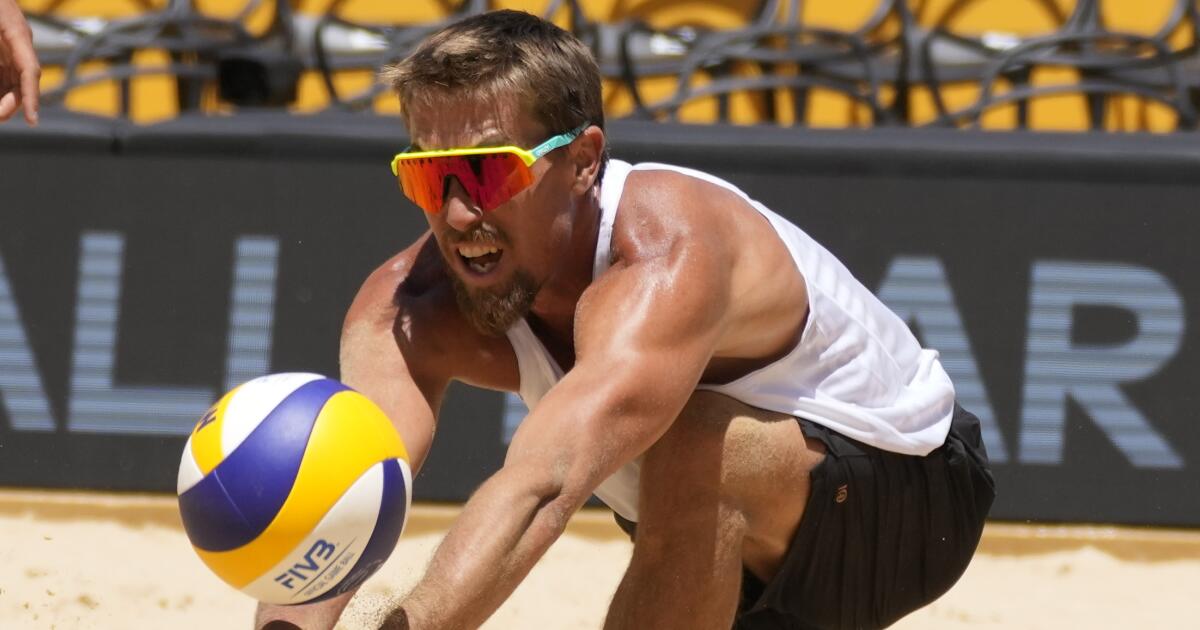
Taylor Crabb is no stranger to South California beaches. The Long Beach State alum returns home this weekend to compete in AVP League matches.
It marks the first time AVP will compete in Long Beach since 2020 and allows players to compete at the 2028 Olympics beach volleyball venue.
Crabb, 34, made his AVP debut in 2013 with his brother, Trevor, and advanced from the qualifier in Manhattan Beach before finishing 25th in his first tournament.
After years of competing with various different partners, Taylor Crabb and Andy Benesh have delivered the top performances this AVP season.
The following interview with Crabb has been edited for clarity and length.
Are you excited to compete in this weekend’s event at Long Beach?
Crabb: Very excited. A lot of my college teammates and part of the school have reached out, saying that they’re gonna come. So I’m excited to get a chance to play in front of them again.
When was the last time you were in Long Beach?
Crabb: I always try to go down there for alumni events or any big games they have. I went to UCLA against Long Beach last year, when it was No. 1 versus No. 2, so I always try to get down there and support them.
You missed out on the chance to compete in the 2020 Olympics because of COVID-19 restrictions and chose not to pursue a spot at the 2024 Olympics. Are you fired up to try to compete in the 2028 Olympics, knowing that Long Beach will host the competition?
Crabb: Yeah, it’s definitely an exciting time having the Olympics in Long Beach, and we kind of get to break it in this weekend. As you said, Tokyo didn’t go the way I wanted, but I’m going full force now. I have a great partner in Andy Benesh, who obviously went to the Paris Olympics, and if it weren’t for the Olympics being in Long Beach, and me getting a partner like Andy, I’m not even sure I’d be going for it, but because of those two things, I want to make the most of it.
You mentioned that if it wasn’t for a partner like Andy, you wouldn’t be going for it. What do you mean by that?
Crabb: I didn’t feel motivated by playing in all the international events, but now, I think, sitting out kind of lit the fire under me, and I’m really motivated now.
You’ve had different partners throughout your time. What other motivation does Andy give you?
Crabb: He’s been, in my mind, the top blocker for the U.S. the last four or five years. Seeing the professionalism he brings every day to practice, on and off the court, while traveling and when showing up to tournaments, it rubs off on you and that’s really motivating to see. And I just want to make him proud.
Why do you love volleyball?
Crabb: A lot of reasons, but it’s just a feeling I have when I’m out there on the court. It feels natural. It feels like home. I was born into a volleyball family. I had a volleyball in my hands my entire life, so I’ve always just enjoyed it.
-
 Lifestyle1 minute ago
‘The Odyssey’ is the mother of bad-trip tales. Why are we obsessed with travel disasters?
-
 Politics8 minutes ago
Trump slashes wildlife protections, putting endangered California animals at risk
-
Sports16 minutes ago
Lakers’ Arthur Kaluma erupts for 34 points in breakout Summer League performance
-

 World27 minutes ago
Sheikh Hamad bin Khalifa Al Thani, architect of modern Qatar
-
 News56 minutes ago
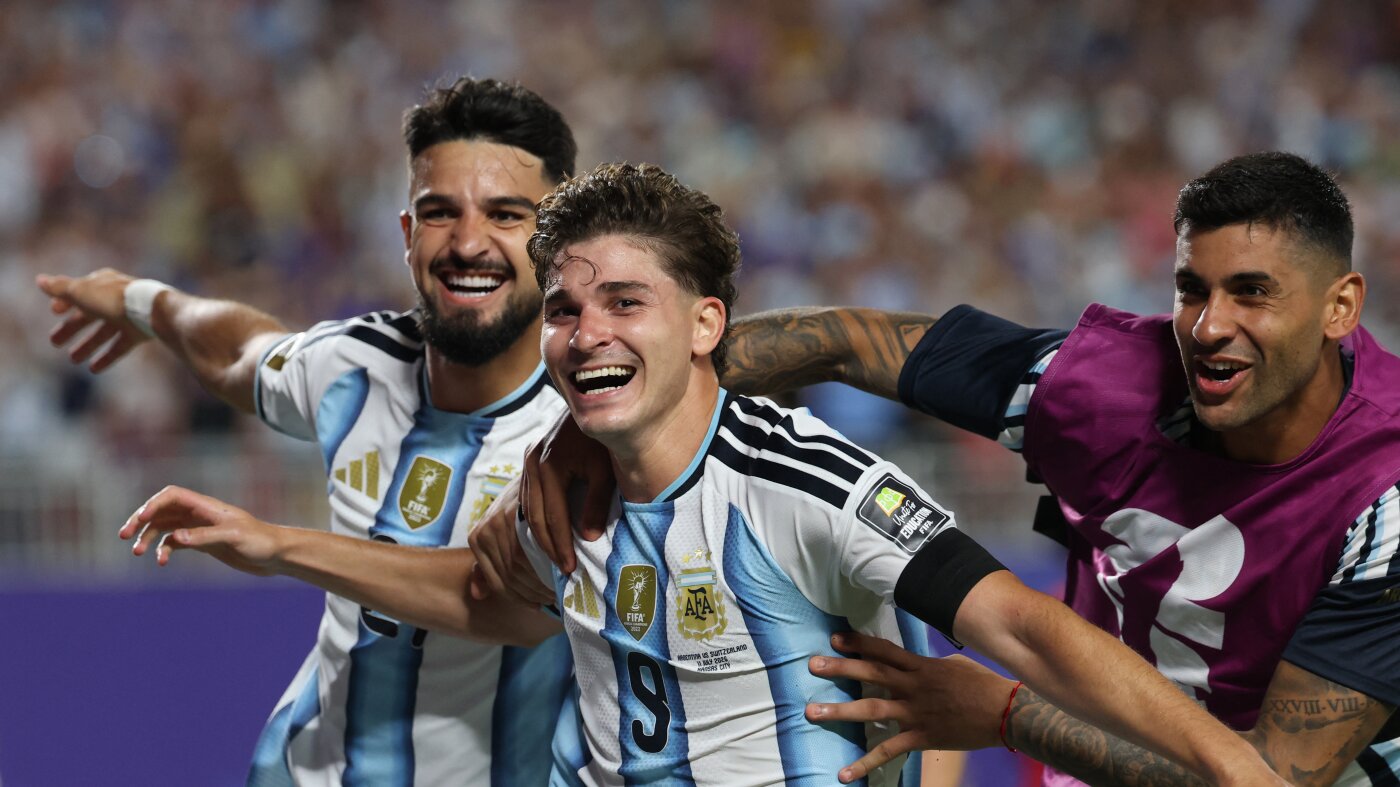
Messi and Argentina survive another close call to reach the World Cup semifinals
-

 Los Angeles, Ca2 hours ago
19-year-old arrested, accused of distributing marijuana to minors across Riverside County
-

 Detroit, MI3 hours ago
Phillies end the Tigers’ winning streak at 6 with a 4-2 victory
-

 San Francisco, CA3 hours ago
Giants select Barry Bonds’ nephew Peyton in third round

