Sports
Rosenthal: When Roki Sasaki signs, other international amateurs will suffer. They shouldn’t


The excitement over Japanese phenom Roki Sasaki coming to Major League Baseball should be tempered by the likelihood that his signing will produce unintended consequences — teenage Latin American prospects who will be abandoned by the team that signs him.
Sasaki, 23, might be a top-of-the-rotation starter as soon as next season. The current international signing period ends Dec. 15. If, as expected, he delays his choice until the next period, which opens Jan. 15, the team he picks almost certainly will expend its entire bonus pool on him, breaking pre-existing verbal commitments with Latin American players who are further away from the majors.
Depriving those players of life-changing money isn’t right. And baseball should not allow it to happen.
The system for signing international players is broken, has been for a long time. Since teams are restricted in what they can spend on those players, many budget out agreements well in advance of the opening of the international signing period, trying to maximize their bonus pool allotment. Players cannot officially sign until they are 16, but teams often strike verbal deals with players from the Dominican Republic and other countries who are as young as 12. Such deals technically are forbidden, and not binding.
As detailed by Baseball America’s Ben Badler, the players who likely would be spurned by Sasaki’s team would be left in a lurch, their futures uncertain. In effect, they would be collateral damage in a system that no longer would exist if MLB and the Players Association had agreed on an international draft in 2022. Sasaki almost certainly would have been the top pick this year. The players whose agreements his signing might jeopardize would have been eligible for selection.
It is not unusual for teams to back out of verbal deals with Latin American prospects. An issue with a player’s physical might be one reason. A reduction in a team’s international budget might be another. An overzealous commitment to too many players might be a third. But as Badler points out, if a team has an agreement with a player at this late stage, less than two months before the 2025 signing period opens, it expects to sign him. If those deals are broken, the players will likely need to accept reduced bonuses from other teams, if they can find openings at all. This could create a ripple effect if players sign with new clubs who then have to break agreements they had previously made in order to fit the new deals into their bonus pool. Players who are caught in this shuffle also could wait to sign until 2026, though teams already have made commitments to players in that class, too, and those players would be a year older.
A solution to all this is possible, if MLB wants to take responsibility rather than allow a team to drop the hammer on a group of eager kids, many of whom come from impoverished backgrounds: Allow Sasaki to sign separately from his new team’s international pool. Uphold the preexisting agreements with the Latin American prospects. Do the honorable thing, rather than simply blame a dishonorable system that should have been fixed long ago.
This is not to suggest Sasaki should become an unrestricted free agent, not when he has yet to fulfill the requirement of being 25 and playing six seasons in a foreign professional league the way Japanese right-hander Yoshinobu Yamamoto had last offseason. The same basic framework for Sasaki’s contract would apply. His bonus from whichever team wins the bidding could be capped at $7.56 million, a sum that would match the largest pool available in the 2025 signing period. The team that signed him happily would take on the additional cost.
Japan’s Yoshinobu Yamamoto was an unrestricted free agent when he signed with the Dodgers last winter. His countryman, Roki Sasaki, is subject to a different set of rules because of his age. (Kiyoshi Mio / Imagn Images)
Wait, you might say, no such exception was necessary for Shohei Ohtani, who fell under the same restrictions as Sasaki when he signed with the Los Angeles Angels in December 2017. The difference then was the calendar: In 2017, the international signing period opened on July 2 and closed the following June 15. No preexisting agreements needed to be broken. Deals for the bigger names in that class, which included Julio Rodríguez and Wander Franco, had been official for months.
It is ridiculous that young, established Japanese professionals are placed in the same category as amateurs from Latin America and other regions, but that’s another story. In 2021, the league shifted the dates of the international signing period so that it would run from Jan. 15 to Dec. 15. If Sasaki is posted soon enough, he could sign during the current period. But it would behoove him and his Japanese club, the Chiba Lotte Marines, to wait.
The team with the most money left in its bonus pool for the current period, the Los Angeles Dodgers, has slightly more than $2.5 million available, according to Baseball America. A team can trade for up to an additional 60 percent of its original allotment, but the 2025 bonus pools, ranging from $5.1 million to $7.56 million, still would be greater. More money for Sasaki and more money for the Marines, who would receive a release fee equal to 20 percent of Sasaki’s bonus under the current rules.
Separating Sasaki from the system, if only as a one-time exception, would raise uncomfortable questions. What would happen the next time a ballyhooed international professional under the age of 25 announces his intention to play in the majors? How would the league determine whether a player was good enough to warrant the same treatment as Sasaki? And would the team that lands Sasaki gain an unfair competitive advantage if it also was permitted to sign the rest of its international class, a group that generally consists of 10 to 30 players?
Sorry, this isn’t that complicated. The current collective bargaining agreement expires on Dec. 1, 2026. No international free agent with Sasaki’s profile and talent is on the horizon for the next two years. So, to avoid the issue resurfacing, MLB and the union would simply need to agree on an international draft in the next CBA. For reasons that go well beyond Sasaki, their motivation to create a better feeder system for international talent should only be increasing.
Almost three years ago, The Athletic reported on corruption in the current system, with teams pledging contracts to players in Latin America before they were even teenagers. Earlier this month, both ESPN and Baseball America reported on MLB investigations that led to the quashing of deals for teenage prospects who were found to have falsified their ages and identities.
The international draft is an imperfect solution with its share of detractors. For years, it has been a sticking point between MLB and the Players Association. But the union, in the last round of bargaining, dropped its philosophical opposition to the concept. The league offered to eliminate the qualifying offer system in exchange for the draft. The union countered the league’s proposal with one of its own, and the two sides wound up $69 million apart. While the parties also had other differences, their argument mostly boiled down to money.
As for the imbalance of one team getting Sasaki plus an entire international class, what are we really talking about? International amateurs typically sign at 16. The ones who become major leaguers generally require four or five years of development, and most never even reach that level. The biggest advantage for a team that winds up with Sasaki in addition to a full international class would be Sasaki. True, that team also might land a Juan Soto or Vladimir Guerrero Jr. But signing top international talents doesn’t always guarantee those players will have any impact in the big leagues. And far greater inequities exist in the sport.
If the league isn’t keen on making an exception with Sasaki, it could explore other options. Adding to the other 29 teams’ bonus pools to allow them to sign players who lose their agreements with Sasaki’s club. Finding a way to give those players some form of financial security while allowing them to become free agents. Allowing a team to pay Sasaki in 2025 but count him against its pool in ’26, giving players to whom the team verbally committed for ’26 more time to find new deals.
Clearly, there is no perfect answer. But baseball people, when forced to accept a difficult circumstance, often acknowledge the need to “wear it.” A general manager makes a bad trade, wear it. A fielder makes a critical error, wear it. A starting pitcher struggles but needs to cover innings, wear it.
The likelihood of Sasaki signing in the next period raises a different kind of difficult circumstance. A select group of Latin American teenagers stands to lose deals in the hundreds of thousands, if not millions. Let’s hear someone explain why those players might need to wear it. There’s no way it should happen, if this sport has any conscience.
(Top photo of Roki Sasaki in the 2023 WBC: Eric Espada / Getty Images)



Sports
Pirates star pitcher makes unfortunate history after being taken out in middle of perfect game bid

NEWYou can now listen to Fox News articles!
Jared Jones was flirting with Major League Baseball history on Wednesday night — he got it, but it was not what he originally envisioned.
The Pittsburgh Pirates pitcher retired the first 18 batters he faced, but he was taken out in the middle of his perfect game bid after six innings.
Now, the Pirates certainly have their reasons — the 24-year-old Jones hasn’t thrown more than 81 pitches in eight starts since returning May 20 after missing all of last season while undergoing ulnar collateral ligament internal brace surgery on May 21, 2025. He was yanked with 77 pitches and likely would have needed more than 100 pitches to record the 25th perfect game in MLB history.
Jared Jones of the Pittsburgh Pirates pitches during the first inning against the Atlanta Braves at PNC Park on July 8, 2026, in Pittsburgh, Pennsylvania. (Photo by Joe Sargent/Getty Images)
However, Jones left the game after getting zero run support, so when the Atlanta Braves tacked on three runs late for a 3-0 victory, Jones instead found himself in the wrong chapter of the history books.
According to Opta Stats, Jones became the first pitcher in the modern era (since 1920) to pitch at least six perfect innings and not record a win.
“It does suck. Something’s cool coming on, but I’m on what? My eighth start off of surgery? I completely understand it, and it is what it is,” Jones told reporters after the game.
Pittsburgh Pirates starting pitcher Jared Jones (17) makes his way to the field to warm up before pitching against the Atlanta Braves at PNC Park. (Charles LeClaire/Imagn Images)
JUSTIN VERLANDER ANNOUNCES HE WILL RETIRE AFTER THIS SEASON: ‘I’VE REALIZED THAT TIME HAS COME’
Jones said he didn’t entertain attempting to complete the perfect game.
“Not with the pitch count,” he said. “Not really ever expecting to go nine right now, so that was never in my head.”
Joey Bart, traded to the Braves from the Pirates on June 18, followed a double by Mike Yastrzemski with a 422-foot, two-run homer to left-center field off a slider from Dennis Santana. Drake Baldwin added an RBI single to center in the ninth for good measure.
It was the second time in less than a week that a pitcher was taken out of the game with a perfect bid through six innings — the Miami Marlins took Eury Perez out after seven innings in which he had 92 pitches. Perez, too, is in the midst of returning from injury and has surprisingly found himself right in the postseason mix.
He was pulled for Lake Bachar to start the eighth, and the Marlins allowed eight runs to the Athletics in the final two innings, but held on to win 9-8.
Jared Jones (17) of the Pittsburgh Pirates delivers a pitch during a MLB game against the Cincinnati Reds on June 27, 2026, at PNC Park in Pittsburgh, Pennsylvania. (Joe Robbins/Icon Sportswire via Getty Images)
CLICK HERE TO DOWNLOAD THE FOX NEWS APP
The Pirates are 4.0 games out of the final wild card spot, which is held by the Marlins.
The Associated Press contributed to this report.
Follow Fox News Digital’s sports coverage on X, and subscribe to the Fox News Sports Huddle newsletter.
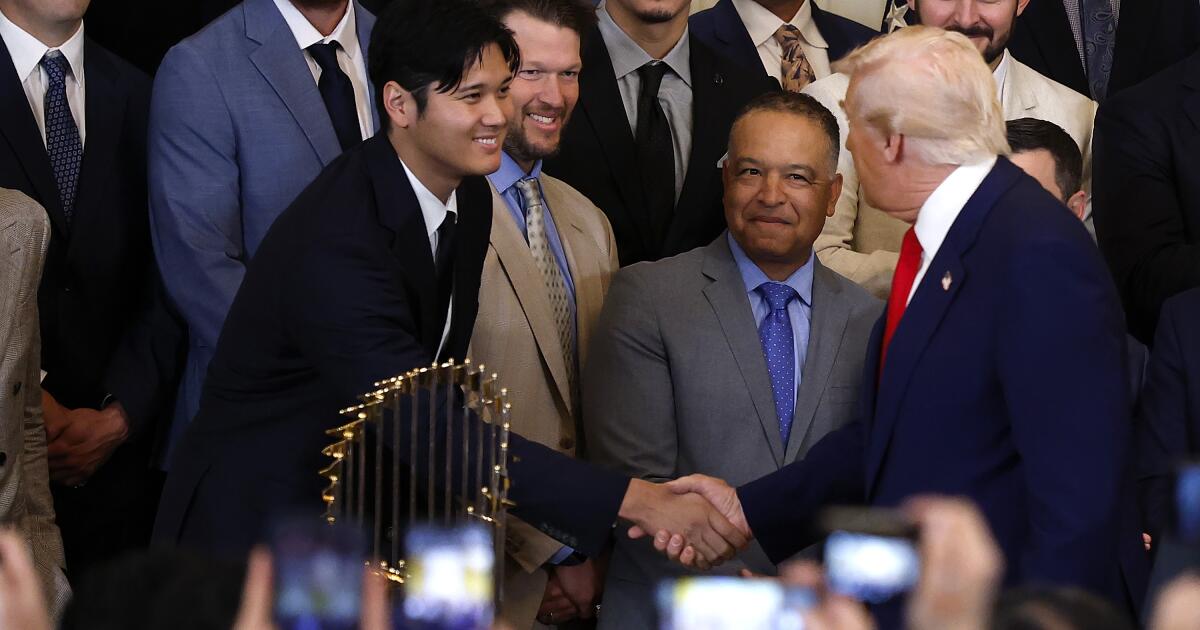
WASHINGTON — The Dodgers are scheduled to visit the White House on July 23 to celebrate their latest World Series title.
“President Trump is excited to welcome the Los Angeles Dodgers BACK to the White House to celebrate their World Series championship!,” White House spokesperson Taylor Rogers said in a statement to The Times.
The date falls on a scheduled off day in the middle of a nine-game East Coast road trip for the Dodgers. The team will play three games in Philadelphia against the Phillies July 20-22 before ending the trip with a three-game series against the New York Mets July 24 to 26.
The visit continues a tradition from the Dodgers’ two previous World Series championships. They were hosted by President Biden in 2021 and President Trump in April 2025.
After the Dodgers claimed their second consecutive World Series title with a dramatic Game 7 victory over the Toronto Blue Jays, a visit to the White House was planned, but it wasn’t until Thursday that a date was officially booked and confirmed.
Questions swirled around whether players would decline the visit this year after it did not happen during a scheduled visit to Washington in April.
Kiké Hernández said in 2018 he was unsure he would have gone had the Dodgers won the World Series the previous year. Mookie Betts said he was undecided and needed to talk it over with his family when last year’s visit was announced. After winning his first World Series with the Boston Red Sox in 2018, Betts skipped their trip to the White House the following year during Trump’s first term.
Both players, along with every returning member of the 2024 team who was with the team during its road trip, participated in the visit. The only notable absence was first baseman Freddie Freeman, who remained in Los Angeles to nurse an ankle injury.
Manager Dave Roberts, who indicated in comments to The Times in 2019 he might not go to the White House if Trump was president, also participated in last year’s ceremony.
Asked at the Dodgers’ fan festival in January about the possibility of returning to the White House, Roberts told The Times’ Bill Shaikin: “For me, I stand by: I’m a baseball manager. That’s my job.”
“I was raised — by a man who served our country for 30 years — to respect the highest office in our country,” Roberts said. “For me, it doesn’t matter who is in the office, I’m going to go to the White House. I’ve never tried to be political. … For me, I am going to continue to try to do what tradition says and not try to make political statements, because I am not a politician.”
Clayton Kershaw, who retired after last season but was on Team USA for this year’s World Baseball Classic, told The Times in the spring that he was aware Dodgers fans are split over whether the team should visit the White House again this year, but he said he is looking forward to it.
“I went when President Biden was in office. I’m going to go when President Trump is in office,” Kershaw said. “To me, it’s just about getting to go to the White House. You don’t get that opportunity every day, so I’m excited to go.”
Times deputy sports editor Ed Guzman contributed to this report.

NEWYou can now listen to Fox News articles!
All eyes were on Caitlin Clark on Wednesday night as she made her anticipated return from injury in a road matchup in Los Angeles.
But instead of a triumphant comeback, the Fever spent the entire night chasing the Sparks as Clark’s rough return fueled a 106-92 rout.
The superstar never found a groove, looking completely out of sync in her return from a back injury.
STEPHANIE WHITE GIVES CAITLIN CLARK STATUS UPDATE AHEAD OF FEVER-SPARKS, BUT HER NEXT MOVE RAISES QUESTIONS
Caitlin Clark huddles with teammates as the Indiana Fever battle the Sparks. (Photo by Katelyn Mulcahy/Getty Images) ((Photo by Katelyn Mulcahy/Getty Images))
Much of that disjointed performance falls squarely on head coach Stephanie White, who kept Clark on a ridiculously tight leash by limiting her to just 16 minutes. The stop-and-go approach could have sabotaged any chance for the phenom to establish a rhythm.
Clark finished with just 9 points, 4 rebounds and 3 assists. Her minus-16 plus-minus told the story.
The Los Angeles Sparks were severely shorthanded, taking the floor without stars Kelsey Plum and Cameron Brink.
MERCURY’S NOW-DELETED SOCIAL MEDIA POST MOCKING CAITLIN CLARK DRAWS SCRUTINY AFTER STAR’S INJURY
Yet while a depleted Sparks roster played to win, Indiana spent the night over-managing its biggest asset.
With Clark on a minutes restriction and Aliyah Boston out of the lineup, Kelsey Mitchell was forced to shoulder the entire offensive burden.
Mitchell did her part, pouring in 29 points while shooting 5-of-9 from beyond the arc.
Caitlin Clark orchestrates the Fever offense as Indiana battles the Los Angeles Sparks in primetime action. (Photo by Katelyn Mulcahy/Getty Images) ((Photo by Katelyn Mulcahy/Getty Images))
But one hot hand couldn’t stop an efficient LA squad.
The Sparks shot 45% from three-point range, going 9-of-20 from deep to cruise to the 106-92 victory.
White’s next move is to sit Clark against the Mercury on Thursday while Boston returns.
CLICK HERE TO DOWNLOAD THE FOX NEWS APP
After Wednesday’s loss to a shorthanded Sparks team, it’s fair to question whether Indiana’s cautious approach is working. The Fever dropped to 12-9.
Caitlin Clark and Dearica Hamby face off as Fever and Sparks battle at Crypto.com Arena in Los Angeles. (Photo by Tyler Ross/NBAE via Getty Images) ((Photo by Tyler Ross/NBAE via Getty Images))
Send us your thoughts: alejandro.avila@outkick.com / Follow along on X: @alejandroaveela
-

 Los Angeles, Ca26 minutes ago
California teen e-biker baiting police to chase tracked by drone, arrested
-

 Detroit, MI45 minutes ago
Our picks for state\nSenate from Wayne Co. | Endorsements
-

 San Francisco, CA55 minutes ago
Man reported missing in San Francisco
-

 Dallas, TX1 hour ago
How to buy France World Cup semifinal soccer tickets in Dallas
-

 Miami, FL1 hour ago
Miami-Dade Schools names six semifinalists for superintendent
-

 Boston, MA1 hour ago
Lawsuit: ICE detained East Boston father despite legal status
-

 Denver, CO1 hour ago
Victor Marx wins GOP primary for Colorado governor, defeating veteran lawmaker after unorthodox campaign
-

 Seattle, WA1 hour ago
Widower of pregnant woman who was shot to death in Seattle sues homelessness authority

