Sports
Q&A: Hello, Big Ten. UCLA's Martin Jarmond says 'we're ready' as move becomes official

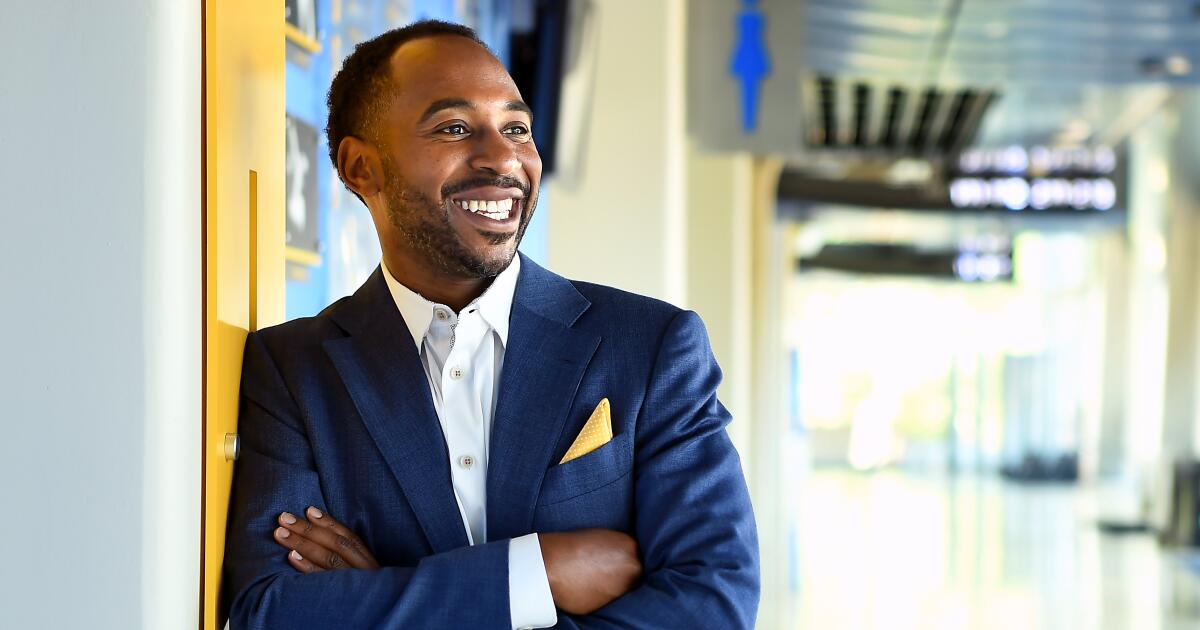
UCLA is no longer on its way to the Big Ten.
It’s arrived.
What started as an exploratory conversation between Bruins athletic director Martin Jarmond and chancellor Gene Block in the fall of 2021 is no longer just a hypothetical solution to solidifying the school’s athletic future.
After more than two years of intense preparation, the school on Friday will celebrate its first day as an official member of its new conference. Athletic departments staffers will sign a giant banner commemorating the moment. Around 500 alumni are expected to attend a celebratory lunch. Football practice will be opened to donors and academic leaders from across campus.
“It’s a big day in our history,” Jarmond told The Times, “so we want to properly recognize it.”
The Bruins’ first game as members of the Big Ten comes Aug. 15, when their women’s soccer team plays Long Beach State. Their first conference game comes Sept. 13, when their men’s soccer team faces Northwestern. Their first conference football game comes Sept. 14 against Indiana, which will be making only its second trip to the Rose Bowl after having lost to USC on Jan. 1, 1968.
Jarmond is one of the last standing among the key early stakeholders as part of UCLA’s Pac-12 defection alongside USC (later to be joined by Oregon and Washington). Block has retired and Trojans athletic director Mike Bohn has parted ways with the school, leaving Jarmond to forge ahead alongside new USC counterpart Jennifer Cohen.
On the eve of UCLA’s first day in the Big Ten, Jarmond discussed the monumental move during a wide-ranging interview with The Times that has been edited for brevity and clarity.
How confident are you that UCLA is ready for this move?
Jarmond: “Very confident. We’re ready. We’ve had two years of preparation that has set UCLA up for success in the Big Ten transition. We’ve been very thorough in our approach and at the core of what we do, we’re here to develop young people and to win, and we’re committed to doing what it takes to attract and retain the best and the brightest, so I’m excited about [Friday] and I’m excited about the work and preparation that’s been put into place.”
What have been the final pieces to making sure the transition is as seamless as possible?
Jarmond: “Well, let me start from the beginning. We established three main priorities in July 2022 that guided our preparation, and in those areas we’ve been very successful. The first one, we wanted to integrate UCLA into the conference conversation and operations as quickly as possible. If you recall, for a couple of months we were working with the UC regents while responding to their questions and then in January 2023 we got Big Ten Conference leadership on campus for the first time and launched our integration for the next 18 months. And then by March 2023, we were in conference meetings and that really helped us learn how the Big Ten operated, what are some of the things that we needed to adjust and adapt.
“Our second priority was putting as much energy and focus in the scheduling piece to make it as fair and minimally disruptive as possible for our student-athletes. The big thing I want to make sure people understand, the change in travel is incremental, not seismic. The scheduling outcome is as good as we could have hoped for in this first season in the Big Ten. Most sports will have one to two trips — maybe — per year in a different time zone than the Pac-12 footprint. For example, women’s soccer student-athletes will only miss one more day of class versus Pac-12 travel. Women’s soccer only has two Big Ten regular-season trips out of the time zone — and only one of those happens when classes are in session, which will be Northwestern and Illinois. So that is huge. That’s a better outcome than what we even shared with the UC regents back a year and a half ago as far as what we were projecting some of the travel to be, and that was a credit to our team and working with the Big Ten and really pushing to make sure this was as minimally invasive as possible to our student-athletes and their academic pursuits.
“The third priority was involving departments, staff, coaches and student-athletes in as many elements of this transition as possible. Starting with the Big Ten announcement, we also launched a strategic planning process. I wanted to do them in tandem just so we could plan this new era and this new day together. We brought in more than 100 staff, student-athletes and coaches and we established student-leadership committees, conducted surveys and there was constant two-way communication and opportunities for input, and that was important to us.”
UCLA committed $10.32 million in additional support for its athletes as part of the conference switch. What are some of the ways that money is being spent?
Jarmond: “With charter flights, we implemented a travel review board with a comprehensive assessment of each team’s schedule to evaluate when and where to charter based on different factors — basically, flight distance, plane availability and exam schedules — to minimize missed class times and trips outside the Pacific time zone outside of the academic year, and we’re in the early stages of this. So far, women’s volleyball has been approved for four charter flights — something that’s never been done before — during the 2024 regular season, and we’ll be evaluating adding more as needed to benefit the students.
“Academically, we’ve increased spending in academic support by $1.5 million annually. We’ve added more learning specialists, we’re going to travel more people with teams to help with their academic pursuits and we’re going to schedule in ways that limit additional days away. In mental health, we’ve added at least $560,000 to the budget for next year and around $1 million per year over the last two years. What I’m really happy to see, we’ve built out the department – we went from one full-time staff member to a team of five or six people for mental health support, including four full-time psychologists. This is something that our student-athletes shared that they wanted, shorter wait times to see someone.
“The last part is nutrition – we’re going to be spending north of $4 million annually. Starting this fall, every student-athlete will get breakfast and lunch five days a week whereas they used to have to rely on campus meal plans and supplemental snacks, but they have such demanding class and practice schedules that we want to make it easy for them to get their nutrition. And we also have a performance nutrition staff that will be able to provide specific meal recommendations on the road to each team to best fuel our teams.”
What have you learned about the best way to handle all the extra miles your athletes and coaches will be traveling?
Jarmond: “It’s individualized, so we worked with our UCLA sleep clinic, bringing doctors into the process to guide us. They’re going to provide detailed guidance on departure times, dates and sleep scheduling for teams. They’re also providing overall sleep education to coaches and staff. So that’s going to be individualized and ongoing, based on the team.”
Have there been any unexpected hurdles as part of the transition, and if so how did you handle them?
Jarmond: “I thought some of my fellow Big Ten schools would be more excited about coming out to L.A. and the warm weather. I wanted to see a few more events — maybe neutral-site events — in L.A., but I think we’re still in the early stages of working through schedules and you’ve got to go through a year or two to see how things kind of shake out, but one thing that I was hopeful that we would have more events here on the West Coast.”
But you did have the Big Ten meetings out here, right?
Jarmond: “That’s right, we got them out to the Terranea Resort in Palos Verdes, which was nice, so I look forward to trying to get more events to the West Coast. The women’s and men’s basketball tournaments are going to come out to Las Vegas in 2027 and 2028, respectively, and that’s good to see because it makes it easier for our fans to really support our Bruins when it’s on the West Coast. But I want to say the Big Ten has been phenomenal to work with over these past two years. You know, I spent 15 years in the Big Ten before this, so just the relationships and the collaboration with the Big Ten and our team has been great and better than I expected, quite frankly.”
When will you know the exact amount of UCLA’s first media rights payment from the Big Ten?
Jarmond: “We’ll know later this fall. It’s a moving target, but usually they communicate that to the schools later in the fall when they have the actual numbers instead of the projections.”
How much can the move to the Big Ten help the UCLA athletic department get out of its $167.7 million budget deficit, and is there a timetable for getting back to operating in the black?
Jarmond: “We’re obviously going to bring in more revenue than we did the last few years going through the Pac-12, and being fiscally responsible is something that we pay a lot of attention to and that we focus on every year. At the same time, we have to balance that with a changing dynamic in college athletics. You know, two years ago, we weren’t talking about the House settlement [with the NCAA] and sharing up to $23 million a year in revenue with student-athletes. So if you’re going to have a cap of 22% of revenue that could be around that amount, you’ve got to balance what you’re going to do there with also being fiscally responsible and making sure we give our student-athletes a chance to be successful. So you’ve got to do both and we’re going to figure that out.
“But our fiscal situation is always something that we’re monitoring closely and we’re going to improve upon. It takes time, especially in a world where the whole model has changed just in the past few weeks.”
UCLA added California to its future football schedules at a time when the UC regents ordered UCLA to pay $10 million a year to its sister school to help bridge the gap in athletic revenue between the schools. What was the thinking there?
Jarmond: “I’m excited that we got them on the football schedule. We scheduled a four-game series starting in 2026 — and I know some of our fans are happy about that and some of our fans aren’t, but in the end I thought it was important to still play Cal because we want to have a presence in Northern California to see our Bay Area Bruins and also it’s important to a lot of families, that rivalry and that relationship. So I’m excited to play them, looking forward to that and I wish Cal well in the ACC.”
How will bowl payment shares work given that UCLA is now in the Big Ten but will keep its bowl tie-ins to the old Pac-12 bowls for the next two years?
Jarmond: “My understanding is that it will be similar to how it’s been in the past. If we were to get into one of the old Pac-12 bowls, that money would still go to the Big Ten and it would be facilitated to us and shared throughout the Big Ten.”
UCLA has announced that it expects to distribute up to $22 million a year to its athletes once revenue sharing starts in August 2025 as a result of an NCAA settlement agreement. What are your thoughts on how that money will be split among the school’s more than 600 athletes?
Jarmond: “This is a new day. Embracing change is the only way forward. You can’t romanticize, you have to modernize and that’s what we’re going to do here at UCLA. We’re going to share revenue with our student-athletes. We’re anticipating that the cap of 22% will probably land in the range of $21 million to $23 million per year — that’s the cap, that doesn’t mean you have to get up to that point, but we want to be competitive, we want to win, and so we’re going to put together three different models for campus to show what that could look like and there’s other factors we have to get more guidance on before we can solidify that. We have to see where the House settlement finalizes, we’ve got to see how Title IX impacts that and we’ve got to look at the roster size limits now because that’s going to require us to reduce the overall number of student-athletes we have, and then you’ve got to look at the Alston awards and NIL’s impact.
“I have a subset of our executive team that meets with me weekly and we are putting pencil to paper and modeling numbers, looking at financial aid, NIL — all of those things — to see what that could look like next year. But what I do is that we’re going to share revenue, we’re going to be aggressive, we want to support our student-athletes and we want to attract, retain and support the best and the brightest and we’re going to embrace that.”
Will athletes in the primary revenue-generating sports of football and men’s basketball get a bigger share of the revenue than their counterparts in other sports?
Jarmond: “I anticipate that just based on the House settlement and some of the models out there as far as how much revenue football is responsible for. We don’t have anything finalized, but I anticipate more revenue going to football and men’s basketball student-athletes simply due to the fact that they are responsible for more of the revenue based on the House settlement and the back pay for NIL and all those things.”
Would that raise any red flags with Title IX compliance?
Jarmond: “We have to get guidance on that; we don’t know that yet.”
How do you think the scholarship increases to 105 in football and 15 in men’s basketball will impact UCLA? Will the school fund all those football scholarships?
Jarmond: “We’re evaluating that. I don’t know if you’re going to see everybody go up to 105 and I don’t anticipate UCLA going up to 105 because one, that’s a significant financial outlay and two, the more scholarships that you increase and that go toward your cap, the less revenue you can share with student-athletes, so you want to have the flexibility to share revenue at the level you need. So we’re evaluating all that and it’s something we’re going to get more into as we go forward but the good news is we have time, we don’t have to make those decisions today.”
Will the House settlement fundamentally change the way your athletic department operates?
Jarmond: “Absolutely. You know, our model is changing. We’re going to have next year potentially up to $23 million that we’re going to divert to student-athletes, so when you have that situation you have to look at every aspect of your business and our team understands that. There are going to be some things that we were able to do previously that we’re not going to be able to do. We’re going to invest in areas now that we weren’t investing in before. This is going more to a pro model, so we’re looking at cap analysts, data analytics, people with expertise that maybe we don’t have in the department now that we have to utilize to make sure we’re making the proper evaluations when it comes to investment and allocation of resources on our teams and within our teams and that’s all of our sports but especially football and the basketballs. Make no mistake, this is going to change. We’re embracing change — that’s the only way forward.”
What’s your big-picture assessment of UCLA athletics and its future versus when you started the job in the summer of 2020?
Jarmond: “I’m more excited and encouraged about our future than I ever have been in my four-plus years here. We’re going to the Big Ten, we have a new football staff that has an energy and enthusiasm around the program, and in basketball and our Olympics sports, we’re firing on all cylinders. I know that we have a bright future and I’m excited. This has been such a Herculean task to get to the Big Ten and prepare the way we needed to to be successful and win on Day 1. We are going to win, we are going to compete and I’m as excited as I’ve ever been at UCLA about our future.”


MINNEAPOLIS — Dodgers manager Dave Roberts is planning for right fielder Kyle Tucker to be out for the rest of the series against the Minnesota Twins, after he left Monday’s game with low back spasms.
Roberts hopes to write Tucker into the lineup Friday, when the Dodgers open a three-game series in San Diego, after three days off, plus most of the game Monday.
“Hopefully he [can take] advantage of this, obviously to get right, but also kind of a mental reset,” Roberts said. “Hopefully the four days will suffice.”
Tucker, who said he felt a little better Tuesday but still sore, especially when rotating, is “pretty confident” that he’ll be able to avoid the injured list. And if he can take swings on Wednesday, he’ll probably be on track for that Friday return.
“But if he doesn’t, then we’ll have probably a tougher decision on Friday,” Roberts said.
Tucker, who has a .707 on-base-plus-slugging-percentage this season, has had a slow offensive start to his Dodgers’ tenure. He wasn’t ready to make any declarations about the potential benefits of time off to reset.
“Maybe,” he said. “We’ll see after I get back. We’ll see how that goes.”
The news on catcher Dalton Rushing, who exited Monday’s game to rule out a concussion, was more straightforward.
Rushing hadn’t yet gone through the second round of concussion testing needed to clear him to play when Roberts addressed the media Tuesday afternoon. But Rushing had told Roberts he was ready to play.
“That doesn’t carry too much weight until I hear from the medical staff,” Roberts said. “But it is good to know that he said he’s good to go. My hope is that he’ll be available off the bench in some capacity.”
As a downpour hammered the tarped field early Tuesday evening, it was unclear when exactly the Dodgers would be playing. But despite plenty of rain in the forecast Tuesday evening, the teams and Major League Baseball identified a window for the game.
The Twins announced an estimated 5:05 p.m. PDT first pitch, representing a 25-minute rain delay.

NEWYou can now listen to Fox News articles!
Wyndham Clark reflected on winning what was his second U.S. Open with an emotional message filled with appreciation.
Clark went wire-to-wire at Shinnecock Hills to become the 24th player to win at least two U.S. Opens in their career after beating fellow American Sam Burns by one shot. The 32-year-old’s first U.S. Open title came in 2023 at Los Angeles Country Club, another one-shot victory, where he got the best of runner-up Rory McIlroy.
“I’m not sure I’ve found the words yet. If I’m being honest, last year wasn’t filled with many highs. There were a lot more questions than answers, a lot more frustration than celebration, and plenty of moments that tested my belief in myself,” Clark’s note on X began.
Wyndham Clark of the United States looks on after winning the 126th U.S. OPEN at Shinnecock Hills Golf Club on June 21, 2026, in Southampton, New York. (Cliff Hawkins/Getty Images)
WYNDHAM CLARK DOESN’T HAVE TO BE LOVED, BUT HE DOES HAVE TO BE RESPECTED AFTER US OPEN TRIUMPH AT SHINNECOCK
“This game can be incredibly humbling. It doesn’t owe you anything, and sometimes the only thing you can do is keep showing up and trust that the work will eventually pay off. That’s why this week means so much. To the fans, thank you for making this championship what it is. New York crowds are passionate, honest, and demanding. Whether you were pulling for me or not, you created an atmosphere I’ll never forget and pushed all of us to compete at our best.
“Thank you to the USGA, the members of Shinnecock Hills, the volunteers, and every person behind the scenes who made this week so special. This place is everything a U.S. Open should be, and I’m incredibly honored to have my name connected to it forever.
“To my team, family, friends, and sponsors, thank you for staying in my corner through the difficult stretches. Thank you for believing in me on the days when believing wasn’t easy. This trophy means more because of the road it took to get here. The setbacks, the doubts, and the hard days all make this moment that much sweeter. I’ll never forget this week, this place, and what it feels like to stand here as a two-time U.S. Open Champion. Forever grateful.”
CLICK HERE TO DOWNLOAD THE FOX NEWS APP
NEW YORK GOLF FANS DESERVE TO BE CALLED OUT, SAM BURNS HAS A GOOD CRY, WYNDHAM CLARK’S BEST SHOT AT SHINNECOCK
Wyndham Clark celebrates with his caddie, David Pelekoudas, on the 18th green during the final round of the 126th U.S. Open Championship at Shinnecock Hills Golf Club on June 21, 2026, in Southampton, New York. (Tracy Wilcox/PGA TOUR via Getty Images)
Clark was far from the fan favorite during Sunday’s final round at Shinnecock. The majority of fans on the Long Island, New York property appeared to be pulling against the Colorado native with countless shouts for his golf ball to find bunkers and minor roars after each of his five bogeys during the final round.
Wyndham Clark celebrates with his girlfriend Emily Tanner after winning the 126th U.S. Open Championship at Shinnecock Hills Golf Club. (Tracy Wilcox/PGA Tour)
CLICK HERE TO DOWNLOAD THE FOX NEWS APP
Clark made a pair of public mistakes during the 2025 PGA Tour season. During the final round of the 2025 PGA Championship, he threw his driver through an advertisement sign behind a tee box. A month later, after missing the cut at Oakmont in the 2025 U.S. Open, he ripped apart two lockers inside the clubhouse and was barred by the historic club in the following days.

SEATTLE — Jaysen Dickinson flew to Seattle from Vermont to cross an item off his lengthy bucket list.
“To see the World Cup and the U.S. play in the World Cup,” he said.
Kim Fletcher and her 17-year-old son Kelan caught a 5 a.m. flight from Sacramento last week for the same reason.
“It’s a must-do right now,” she said.
They weren’t alone. Tens of thousands of people poured into Seattle on Friday morning for the U.S. team’s group-stage game with Australia, turning the Emerald City into a sea of red, white and blue. Some had tickets, most did not.
United States’ Folarin Balogun celebrates the team’s first goal with fans during the game against Australia in Seattle on June 19, 2026.
(Lindsey Wasson / Associated Press)
But who needed a ticket? More than 66,000 people filled Lumen Field in Seattle’s SoDo district, but thousands more simply stood in the streets surrounding the stadium to soak up the energy.
“It’s electric,” said Fletcher, whose son wore an American flag as a cape beneath a tri-cornered colonial hat. Another man was dressed in overalls in star-spangled colors while one couple wore large and seemingly uncomfortable bald eagle heads, topped by red, white and blue cloth stovepipe hats.
“I’ve never seen anything like it,” said one fan, whose been attending sporting events in the city for more than seven decades.
If this World Cup has been marred by astronomical ticket prices and an opaque system for selling them, resulting in large swaths of vacant seats visible on telecasts from Guadalajara, Santa Clara and Miami Gardens, that hasn’t put a damper on the tournament in the Pacific Northwest. Los Angeles is far from the only city with World Cup fever.
The midday celebration on Friday engulfed — and overwhelmed — one of the country’s largest cities on what was supposed to be a workday.
A viewing party in historic Pioneer Square was packed so tightly it was hard to move. Along the city’s waterfront, hundreds of people paid $52 to stand on a barge and watch the game on a scoreboard-sized TV. Thousands more had scaled the steep cascading steps across the street, where they strained to watch for free.
“There were just people who wanted to be in the atmosphere. And that’s Seattle,” said Kasey Keller, a four-time World Cup goalkeeper for the U.S. from nearby Olympia, Wash.
“This,” agreed MLS commissioner Don Garber “is a soccer city.”
The first game in Seattle, also played on a weekday afternoon, drew a sellout crowd for Egypt-Belgium while in Vancouver, 35 miles north of the U.S. border, a 10-block stretch that knifes through the heart of the central business district has been turned over to a street party for the duration of the 39-day World Cup, snarling traffic and rerouting buses.

Fans of Belgium wait for the beginning of the World Cup Group G soccer game between Belgium and Egypt in Seattle on June 15, 2026.
(Lindsey Wasson / Associated Press)
Not that many folks were complaining.
Fans marched to last Thursday’s afternoon game with Qatar wearing Canadian flags draped over their shoulders and headdresses that sprouted small maple leafs. Thousands more watched on TV from bars and restaurants along Granville Street, where 15-foot-tall soccer players and giant soccer balls stand beneath miles of red and white streamers.
Even a strip club in the center of the fan zone got in on the action, draping the flags of Canada and nine other World Cup teams above its heavy wooden doors.
“It’s beautiful to see. The whole country showed up,” goalkeeper Maxime Crepeau said. “It’s beautiful. We were all one nation tonight.”
Crepeau and his teammates said they fed off that atmosphere in their victory over Qatar, giving Canada its first-ever World Cup win. Mauricio Pochettino, the Argentine-born U.S. coach, said the same thing about the Americans’ reception in Seattle.
“Even if I am not American I was emotional because the atmosphere was amazing, the fans were amazing,” he said. “The way they supported us and the way they celebrated victory, it was an amazing and perfect connection from the stands and the team.
“It makes us feel very proud because to connect with the people is what we wanted — here in Seattle, and the rest of the country.”

U.S. and Australia fans bump fists on their way to the stadium before their game in Seattle on June 19, 2026.
(Lindsey Wasson / Associated Press)
U.S. and Canadian soccer fans have come a long way since 1994, the last time North America played host to the World Cup. Keller remembers watching a group-stage game with a very confused man at a bar in Florida.
“There was a guy sitting next to me rooting for the wrong team,” he said. “‘Wait a minute. Ireland’s in white?’ It took him 30 minutes to figure out which team he wanted to root for.”
That hasn’t been a problem this summer. Three days before the U.S. game in Seattle some 500 fans, most wearing the blue-and-white striped jerseys of Argentina, filed onto a 322-foot cargo barge moored in Elliott Bay to watch their team play Algeria.
“Our city is really crushing it for the World Cup,” said Daniel Norberg, a recent transplant from Amsterdam. “We’ve been really impressed.
“It’s got a great vibe.”
The aging 53-year-old barge, which typically plies the waters of southeastern Alaska, was towed to Seattle by the RAVE Foundation, the charitable arm of Seattle’s two professional soccer teams, the Sounders and the Reign of the NWSL.
“Elliott Bay on Seattle’s waterfront, it just felt right. Because it is so very Seattle,” said Ashley Fosberg, the foundation’s executive director.
For the U.S. game, tens of thousands more packed the breathtakingly beautiful shoreline. Sitting on folding chairs and under portable awnings or standing on concrete steps and bridges, the crowd seemed to stretch from the water’s edge to the horizon. When the Americans took an early lead on an own goal from Australia, the crowd broke into a raucous cheer that gave way to chants of “USA! USA!”
A mile away, inside Lumen Field, the reaction to Alex Freeman’s goal at the end of the first half produced measurable earth movement, according to the Pacific Northwest Seismic Network. The players felt the shaking — and the support.
“It’s tough to put it into words,” forward Folarin Balogun said. “It’s extremely special. It gives us that last bit of motivation to just go out there and really go crazy.”
After the 2-0 win, a victory that sent the U.S. through to the knockout stage and opened up the possibility of a return to Seattle for the round of 16, the players took a victory lap around the field as the fans serenaded them with John Denver’s “Take Me Home, Country Roads,” overwhelming the version playing on the stadium sound system.
Seattle, the crowd told the players, was the place where they belonged.
“It was just incredible,” said captain Tim Ream, who teared up as he gathered with his teammates afterward. “It’s one of those moments where you’re like, ‘Is this real life?’”
Deputy Sports editor Ed Guzman contributed to this report.
-
 Entertainment5 minutes ago
This is why the Madonna biopic starring Julia Garner isn’t happening after all
-
 Lifestyle12 minutes ago
‘Worth every penny’: This is how much fans spent to attend the World Cup in L.A.
-
 Politics15 minutes ago
Democrats want California voters to give them more flexibility over spending
-
Sports30 minutes ago
Dodgers game to start 30 minutes late; give updates on Kyle Tucker and Dalton Rushing
-

 World42 minutes ago
Iceland kills first whales since 2023, resuming whaling
-

 News1 hour ago
ODNI under Pulte fires 6 staff, sends 45 back to home agencies
-

 Los Angeles, Ca2 hours ago
Air quality concerns remain as the Boyle Heights warehouse fire continues to burn
-

 Detroit, MI3 hours ago
Wenceel Pérez returns home, but when will he return to Detroit Tigers?

