Sports
Martin Odegaard’s Real Madrid move revisited 10 years on – and why it didn’t work out


Mop-haired and dressed in jeans and a black-and-white striped sweater, 16-year-old Martin Odegaard looked like a student walking the streets of Madrid.
But this was no ordinary teenager.
Ten years ago today, Odegaard was in the Spanish capital to be presented as Real Madrid’s new £3.5million ($4.3m at the current exchange rate) signing, the club having beaten a host of European football’s other big beasts to buy one of world football’s brightest prospects from Stromsgodset in his homeland of Norway.
Flanked by Madrid’s communications director, he sat in silence for more than a minute as a cacophony of camera shutters clicked in front of him. Not entirely sure where to look, what to do with his hands or whether to wear the headphones he had been given for translation, a 15-minute press conference with the world’s media soon commenced.
He had not long been told about the event he was to attend. Once off the plane, there was no stop at a hotel for a briefing and no club tracksuit offered before he was taken to the Bernabeu, Madrid’s home stadium, and placed in a chair with a microphone in front of him.
Odegaard’s upbringing and temperament meant he was not overawed but it seems unthinkable today that more care would not be taken in preparing so young a player for such an experience.
Perhaps it was thought that ‘civilian’ clothes and scruffy hair would present him as a teenager with boyish potential, whereas a glossy makeover would risk hurriedly packaging the kid as Madrid’s next galactico-in-waiting.
Martin Odegaard prepares to speak to the media after signing for Real Madrid (Denis Doyle/Getty Images)
It was to be that very dilemma, of how to pace his ascent to stardom, which paralysed his six years as a Madrid player.
But how did such a talented player, who has proven he can excel at the elite level over the past three years as Arsenal captain, not do it at the club who invested so much into signing him to begin with?
Odegaard’s name had started to reverberate around European scouting circles in 2012, when he was just 13 years old but already training with Stromgodset’s first team. The secret was out and so the competition began with the red carpet rolled out by virtually every major club. His father said they received more than 30 official offers come the end of their tour.
“There was a meeting in my living room, with me, the Norway national team coach, Martin and his dad,” says Jan Aage Fjortoft, Norway’s team manager from 2014.
“We were discussing his options, which was like choosing between The Beatles, The Rolling Stones and Elvis Presley. I still have two lists: the four I thought he should choose between and the four I guessed he was thinking about.”
Bayern Munich, Real Madrid, Arsenal and Liverpool made the final shortlist.
Odegaard was a player rubber-stamped by Madrid’s renowned chief scout Juni Calafat and the club’s offer included the guarantee he would train with the first team. They were also the only one of the four contenders to have a B team, which was coached at that time by legendary former player Zinedine Zidane, who had made a point of introducing himself.
Odegaard chose Madrid and immediately entered into an unusual hybrid schedule. He trained with Carlo Ancelotti’s first team during the week, alongside Marcos Llorente and Borja Mayoral — two of the club’s other highly-rated young talents. It was only on the final session of the week that Odegaard would drop down to the Castilla (reserve) team, who compete in the third tier of Spanish football.
He did not get off to the best of starts.
“He made his debut against Amorebieta and played 45 minutes on a pitch that was all mud; the water was up to our ankles,” says former Castilla team-mate Jorge Franco Alviz, known as Burgui. “Zidane had to change (substitute) him at half-time and in the locker room Odegaard kept saying, ‘Disaster, disaster’. He touched the ball twice, I think.”
Odegaard started regularly for Zidane’s B team but only registered one goal and one assist in 11 appearances. The media attention and wonderkid tag did not always sit well with other players in the Castilla team who were watching those matches from the bench despite working hard in training all week.
The two heads of youth at Madrid, Paco de Gracia and Ramon Martinez, asked Burgui to help Odegaard adapt because the newcomer was so shy. He improved over time but tended to avoid large groups and preferred to socialise with just one or two team-mates instead.
Odegaard’s father Hans, now manager of Norwegian club Lillestrom, moved to Spain with his son and was given a job coaching Madrid’s under-11 team. Football Leaks later said Odegaard Sr’s contract was allegedly worth £2.7million, roughly 10 times what would normally be expected for that kind of job.
“His father was always with him. You would see him in the corridors, so he never really left him to be alone,” says Burgui.
“I tried to help him by putting him next to me at the locker in the dressing room, because I am very open. We trained together in the gym in the afternoons. Each Tuesday and Wednesday, we were together and that brought us closer. He was 16 and I was 21 but he was at Castilla level as he was so skilful. He had a spectacular last pass, as well as his ball striking. I had no doubt that he would get to where he is now.”
Top young talents still need an avenue to experience competitive games if they are not deemed ready for a club’s first team. Come the end of that first season, Ancelotti was still showing little interest in using Odegaard — he did not name him in a single squad until the league finale.
“I thought, ‘I don’t care if he comes or not, because he’s not going to play for me now’,” recalls Ancelotti in a chapter from his 2016 autobiography Quiet Leadership, about how he focuses on managing rather than the power dynamics at clubs.

Odegaard and Ancelotti at Madrid training in 2015 (Angel Martinez/Real Madrid via Getty Images)
“He could go on to be the best player in the world after I’m gone, but I’m not interested in the signing because it isn’t of importance to my job,” he continued.
“Of course, when he came, I treated him with the same respect I would give to any young player, but why would I want to be involved in his recruitment? He is being recruited for the future, for other managers after my time.”
Odegaard did become part of Ancelotti’s tenure, however, when he was introduced 58 minutes into a 7-3 home win over Getafe that late May afternoon, replacing reigning Ballon d’Or winner Cristiano Ronaldo.
It was a strange game to come into. There was a wild scoreline in Madrid’s last game of the season but a flat atmosphere due to it being a trophyless campaign for the club. He may have masterminded Madrid’s long-awaited 10th Champions League triumph a year earlier, but Ancelotti knew this failure meant these were likely his final minutes in charge.
Despite that, he acquiesced to the pressure applied by club president Florentino Perez to give Odegaard his debut.
“It is still vital to respect the vision of the owners,” said Ancelotti. “Perez was well known for his galacticos approach, where the biggest and most expensive superstars in world football are recruited, so players would arrive and depart who would not necessarily have been my choice, but it was my job to make the team work with whatever assets I was given.
“It is a waste of time and energy to fight against something that has already happened — you must manage it. After all, that is why we are called managers. If the president decides that, for a PR exercise, he needs the Norwegian boy to play three games with the first team, I will work out a way of doing that.”
Rafael Benitez took over that summer but was sacked midway through the following season and replaced with Zidane, who knew Odegaard’s game from his time coaching him in the Castilla team. Yet Odegaard did not play a single minute in 2015-16, and made it into only one matchday squad.
The midfield options at Madrid still included Casemiro, Toni Kroos, Mateo Kovacic, Luka Modric, Isco, James Rodriguez and Llorente, which meant Odegaard and Llorente had to get regular game time from somewhere.
“There was no directive (to play them),” says Luis Miguel Ramis, who moved up from coaching the under-19 squad to take over as Castilla head coach in January 2016. “They were very good kids, so it was normal for them to play. I only remember once, in a game in Castilla La Mancha, on a very bad pitch, that I took him (Odegaard) off at half-time. The boy was lost.
“What happened is that, because he was so young, he wasn’t yet able to keep up with the competitive pace of the first team or go at the same speed. With us, the league we were in meant a lot of defensive work. He was a boy who was used to looking forwards and when he came to us, we had to work to get him to start looking backwards, and it was a bit more difficult for him.”
While Odegaard was playing in the Spanish third division, he was also regularly starting for Norway’s national team. Norway were benefiting from a long-term investment in his talent, made at a very early age, as they sought to promote him and build a side around him.
“We were discussing whether we could nominate (pick) a 15-year-old, going back and forward,” says Fjortoft. “I said, ‘Is he among the best 18 players in Norway?’, and we all agreed. One of the reasons we took him in was that we felt it was a great idea for him and his family to use the expertise and knowledge in and around the national team.
“For him to come to the national team was a great way to escape everything. The coach, Per-Mathias Hogmo, was very supportive and saw that he had to build him, to understand what a valuable asset he will be for the future of Norwegian football. He was brilliant, as a lot of coaches don’t always speak with the players a lot as they have others who will do it but he was close to Martin.
“I remember the first game Martin played. He came on, and the players just started giving him the ball. There was an acceptance of him demanding the ball and demanding the next one even if he had lost it. The best players have that.”
In Madrid, Odegaard was viewed as a little introverted but a very good team-mate and a professional in terms of training. However, there was a sense he was caught between two camps and his development stalled.
“He trained very little with us, he was always with the first team,” says Castilla team-mate Burgui. “He told me he would like to train with us for two or three days, because there were times when the first team was resting or the workload was very low because they had played Champions League the previous night. Because of the language and not being in daily dynamics with us, when he came, he didn’t understand the exercises at all.”
Odegaard played 23 games in the Norwegian top division after making his debut aged 15 years and 118 days. He became his country’s youngest international four months later and had won nine caps by March 2016, when he was still only 17.
Although many on the outside world expected Odegaard to be part of the Madrid first team, there was a feeling shared internally by some staff that even the Castilla side was too quick a step to make.
“You could see he was different on a technical level, but he struggled with the language and the tactical patterns,” says a senior Madrid academy source, speaking on the condition of anonymity to protect relationships.
“With Jose Gil (assistant to Ramis), he didn’t connect very well. Jose used to give him a lot of stick. The kid didn’t cause any problems but they even asked for him to go to the Juvenil A (youth) team.
“I would have put him in Juvenil A and stimulated him with appearances with Castilla, little by little. He would have had more security and time. He was not like Rodrygo or Vinicius Junior years later, who arrived ready-made. He was very anarchic (in his play), but when he was training with the ball, he was a crazy thing. He had arrived from a culture based on the technical, and that weighed him down.”
With no first-team pathway emerging at Madrid, Odegaard joined Dutch side Heerenveen on loan in January 2017. He spent 18 months there and a further year on loan in the same country at Vitesse Arnhem, playing 82 times as he posted expected assist (xA) numbers which made him by far the most creative under-21 talent in any of Europe’s major leagues.
The lack of goals and assists, combined with the lower level of competition, skewed the success of his time in the Netherlands. Odegaard was out of sight and out of mind — a player who had become less relevant because he was not doing it at the very top level, as had been expected.
When he returned to Madrid in summer 2019, he was still not deemed ready to break through at senior level. Instead, he joined Real Sociedad on a season-long loan and established himself as La Liga-ready, helping the Basque club to a sixth-place finish and to win the Copa del Rey, starting and scoring the first goal in a 4-3 victory over his parent club in the Bernabeu in the quarter-finals.
Having settled at a team who were playing European football, the prospect of extending his stay in San Sebastian seemed like a sensible one. It looked like it might happen, too, until Madrid tempted Odegaard back aboard the mothership with the promise of the first-team role with them he had been seeking for five years.
“All I can say is that he was very happy here,” says a Real Sociedad source, speaking anonymously to protect relationships. “Only a call from Zidane telling him that he was counting on him and that he would be important at Madrid led him not to continue for a second year. Martin wanted to stay.”
Zidane’s style of football was less structured and gave way to more back-and-forth games rather than being a possession-dominant side every week. Isco and Marcelo were two victims of that, and there was a belief that it did not suit Odegaard either.
True to his word, Zidane started Odegaard in the first two league games of the season but he was taken off at half-time away to Real Betis in the second one with his team trailing, 2-1. Isco replaced him and Madrid turned it around to win, 3-2. Odegaard dropped out of the team and two muscle injuries meant he started just one more league game and two more Champions League matches.
By that December, Odegaard was 22 years old and had played just 489 minutes for Madrid in almost six years.
The loan to Arsenal for the rest of that season had the potential to be an unsettling experience, another new country with a different style of football and no knowledge of whether it would just be a stopover for six months.
Four years on, Odegaard has made 174 appearances for the north London club. It took him time to find his top level but in Mikel Arteta he found a manager who believed in him and has designed Arsenal’s right flank to maximise his strengths in small spaces.

Martin Odegaard has become a leader under Mikel Arteta at Arsenal (Eddie Keogh/Getty Images)
Odegaard has no regrets over his decision to join Madrid as he saw it as the best education in world football at the time. There were moments during the journey when he did not know whether he was coming or going but that series of loans made him stronger.
Entering so many different changing rooms with the weight of his name hanging over him is not easy but it has built leadership qualities in him and Arteta saw fit to give him the captain’s armband ahead of the 2022-23 season, having made the transfer permanent for an initial £30million the previous summer.
“People talk about players as if they are machines, but he is like any 16-year-old leaving home to go to college for the first time,” said Fjortoft. “When I was 16, I didn’t want to go to my grandparents’ house 30km (18 miles) away because I missed home. It is all down to the mind, the toughness.
“There were people who thought he could just walk into the Madrid team and be the best player, but thankfully he has always had a good team around him. There are not many wonderkids who turned their talent into the career he has got. A few. like Wayne Rooney (after he joined Manchester United aged 18), go: trophy, trophy, trophy. But Martin had to go down and then back up, which is amazing.
“Don’t underestimate him by the way he looks. He is one of the most consequence-thinking people I have met. He looks like a guy the Vikings would have said no to, as he is not tall or brutal enough, but I would take him on any ship.”
Arteta has chosen Odegaard to steer Arsenal and now the only — albeit most difficult — task they have left is to make the transition from challengers into winners.
Additional reporting: Mario Cortegana, Guillermo Rai and Dermot Corrigan
(Top photos: Getty Images; design: Dan Goldfarb)



NEWYou can now listen to Fox News articles!
CM Punk appeared on “Friday Night SmackDown” ready to take on any challenger that was ready to step to him after winning the Undisputed WWE Championship against Sami Zayn.
Punk entered the ring in Oklahoma City and called back to the “Monday Night Raw” after WrestleMania 42 when he told Cody Rhodes he’d be ready to deliver if a championship opportunity fell “out of the sky.”
COMPLETE PRO WRESTLING COVERAGE ON FOX NEWS DIGITAL
Cody Rhodes and CM Punk face off during SmackDown at Paycom Center in Oklahoma City, Okla. (Craig Ambrosio/WWE via Getty Images)
“When championship opportunities fall out of the sky, CM Punk catches them,” he said.
Punk named potential SmackDown superstars he’d think might come for the title, including Gunther, Finn Balor, Royce Keys, Damian Priest and Trick Williams. He even said that Zayn could come back around and get his rematch if he wanted. He didn’t mention Rhodes’ name, but the “American Nightmare” came out uncalled and marched his way down to the ring.
“I don’t think you and I can run away from each other anymore,” Punk told Rhodes.
Cody Rhodes looks on during SmackDown at Paycom Center in Oklahoma City, Okla., on July 10, 2026. (Craig Ambrosio/WWE via Getty Images)
Rhodes agreed and mentioned that Punk would want a match with him, just “say when.” It was a quick retort from Punk, who said, “when.” SmackDown general manager Nick Aldis, who was in the ring for the segment, booked the match for SummerSlam.
Punk will defend the Undisputed WWE Championship at SummerSlam, which takes place Aug. 1 and 2 at U.S. Bank Stadium in Minneapolis.
First, however, Punk and Rhodes will be involved in a tag team match at Saturday Night’s Main Event in New York City next week. Aldis made the match after Gunther demanded that Aldis put him in a match against Punk. Gunther was hoping it would be for the championship. Instead, Gunther will tag with Zayn.
Gunther didn’t take too kindly to that and attacked Aldis. Rhodes came back out to break up the calamity. He wanted to take on Gunther after the show went off air but Gunther walked away.
Gunther makes his entrance during SmackDown at Paycom Center in Oklahoma City, Okla., on July 10, 2026. (Rich Wade/WWE via Getty Images)
CLICK HERE TO DOWNLOAD THE FOX NEWS APP
Punk definitely has his hands full as he moves to SmackDown to become a fighting champion.
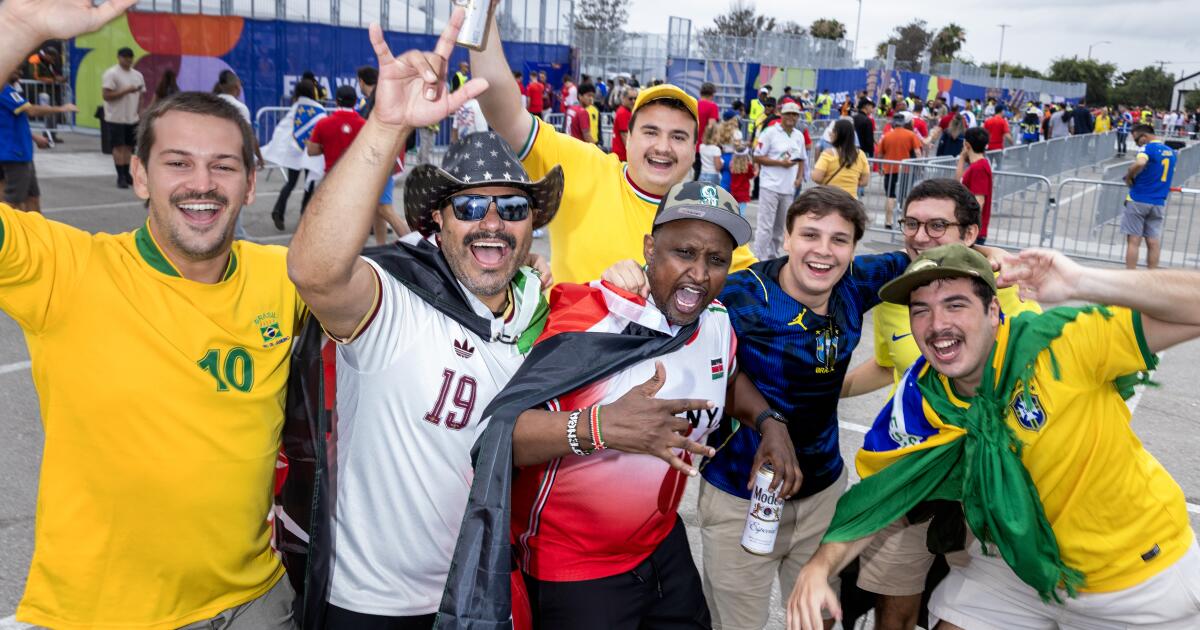
World Cup tourists are coming to L.A. for the soccer, but they’re staying for the $21 smoothies and Double-Doubles.
As the last Los Angeles FIFA World Cup event ended Friday, soccer fans were eating like locals and famous chains from the region were cashing in.
In the weeks that L.A. has hosted the World Cup, international soccer enthusiasts have flocked to big brands from the area, often in large groups wearing their countries’ jerseys.
It is a phenomenon seen at many of the host cities. In Dallas, giant gas station Buc-ee’s is the main attraction. For people visiting New Jersey, deli shops have been a hot ticket. In L.A., the place to be between matches was Erewhon.
Thirsty international sports fans gathered for pictures outside different Erewhons, wandered their aisles smiling, and, of course, picked up pricey smoothies.
While Erewhon would not comment on its business, mobility data company Arity, which uses phone data to track consumers, said Erewhon visits at the outlets around SoFi Stadium were quadruple what they were a week earlier on June 12, the day of the U.S. national soccer team’s opening match there.
Arity looked at what stores people visited within a 10-mile radius of SoFi that day and also found surges in visitors to nearby El Pollo Loco and Trader Joe’s.
Locals have spotted groups of people in Korea jerseys huddled together, trying to decide what to order at In-N-Out.
Some complained on social media that international tourists at Trader Joe’s were buying up all the mini canvas tote bags.
Soon after the Belgium vs. Spain quarterfinal ended Friday, the In-N-Out near SoFi had a long line of soccer fans stretching out the door in bright red and yellow and black jerseys and matching striped hats and scarves.
One of the workers said he had to explain “spread” and “animal style” to foreign football fans.
“I didn’t know this place existed,” a fan from Romania said while waiting in line.
Los Angeles and other cities and states that have hosted the event need the soccer fans to spend money to make the event worth all the time, effort and money it requires.
A rosy 2024 report projected the World Cup could bring more than $800 million to the L.A. region as 180,000 people converge on the area to sleep, eat and spend.
There were early concerns people weren’t turning up for the event because of the high ticket prices and the difficulty of obtaining visas for citizens of some countries.
However, at least for some L.A. hotels, there was a surge of last-minute visitors which pushed up occupancy and room rates.
While sports fans are not in the region to shop, they do make time for it.
World Cup customer spending is also apparent in beer sales. Andrew Heritage, the chief economist at the Beer Institute said beer purchases at entertainment and attractions in L.A. – outside of World Cup spaces – were up around 10% from normal.
“That tells me that fans in the L.A. area have decided to extend their stay and take in all the other things that the area has to offer, rather than just the match itself,” he said.
On social media, the purpose of these shoppers is clear: grab a quick souvenir or local specialty and take a selfie.
The data from Arity suggests that fans are very efficient when they spend at local spots, diving in, getting what they want and getting out as soon as possible, said Jeff Schlitt, a director at the company.
“Normally you’re there for an hour. They’re going to be there for 15, 18 minutes,” he said. “Why is that? Because they were purpose-driven shoppers.”
For some travelers, the more popular American chains aren’t unfamiliar. But some of the native L.A. fare still comes as a surprise.
As one Belgium-Spain matchgoer from the Netherlands stood taking a picture of the In-N-Out sign after the game, he said he’d never had a burger like the one he’d just tried.
“We only have McDonald’s and Burger King,” he said. “It’s way better.”

NEWYou can now listen to Fox News articles!
The face of baseball will not be at Tuesday’s All-Star Game.
Shohei Ohtani was scratched from his start on Friday as the Los Angeles Dodgers said he will also miss the Midsummer Classic with what the team called left knee irritation.
Ohtani, for obvious reasons, has become an All-Star Game fixture. He has earned the honor in each of the past five seasons and made his first start in 2021.
Starting pitcher Shohei Ohtani #17 of the Los Angeles Dodgers warms up before the MLB game against the Arizona Diamondbacks at Chase Field on June 03, 2026 in Phoenix, Arizona. (Photo by Christian Petersen/Getty Images) (Christian Petersen/Getty Images)
The two-way phenom is on his way to winning his fifth MVP award in his last six seasons as he is hitting .290 with a .939 OPS and pitching to a minuscule 1.79 ERA, the second-lowest in the sport among pitchers with 80-plus innings. His OPS is also the seventh-best mark in the league.
The Dodgers said Ohtani will be the team’s designated hitter up until the break, but he will “have some interventions on his knee to put him in the best position for the second half of the season.”
Ohtani dealt with knee issues earlier in the season.
It is certainly a big hit for the game as the other face of the sport, Aaron Judge, will miss the game due to a fractured rib that has kept him out since late May.
Shohei Ohtani #17 of the Los Angeles Dodgers gets ready in the on deck circle against the Arizona Diamondbacks at Chase Field on June 01, 2026 in Phoenix, Arizona. (Photo by Norm Hall/Getty Images) (Norm Hall/Getty Images)
DODGERS WILL AGAIN VISIT WHITE HOUSE TO CELEBRATE WORLD SERIES CHAMPIONSHIP, OFFICIAL SAYS
Ohtani hit 99 home runs combined in 2024 and 2025, leading the National League with a 1.025 OPS in that span. Ohtani did not pitch in 2024 after elbow surgery but returned to the bump last year and owned a 2.87 ERA and 11.9 K/9, a figure he also put up in 2022 that led the American League.
The “Japanese Babe Ruth” is the only player in MLB history to have 300-plus plate appearances and 40-plus innings in six separate seasons (Ruth only did it twice and never stole 50 bases), and he has more than excelled at both.
Shohei Ohtani pitches for the Los Angeles Dodgers against the San Francisco Giants at Dodger Stadium in Los Angeles, California, on May 13, 2026. (Gary A. Vasquez/Imagn Images)
CLICK HERE TO DOWNLOAD THE FOX NEWS APP
Ohtani is not hitting like he has in the past, but certainly the best pitching performance of his career will make up for it. He “only” has 20 homers and 56 RBI this season.
Follow Fox News Digital’s sports coverage on X, and subscribe to the Fox News Sports Huddle newsletter.
-

 Los Angeles, Ca33 minutes ago
New details emerge in fatal stabbing of boy in El Monte
-

 Detroit, MI60 minutes ago
1 dead, 1 injured after two-vehicle crash at Collingwood and Belleterre in Detroit
-

 San Francisco, CA1 hour ago
4 arrested, 3 cited after brawl following Giants vs. Rockies game at Oracle Park
-

 Dallas, TX1 hour ago
Mark Cuban takes legal action against Dallas Mavericks ownership over potential new arena deal
-

 Miami, FL1 hour ago
South Florida Dirt: A timeline of the Vacchi vs. Stern legal battle
-

 Boston, MA1 hour ago
Tall Ships begin historic Boston parade of sails
-

 Denver, CO1 hour ago
Lakers Proposed to Land Peyton Watson in Massive 9-Player Blockbuster Trade
-

 Seattle, WA2 hours ago
Cyclists fill backroads for annual summer Seattle-to-Portland ride

