Sports
'I was lost': Ricky Rubio reflects on his NBA career and the dark days that occurred


Growing up in Spain, Ricky Rubio had a decision to make. At just 10, he showed promise as an athlete and was asked to choose between basketball and soccer.
“The real football,” he said.
He was a good soccer player, and the popularity of the sport in his country compelled him to throw everything into it. That lasted for about a month.
Rubio could not ignore a connection to basketball that ran deep. His father was a basketball coach. His older brother was an accomplished player. But more than family ties called to him. The rhythm of the game, the metronomic beat created by the ball bouncing on the hardwood, was music to his ears. The angles and geometry needed to excel created equations he reveled in solving.
“I decided I miss basketball too much. It’s something that was inside of me,” he said. “Nobody pushed me to play basketball. It’s just a sport that I fell in love with because of how complex it is in all single details in the game.”
Those early, innocent days birthed a career that included Olympic medals, a World Cup title and MVP award and a 12-year NBA career that ended earlier in January when he announced his retirement from the Cleveland Cavaliers.
Rubio also paid a price during almost two decades in the spotlight. As a 14-year-old prodigy in Spain, he gave his youth to the game in his eagerness to get his career started. He shouldered the pressure that comes with being a much-hyped prospect and endured several major injuries throughout his NBA career that challenged him mentally and physically to such a degree that he could not muster a 13th season in the NBA.
Rubio’s decision to retire came four months after he announced he was stepping away to address his mental health. He alluded to July 30 being “one of the toughest nights of my life” and said the feeling of losing control prompted him to end his career.
For a player who won over fans, coaches and teammates with his charming, relentlessly positive personality in the locker room and his dazzling unselfishness on the court, Rubio’s revelation was concerning for so many who connected with him. To hear Rubio tell it now, his love for the game and playing it was always pure, but his hakuna matata exterior masked an underlying anguish that was tormenting him.
“I’ve always been that guy trying to be positive,” Rubio said in a telephone interview from his home in Spain. “But sometimes it was me lying to myself, saying, ‘Don’t feel that way’ because it might stop you. … Eventually, if you lie to yourself, it can catch up in a wrong way, like what happened to me. So be true to yourself.”
He is not yet ready to make public the exact nature of his struggles. His wounds are healing, but there is still work he is doing to climb out of the hole he was in. What he can say right now is just how deep in the hole he was.
“I have goose bumps thinking about those days when everything was dark,” Rubio said. “I had something clouding my mind that I couldn’t get over. Now I’m doing much better with the help that I needed and building myself from inside-out instead of outside-in.”
Ricky Rubio played for four franchises over his 12-year career, finishing with the Cleveland Cavaliers. (David Richard / USA Today)
It was clear from a young age that the game coursed through his veins. He showed enough promise to suit up for DKV Joventut as a 14-year-old in 2005, becoming the youngest ever to play in a Spanish ACB League game.
He was named FIBA Europe Young Player of the Year in 2007, ’08 and ’09. His vision and passing made him a crowd favorite and his family worked hard to protect him from the attention at such a young age.
“It came so fast and so natural that I couldn’t even think (do) I want to be a professional,” Rubio said. “It was, I am a professional.”
He joined the Spanish national team for the 2008 Olympics and went global with his performance against Team USA in the gold medal game in Beijing. The Spaniards pushed the Redeem Team, led by Kobe Bryant, LeBron James, Dwyane Wade, Chris Paul and Carmelo Anthony. Their 17-year-old point guard didn’t back down an inch.
“I was fearless and I didn’t know the wrong side, I would say,” Rubio said. “I always thought about good things and I enjoyed that final.”
His numbers didn’t leap out. Six points, six rebounds, three assists. But as the game wore on, it was clear that this teenager was one of his country’s most important players. Spain fell 118-107 with Wade and Bryant leading the Americans’ bounce back from a bronze medal finish in Athens in 2004.
But the performance put Rubio on the map. Shortly after the game, he needed surgery on his right wrist because of an injury he suffered, but the rush he felt of competing against players he watched on television as a boy masked any pain during the game itself.
“I was having so much fun, I could have played with one leg,” he said.
Rubio and Spain went on to win the gold medal at EuroBasket in 2009. Ten years later, he earned MVP honors as he led Spain to the FIBA World Cup championship. Those teams were Rubio’s favorite, a brotherhood with the likes of Pau and Marc Gasol, Rudy Fernandez, Juan Carlos Navarro and Juancho and Willy Hernangomez. His affection and respect for those men helped hone his approach to the game as he evolved from one of the first real YouTube sensations into a true floor general.
As Rubio prepared for the 2009 NBA Draft, those grainy highlight reels were all that most fans had to get an idea of what this floppy-haired passing savant was all about. His workouts with NBA teams leading up to the draft were shrouded in mystery. When he was chosen fifth by the Minnesota Timberwolves, he was asked in his first interview off of the stage to what player he would compare himself.
“I’m Ricky Rubio,” he said. “I’m not like anybody else.”
That became a mantra of sorts that followed Rubio to the Twin Cities, a philosophy that focused on avoiding comparisons and staying true to one’s self. Fifteen years later, Rubio says that deep down inside, adhering to that credo was much more difficult than he made it look.
“I wish I could have lived by those words. I have tried,” Rubio said.
The celebration on draft night was muted because of the uncertainty surrounding his contract situation in Spain. His contract with Joventut called for a buyout of more than $6.5 million to secure his release. The Timberwolves were only allowed to pay $500,000, so Rubio remained in Spain for two more seasons.
He was traded from Joventut to Regal Barcelona in 2009, and Rubio remembers being booed by Joventut fans when he came back to play there, a stinging reaction to something beyond his control that gave him an early glimpse into the more cutthroat side of the game.
“It has been kind of forgotten because I didn’t want to believe that feeling,” Rubio said. “If I would have believed that feeling, it would have destroyed me. I was 18 years old, and it was super huge for me. And then I realized it was a business.”
So began Rubio’s efforts to not let the outside world know what was happening underneath his boyish smile and enthusiastic nature.
“Maybe because I’m a super sentimental person, but I had to hide my feelings from me sometimes (so I) don’t feel it and it doesn’t stop me from performing at a high level,” he said.
After two years with Barcelona, the buyout finally reached a manageable figure to allow Rubio to come to the NBA.
On June 20, 2011, he arrived with his family at Minneapolis-St. Paul International Airport. When he walked into the baggage claim area, more than 100 fans, team employees and cheerleaders were waiting for him.
“I felt like a rock star,” he said. “I didn’t want any of the spotlight, to be honest. But I wasn’t complaining. It felt great.”
When he finally hit the court at Target Center, it was pure electricity. Teaming with a young All-Star in Kevin Love and playing under an accomplished head coach in Rick Adelman, Rubio burst onto the NBA scene. He threw passes from angles only he could see and teammates would be shocked when the ball found its way into their hands for an easy dunk or wide-open jumper.
In an era where scoring point guards such as Derrick Rose, Russell Westbrook and Deron Williams were becoming the norm, Rubio made passing cool again. Behind the back, no-look, on the run, lobs from beyond half court, anything was on the table.
“That was pure Ricky,” he said. “It wasn’t something disrespectful to the other team. It was more something to have fun with the game. I’m always trying to be respectful with everybody. But at the same time, I like to have fun on a basketball court.”
Behind Rubio’s joyous orchestration and Love’s scoring and rebounding, the Timberwolves were 21-19 and chasing down their first playoff appearance since 2004 when they played the Los Angeles Lakers on March 9, 2012. They led 102-101 with 17 seconds to play when Bryant collided with Rubio’s knee, and Rubio crumpled to the court. The arena has never been so quiet. He tore the ACL in his left knee, an injury that started the Wolves on a downward spiral and changed the course of his career.
“I felt, at one point, invincible,” he said. “Then that injury happened and I said that it won’t affect me. I will come back. I won’t say I was innocent, but I was not thinking that I could fail.”
Rubio missed the first six weeks of his second season while completing his rehab, and it took him another six weeks to start playing up to his expectations. The Rubio who returned from that injury was a more careful player, more deliberate in his passing and less prone to taking risks. He would eventually return to a starting-caliber point guard with some exceptional moments, but he never quite recaptured the magic of that rookie season.
“I always think about that day that I got hurt and what could have happened,” Rubio said. “Everything happens for a reason. And sometimes I think about it. But I was having so much fun that season, I couldn’t believe it.”
Just days before the 2015-16 season began, Timberwolves president of basketball operations Flip Saunders, who developed a close bond with Rubio, died suddenly from Hodgkin’s lymphoma. Rubio lost his mother, Tona, to lung cancer in 2016, a death so devastating that he considered retirement. He tried to keep his chin up while enduring the pain, but it was exhausting.
“I had to perform, I had to play basketball. And that’s what I’m here for. And it’s something that I don’t regret because things worked in a really good way for me,” Rubio said. “But at the same time, I wish I would have been more honest with myself.”
He spent one more season (2016-17) in Minnesota, but he never got on the same page as coach Tom Thibodeau and was traded to Utah before the 2017 draft.
“Looking back in the 12 years of my career, of course, your first time it’s always great. A rookie season is special,” Rubio said. “But that was something really, really special for me, and I think for Minnesota as well.”

As hard as he played, Rubio says he wishes he “would have been more honest with myself.” (J Pat Carter / Getty Images)
The transition to Utah was comfortable for Rubio, who saw similarities to Minnesota in terms of the mid-sized market and quality of life away from the court. He took quickly to the Jazz organization, a tradition-rich franchise that treated its players well and had a standard of expectations that he wasn’t used to in Minnesota.
The Jazz won 48 games in Rubio’s first season there, giving him his first taste of the playoffs in his seventh season in the league. The Jazz beat the Oklahoma City Thunder in the first round, and Rubio thoroughly outplayed Westbrook in the series, averaging 14.0 points, 7.3 rebounds, 7.0 assists and 1.3 steals.
“That was my biggest challenge in the NBA,” Rubio said. “I never took it personally. I always thought about the team and how we could beat them as a team.”
While in Utah, Rubio teamed up with the A Breath of Hope Lung Foundation to raise money for cancer research in honor of his mother. He was active in the community and appreciative of the Utah fans’ basketball knowledge and passion.
“I feel like the fans are a part of the game as well,” he said. “I always try to leave an impact in the community that I play for just because we’re so grateful that we have to be a good role model for a lot of kids growing up and watching us play. We have to use our celebrity to our advantage, that they listen to us more than a teacher or a parent sometimes.”
Rubio spent two seasons in Utah before signing with the rebuilding Phoenix Suns as a free agent in 2019. He spent a year in Phoenix, where he and his wife, Sara, welcomed their son, Liam, into the family and then spent the ill-fated 2020-21 season back in Minnesota, where a heartwarming reunion was short-circuited by the pandemic.
The Timberwolves traded Rubio to Cleveland in the 2021 offseason. After initially having reservations about joining another young team that did not figure to contend right away, he was quickly won over by the Cavaliers. He scored 37 points in a win in Madison Square Garden early in the season and averaged a career-high 13.1 points per game off the bench for a Cavs team that exceeded expectations.
After years of searching for the vibes of that rookie season in Minnesota, Rubio finally started to feel that tingle of invincibility again.
“I reached a point where everything was in a perfect situation. Me being in a team that they need me to perform at a high level, at my prime physically and mentally,” Rubio said. “It was the best I felt.”
That made what happened in New Orleans on Dec. 28, 2021, all the more devastating. The Cavs were down two in the final 2 minutes, 30 seconds of the game when Rubio took a shovel pass from Love and drove down the lane. As Pelicans center Jonas Valančiūnas slid over to stop the penetration, Rubio planted with his left leg and slipped a pass to Evan Mobley. His left knee, the same one he injured in 2012, buckled.
A day after the injury, with an outpouring of sympathy directed toward one of the league’s most well-liked players, Rubio again projected positivity. He posted a video of Bryant urging to “always keep going.”
“What I’ve come to find out,” Bryant said, “is that, no matter what happens, the storm eventually ends.”
It took Rubio more than a year to come back from that injury, but in some ways, his storm is still going.
“I still think I’m not over it, to be honest with you,” Rubio said. “I lost a lot of confidence on why things always worked in that way where I was having a good season with everything in place and, after all the storms that I have been through, and you give me that now?”
The Cavaliers’ season ended in April with a disappointing 4-1 loss to the Knicks in the first round of the playoffs. Rubio returned to Spain and was met face-to-face by the demons that had been whispering in his ears for years. In his NBA retirement announcement, he said that July 30 “was one of the toughest nights of my life. My mind went to a dark place.”
Rubio had dealt with depression in the past, but he could identify the root cause when his mother passed away. This time was not so straightforward. Yes, the injury was deflating, but he did not believe that was a “major, significant event that caused me that. It’s been small, little things that have been building from the past and eventually catches up.”
All these years later, Rubio wonders if starting so young was the best thing for him, especially if the stressors that started at 14 and accumulated across two decades prevented his one chance at being a kid.
“It’s tough and it’s hard to do because you only have one chance, probably, sometimes in life,” he said. “If you don’t jump on that train, you don’t know what would have happened. But I wish I would have enjoyed more that early stage of my life.”
Maybe that’s why that boyish charm was so evident in his early days in the NBA, the kid inside of him trying to burst out of the fishbowl created by entering the professional realm so young. Eventually, basketball became one of the main things in his life that was holding him back and not giving him joy.
He was stateside because of basketball while his mother was being treated for cancer. He had to leave his wife and newborn son just a few days after he was born to go on the road with the Suns.
Through every bit of adversity, Rubio tried to tell himself, and the world around him, “never too high, never too low.” The conflict inside him finally became too much to bear.
“I was lost. I didn’t know who I was. I had to rebuild myself,” he said. “I think eventually a lot of people have that point in their life that has to rebuild them because they have lost the focus on the purpose of their life. Luckily, I stopped it in time.”
Rubio was surrounded by family, friends, former teammates and basketball people who offered support and well wishes. He started to get help to address what he was going through and has, gradually, started to come out of the fog.
“I know I’m not alone. So I feel like when you speak out, people relate to you,” he said. “We’re human beings, we go through the same things in a different context. Lean on each other, lean on who you love. It’s been a tough process, I’m not going to lie.”
In the wake of the retirement, teammates from every stop have praised Rubio for his abilities on the court, but even more for the teammate and friend he was off of it.
“I’m gonna miss him on the court, but he’s a friend forever,” Devin Booker told reporters in Phoenix. “Even though it was just one year, it was so impactful to my career.”
“That’s my championship, I’ll say,” Rubio said. “I’d rather be seen as a good person than a great player. At the end of the day, what people will remember is who you are and how you make them feel, not because you play good basketball or bad.”
As he has pulled himself back together, he has found peace and contentment away from the game. This was the first Christmas since 2011 that he could be at home in Spain with his family.
“Things in life change, but you’re trying to build memories,” Rubio said. “This year was one of the traditions that I always put aside because of basketball. Finally, I could do it.”
Little by little, Rubio is finding himself again. The personal improvement he has made in recent weeks only validates his decision to bring an end to his NBA career.
“Sometimes I wish I could have had a better NBA career,” he said. “Sometimes I wish I would’ve had a championship. Sometimes I think about my career, but at the end of the day, I had a lot of fun. I enjoyed it.
“Was there bad times? Of course. This is not a perfect story. But I learned a lot, I made a lot of friends through this process and I grew up a lot. I enjoyed basketball a lot.”
While his NBA days are over, Rubio has not ruled out a return to the court in Europe. With his mind clearer, he began to think about how his body would feel if he laced up the sneakers again. For all of his trials in the game, he is not ready to say his playing days are completely done.
“I hope not,” he said. “Eventually I want to try it out since I’m doing better, but I’m sure it will be a different me. I will put myself first. I’m still in the recovery process of a big shock, but I know basketball is a big part of who I am.”
(Illustration: John Bradford / The Athletic; photos: Christian Petersen, Streeter Lecka / Getty Images)



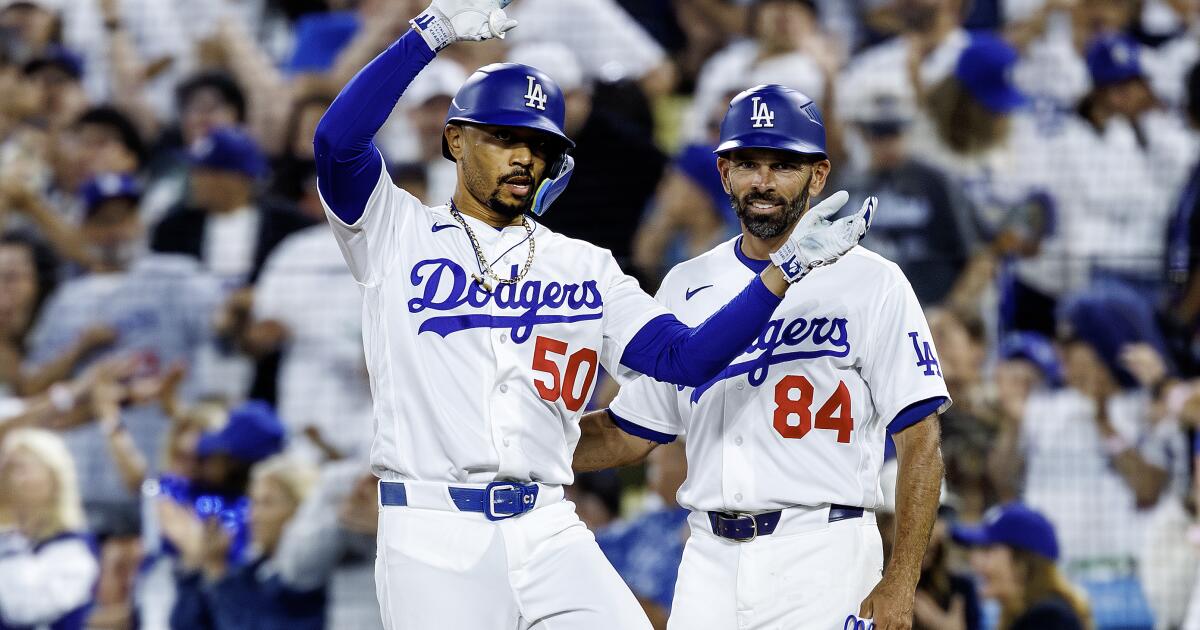
Mookie Betts’ first hit this series against the Rockies couldn’t have come at a more opportune time. With the crack of the ball against his bat, Tommy Edman scored from third, giving the Dodgers the lead.
And as Betts reached first, he pointed to Freddie Freeman, whose single put Edman in scoring position. It had taken a team effort to overcome another middling start from Roki Sasaki, and Betts, who had little to show before his game-winning hit, took the chance to highlight the joint contribution in the Dodgers’ 4-3 rubber-match win over Colorado (38-56).
“It feels great,” Betts said of his nine-pitch battle. “Helping the boys win, that’s really all it is. We play the game to win, and coming through in a big moment is kind of what, when you’re a kid, playing in the backyard, getting that hit is what you always strive to do, and fortunately, I was able to do it.”
Given a three-run lead in the first inning, brought to the Dodgers by a wild pitch and Kyle Tucker’s two-run, line-drive single to left field, Sasaki seemed set up for success.
Still, he gave away the lead as quickly as it came. In the second inning, he left a fastball too far over the plate, and third baseman Kyle Karros drove the ball over the left-center wall. The slider he dealt two batters later to second baseman Edouard Julien also crossed the zone too far over the plate, and Julien rounded the bases with another homer. In the third, a sacrifice fly by Mickey Moniak evened the scored, 3-3.
Sasaki’s troubles this season have been hard to pin down since his last win on May 23, as Sasaki tries to claw back the triple-digit velocity that’s escaped him as of late.
Against the Rockies, his fastball topped out at 99.1 miles per hour before steadily dropping to 98. He had managed five strikeouts in his six innings when manager Dave Roberts replaced him with Jack Dreyer, though the three earned runs couldn’t be ignored.
But Roberts also acknowledged the possibility that the pitcher had been tipping his pitches, possibly since he was playing in Japan, and Sasaki has tried to address it after a three-inning, six-run start last week. Even if he had fully self-corrected, his control issues remain. In the third inning, he walked the tying runner, Brett Sullivan.
“I’ve been working on a lot of things like the tipping stuff,” Sasaki said through interpreter Kensuke Okubo. “Also, I need to make quality pitches.”
Sasaki regained some of his confidence in the fourth when he worked out of a two-base jam with two strikeouts and a flyball to right, something that didn’t go unnoticed by Roberts.
“You can see the demeanor walking off the mound, the confidence,” Roberts said. “For me, it was more of let him end on a high note, feeling good about his outing, and then go from there.”
The Dodgers’ problems were compounded by Alex Call wasting the team’s two challenges in his at-bat in the first inning when the team had already taken the lead. And maybe it would’ve been excusable if Call had driven in the runners on first and second, but instead he ended the inning on a strikeout, stranding both. Roberts called the situation an “outlier” and didn’t feel as though he needed to have a conversation with Call regarding the situation.
After the three-run first, the Dodgers (61-33) remained hitless until Max Muncy laced a double down the right-field line in the sixth, though to little avail. As the innings ticked forward, Colorado’s chances seemed to increase. The Rockies hold the best league batting average (.297) in the eighth and ninth innings (the Dodgers are fourth with .268). And the Dodgers relievers, within the same constraints, have a 3.83 ERA — not bad, but not in the top 10 either.
Third baseman Max Muncy can’t get his glove on a line-drive double by Kyle Karros in the fourth inning.
(Gina Ferazzi/Los Angeles Times)
So when Alex Vesia struggled against the Rockies in the eighth inning and Muncy suffered a throwing error, Colorado seemed in position to score with the bases loaded and one out. Vesia struck out TJ Rumfield and Edgardo Henriquez (4-0), his replacement, retired Karros on a fly ball to right.
After Betts’ single allowed the Dodgers to take the lead, Tanner Scott (13) shut down the Rockies with back-to-back strikeouts, avoiding the team’s eighth series loss of the season.
“Didn’t feel great,” Roberts said. “Fortunately, we won a series, but that’s not the kind of way you want to do it.”
Sports
Justin Verlander announces he will retire after this season: ‘I’ve realized that time has come’

NEWYou can now listen to Fox News articles!
One of the greatest pitchers in the history of baseball will be hanging up his cleats after this season.
Three-time Cy Young Award winner Justin Verlander announced on Wednesday that the 2026 season will be his last.
Amid an injury-riddled season with the Detroit Tigers, Verlander decided it’s time to go.
Detroit Tigers pitcher Justin Verlander watches from the dugout during a game against the Chicago White Sox at Comerica Park in Detroit June 21, 2026. (David Rodriguez-Munoz/USA Today Network via Imagn Images)
“This season has challenged me in ways I haven’t experienced before, both physically and mentally. I’ve always believed that as long as I could compete at the level I expect of myself, I’d keep playing. I never wanted to retire because of a milestone, a number, or a date on the calendar. I wanted the game to tell me when it was time. Over the last several months, I’ve realized that time has come,” Verlander said in a social media post.
“While I’m fully committed to giving my team everything I have for the rest of this season, I’ve decided this will be my last. It’s fitting that I get to finish where it all started – with the Detroit Tigers, the organization that drafted me and gave me my first opportunity.”
Verlander inked a one-year deal with the Tigers, with whom he spent his first 12½ seasons before being traded to the Houston Astros, in the offseason. In Houston, he returned to dominance, winning both of his World Series titles and two of his Cy Young Awards.
“Baseball has given me more than I could have imagined. It taught me discipline, resilience, and the value of continuing to adapt and evolve. I’ve been fortunate to play with and against incredible players, for outstanding organizations, and compete in-front of fans who deeply appreciate the game,” Verlander added in his announcement.
Justin Verlander of the Houston Astros celebrates after the Astros defeated the Philadelphia Phillies in Game 6 of the 2022 World Series at Minute Maid Park Nov. 5, 2022, in Houston, Texas. (Mary DeCicco/MLB Photos via Getty Images)
PHILLIES STAR SAYS ‘BS RULE’ IS KEEPING HIM FROM BEING NAMED ALL-STAR IN FRONT OF HOME CROWD
“To every teammate, coach, player, clubhouse attendant, and fan who has been part of this journey – thank you. It’s been a privilege to share the field with you. To my family, especially my wife Kate, thank you for standing beside me through every season, every rehab, and every high and low. I couldn’t have done this without you. It’s time for the next chapter. But first, I’m excited to finish this season the only way I know how – with everything I’ve got.”
Verlander is the active leader with 3,554 strikeouts, which is good for eighth all-time. He needs 21 to surpass Don Sutton and 87 to pass Tom Seaver.
The 43-year-old made his MLB debut in 2005 and won the American League Rookie of the Year Award the following season in what was just a small glimpse of what was to come.
Verlander was a Cy Young Award finalist on four other occasions, consistently near the top of the leaderboard in just about every pitching stat. MLB Commissioner Rob Manfred gave Verlander a legend’s exemption to this year’s Midsummer Classic, making him a 10-time All-Star.
One could argue that Verlander should have at least one more Cy Young Award on his mantle, but he is on the fast track to Cooperstown and very much in the conversation to join Mariano Rivera as the only player unanimously elected to the Hall of Fame.
Verlander’s best season came in 2022, when he pitched to a career-best 1.75 ERA along with a 0.829 WHIP. However, that came after he missed the entire 2021 season due to Tommy John surgery for an injury he suffered after pitching just one inning in the abbreviated 2020 season.
Houston Astros starting pitcher Justin Verlander throws against the Boston Red Sox during the first inning Aug. 22, 2023, in Houston. (AP Photo/Michael Wyke)
CLICK HERE TO DOWNLOAD THE FOX NEWS APP
He won his first Cy Young Award in 2011, when he was also awarded the MVP Award, and his second in 2019. Verlander’s 11 seasons between his first and final Cy Young Awards are the second-most behind Roger Clemens, who had 18 seasons between his first and seventh.
Verlander led the majors in innings and WHIP four times while recording the most strikeouts in three seasons.
Follow Fox News Digital’s sports coverage on X, and subscribe to the Fox News Sports Huddle newsletter.
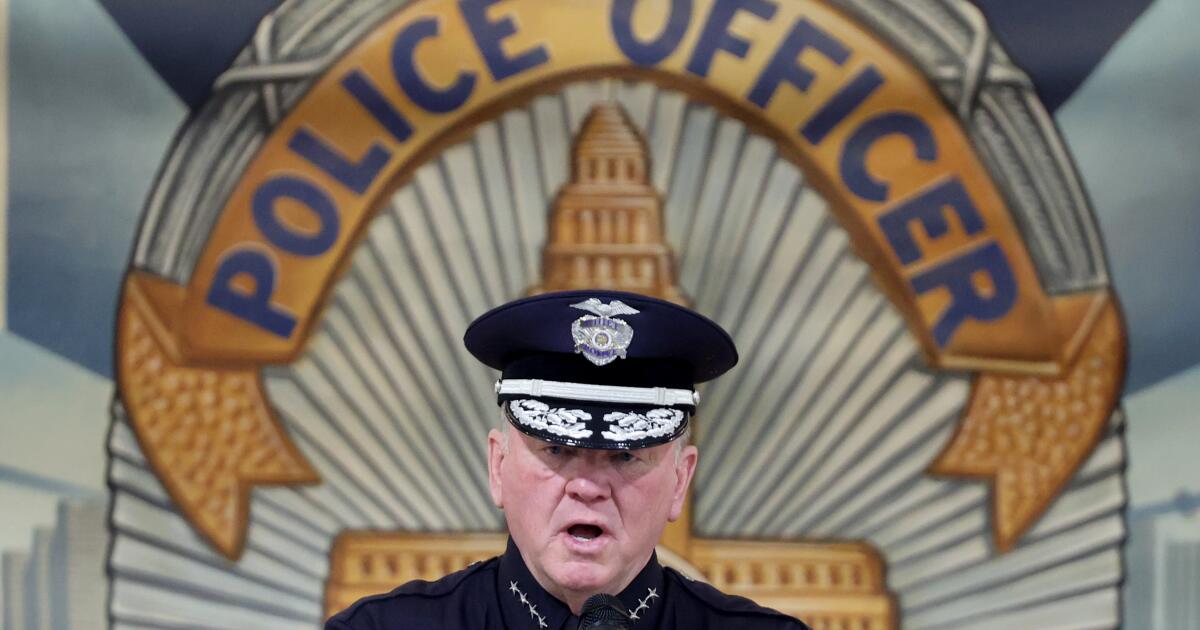
The LAPD is considering whether to shut down its police academy for part of 2028 in order to put hundreds of officers back to work on the streets in time for the Olympic and Paralympic Games, according to four department sources.
The sources, who requested anonymity because they were not authorized to publicly discuss internal matters, said the proposal was floated at a senior staff meeting last week. The idea has sparked debate, the sources said, with some officials worried that a pause would set back the department’s efforts to hire more police officers and replenish its dwindling ranks.
The LAPD declined to make any official available for an interview about the proposal. In response to an inquiry from The Times, the department released a short statement that said: “The Olympic Games are two years away. The LAPD will be prepared as always to keep the citizens and visitors of Los Angeles safe. We look forward to a memorable event.”
Much could still change between now and the start of the Olympics. The size of recruit classes are dictated by the department’s annual budget, which is approved by the City Council before each fiscal year.
Recently, the council signed off on a $15-billion city budget for 2026-27, preserving Mayor Karen Bass’ plan to hire 510 officers — only enough cops to replace those who are expected to leave over the next fiscal year.
It’s not uncommon during large events for the department to mobilize officers from specialized units and others who don’t normally work in the field. But the potential cancellation of more than half of the 13 academy classes that the LAPD typically graduates in a given year came as a surprise to some.
Under the proposal, the academy could cease operations for roughly seven months after the January 2028 class, which would let the department temporarily reassign more than 300 officers from its training division. These include instructors who would normally be spending their days teaching the basics of how to handle firearms, pull over speeding motorists, collect evidence at a crime scene and interview victims and suspects.
Sources said the proposed plan calls for increasing academy class sizes before and after the Olympics and Paralympics in order to offset resignations and retirements.
The plan has still been met with deep skepticism in some quarters, with officials pointing to the department’s well-documented recruitment struggles in recent years. Any interruptions in recruiting officers could set the department back, the skeptics argue.
L.A. City Councilmember Tim McOsker said he understood the need for the department to continue its recruitment efforts, but said that putting training officers back to the field felt like a necessary “sacrifice to be able to host the Olympics.”
Late last month, L.A. officials reached a tentative deal with Olympic organizers laying out the process for reimbursing the city for potentially hundreds of millions of dollars for public services, ranging from traffic control to trash pickup. But the question of how the city will pay for police protection remains largely unsettled.
The costs could theoretically be covered by the $1 billion in funding the federal government has allocated for the Games’ costs. However, some elected officials have expressed concern that the money might not materialize once the Games are over. Another funding option is a $270-million contingency fund maintained by LA28 that can be distributed as a surplus if the Games make money or be used to cover any losses in the event of a shortfall.
For months, LAPD Chief Jim McDonnell has warned that public safety will suffer if the city doesn’t hire more officers to not only safeguard Olympic venues, but also continue normal operations over the 66 days between the July 14 start of the Olympic Games and the end of the Paralympic Games. At a budget hearing last year, McDonnell called on the council to fund new hires — while arguing against creating any delays in recruiting and on-boarding more officers.
Some City Council members have pushed back, saying overspending at the LAPD could force city leaders to contemplate cuts to other city jobs, which they oppose.
The Olympics will also be staffed by thousands of officers from agencies from across the state. A bill currently under consideration in the California Legislature would pave the way for the hundreds of officers from other states to help police the 2028 Games. The proposed legislation is opposed by the Peace Officers Research Association of California, the state’s largest law enforcement labor organization, which has argued that bringing in officers who don’t meet statewide training standards could spell disaster.
-
 Science3 seconds ago
Not everyone is leaving California. A new commercial battery maker just landed in Sacramento
-
Sports3 minutes ago
Mookie Betts’ eighth-inning single gives Dodgers the win over the Rockies
-
World15 minutes ago
From sewers to swimming sites: how Europe's cities reclaim their rivers
-

 News45 minutes ago
Three more people charged with damaging Reflecting Pool after Trump’s multimillion-dollar restoration | CNN Politics
-

 Los Angeles, Ca2 hours ago
Loved ones search for missing 34-year-old Southern California woman
-

 Detroit, MI2 hours ago
Chickens, geese found at vacant home after nonprofit reports them stolen
-

 San Francisco, CA3 hours ago
What’s next for San Francisco Giants as MLB trade deadline approaches?
-
 Dallas, TX3 hours ago
Dallas millionaire files lawsuit against groundwater district

