
Entertainment
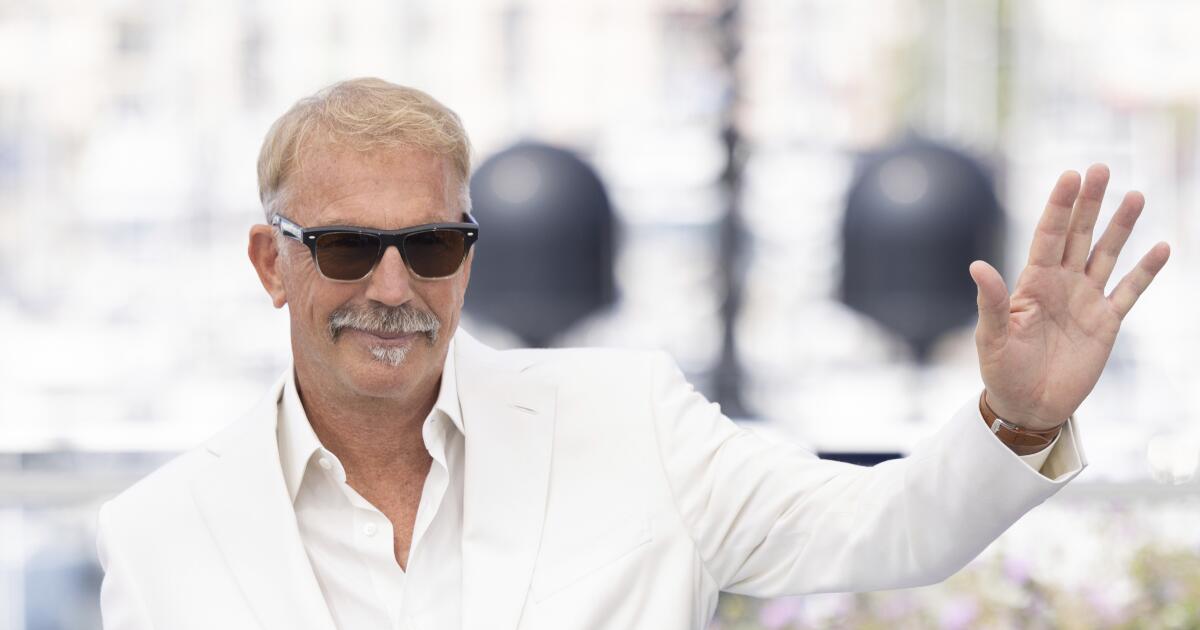
Kevin Costner reveals his promise to Whitney Houston — and his refusal to trim her eulogy
At Whitney Houston’s 2012 funeral, which was broadcast live on CNN, Kevin Costner delivered a 17-minute eulogy. But if the network had had its way, his remarks would have run much shorter, the “Yellowstone” actor says.
Costner, who co-starred with Houston in the 1992 romantic thriller “The Bodyguard,” was one of eight speakers at the esteemed singer’s funeral. Initially, he was hesitant to accept the invitation to speak, but at the encouragement of Houston’s aunt, singer Dionne Warwick, he changed his mind.
With a friend’s help, he told “Armchair Expert” podcast hosts Dax Shepard and Monica Padman, “I tried to compile everything I wanted to do and finally crafted this speech.” Then it was nearly derailed by the network.
“Somebody said, ‘CNN’s here, they wouldn’t mind if your remarks were kept shorter because they’re going to have commercials.’ And I said, ‘They can get over that. They can play the commercial while I’m talking, I don’t care.’ ”
CNN did not reply immediately Wednesday to The Times’ request for comment.
Costner’s refusal had its roots in a protectiveness over Houston that he described adopting early into filming “The Bodyguard.”
“I realized that the world had a higher idea of who we were, so I basically embraced it. I was her imaginary bodyguard,” he said. “I started to guide her, and I wasn’t trying to usurp my director. But I made a promise to her.”
Costner said he promised Houston — and her mentor Clive Davis — that the movie would be a hit, and that she would shine in it. He was right.
Despite a review from The Times labeling Costner’s character a “joyless mope,” “The Bodyguard” has grossed nearly $122 million domestically, according to Box Office Mojo, and Houston’s cover of Dolly Parton’s “I Will Always Love You” received numerous awards, including a record of the year Grammy. The film’s 13-song collection remains the best-selling movie soundtrack of all time.
“That was my promise to her,” Costner said. “She’s always gonna love me in the song. I was always gonna keep my promise to her.”
Costner and Houston stayed friends until the singer’s death at age 48 from accidental drowning at the Beverly Hilton Hotel.
“I eulogized her and I didn’t want to,” the actor-director said Monday. “When she passed away, there was a steady drumbeat to hear.”
Movie Reviews
‘The End of It’ Review: Rebecca Hall, Gael García Bernal and Beanie Feldstein in a Compellingly Quirky, if Overstretched, Sci-Fi Exercise
The always eminently watchable Rebecca Hall (The Man I Love, TV’s The Beauty) both anchors and buoys the tonally irregular but consistently thoughtful and compelling sci-fi comedy-drama The End of It, a feature debut for Catalan writer-director Maria Martinez Bayona.
Offering a near future that’s creepily plausible, resonant with recent headlines and nicely underplayed in terms of design, this posits Hall as Claire, a 250-year-old artist who’s kept looking like an elegant 30something thanks to sophisticated blood dialysis techniques and other kinds of high-tech, vaguely defined wizardry, available to a very select few.
The End of It
The Bottom Line Augurs a potentially interesting career.
Venue: Cannes Film Festival (Cannes Premiere)
Cast: Rebecca Hall, Gael Garcia Bernal, Noomi Rapace, Beanie Feldstein
Director/screenwriter: Maria Martinez Bayona
2 hours 22 minutes
However, when Claire grows bored with an effectively immortal life and chooses to die, her husband Diego (Gael García Bernal), 180-year-old daughter Martha (Noomi Rapace), and android personal assistant Sarah (Beanie Feldstein) react in various ways, ranging from supportive to angry. Running an attenuated 142-minutes, this feels slightly flawed by a script that doesn’t quite know how to play out its endgame and erupts with jarring flashes of spongey, overegged satire. Still, the performances and visuals consistently add value, and if this doesn’t sell many tickets IRL, it should haul in clicks as a streaming entity.
Shot mostly in the Canary Islands with the region’s searing, glaring Tropic-of-Cancer-adjacent light, freakishly black, volcanic soil and groovy mid-century-modernist buildings, the film suggests a future where the worst climactic disasters have been avoided. That, or the people we meet here are wealthy enough to have found a cushy little enclave to live forever without a care in the world. It seems they’re part of the select few, members of a vaguely alluded-to world order that provides the means to exist in a state of permanent, hedonistic ennui.
But the only way to get in on this immortality gig, or to be granted permission to have a baby, is for someone else to die. And since no one expires from, say, cancer or other now-curable diseases, and bones and organs can be replaced like car parts with artificial spares, people only pass when involved in freak accidents…or take their own lives.
On the occasion of her 250th birthday (she gets a cake with so many candles she can barely be bothered to blow them out), Claire is in a funk and just not enjoying any of this anymore. Having just replaced her last remaining natural bone, she takes stock. Years ago, she was an acclaimed artist whose work was a bit avant-garde and challenging. Now she designs jewelry, a remunerative but not very intellectually rewarding pursuit. (This plot point is a bit mean to jewelry designers.) Suffering an acute case of anhedonia, she decides that she will no longer have her blood work every day or any other kind of life-extending treatment and instead will just let nature take its course.
As grey hairs appear and other augurs of age become visible, Claire contends with the varied reactions of her small social circle. She couldn’t care less about the assorted colorful acquaintances who attended her birthday party, a cohort clad in an assortment of semi-minimalist clothes with funky little details and interestingly textured textiles, as if dressed in a mix of Comme des Garçons and Cos. (Costume designer Pau Auli’s work throughout is both witty and oddly covetable with its precise tailoring and subtle color palette.)
But it is more upsetting that Diego, her husband of many years, doesn’t get her reasoning at all, or even sees this as a personal rejection. Sarah, Claire’s relentlessly perky robot sidekick, similarly cannot compute why Claire would wish to undermine Sarah’s prime directive, to keep Claire alive. But she’ll do whatever it takes to keep her mistress happy, like some kind of humanoid golden retriever.
Only her daughter Martha, who shows up suddenly, having not seen her mother in 50 years, seems at peace with Claire’s decision. That turns out to be because she thinks this may be her chance to take Claire’s place as a breeding female in their society and has brought along an android baby to practice on, like some kind of 23rd century Tamagotchi that can be switched off and recharged whenever necessary.
Prone to wearing clothes that suggest an overgrown pre-teen herself, all frills, flounces and bright colors, Martha doesn’t look like great maternal material to Claire, although this judgmental attitude may be evidence of her own maternal deficiencies. The peevish sparring between the two of them gets a comic push from the fact that the two actors are very close in age (Hall is three years younger than Rapace), but like so many parents and children they remain stuck in a dynamic that formed sometime in adolescence and has never been outgrown.
The digs at the pretensions of artists, channeled through Claire’s decision to make her death a public spectacle in order to secure some future fame, are less amusing here because the blows never seem to quite connect with their targets. Also, one begins to suspect that a small budget prohibited the filmmakers from showing a wider view of this society, which also dampens any parodic purpose. Claire’s elective death therefore remains a problematic choice for some viewers, an act of vainglorious selfishness from a woman who was never terribly nice to begin with.
It’s lucky she’s played by Hall, who endows Claire with a spiky sort of wit and charisma, while her performance in the film’s final minutes packs a considerable emotional wallop and pathos to spare. The impact of that shocking final scene is sufficient to send viewers out feeling enervated after what’s been a pretty desultory final act. But even with these flaws, The End of It looks like it marks the beginning of an interesting career for its young writer-director, a talent with a strong visual sensibility and skills with actors.
Entertainment
Star Wars strikes back with $102 million projected for ‘The Mandalorian and Grogu’
After a nearly seven-year absence from theaters, Star Wars proved it still has the Force, as the latest installment, “The Mandalorian and Grogu,” is on track to earn an estimated $102 million in the U.S. and Canada for the Memorial Day weekend.
The movie, which is a continuation of “The Mandalorian” streaming show that debuted on Disney+ in 2019, met studio expectations for its opening weekend results.
Globally, the film was on track to pull in $165 million for the four-day holiday weekend.
Director Jon Favreau’s “The Mandalorian and Grogu” now ranks as the year’s third-highest grossing domestic opening, based on its Friday-Sunday ticket sales of $82 million, according to ticket tracker Comscore.
The results are likely a relief to Walt Disney Co.-owned Lucasfilm, which had not released a theatrical Star Wars film since 2019’s “Star Wars: Episode IX — The Rise of Skywalker.”
Since then, the San Francisco-based studio has largely focused on its Star Wars streaming shows, which have included both live-action and animated series. Some of those shows received mixed reviews, though “The Mandalorian” and “Rogue One” spin-off “Andor” were breakout hits, praised by critics and largely revered by fans.
The movie — starring Pedro Pascal, Sigourney Weaver and Jeremy Allen White — benefited from positive reviews from moviegoers, but it stopped short of shattering expectations. Its initial financial performance was on par with the disappointing 2018 opening weekend for “Solo: A Star Wars Story.” That film notched $103 million in its opening weekend.
Still, as cinemas struggle to recover from pandemic-era shutdowns, a film that generates more than $100 million in its the opening weekend is typically seen as a success.
Box office revenue for “The Mandalorian and Grogu,” which played in 4,300 theaters, will be just one indicator of the movie’s success.
The Burbank entertainment giant is counting on the film to boost other parts of its business, including views of Star Wars shows on the Disney+ streaming service, its gaming collaboration with Fortnite and its all-important theme parks sector. The main characters are present in the Star Wars: Galaxy’s Edge-themed land, and the Millennium Falcon: Smugglers Run ride has been overlaid with a new “Mandalorian and Grogu” storyline at Disney parks in Anaheim and Orlando.
The weekend ticket sales underscore the enduring appeal of Star Wars, which remains among Disney’s top five franchises, producing more than $1 billion in annual retail sales.
Reception for the film was seen as critical to keeping the franchise fresh in moviegoers’ minds, particularly as Disney prepares for the upcoming 50th anniversary of Star Wars and a new movie starring Ryan Gosling set for next year.
Locally, “The Mandalorian and Grogu” is the first Star Wars movie to be made entirely in Los Angeles.
The film received a state tax credit to film in the Golden State, Favreau said at the premiere last week.
“The Mandalorian and Grogu” faced little new competition at the box office this Memorial Day weekend. Rival studios largely stayed on the sidelines, with no other potential blockbuster debuting at the same time.
Focus Films’ horror hit “Obsession” came in second at the box office with $22.4 million for its three-day total, according to Comscore.
Lionsgate’s blockbuster Michael Jackson documentary, “Michael,” snared $20 million, bringing its total to $314 million. “The Devil Wears Prada 2” came in fourth with $12.6 million, bringing its purse to $196 million since it opened earlier this month.
Amazon’s MGM studio’s “The Sheep Detectives” rounded out the top five with nearly $9 million.
Movie Reviews
Movie Review | Remarkably Bright Creature
Remarkably Bright Creature (Photo – Netflix)
“I’d like to be under the sea in an octopus’s garden…”
Remarkably Bright Creature
Directed by Olivia Newman – 2026
Reviewed by Garrett Rowlan
Whenever you have a lyric from a C-list Beatle song running through your head while watching a movie, it’s not a good sign.
But halfway through Remarkably Bright Creatures, a new film starring Sally Fields, those words earwormed their way into my head, replacing, I fear, the heartwarming sentiment I was expected to feel.
Based on a popular novel, Remarkably Bright Creatures—or RBC hereafter—is narrated by a captive octopus named Marcellus, who makes observations from his tank in a seaside Washington town.
The digitally animated creature, voiced by Alfred Molina in a flat tone that itself sounds half-submerged, spends his days hiding from the grasping eyes and fingerprints of schoolchildren on field trips. By night, he communicates through touch and glance with the janitor, Tova Sullivan, played by Sally Fields, a widow with a tragic past. She hobbles around on a sprained ankle and debates whether to move into a retirement facility.
As you might guess, RBC is slight on dramatic material, relying instead on the commentary of Marcellus, the aging octopus; Tova’s interactions with her octogenarian friends; and the arrival in town of a struggling musician seeking the father he never knew.
The film reminded me of those BBC-produced cozy mysteries I’ve become fond of renting from the Pasadena Public Library: small-town atmospheres filled with chumminess and colorful characters. Those mysteries, however, have an unsolved crime to propel the plot. Aside from the struggling musician’s attempt to locate his wealthy, incognito biological father, RBC leaves the viewer with little to chew on—or, I suppose, suck on. Marcellus’s eight arms and clinging suckers not only allow him to move in unique ways, but also to comment on the other characters from the vantage of his tank, a POV oddity that becomes one of the film’s more troubling anomalies.
As usual with this geezer genre, there’s the sobering apprehension of familiar faces, Kathy Baker and Joan Chen in this case, whose wrinkles and tissue breakdown reminded me of my own softening jawline. Colm Meaney, playing a former Grateful Dead fanatic turned coffee-shop owner, serves as Sally Fields’s love interest; his Irish brogue further evokes those BBC cozies.
“She lives in a larger tank than me,” observes Marcellus of the fussy attendant. His periodic comments sprinkle the plot, easing along our understanding of the characters until the metaphorical enclosure around Sally Fields dissolves as she takes the aging Marcellus to the seashore and returns him to his own octopus’s garden.
What the ultimate public reception of RBC will be, I don’t know. I wouldn’t have thought Project Hail Mary, with its spidery co-star in a beach-ball enclosure, would be popular either, so I suppose there’s hope yet for the movie and its slithering protagonist.
> Streaming on Netflix.
-
Wyoming6 minutes agoWyoming’s Hageman aims to block future ‘roadless areas,’ despite overwhelming support to keep public land pristine
-
Crypto12 minutes agoWeekend Round-Up: Bitcoin’s Big Players, XRP ETFs, SpaceX’s BTC Holdings And More
-
Finance18 minutes agoMum reveals grim property reality facing millions of parents: ‘Screwed’
-
Fitness24 minutes agoDevon fitness community helps women rethink exercise during menopause
-
Movie Reviews36 minutes ago‘The End of It’ Review: Rebecca Hall, Gael García Bernal and Beanie Feldstein in a Compellingly Quirky, if Overstretched, Sci-Fi Exercise
-
World48 minutes agoBox Office: ‘Michael’ Nears $800 Million, ‘Devil Wears Prada 2’ Hits $600 Million Globally
-
News54 minutes agoFirefighters Still Working to Cool Garden Grove Chemical Tank
-
Politics60 minutes agoGunman in Shooting Near White House Killed in Exchange of Fire With Secret Service
