Sports
'I consider myself lucky': Dominic Thiem and the agonising what-ifs of tennis


The greatest moment of Dominic Thiem’s tennis career came in an eerie vacuum in front of more than 20,000 empty seats.
As he collapsed to the ground after four hours on court against Alexander Zverev in the 2020 U.S. Open final, the noise he heard was the whirr of camera shutters and a smattering of applause, not the cacophony that normally greets a singles champion inside Arthur Ashe Stadium in New York City.
It didn’t matter. He had finally done it. He had his Grand Slam title.
It was not a final for the purists, regardless of the context, as tennis returned from a Covid-19-enforced hiatus to play before rows of empty seats. Thiem and Zverev were manacled by the weight of history and opportunity, first separately, and then both at once, their tennis labouring to reach something as yet unachievable. Rafael Nadal and Roger Federer had skipped the tournament; Novak Djokovic was defaulted in the fourth round for accidentally hitting a line judge with a ball. Having lived under the crushing dominance of that ‘Big Three‘, suddenly, there was a path.
Things started terribly that day for the Austrian, who had dropped only one set in reaching the final. He lost the first two against Zverev and looked set for a crushing defeat.
“I already felt before the match that something was not right,” Thiem tells The Athletic in a video interview from his home in Austria. “I wasn’t getting into the zone or the flow. And that’s how the first two sets went — they were way too tense, too nervous. Sascha (Zverev) was playing really well.
“The pressure was so high. I was thinking back to my previous finals. Maybe it’s less pressure to face the greatest players of all time. Because the U.S. Open, I had to win (in those circumstances), and that was really tough.”
It’s Dominic Thiem’s moment.
The point that made him a Grand Slam champion 👇 pic.twitter.com/uYMplH3TF7
— US Open Tennis (@usopen) September 14, 2020
Before winning in your fourth Grand Slam final, you have to lose three, and Thiem fell just short of two of the toughest feats in men’s tennis in all of them. He lost two French Open finals to 14-time Roland Garros champion Nadal, and one Australian Open to Djokovic, who has lifted the trophy in Melbourne 10 times. Along with Andy Murray and Stan Wawrinka, no player suffered from the supremacy of Nadal, Djokovic and Federer more than he did.
“Every Grand Slam final felt like it could be the last one, because the journey is really tough,” Thiem says. “You have to beat great players, you have to stay healthy. Many, many little things have to come together. When I played Sascha (that day in New York), it was like now or never.
“When I was two sets down, luckily I released a bit and he also started to think a bit more that he’s very close to the title.”
After Thiem clawed back that two-set deficit, Zverev served for the championship at 5-3, but Thiem broke to stay in the contest. The match went to a final-set tiebreak.
It remains a tough watch almost four years on.
In one corner is the exhausted Thiem, drenched in sweat, battling an Achilles tendon problem and suffering so badly from cramp he struggled to serve. In the other is Zverev, so gripped by nerves he could only muster a 68mph (109kph) second serve when down match point, as well as hitting two double faults.
Thiem won by seizing the initiative, ripping away a couple of decisive forehand winners. His fearlessness remains one of his defining characteristics, and it came to the fore at the most critical moment of his career. Former world No 4 Tim Henman said in commentary for Amazon Prime: “I’ve never seen anything like that. The legs had gone, but the belief hadn’t.”
The Austrian finally claimed a Grand Slam title at the fourth attempt (Matthew Stockman/Getty Images)
Thiem’s moment had finally arrived but in the most surreal circumstances imaginable, with no fans in the crowd, just a small collection of tournament staff.
That U.S. Open was supposed to herald the start of something exciting for Thiem. Instead, it marked the beginning of the end.

This month, Thiem is back in New York as a wildcard, where he will face home hope Ben Shelton in the first round.
This will be his last Grand Slam tournament, and he is likely to be out of it by the time he turns 31 on September 3. Thiem has won just one of his eight ATP Tour matches in 2024, and is now 209th in the world rankings. This lack of competitiveness — defined by the after-effects of a serious wrist injury from 2021 — is why he is calling it a day. He has no interest in carrying on in such a diminished state, and does not think surgery would change anything.
“There wasn’t a particular moment I decided (to retire) but towards the end of last year I was working hard, putting in a lot of hours, doing a good job, giving it my all, and the steps in the right direction were just not satisfying for me,” he says. “I was not playing well enough, especially when I was comparing myself to three, four, five years ago.”
A wrist injury is just about the worst a tennis player can suffer — it is at the end of the kinetic chain and the part of the body most connected to the racket. Although it can be traced to an innocuous match against Adrian Mannarino in Mallorca, it came from the thrashing of the ball that was Thiem’s signature, as well as the effort of facing the greatest players of all time, largely all at once.

Thiem’s flashing, brutal groundstrokes were his signature (Julian Finney/Getty Images)
Thiem was not a tennis prodigy everyone assumed would win Grand Slams, as was the case with other children of the 1990s such as Zverev, Grigor Dimitrov and Stefanos Tsitsipas. He became the first of two players born in the 1990s to win a major — succeeded by Daniil Medvedev — thanks largely to unrelenting hard work. He became synonymous with the post-Wimbledon clay-court swing, a time when most top players put their feet up. In 2015, he set a personal record by entering 29 tournaments — 13 more than year-end world No 1 Djokovic.
With his youthful look, throwback 1990s haircuts, and the way he would occasionally berate himself after a missed shot, Thiem possessed a vulnerability that endeared himself to tennis fans.
It took a toll, especially as a mere mortal trying to compete with the sport’s three demigods.
“That contributed to the injury, definitely,” he says. “I was competing with the three greatest of all time. That was intense.
“But also, all the years before I always had a big load and intensity in my practice. That’s something the doctor and many other people said: that at one point the wrist broke because of all the shots I did, all the hard practice I did all those years before.
“I was always striving to get better and get even closer to the best players in the world.”
Rather than cursing his luck, he feels privileged to have faced the three greatest male players of all time in the biggest matches. Thiem had 35 meetings with the Big Three, boasting a 16-19 win-loss record, including beating Federer in five of their seven encounters.

Thiem defeated Federer to win Indian Wells in 2019 (Sean M. Haffey/Getty Images)
“I consider myself lucky to be in that timeline with the Big Three and all the other great players,” he says. “I came up into the top 100 way later than most; they came up when they were, like, 18, whereas I was 20 and a half. I didn’t think it would be possible that I’d be a Grand Slam champion and No 3 in the world.”
Thiem’s positive outlook made him one of the most popular players on the ATP Tour over the last decade. When he announced in Rome in May that he would retire on home soil at October’s Vienna Open, there was a palpable feeling of disappointment among the assembled players in the Italian capital.
His good friend Zverev, vanquished in that agonising five-set U.S. Open final, described him as extremely down-to-earth: “He hasn’t changed with success, which sometimes is difficult to do. On the court, the power he had, the way he played — he gave it 110 per cent every time. You could feel that as a player and as a spectator, and that made him very special.
“He’s one of my best friends on tour.”
That final sentiment is familiar — it became a running joke in the locker room that players would invariably choose Thiem when asked who their best pal on tour was.
Even if Thiem was relatively slow to reach the world’s top 100, he made up for lost time.
After reaching the French Open semifinals for the first time, he cracked the top 10 in June 2016. He lost to Djokovic in that semifinal, when he was en route to his fourth straight Grand Slam title. The Big Three brick wall started early.
Thiem grew up on clay, and the slower surface defined and suited his long, wound-up swings — especially on the backhand side. His single-handed backhand, with its mixture of beauty and violence, symbolises his game. Of his 17 ATP singles titles, Thiem won 10 on clay, one on grass, and six on hard courts.
Clay suited the athleticism of Thiem, who played football to a decent level, as a central midfielder, until he was 14. He eventually became the second-best clay-courter in the world, but it mattered little: the best was in a different galaxy. Thiem would twice beat Djokovic at the French Open, only to run into Nadal for three straight years between 2017 and 2019. He lost all three, winning a single set across one semifinal and back-to-back finals.
“The first one (2018), I was a bit overwhelmed from reaching a Grand Slam final,” Thiem says. “Maybe I was one or two per cent too satisfied, too happy already with being in the finals. And I paid the bill for that.”
Nadal won 6-4, 6-3, 6-2.
The following year, having won Indian Wells in the March, Thiem’s reward for beating Djokovic in a two-day semifinal was another meeting with Nadal. The Austrian took the second set to level the match, but Nadal raced away with the next two to claim a 12th Roland Garros title.

Thiem never got the better of Nadal at the French Open (Clive Brunskill/Getty Images)
“That time, I really went on the court with the belief to win,” Thiem says. “I had a great attitude in this match and played really well. But he was just on a different level. It was very painful in the beginning, but it was a great match against the greatest player at this tournament of all time.”
There was more pain at the 2019 French Open, but of a different kind.
The famously easygoing Thiem came off the court to a bizarre incident when he was forced out of the interview room by a furious Serena Williams. The 23-time Grand Slam singles champion wanted to do her press conference as quickly as possible after losing in the third round. A disbelieving Thiem was furious, saying, “What the hell? But it’s a joke, really,” as he was ushered out of the room.
He added that Williams had shown a “bad personality” and he was suddenly catching strays from luminaries, including Whoopi Goldberg. “Don’t blame her, stop being a bonehead,” the actor said on U.S. broadcaster NBC.
Reflecting on the incident now, Thiem laughs. His frustration was partly directed at his own stressful third-round match against Pablo Cuevas — and, there was a happy ending. “Looking back, it’s very funny, because a few weeks later, we met around the Wimbledon practice courts, and Serena came up to me and said sorry. I also said sorry, because I lost it a bit there. It was a very nice conversation.”
The 2019 French Open was his first major after splitting with long-term coach and manager Gunter Bresnik. Thiem replaced Bresnik, often associated with his punishing schedule, with the 2004 Olympic champion Nicolas Massu, who was there for the 2020 U.S. Open win.
Bresnik later sued Thiem for a share of his earnings in the period shortly after they had stopped working together. This was settled out of court in March 2021.
Thiem’s next big chance at a major was the 2020 Australian Open, where he led Djokovic, as formidable in Melbourne as Nadal was in Paris, by two sets to one in the final. He had a point to move up a break in the fourth set but couldn’t convert it and ended up losing in five sets.
Thiem, who beat Nadal en route to the final, believes this was the peak of his career: “That was the best I played; how I was moving, playing attacking tennis, the way I was serving and returning, which was not my biggest weapon. Losing was very painful as I had chances like never before in that final.”

At the 2020 Australian Open, Thiem lost the final to Djokovic in five sets (Cameron Spencer/Getty Images)
Despite his incredible record and the challenges of playing his first three Grand Slam finals against two of the Big Three, Thiem was on the cusp of becoming a nearly-man. Beating one of Federer, Nadal or Djokovic was rarely enough, and they played each other so often that they continuously elevated each other’s level. The recently-retired Murray had a similar experience, losing his first four major finals to Federer (three times) and Djokovic. Thiem says that in retirement, he would like to get together with Murray and some of his other former rivals and “have a really deep conversation” over a beer.
Like Murray, Thiem broke the duck, but because of the pandemic that had turned his triumph into such a surreal occasion, he had no time to savour his victory. That year’s French Open had been moved from its May/June slot to late September/early October, meaning it started only two weeks after his U.S. Open triumph. Thiem reached the quarterfinals, and then the final of the year-end ATP Finals. He seemed on track to kick on — but he knew that something wasn’t right mentally.
“Straight after the U.S. Open, I thought, ‘Wow, it’s going to be so easy, because now I won’t put pressure on myself’. But I needed the pressure, I needed the stress, to be in the zone to play my best. I completely lost that feeling. It was pure emptiness going on court.”
Dimitrov hammered Thiem in the fourth round of the 2021 Australian Open and, after a few months in which he was slowly rediscovering his motivation, the wrist injury against Mannarino ended his season — meaning he couldn’t defend his U.S. Open title.
“I had that inner fire and inner drive again, the feeling to practise with 100 per cent intensity again — then the wrist injury happened,” he says.

Thiem and Djokovic played cat-and-mouse through the years (Tim Clayton/Corbis via Getty Images)
Since the injury, Thiem has never been able to go at full pelt. There have been some good results and entertaining matches — reaching the 2023 Kitzbuhel final in his homeland, and a close three-set defeat to Tsitsipas in Madrid a few months earlier — but he has never sustained any form.
Thiem felt relief in May when he publicly announced his plan to retire — he had been more emotional when the thought first entered his mind late last year. He had retained the belief he could find his old self for some time, but never wanted to go out feeling like it was unattainable.

Thiem showed some of the old ferocity at the 2023 Madrid Open (Javier Soriano/AFP)
“Maybe there would be one act or tournament that would change everything,” he says. “But it just didn’t happen. Even when I had good results, it was more because of the fighting spirit than the playing level. That was always unsatisfying, and it helped with the decision.”
In April, he posted on social media: “I’m not the player of 2020 anymore. I have to deal with the current situation, with the fact that my wrist doesn’t give me the strength it used to.”
The expectation was that Thiem, a two-time finalist, would be given a wildcard for the French Open a couple of weeks after his decision. Instead, he had to try to qualify, losing in the second round but receiving a special presentation on a packed Court Suzanne-Lenglen.
Thiem bears no ill will for the snub, cherishing instead the memory of his farewell on one of his favourite courts and adding: “I was very relaxed, because I had enough time to play myself into the top 100 and have a spot in the main draw. I didn’t take that chance. It was OK.”
Since then, Thiem has lost three straight matches as he seeks one last big performance in New York. While he looks ahead to life after tennis — dreaming of setting up a sustainable football club, like Forest Green Rovers, who play in the fifth tier of English football; starting a family with his partner, the circus performer Lili Paul-Roncalli; maybe commentary; maybe coaching — he knows watching the sport’s leading players, some of them older than him, doing what he used to do will be one of the realities of retirement.
Even that level feels distant now but, as with having to face the Big Three on court, Thiem is excited, not bitter.
To watch matches “without being worried about anything, just to enjoy the sport, which is unbelievably beautiful” is enough now.
And first, there is New York, the site of his surreal, but beautiful moment on Arthur Ashe.
(Top photos: Getty Images; design: Eamonn Dalton)



NEWYou can now listen to Fox News articles!
Russell Wilson and Sean Payton spent just one NFL season together, but tension lingered after a rocky year.
And it appears the tension that built up from that tumultuous stretch continues to linger.
Wilson’s interview on the “Bussin’ With the Boys” podcast, recorded before last month’s Super Bowl between Seattle and New England, recently resurfaced.
In the interview, Wilson doubled down on his October comment labeling Payton “classless,” saying he felt slighted by his former coach’s remarks.
Head coach Sean Payton of the Denver Broncos talks to quarterback Russell Wilson on the sideline during an NFL preseason football game against the Arizona Cardinals at State Farm Stadium Aug. 11, 2023, in Glendale, Ariz. (Ryan Kang/Getty Images)
“[When] you’ve been on the same side or this and that, and I got the same amount of rings as you got, meaning Sean, right?” said Wilson, who won a Super Bowl with the Seattle Seahawks as Payton did coaching for the New Orleans Saints.
“I got a lot of respect for him as a play-caller, this and that, but to take a shot, I don’t like. I don’t think it’s necessary, you know, I mean, especially when I’m not even on your own team anymore. So, for me, there’s a point in time where you have to, I’ve realized, I’ve stayed quiet for so long. There’s a there’s a time and place where I’m not.
“I know who I am as a competitor, as a warrior, as a champion, too, and, you know, I’ve beaten Sean, too. You know, like we’ve been on the same place and the same thing. And so, it’s not a matter of disrespect. Just don’t disrespect me.”
Sean Payton and Russell Wilson of the Denver Broncos during an a game against the Minnesota Vikings at Empower Field at Mile High Nov. 19, 2023, in Denver, Colo. (Ryan Kang/Getty Images)
After a rocky one-year stint with the Pittsburgh Steelers in 2024, Wilson joined the New York Giants last offseason. However, he was relegated to a backup role after just three games.
Rookie Jaxson Dart quickly showed promise once he had the chance to start, but his season was briefly derailed by injury. Jameis Winston — not Wilson — stepped in for Dart in a handful of games. Dart threw three touchdowns in a Week 7 matchup with the Broncos, nearly pulling off an upset in what was eventually a close loss.
After the game, Payton said Dart provided a “spark” to the Giants’ offense.
“I was talking to [Giants owner] John Mara not too long ago, and I said, ‘We were hoping that that change would have happened long after our game,’” Payton said.
The New York Giants’ Russell Wilson attempts to escape a sack by Dallas Cowboys defensive end James Houston (53) in the first half of a game Sept. 14, 2025, in Arlington, Texas. (AP Photo/Julio Cortez)
Payton also said the Broncos would have faced less of a challenge had Wilson been under center.
“Classless … but not surprised,” Wilson responded in a social media post. “Didn’t realize you’re still bounty hunting 15+ years later though the media.”
Despite last season’s struggles and chatter about his football future, Wilson does not appear ready to call it quits in 2026.
“I wanna play a few more years for sure,” he said. “I think, for me, I’ve always had the vision of getting to 40, at least. I think the game is different. Quarterbacks, we get hit. It’s not, you know, we get hit hard, but … there’s certain rules. I mean, back in the day when I started, bro, it was you just get [clobbered].
“I mean, so I feel like the game allows you to, you know, live a little longer, I guess. I feel healthy. I feel great. But I think, more than anything else is, do you love the game? Do you love studying? Do you love the passion for it all? Do you love the process? Do you love the practice? Do you love — everybody loves the winning part of it, but it’s process. There’s a journey that you got to be obsessed with. And that part I’m obsessed with.”
Follow Fox News Digital’s sports coverage on X, and subscribe to the Fox News Sports Huddle newsletter.
Related Article
The early rounds of the BNP Paribas Open began Wednesday, with top seeds slated to start play Friday during the 12-day ATP and WTPA Master 1000 tournament.
A busy stretch of the tennis season reaches another gear at Indian Wells Tennis Garden, the second largest outdoor tennis stadium in the world.
While many consider it the “fifth Grand Slam” because of its elite player field, amenities and equal prize money for men and women, professionals acknowledge the tournament is part of a stressful stretch on the tennis calendar.
Indian Wells is followed by the Miami Open, another two-week Master 1000 tournament. The tour stops are known as the “Sunshine Double.”
Some players made the short trip from Indian Wells to Las Vegas this past weekend to participate in the MGM Grand Slam, an exhibition designed to help players ramp up for back-to-back tournaments.
American Reilly Opelka, a 6-foot–11 pro, said managing fatigue after a series of tournaments before hitting Indian Wells has altered his practice and play in exhibition matches, including a loss to 19-year-old Brazilian Joao Fonseca in Las Vegas.
“Normally in any kind of competition, you get excited and play with a pressure point … but you don’t feel this when you are practicing,” Opelka said.
“I was trying to feel like this a few days ago while practicing with … [Tommy Paul,] but instead we got tired and hungry. … That usually doesn’t happen. We just decided to stop and go to eat somewhere.”
Paul said despite the decision to cut practice short, he feels fresh for the upcoming events.
“I started the year pretty well and for Americans, we are excited for the Sunshine Double,” Paul said.
Casper Rudd lost to Opelka during the first round of the Las Vegas exhibition. The Norwegian also lost a week ago during the first round of the Acapulco Open, falling to Chinese qualifier Yibing Wu in straight sets.
Rudd said he felt “extremely tired” after the Australian Open in January.
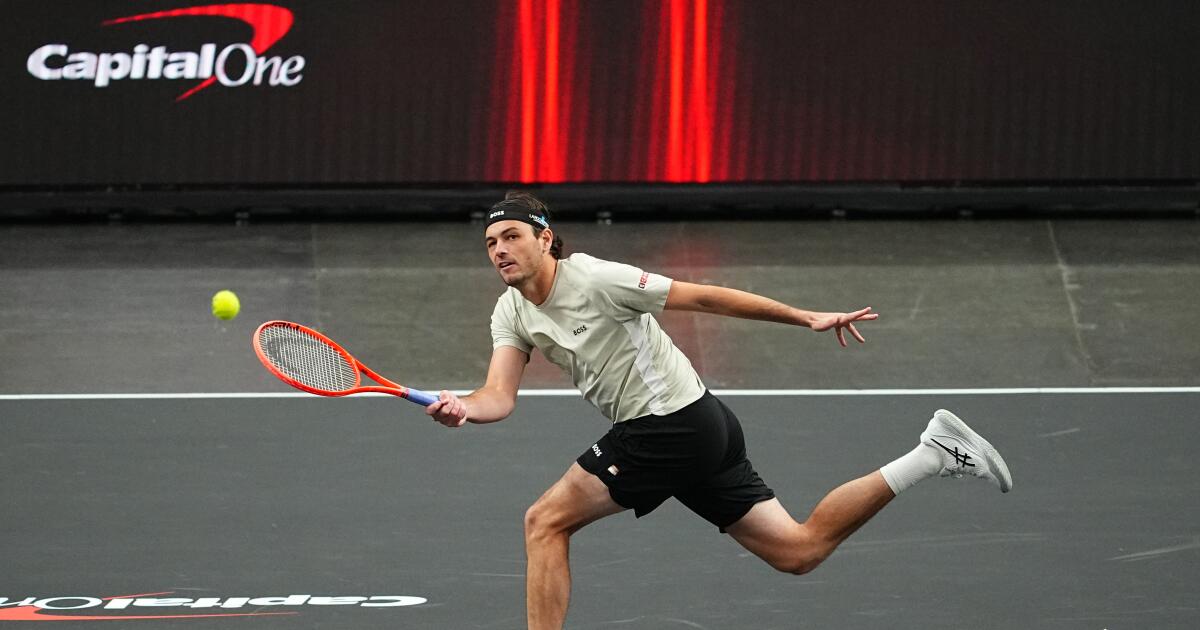
Rancho Palo Verdes resident Taylor Fritz, ranked No. 7 in the world, said the best way to prepare yourself for grueling tour schedule is “putting [in] the time, work and repetition.”
“… Be there, be focused on the quality that you are doing,” said Fritz, a 28-year-old who won the Indian Wells title in 2022.
While some players are guarding against burnout, others struggled to even reach California. Some players who live in Dubai, including Russians Daniil Medvedev and Andrey Rublev, have to contend with closed airspace triggered by the U.S. and Israel bombing Iran.
The ATP announced Wednesday that, “the vast majority of players who were in Dubai have successfully departed today on selected flights.”
Sports
Law firm fighting for women’s sports in SCOTUS battle comments on ruling possibly impacting SJSU trans lawsuit

NEWYou can now listen to Fox News articles!
A law firm leading the charge in the ongoing Supreme Court case over trans athletes in women’s sports has responded after a federal judge suggested the case’s ruling could impact a separate case involving a similar issue.
Colorado District Judge Kato Crews deferred ruling in motions to dismiss former San Jose State volleyball co-captain Brooke Slusser’s lawsuit against the California State University (CSU) system until after a ruling in the B.P.J. v. West Virginia Supreme Court case, which is expected to come in June.
Slusser filed the lawsuit against representatives of her school and the Mountain West Conference in fall 2024 after she allegedly was made to share bedrooms and changing spaces with trans teammate Blaire Fleming for a whole season without being informed that Fleming is a biological male.
Meanwhile, the B.P.J. case went to the Supreme Court after a trans teen sued West Virginia to block the state’s law that prevents males from competing in girls’ high school sports.
The Alliance Defending Freedom (ADF) is the primary law firm defending West Virginia in that case at the Supreme Court, and has now responded to news that Slusser’s lawsuit could be affected by the SCOTUS ruling.
“We hope the ruling from the Supreme Court will affirm that Title IX was designed to guarantee equal opportunity for women, not to let male athletes displace women and girl in competition. It is crucial that sports be separated by sex for not only the equal opportunity of women but for safety and privacy. Title IX should protect women’s right to compete in their own sports. Allowing men to compete in the female category reverses 50 years of advancement for women,” ADF Vice President of Litigation Strategies Jonathan Scruggs said.
Slusser’s attorney, Bill Bock of the Independent Council on Women’s Sports, expects a Supreme Court ruling in favor of the legal defense representing West Virginia, thus helping his case.
(Left) Brooke Slusser (10) of the San Jose State Spartans serves the ball during the first set against the Air Force Falcons at Falcon Court at East Gym in Colorado Springs, Colorado, on Oct. 19, 2024. (Right) Blaire Fleming #3 of the San Jose State Spartans looks on during the third set against the Air Force Falcons at Falcon Court at East Gym on October 19, 2024 in Colorado Springs, Colorado. ( Andrew Wevers/Getty Images; Andrew Wevers/Getty Images)
“We’re looking forward to the case going forward,” Bock told Fox News Digital.
“I believe that the court is going to find that Title IX operates on the basis of biological sex, without regard to an assumed or professed gender, and so just like the congress and the members of congress that passed Title IX in 1972, allowed this specifically provided for in the regulations that there had to be separate men’s and women’s teams based on biological sex, I think the court is going to see that is the original meaning of the statute and apply it in that way, and I think it’s going to be a big win in women’s sports.”
The Supreme Court’s conservative majority appeared prepared to rule in favor of West Virginia after oral arguments on Jan. 13.
Slusser spoke on the steps of the Supreme Court on Jan. 13 while oral arguments took place inside, sharing her experience with a divided crowd of opposing protesters.
With Fleming on its roster, SJSU reached the 2024 conference final by virtue of a forfeit by Boise State in the semifinal round. SJSU lost in the final to Colorado State.
Slusser went on to develop an eating disorder due to the anxiety and trauma from the scandal and dropped out of her classes the following semester. The eating disorder became so severe, that Slusser said she lost her menstrual cycle for nine months. Her decision to drop her classes resulted in the loss of her scholarship, and her parents said they had to foot the bill out of pocket for an unfinished final semester of college.
President Donald Trump’s Department of Education determined in January that SJSU violated Title IX in its handling of the situation involving Fleming, and has given the university an ultimatum to agree to a series of resolutions or face a referral to the Department of Justice.
Among the department’s findings, it determined that a female athlete discovered that the trans student allegedly conspired to have a member of an opposing team spike her in the face during a match. ED claims that “SJSU did not investigate the conspiracy, but later subjected the female athlete to a Title IX complaint for ‘misgendering’ the male athlete in online videos and interviews.”
CLICK HERE TO DOWNLOAD THE FOX NEWS APP
SJSU trans player Blaire Fleming and teammate Brooke Slusser went to a magic show and had Thanksgiving together in Las Vegas despite an ongoing lawsuit over Fleming being transgender. (Thien-An Truong/San Jose State Athletics)
SJSU Athletic Director Jeff Konya told Fox News Digital in a July interview that he was satisfied with how the university handled the situation involving Fleming.
“I think everybody acted in the best possible way they could, given the circumstances,” Konya said.
Follow Fox News Digital’s sports coverage on X, and subscribe to the Fox News Sports Huddle newsletter.
Related Article

Five takeaways from Denver’s restaurant report

Seattle’s Real Time Crime Center triples arrest odds, according to police review – MyNorthwest.com

How to watch San Diego State vs. UNLV basketball game

Milwaukee oversight body asks for more police pursuit policy changes

Stolen bikes derail program that teaches Atlanta youth to ride

Florida High School Football Rankings: Top 25 teams – Oct. 21

Cleary's 21 help Le Moyne down Central Connecticut State 69-64 in OT

How old is Bo Nix? What to know about Oregon quarterback ahead of 2024 NFL Draft

99th annual Pony Swim held in Virginia

Indiana Members Credit Union announced as new anchor tenant at Bottleworks District

DOJ continues Biden autopen probe despite former president unlikely to face charges
Fact check: Did French border guards mock influencers returning from Dubai amid Iran war?

Iran’s fight for survival / The widening war / Trump’s nebulous goals : Sources & Methods

Map: 4.9-Magnitude Earthquake Shakes Louisiana

Paxton vows he’s ‘staying in this race’ even if Trump backs Cornyn in Texas GOP clash
-

 World1 week ago
Exclusive: DeepSeek withholds latest AI model from US chipmakers including Nvidia, sources say
-

 Wisconsin4 days ago
Setting sail on iceboats across a frozen lake in Wisconsin
-

 Massachusetts1 week ago
Mother and daughter injured in Taunton house explosion
-

 Massachusetts3 days ago
Massachusetts man awaits word from family in Iran after attacks
-

 Maryland5 days ago
AM showers Sunday in Maryland
-

 Florida5 days ago
Florida man rescued after being stuck in shoulder-deep mud for days
-

 Denver, CO1 week ago
10 acres charred, 5 injured in Thornton grass fire, evacuation orders lifted
-

 Oregon7 days ago
2026 OSAA Oregon Wrestling State Championship Results And Brackets – FloWrestling