Sports
'I consider myself lucky': Dominic Thiem and the agonising what-ifs of tennis


The greatest moment of Dominic Thiem’s tennis career came in an eerie vacuum in front of more than 20,000 empty seats.
As he collapsed to the ground after four hours on court against Alexander Zverev in the 2020 U.S. Open final, the noise he heard was the whirr of camera shutters and a smattering of applause, not the cacophony that normally greets a singles champion inside Arthur Ashe Stadium in New York City.
It didn’t matter. He had finally done it. He had his Grand Slam title.
It was not a final for the purists, regardless of the context, as tennis returned from a Covid-19-enforced hiatus to play before rows of empty seats. Thiem and Zverev were manacled by the weight of history and opportunity, first separately, and then both at once, their tennis labouring to reach something as yet unachievable. Rafael Nadal and Roger Federer had skipped the tournament; Novak Djokovic was defaulted in the fourth round for accidentally hitting a line judge with a ball. Having lived under the crushing dominance of that ‘Big Three‘, suddenly, there was a path.
Things started terribly that day for the Austrian, who had dropped only one set in reaching the final. He lost the first two against Zverev and looked set for a crushing defeat.
“I already felt before the match that something was not right,” Thiem tells The Athletic in a video interview from his home in Austria. “I wasn’t getting into the zone or the flow. And that’s how the first two sets went — they were way too tense, too nervous. Sascha (Zverev) was playing really well.
“The pressure was so high. I was thinking back to my previous finals. Maybe it’s less pressure to face the greatest players of all time. Because the U.S. Open, I had to win (in those circumstances), and that was really tough.”
It’s Dominic Thiem’s moment.
The point that made him a Grand Slam champion 👇 pic.twitter.com/uYMplH3TF7
— US Open Tennis (@usopen) September 14, 2020
Before winning in your fourth Grand Slam final, you have to lose three, and Thiem fell just short of two of the toughest feats in men’s tennis in all of them. He lost two French Open finals to 14-time Roland Garros champion Nadal, and one Australian Open to Djokovic, who has lifted the trophy in Melbourne 10 times. Along with Andy Murray and Stan Wawrinka, no player suffered from the supremacy of Nadal, Djokovic and Federer more than he did.
“Every Grand Slam final felt like it could be the last one, because the journey is really tough,” Thiem says. “You have to beat great players, you have to stay healthy. Many, many little things have to come together. When I played Sascha (that day in New York), it was like now or never.
“When I was two sets down, luckily I released a bit and he also started to think a bit more that he’s very close to the title.”
After Thiem clawed back that two-set deficit, Zverev served for the championship at 5-3, but Thiem broke to stay in the contest. The match went to a final-set tiebreak.
It remains a tough watch almost four years on.
In one corner is the exhausted Thiem, drenched in sweat, battling an Achilles tendon problem and suffering so badly from cramp he struggled to serve. In the other is Zverev, so gripped by nerves he could only muster a 68mph (109kph) second serve when down match point, as well as hitting two double faults.
Thiem won by seizing the initiative, ripping away a couple of decisive forehand winners. His fearlessness remains one of his defining characteristics, and it came to the fore at the most critical moment of his career. Former world No 4 Tim Henman said in commentary for Amazon Prime: “I’ve never seen anything like that. The legs had gone, but the belief hadn’t.”
The Austrian finally claimed a Grand Slam title at the fourth attempt (Matthew Stockman/Getty Images)
Thiem’s moment had finally arrived but in the most surreal circumstances imaginable, with no fans in the crowd, just a small collection of tournament staff.
That U.S. Open was supposed to herald the start of something exciting for Thiem. Instead, it marked the beginning of the end.

This month, Thiem is back in New York as a wildcard, where he will face home hope Ben Shelton in the first round.
This will be his last Grand Slam tournament, and he is likely to be out of it by the time he turns 31 on September 3. Thiem has won just one of his eight ATP Tour matches in 2024, and is now 209th in the world rankings. This lack of competitiveness — defined by the after-effects of a serious wrist injury from 2021 — is why he is calling it a day. He has no interest in carrying on in such a diminished state, and does not think surgery would change anything.
“There wasn’t a particular moment I decided (to retire) but towards the end of last year I was working hard, putting in a lot of hours, doing a good job, giving it my all, and the steps in the right direction were just not satisfying for me,” he says. “I was not playing well enough, especially when I was comparing myself to three, four, five years ago.”
A wrist injury is just about the worst a tennis player can suffer — it is at the end of the kinetic chain and the part of the body most connected to the racket. Although it can be traced to an innocuous match against Adrian Mannarino in Mallorca, it came from the thrashing of the ball that was Thiem’s signature, as well as the effort of facing the greatest players of all time, largely all at once.

Thiem’s flashing, brutal groundstrokes were his signature (Julian Finney/Getty Images)
Thiem was not a tennis prodigy everyone assumed would win Grand Slams, as was the case with other children of the 1990s such as Zverev, Grigor Dimitrov and Stefanos Tsitsipas. He became the first of two players born in the 1990s to win a major — succeeded by Daniil Medvedev — thanks largely to unrelenting hard work. He became synonymous with the post-Wimbledon clay-court swing, a time when most top players put their feet up. In 2015, he set a personal record by entering 29 tournaments — 13 more than year-end world No 1 Djokovic.
With his youthful look, throwback 1990s haircuts, and the way he would occasionally berate himself after a missed shot, Thiem possessed a vulnerability that endeared himself to tennis fans.
It took a toll, especially as a mere mortal trying to compete with the sport’s three demigods.
“That contributed to the injury, definitely,” he says. “I was competing with the three greatest of all time. That was intense.
“But also, all the years before I always had a big load and intensity in my practice. That’s something the doctor and many other people said: that at one point the wrist broke because of all the shots I did, all the hard practice I did all those years before.
“I was always striving to get better and get even closer to the best players in the world.”
Rather than cursing his luck, he feels privileged to have faced the three greatest male players of all time in the biggest matches. Thiem had 35 meetings with the Big Three, boasting a 16-19 win-loss record, including beating Federer in five of their seven encounters.

Thiem defeated Federer to win Indian Wells in 2019 (Sean M. Haffey/Getty Images)
“I consider myself lucky to be in that timeline with the Big Three and all the other great players,” he says. “I came up into the top 100 way later than most; they came up when they were, like, 18, whereas I was 20 and a half. I didn’t think it would be possible that I’d be a Grand Slam champion and No 3 in the world.”
Thiem’s positive outlook made him one of the most popular players on the ATP Tour over the last decade. When he announced in Rome in May that he would retire on home soil at October’s Vienna Open, there was a palpable feeling of disappointment among the assembled players in the Italian capital.
His good friend Zverev, vanquished in that agonising five-set U.S. Open final, described him as extremely down-to-earth: “He hasn’t changed with success, which sometimes is difficult to do. On the court, the power he had, the way he played — he gave it 110 per cent every time. You could feel that as a player and as a spectator, and that made him very special.
“He’s one of my best friends on tour.”
That final sentiment is familiar — it became a running joke in the locker room that players would invariably choose Thiem when asked who their best pal on tour was.
Even if Thiem was relatively slow to reach the world’s top 100, he made up for lost time.
After reaching the French Open semifinals for the first time, he cracked the top 10 in June 2016. He lost to Djokovic in that semifinal, when he was en route to his fourth straight Grand Slam title. The Big Three brick wall started early.
Thiem grew up on clay, and the slower surface defined and suited his long, wound-up swings — especially on the backhand side. His single-handed backhand, with its mixture of beauty and violence, symbolises his game. Of his 17 ATP singles titles, Thiem won 10 on clay, one on grass, and six on hard courts.
Clay suited the athleticism of Thiem, who played football to a decent level, as a central midfielder, until he was 14. He eventually became the second-best clay-courter in the world, but it mattered little: the best was in a different galaxy. Thiem would twice beat Djokovic at the French Open, only to run into Nadal for three straight years between 2017 and 2019. He lost all three, winning a single set across one semifinal and back-to-back finals.
“The first one (2018), I was a bit overwhelmed from reaching a Grand Slam final,” Thiem says. “Maybe I was one or two per cent too satisfied, too happy already with being in the finals. And I paid the bill for that.”
Nadal won 6-4, 6-3, 6-2.
The following year, having won Indian Wells in the March, Thiem’s reward for beating Djokovic in a two-day semifinal was another meeting with Nadal. The Austrian took the second set to level the match, but Nadal raced away with the next two to claim a 12th Roland Garros title.

Thiem never got the better of Nadal at the French Open (Clive Brunskill/Getty Images)
“That time, I really went on the court with the belief to win,” Thiem says. “I had a great attitude in this match and played really well. But he was just on a different level. It was very painful in the beginning, but it was a great match against the greatest player at this tournament of all time.”
There was more pain at the 2019 French Open, but of a different kind.
The famously easygoing Thiem came off the court to a bizarre incident when he was forced out of the interview room by a furious Serena Williams. The 23-time Grand Slam singles champion wanted to do her press conference as quickly as possible after losing in the third round. A disbelieving Thiem was furious, saying, “What the hell? But it’s a joke, really,” as he was ushered out of the room.
He added that Williams had shown a “bad personality” and he was suddenly catching strays from luminaries, including Whoopi Goldberg. “Don’t blame her, stop being a bonehead,” the actor said on U.S. broadcaster NBC.
Reflecting on the incident now, Thiem laughs. His frustration was partly directed at his own stressful third-round match against Pablo Cuevas — and, there was a happy ending. “Looking back, it’s very funny, because a few weeks later, we met around the Wimbledon practice courts, and Serena came up to me and said sorry. I also said sorry, because I lost it a bit there. It was a very nice conversation.”
The 2019 French Open was his first major after splitting with long-term coach and manager Gunter Bresnik. Thiem replaced Bresnik, often associated with his punishing schedule, with the 2004 Olympic champion Nicolas Massu, who was there for the 2020 U.S. Open win.
Bresnik later sued Thiem for a share of his earnings in the period shortly after they had stopped working together. This was settled out of court in March 2021.
Thiem’s next big chance at a major was the 2020 Australian Open, where he led Djokovic, as formidable in Melbourne as Nadal was in Paris, by two sets to one in the final. He had a point to move up a break in the fourth set but couldn’t convert it and ended up losing in five sets.
Thiem, who beat Nadal en route to the final, believes this was the peak of his career: “That was the best I played; how I was moving, playing attacking tennis, the way I was serving and returning, which was not my biggest weapon. Losing was very painful as I had chances like never before in that final.”

At the 2020 Australian Open, Thiem lost the final to Djokovic in five sets (Cameron Spencer/Getty Images)
Despite his incredible record and the challenges of playing his first three Grand Slam finals against two of the Big Three, Thiem was on the cusp of becoming a nearly-man. Beating one of Federer, Nadal or Djokovic was rarely enough, and they played each other so often that they continuously elevated each other’s level. The recently-retired Murray had a similar experience, losing his first four major finals to Federer (three times) and Djokovic. Thiem says that in retirement, he would like to get together with Murray and some of his other former rivals and “have a really deep conversation” over a beer.
Like Murray, Thiem broke the duck, but because of the pandemic that had turned his triumph into such a surreal occasion, he had no time to savour his victory. That year’s French Open had been moved from its May/June slot to late September/early October, meaning it started only two weeks after his U.S. Open triumph. Thiem reached the quarterfinals, and then the final of the year-end ATP Finals. He seemed on track to kick on — but he knew that something wasn’t right mentally.
“Straight after the U.S. Open, I thought, ‘Wow, it’s going to be so easy, because now I won’t put pressure on myself’. But I needed the pressure, I needed the stress, to be in the zone to play my best. I completely lost that feeling. It was pure emptiness going on court.”
Dimitrov hammered Thiem in the fourth round of the 2021 Australian Open and, after a few months in which he was slowly rediscovering his motivation, the wrist injury against Mannarino ended his season — meaning he couldn’t defend his U.S. Open title.
“I had that inner fire and inner drive again, the feeling to practise with 100 per cent intensity again — then the wrist injury happened,” he says.

Thiem and Djokovic played cat-and-mouse through the years (Tim Clayton/Corbis via Getty Images)
Since the injury, Thiem has never been able to go at full pelt. There have been some good results and entertaining matches — reaching the 2023 Kitzbuhel final in his homeland, and a close three-set defeat to Tsitsipas in Madrid a few months earlier — but he has never sustained any form.
Thiem felt relief in May when he publicly announced his plan to retire — he had been more emotional when the thought first entered his mind late last year. He had retained the belief he could find his old self for some time, but never wanted to go out feeling like it was unattainable.

Thiem showed some of the old ferocity at the 2023 Madrid Open (Javier Soriano/AFP)
“Maybe there would be one act or tournament that would change everything,” he says. “But it just didn’t happen. Even when I had good results, it was more because of the fighting spirit than the playing level. That was always unsatisfying, and it helped with the decision.”
In April, he posted on social media: “I’m not the player of 2020 anymore. I have to deal with the current situation, with the fact that my wrist doesn’t give me the strength it used to.”
The expectation was that Thiem, a two-time finalist, would be given a wildcard for the French Open a couple of weeks after his decision. Instead, he had to try to qualify, losing in the second round but receiving a special presentation on a packed Court Suzanne-Lenglen.
Thiem bears no ill will for the snub, cherishing instead the memory of his farewell on one of his favourite courts and adding: “I was very relaxed, because I had enough time to play myself into the top 100 and have a spot in the main draw. I didn’t take that chance. It was OK.”
Since then, Thiem has lost three straight matches as he seeks one last big performance in New York. While he looks ahead to life after tennis — dreaming of setting up a sustainable football club, like Forest Green Rovers, who play in the fifth tier of English football; starting a family with his partner, the circus performer Lili Paul-Roncalli; maybe commentary; maybe coaching — he knows watching the sport’s leading players, some of them older than him, doing what he used to do will be one of the realities of retirement.
Even that level feels distant now but, as with having to face the Big Three on court, Thiem is excited, not bitter.
To watch matches “without being worried about anything, just to enjoy the sport, which is unbelievably beautiful” is enough now.
And first, there is New York, the site of his surreal, but beautiful moment on Arthur Ashe.
(Top photos: Getty Images; design: Eamonn Dalton)



Sports
Golf star records lowest round in LPGA major history with astounding performance at Evian Championship

NEWYou can now listen to Fox News articles!
There are good days on the golf course, and then there is what Haeran Ryu just did on Saturday.
Ryu, 25, recorded the lowest round in LPGA major history on Saturday with an 11-under 60 at the Evian Championship. With the South Korean golfer’s historic round, she holds a three-stroke lead.
Ryu’s round comes just two weeks after winning her first major at the Women’s PGA Championship. On the 18th hole, Ryu left a 30-foot eagle putt a few inches short, and instead settled for a birdie.
CLICK HERE FOR MORE SPORTS COVERAGE ON FOXNEWS.COM
Haeran Ryu of South Korea reacts on the 18th green after the third round of The Amundi Evian Championship at Evian Resort Golf Club in Evian-les-Bains, France, on July 11, 2026. (Stuart Franklin/Getty Images)
She said after the round that she had no idea what she had done until she counted up her scorecard.
“But after the putt and I counted my score with my caddie,” she said. “Oh my God, it’s 11-under par today. It was so amazing. My caddie says, ‘Yep.’ I’m so happy right now.”
If Ryu had made the eagle putt on the 18th hole, she would have been just the second player to shoot a 59 in LPGA history.
ZERO BS. JUST DAKICH. TAKE THE DON’T @ ME PODCAST ON THE ROAD. DOWNLOAD NOW!
Haeran Ryu of South Korea celebrates a birdie on the 15th green during the third round of The Amundi Evian Championship at Evian Resort Golf Club on July 11, 2026, in Evian-les-Bains, France. (Stuart Franklin/Getty Images)
Her 60 broke the record for the lowest round in an LPGA major by one shot. Leona Maguire and Jeungeun Lee6 in 2021, and Hyo Joo Kim in 2014, each shot 61 at the Evian Championship, which was designated as an LPGA major in 2013.
The lowest round in a men’s major is 62, which is shared by four players — Branden Grace at Royal Birkdale in the 2017 British Open, Xander Schauffele and Rickie Fowler in the 2023 U.S. Open at Los Angeles Country Club, and Schauffele and Shane Lowry in the 2024 PGA Championship at Valhalla.
CLICK HERE TO DOWNLOAD THE FOX NEWS APP
Haeran Ryu of South Korea and Lottie Woad of England interact after their round on the 18th green during the third round of the Amundi Evian Championship at Evian Resort Golf Club in Evian-les-Bains, France, on July 11, 2026. (Stuart Franklin/Getty Images)
Ryu hopes her historic third round can help propel her to a second major win in three weeks.
“That is amazing, amazing dream,” Ryu said. “So I just want that one to come true, but we have one more day.”
The Associated Press contributed to this report.
Follow Fox News Digital’s sports coverage on X, and subscribe to the Fox News Sports Huddle newsletter.
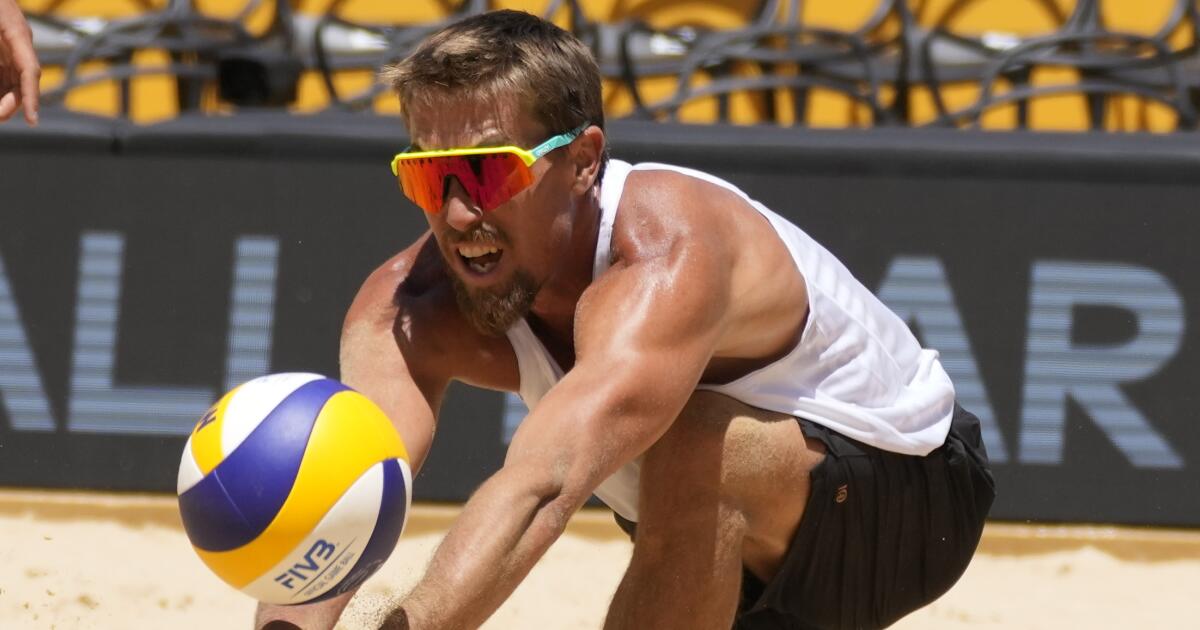
Taylor Crabb is no stranger to South California beaches. The Long Beach State alum returns home this weekend to compete in AVP League matches.
It marks the first time AVP will compete in Long Beach since 2020 and allows players to compete at the 2028 Olympics beach volleyball venue.
Crabb, 34, made his AVP debut in 2013 with his brother, Trevor, and advanced from the qualifier in Manhattan Beach before finishing 25th in his first tournament.
After years of competing with various different partners, Taylor Crabb and Andy Benesh have delivered the top performances this AVP season.
The following interview with Crabb has been edited for clarity and length.
Are you excited to compete in this weekend’s event at Long Beach?
Crabb: Very excited. A lot of my college teammates and part of the school have reached out, saying that they’re gonna come. So I’m excited to get a chance to play in front of them again.
When was the last time you were in Long Beach?
Crabb: I always try to go down there for alumni events or any big games they have. I went to UCLA against Long Beach last year, when it was No. 1 versus No. 2, so I always try to get down there and support them.
You missed out on the chance to compete in the 2020 Olympics because of COVID-19 restrictions and chose not to pursue a spot at the 2024 Olympics. Are you fired up to try to compete in the 2028 Olympics, knowing that Long Beach will host the competition?
Crabb: Yeah, it’s definitely an exciting time having the Olympics in Long Beach, and we kind of get to break it in this weekend. As you said, Tokyo didn’t go the way I wanted, but I’m going full force now. I have a great partner in Andy Benesh, who obviously went to the Paris Olympics, and if it weren’t for the Olympics being in Long Beach, and me getting a partner like Andy, I’m not even sure I’d be going for it, but because of those two things, I want to make the most of it.
You mentioned that if it wasn’t for a partner like Andy, you wouldn’t be going for it. What do you mean by that?
Crabb: I didn’t feel motivated by playing in all the international events, but now, I think, sitting out kind of lit the fire under me, and I’m really motivated now.
You’ve had different partners throughout your time. What other motivation does Andy give you?
Crabb: He’s been, in my mind, the top blocker for the U.S. the last four or five years. Seeing the professionalism he brings every day to practice, on and off the court, while traveling and when showing up to tournaments, it rubs off on you and that’s really motivating to see. And I just want to make him proud.
Why do you love volleyball?
Crabb: A lot of reasons, but it’s just a feeling I have when I’m out there on the court. It feels natural. It feels like home. I was born into a volleyball family. I had a volleyball in my hands my entire life, so I’ve always just enjoyed it.

NEWYou can now listen to Fox News articles!
CM Punk appeared on “Friday Night SmackDown” ready to take on any challenger that was ready to step to him after winning the Undisputed WWE Championship against Sami Zayn.
Punk entered the ring in Oklahoma City and called back to the “Monday Night Raw” after WrestleMania 42 when he told Cody Rhodes he’d be ready to deliver if a championship opportunity fell “out of the sky.”
COMPLETE PRO WRESTLING COVERAGE ON FOX NEWS DIGITAL
Cody Rhodes and CM Punk face off during SmackDown at Paycom Center in Oklahoma City, Okla. (Craig Ambrosio/WWE via Getty Images)
“When championship opportunities fall out of the sky, CM Punk catches them,” he said.
Punk named potential SmackDown superstars he’d think might come for the title, including Gunther, Finn Balor, Royce Keys, Damian Priest and Trick Williams. He even said that Zayn could come back around and get his rematch if he wanted. He didn’t mention Rhodes’ name, but the “American Nightmare” came out uncalled and marched his way down to the ring.
“I don’t think you and I can run away from each other anymore,” Punk told Rhodes.
Cody Rhodes looks on during SmackDown at Paycom Center in Oklahoma City, Okla., on July 10, 2026. (Craig Ambrosio/WWE via Getty Images)
Rhodes agreed and mentioned that Punk would want a match with him, just “say when.” It was a quick retort from Punk, who said, “when.” SmackDown general manager Nick Aldis, who was in the ring for the segment, booked the match for SummerSlam.
Punk will defend the Undisputed WWE Championship at SummerSlam, which takes place Aug. 1 and 2 at U.S. Bank Stadium in Minneapolis.
First, however, Punk and Rhodes will be involved in a tag team match at Saturday Night’s Main Event in New York City next week. Aldis made the match after Gunther demanded that Aldis put him in a match against Punk. Gunther was hoping it would be for the championship. Instead, Gunther will tag with Zayn.
Gunther didn’t take too kindly to that and attacked Aldis. Rhodes came back out to break up the calamity. He wanted to take on Gunther after the show went off air but Gunther walked away.
Gunther makes his entrance during SmackDown at Paycom Center in Oklahoma City, Okla., on July 10, 2026. (Rich Wade/WWE via Getty Images)
CLICK HERE TO DOWNLOAD THE FOX NEWS APP
Punk definitely has his hands full as he moves to SmackDown to become a fighting champion.
-
 Cleveland, OH23 seconds ago
Wanted sex offender arrested at home where Tennessee woman’s body found
-

 Austin, TX6 minutes ago
Man shot and killed by police after pointing gun at people in Austin, Texas
-

 Alabama13 minutes ago
Alabama has Talent returns with local connection
-

 Alaska16 minutes ago
Alaska Sports Scoreboard: July 11, 2026
-

 Arizona21 minutes ago
Cardinals Mailbag: Latest on Jacoby Brissett, Carson Beck, and Arizona’s QB Future
-

 Arkansas28 minutes ago
Arkansas tips its hat to blues pioneer Larry “Totsie” Davis in England dedication
-

 California30 minutes ago
‘Explosive diarrhea’ parasite surfaces in California as health officials fear statewide surge
-

 Colorado36 minutes ago
This Quiet Colorado Town Is An Underrated Gem For Nature Lovers

