Politics
DOJ continues Biden autopen probe despite former president unlikely to face charges


NEWYou can now listen to Fox News articles!
The Department of Justice (DOJ) is continuing its investigation into former President Joe Biden’s use of an autopen in the final months of his administration — focusing on pardons and commutations — though a senior official said Biden is unlikely to face criminal exposure.
A senior DOJ official told Fox News the autopen investigation is ongoing and not closed, adding investigators are reviewing clemency actions taken in the final months of the Biden administration.
The official also pointed out, however, that the use of an autopen by a sitting president is “established law.”
The issue under review is whether the autopen was used in violation of the law, specifically, whether Biden personally approved each name included on pardon and commutation lists.
A framed portrait shows former President Joe Biden’s signature and an autopen along “The Presidential Walk of Fame” outside the Oval Office of the White House. (Andrew Harnick/Getty Images)
“These types of cases are tough. Executive privilege issues come into play,” the official said.
What is also clear, the official indicated, is that the target of any potential prosecution would not likely be Biden.
“It’s hard to imagine how [Biden] could be criminally liable for pardon power,” the senior DOJ official said.
BIDEN’S AUTOPEN PARDONS DISTURBED DOJ BRASS, DOCS SHOW, RAISING QUESTIONS WHETHER THEY ARE LEGALLY BINDING
The use of the autopen by former President Joe Biden remains under investigation. (AP Photo)
The official noted that one reason the former president would be unlikely to face charges stems from a 2024 Supreme Court ruling that originally involved current President Donald Trump but would also apply to Biden.
“We conclude that under our constitutional structure of separated powers, the nature of Presidential power requires that a former President have some immunity from criminal prosecution for official acts during his tenure in office,” the Supreme Court ruled in Trump v. United States in 2024.
“At least with respect to the President’s exercise of his core constitutional powers, this immunity must be absolute.”
Sources familiar with the matter told Fox News Digital that U.S. Attorney Jeanine Pirro’s team continues to review the Biden White House’s reliance on an autopen, contradicting a recent New York Times report that indicated the investigation had been paused.
DOJ SIGNALS IT’S STILL DIGGING INTO BIDEN AUTOPEN USE DESPITE REPORTS PROBE FIZZLED
President Donald Trump has pushed for consequences for former President Joe Biden’s alleged use of the autopen. (Julia Demaree Nikhinson/AP Photo)
Trump has pushed for consequences over the autopen controversy, alleging on social media that aides acted unlawfully in its use and raising the prospect of perjury charges against Biden.
Biden has rejected those claims, saying in a statement last year he personally directed the decisions in question.
“Let me be clear: I made the decisions during my presidency,” Biden said. “I made the decisions about the pardons, executive orders, legislation and proclamations. Any suggestion that I didn’t is ridiculous and false.”
The House Oversight Committee has homed in on Biden’s clemency actions, including five controversial pardons for family members in the final days of his presidency, citing what it described as a lack of “contemporaneous documentation” confirming that Biden directly ordered the pardons.
CLICK HERE TO DOWNLOAD THE FOX NEWS APP
The committee asked the DOJ to investigate “all of former President Biden’s executive actions, particularly clemency actions, to assess whether legal action must be taken to void any action that the former president did not, in fact, take himself.”
Fox News Digital’s Ashley Oliver contributed to this report.
Related Article




Supreme Court justices are asking lawmakers on Capitol Hill to increase their 2027 budget, with most of the additional funding earmarked for security. Ann E. Marimow, a New York Times reporter, explains why the justices say these measures are necessary to protect them from rising threats.

GOP scrambles to replace Sen. Lindsey Graham
Former Kevin McCarthy communications director Mark Bednar discusses the urgent political scramble to replace Sen. Lindsey Graham in South Carolina. He emphasizes President Donald Trump and Gov. McMaster’s need to quickly coordinate an interim appointment and rally around a strong Republican candidate for the impending special election. Potential candidates include Lt. Gov. Pamela Evette and Rep. Russell Fry, with warnings against infighting.
NEWYou can now listen to Fox News articles!
President Donald Trump teased who he may like to see as a long-term replacement for the late Sen. Lindsey Graham, R-S.C., as a special election to lock in a candidate for the seat fast approaches.
Private and public jockeying is already underway to snag Trump’s coveted endorsement in the special election, which is slated for Aug. 11, with two lawmakers already expressing interest in launching a campaign.
And as members of the South Carolina GOP congressional delegation and beyond line up for the race, the president hinted that he may already have a favorite: Rep. Russell Fry, R-S.C.
GRAHAM ALLY RIPS ‘THIRSTY’ REPUBLICANS JOCKEYING TO REPLACE LATE SENATOR
Sen. Lindsey Graham speaks with reporters aboard Air Force One with President Donald Trump and Secretary of Commerce Howard Lutnick on the way back to Washington, D.C., on Jan. 4, 2026. (Jim Watson/AFP via Getty Images)
“I think Russell Fry, a young congressman, is outstanding, and that could happen. I could see that happening,” Trump told Newsmax on Monday night. “I think he’s a very, very talented person.”
Trump backed Fry in his first bid for Congress in 2022, where he toppled former Rep. Tom Rice, R-S.C., in the primary. Rice was one of 10 House Republicans to vote to impeach Trump following the Jan. 6, 2021, riots on Capitol Hill.
‘THE HALLS OF THE SENATE ALREADY FEEL EMPTY’: TEARFUL THUNE HONORS LINDSEY GRAHAM AS SISTER TAKES HIS SEAT
“He took the place of somebody that was — I mean, he’s doing much better than the person that preceded him,” Trump said. “He’s been very popular in the state, so I think a name like Russell Fry is somebody you can watch out for and there are probably some others.”
Trump’s comments on Fry come after Politico reported that the lawmaker has been communicating with the White House about a run and was viewed as a top contender for the president’s stamp of approval. Fox News Digital did not immediately hear back from the White House or Fry on whether he’s being eyed for the special election.
LINDSEY GRAHAM’S SISTER APPOINTED TO SENATE AS GOP RUSHES TO PROTECT FRAGILE MAJORITY
Rep. Russell Fry, R-S.C., arrives for a House Republican Conference caucus meeting at the Capitol Hill Club in Washington on May 13, 2026. (Bill Clark/CQ-Roll Call, Inc. via Getty Images)
In the meantime, Trump threw his support behind Graham’s sister, Sen.-designate Darline Graham, to take over the lawmaker’s seat for the remainder of his term. South Carolina Gov. Henry McMaster appointed her on Monday, and she’ll be sworn in to the role Tuesday afternoon.
Trump said that he believed Graham would be there “only on an interim basis.”
CLICK HERE TO DOWNLOAD THE FOX NEWS APP
Meanwhile, Reps. Nancy Mace, R-S.C., and Ralph Norman, R-S.C., are eyeing the race, too. Norman has gone so far as to ask Trump for his endorsement.
Both Mace and Norman failed to clinch the GOP nomination for governor in South Carolina, which ultimately went to South Carolina Attorney General Alan Wilson, who toppled Trump-backed South Carolina Lt. Gov. Pam Evette.
Politics
Commentary: Two Lorenzos from Mexico. One fulfilled his American dream. ICE killed the other
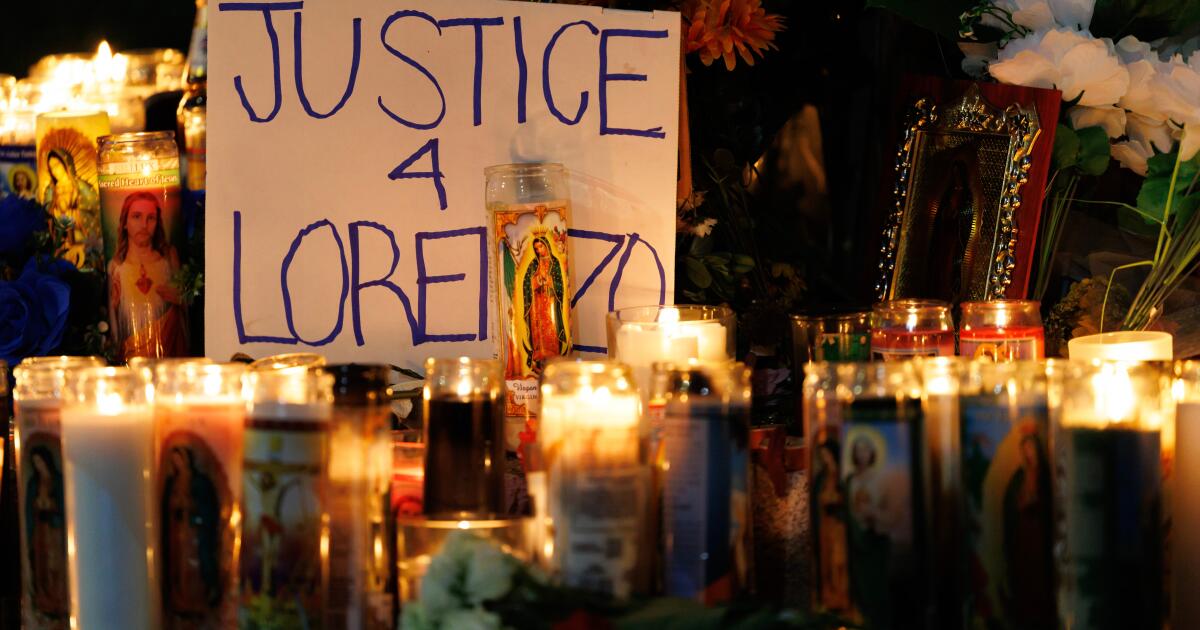
They were Mexican immigrants, both named Lorenzo.
They came to this country without papers as teenagers. Lack of legal status didn’t stop them from building beautiful lives — a wife, a home, a loving dog. A blue-collar job that paid the bills, weekend carne asadas with friends and family, children who followed their father’s example of hard work.
The Lorenzos enjoyed the fruits of their labor in their adopted land, even as they battled to become American citizens while politicians demonized immigrants as invaders and worse.
Lorenzo Arellano arrived in the United States in 1968 and didn’t get his citizenship until nearly 30 years later. Back then, the path to naturalization was far easier.
Lorenzo Salgado Araujo arrived in the early 1990s, when those opportunities were becoming severely limited.
Lorenzo Arellano is my father, a happily retired truck driver living in Anaheim.
Lorenzo Salgado Araujo, 52, who ran his own construction crew, was on his way to a job with his brother and two other men when an Immigration and Customs Enforcement agent shot him dead on July 7 in Houston.
When I see a photo of Salgado Araujo beaming in front of a cake with the number 52 on it at the well-kept home he built with his own hands, I’m reminded that we’ll be celebrating my father’s 75th birthday next month. When I see video of Salgado Araujo’s feet twitching on the ground with two ICE agents next to him as he bleeds out and moans for help, I weep.
Only geography, age and Donald Trump separated the Lorenzos. Even their children — he had three boys, while my father had two boys and two girls — are similar. The Salgado Araujos, like the Arellanos, are college-educated. The eldest son, Ronaldo, is a teacher like my sisters. He wears glasses like me and is now telling the story of his father to the nation, as I have for decades.
I write about my Papi as the puckish personification of immigrant America.
Ronaldo is eulogizing his dad way too soon.
“He wanted nothing else in life but to provide for his wife and see his sons become great people,” Ronaldo said proudly at a news conference the day after his father’s death — words I’ve always said about my Papi. “He did not deserve to be reduced to a headline of ‘Mexican man shot and killed by ICE’” — words I hope to never utter but can sadly see as a possibility given la migra’s unapologetic shoot-first approach and indiscriminate targeting of anyone brown.
Salgado Araujo’s killing came as part of the Trump administration’s newest deportation surge — the New York Times reported that the feds have arrested nearly 2,000 people a day since the end of June. The rate is higher than ICE’s campaign of terror last summer, yet it hasn’t drawn the same attention, fulfilling the promise of newish Homeland Security Secretary Markwayne Mullin that la migra would operate far more quietly and efficiently than under his reckless predecessor, Kristi Noem.
Those quiet times are over.
Ronaldo Salgado, son of Lorenzo Salgado Araujo, dries his tears while talking at a news conference on July 8 in Houston. His father was shot and killed by ICE agents the day before.
(David J. Phillip / Associated Press)
Vigils are popping up across the country in Salgado Araujo’s name. Stories about his life and death have replaced those about Mexico’s World Cup run on my social media timelines. They are heartbreaking, infuriating and a baleful reminder for Mexican Americans that these last five weeks of soccer, as joyful as they were, didn’t change our precarious status in this country under President Trump.
“He deserved to live a quiet life as a husband, a father and a job creator for dozens of men who also wanted the American dream,” Ronaldo said at the news conference through tears as his younger brother, Lorenzo Jr., comforted him. That their father never will — that the Department of Homeland Security is now smearing his name by claiming he “weaponized” his van by trying to run over an agent, even though video evidence proves no such thing — is the latest indictment against the Trump administration’s cruelty toward the undocumented.
Salgado Araujo wasn’t even the target of ICE’s operation. His family said he had applied for a work permit and was on his way toward finally obtaining legal status.
We should heed Ronaldo’s words about his father. As people protest and seek justice, we should also hail the life of Lorenzo Salgado Araujo the way we one day will hail the life of Lorenzo Arellano — as Mexicans who made it, challenges be damned. And we should continue to fight for immigrants who remain in legal limbo, afraid for their lives more than ever.
I called my father to ask how he felt about a tocayo — someone with the same first name — losing his life to la migra.
“I put myself in his place and lament that ese [that] Lorenzo couldn’t get the citizenship that I could,” Papi said in Spanish.
He remembered how immigration agents “did it with respect” when they caught him living in this country illegally in the 1970s and 1980s.
“They asked you for your papers, and if you didn’t have them, they put handcuffs on you, you got deported and that was that. None of these beatings or shootings that are happening now under Trump,” he said. The worst it ever got was when he said he was going to Los Angeles, and an agent snapped that he was going to L.A. but now had to return to Mexico.
Papi asked me what justification ICE has offered for killing Salgado Araujo.
“I hope they put those people who killed him in prison for many years,” he said with disgust. “Will they?”
I replied that probably wasn’t going to happen. ICE has shot and killed 11 people during Trump’s second term, both citizens and noncitizens, and scores more have died in immigration detention. No agents have faced charges for any of these deaths. The agents involved in Salgado Araujo’s killing didn’t even have dashboard cameras or body cameras, a convenient oversight that a Department of Homeland Security spokesperson blamed on “multiple government shutdowns.”
“Pues, Dios sabe que todo se paga en la vida,” my dad responded. Well, God knows you reap what you sow.

Ronaldo Salgado and Lorenzo Jr., sons of Lorenzo Salgado Araujo, hold a photograph of their father during a news conference July 8 in Houston.
(David J. Phillip / Associated Press)
Nothing can bring Lorenzo Salgado Araujo back to his loved ones. But I hope they find solace in his namesake, St. Lawrence. Tradition has it that Roman authorities roasted the Spanish deacon to death after Emperor Valerian demanded that he turn over the treasures of the Church. Instead, Lawrence presented the emperor with the city’s poor and maligned, insisting that he confront the oppression he had forced on them.
May we remember Lorenzo Salgado Araujo as a modern-day martyr, killed because our government refused to give him and so many others a chance at living in this country without fear.
May his name resonate through the ages as embodying the promise and tragedy of the American dream.
-

 South-Carolina6 seconds ago
Earmarks, property tax relief continue to stall SC budget discussions
-

 South Dakota6 minutes ago
Special Interview: South Dakota AG Jackley on 10 bills, deepfakes, suppressors and the Mayday case
-

 Tennessee12 minutes ago
This Tennessee school system credits AI with improving student TCAP scores. Here’s how
-

 Texas18 minutes ago
Texas Quietly Fixed One Problem That Used to Cost the Longhorns Games
-

 Utah24 minutes ago
One of Utah’s public ski areas is for sale
-

 Vermont30 minutes ago
SUV drives into swimming pool at Smugglers’ Notch Resort in Vermont
-

 Virginia36 minutes ago
Three Things We Hope to Learn About Virginia Tech At ACC Media Days
-

 Washington42 minutes ago
Whoopi Goldberg, Kerry Washington and More Celebrate Opening Night of The Whoopi Monologues

