Southwest
On this day in history, June 13, 1966, Supreme Court decision creates Miranda rights for those under arrest

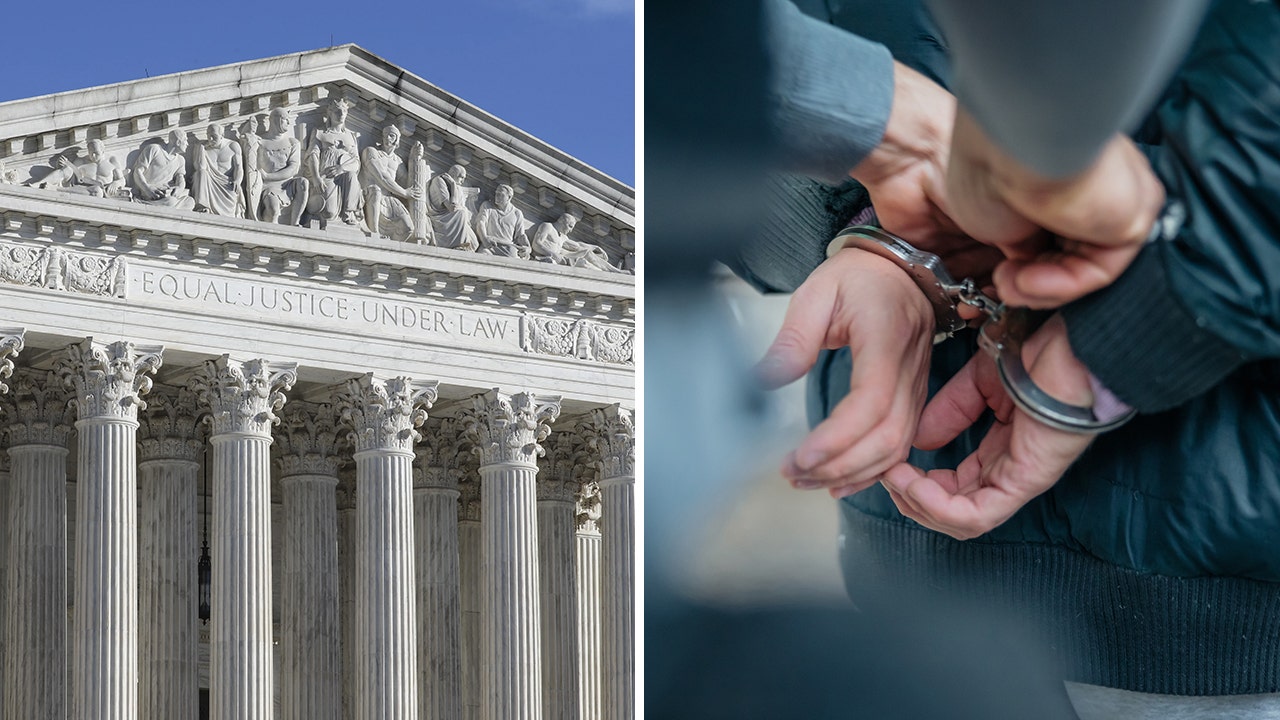
Most Americans are familiar, at least in passing, with the phrase, “You have the right to remain silent.”
And on this day in history, June 13, 1966, this right was announced by the U.S. Supreme Court as a principle of American law in the landmark case Miranda v. Arizona.
In a 5-4 decision in the 1966 case, the nation’s high court ruled that an arrested individual is entitled to rights against self-incrimination and to an attorney under the Fifth and Sixth Amendments of the United States Constitution.
Miranda v. Arizona culminated in the famed “Miranda rights” requirement during arrests, according to the Library of Congress.
ON THIS DAY IN HISTORY, JUNE 12, 1987, REAGAN URGES GORBACHEV TO ‘TEAR DOWN THIS WALL’
In the Miranda v. Arizona Supreme Court case, it was held that the custodial interrogation of an individual must be accompanied by an instruction that the person has the right to remain silent; that any statements the person makes can be used against that person; and that the individual has the right to legal counsel, either retained or appointed, notes the Cornell University School of Law website.
“Absent these safeguards, statements made in this context will be inadmissible in court. These rights have since become known as the Miranda Rights,” that site also noted.
In a Supreme Court decision, the nation’s highest court ruled that an arrested individual is entitled to rights against self-incrimination and to an attorney under the Fifth and Sixth Amendments of the Constitution. (Getty Images/iStock)
The landmark case originated in Phoenix, Arizona. It involved a young man named Ernesto Arturo Miranda, arrested in 1963 based on circumstantial evidence that he had committed a kidnapping and rape, according to the Florida Supreme Court website.
Miranda was brought to police headquarters in Phoenix for questioning, and after a police lineup, law enforcement officers led Miranda to believe he had been positively identified, the site also says.
He was then interrogated by police officers for two hours, which resulted in a signed, written confession, according to the Office of the U.S. Courts on behalf of the Federal Judiciary.
If police fail to give that warning, any confession they obtain from the suspect can then be challenged at trial or on appeal.
At trial, the oral and written confessions were presented to the jury.
Miranda was found guilty of kidnapping and rape and was sentenced to 20-30 years imprisonment on each count, the Office of the U.S. Courts also says.
On appeal, the Supreme Court of Arizona “held that Miranda’s constitutional rights were not violated in obtaining the confession,” says the Office of the U.S. Courts.
ON THIS DAY IN HISTORY, JUNE 5, 1968, PRESIDENTIAL HOPEFUL ROBERT F. KENNEDY IS FATALLY SHOT IN LOS ANGELES
However, “Miranda’s case caught the eye of an attorney with the Phoenix chapter of the American Civil Liberties Union, Robert Corcoran,” History.com says.
“Corcoran reached out to prominent Arizona trial lawyer John J. Flynn, who took over the case and recruited his colleague and expert in constitutional law, John P. Frank, to assist in an appeal to the United States Supreme Court.”
There were two legal issues at hand. First, the Fifth Amendment says that people cannot be forced to be a witness against themselves.
Although suspects may waive their rights to remain silent and to consult an attorney, their waivers are valid (for the purpose of using their statements in court) only if they were performed “voluntarily, knowingly and intelligently.” (iStock)
Second, the Sixth Amendment gives everyone the right to assistance by an attorney whenever they are accused of a crime, as the Florida Supreme Court outlines on its website.
Chief Justice Earl Warren specified new guidelines to ensure “that the individual is accorded his privilege under the Fifth Amendment to the Constitution not to be compelled to incriminate himself.”
The wording used when a person is read the Miranda Warning, also known as being “Mirandized,” is clear and direct, according to MirandaWarning.org.
“As a result of the case against Miranda, each and every person must now be informed of his or her rights when in custody and about to be interrogated.”
The specific wording is this: “You have the right to remain silent. Anything you say can and will be used against you in a court of law. You have the right to an attorney. If you cannot afford an attorney, one will be provided for you. Do you understand the rights I have just read to you? With these rights in mind, do you wish to speak to me?” the Miranda Warning site notes.
ON THIS DAY IN HISTORY, JUNE 4, 1919, CONGRESS PASSES THE 19TH AMENDMENT, GRANTING WOMEN THE RIGHT TO VOTE
Chief Justice Warren also declared that police may not question (or continue questioning) a suspect in custody if at any stage of the process he “indicates in any manner that he does not wish to be interrogated” or “indicates in any manner … that he wishes to consult with an attorney,” according to Britannica.com.
If police fail to give a Miranda warning, any confession they obtain from a suspect can then be challenged at trial or on appeal. (iStock)
Although suspects may waive their rights to remain silent and to consult an attorney, their waivers are valid (for the purpose of using their statements in court) only if they were performed “voluntarily, knowingly and intelligently.”
If police fail to give that warning, any confession they obtain from the suspect can then be challenged at trial or on appeal, according to the Florida Supreme Court’s website.
Important, too, is the understanding that the Miranda warning is only to be used by law enforcement when a person is in police custody (and usually under arrest) and about to be questioned, says the National Constitution Center in Philadelphia.
ON THIS DAY IN HISTORY, MAY 17, 1954, SUPREME COURT TROUNCES SEGREGATION IN LANDMARK BROWN V. BOARD CASE
“Anything you say to an investigator or police officer before you’re taken into custody — and read your Miranda rights — can be used in a court of law, which includes interviews where a person is free to leave the premises and conversations at the scene of an alleged crime,” the center also says.
The Supreme Court is seen at sundown in Washington, D.C., on Nov. 6, 2020. (AP Photo/J. Scott Applewhite, File)
Following the ruling, the Supreme Court overturned Miranda’s conviction, but Miranda was retried and convicted in Oct. 1966.
For more Lifestyle articles, visit www.foxnews/lifestyle
Remaining in prison until 1972, Ernesto Miranda was later stabbed to death in a bar after a poker game in Jan. 1976, says History.com.
“As a result of the case against Miranda, each and every person must now be informed of his or her rights when in custody and about to be interrogated,” the site also says.
More recently, on June 23, 2022, the Supreme Court ruled that law enforcement officers may not be sued for damages under federal civil rights law for failing to issue the Miranda warning to suspects, the same site adds.
Read the full article from Here


The corporation that owns the Langham Huntington Pasadena has settled a civil lawsuit claiming the luxury hotel hiked room rates while more than 200,000 residents evacuated their homes during the pair of deadly and destructive wildfires that devastated the Los Angeles area in January of 2025. The lawsuit, filed by the Los Angeles County District […]

Southern California is bracing for a hot and muggy week ahead, with heat watches in place and a chance of thunderstorms across the mountains and desert regions.
Temperatures are expected to increase each day into midweek, prompting officials to extend a heat advisory until 10 a.m. Tuesday, when it will transition to an extreme heat watch for even warmer conditions through Thursday evening.
Temperatures are expected to peak on Wednesday, with many locations topping 100 degrees and some reaching 110, according to the National Weather Service.
“Monsoonal moisture moving over the area will add to the discomfort, also bringing the potential for showers and thunderstorms each day,” the Weather Service said.
Those thunderstorms are most likely to occur over the mountain and desert areas as subtropical moisture is drawn into the region by a strong ridge of high pressure.
Temperatures along the coast may even reach the 90s by midweek, with very warm temperatures continuing through the night.

“Given the extreme heat and humidity, it’s highly recommended to complete outdoor activities as early as possible,” the Weather Service said.
The high pressure is expected to slowly weaken Thursday, bringing afternoon highs to within a few degrees of normal in most areas by Friday.

Two rare corpse flowers have begun to bloom simultaneously at the Huntington Library in San Marino, the nonprofit organization announced Sunday evening.
Odorysseus, the taller of the two flowers, bloomed first. A second, smaller corpse flower named Odora appears to be following close behind.
The Huntington Library is inviting visitors to take in the flowers’ unique aroma, which is often compared to rotting flesh.
“And so it begins,” the Huntington Library wrote on social media.
Odora is shaped a bit differently than Odorysseus because its spadix is inverted due to a developmental irregularity. This is not expected to affect the blooming of the flower.
“Plot twist!” the Huntington Library wrote on Instagram. “Odora wants to steal the spotlight. Odora’s spathe has started opening, too. Tiny but mighty, we’re in for quite the show with a double bloom.”
-

File: The Corpse Flower, as seen in 2024 at The Huntington in San Marino, California. (Photo by Linnea Stephan)

The Huntington is open from 10 a.m. to 5 p.m. Wednesday through Monday, and is closed on Tuesdays. Reservations are required Friday through Sunday, on holidays, and during peak seasons. “Twilight stroll” hours are available on the Huntington’s website.
The public can also watch a live stream of the bloom on the organization’s YouTube channel.
-

 Wyoming56 seconds ago
July 13 recap: Wyoming news you may have missed today
-

 Crypto7 minutes ago
Why Early Legal Action Matters After a Cryptocurrency Investment Scam
-

 Finance13 minutes ago
Goldman Sachs Sets $1 Trillion M&A Record
-

 Fitness19 minutes ago
HFA Submits Comments to USTR Regarding Trade Policy – Health & Fitness Association
-

 Movie Reviews31 minutes ago
‘Fruit Gathering’ Review: A Factory Worker Falls for Her Female Colleague in a Delicate Burmese Debut
-
World43 minutes ago
Jordan Walker spoils Philly’s Kyle Schwarber party, rallies to win Home Run Derby
-
 Lifestyle2 hours ago
Sam Neill, known for ‘Jurassic Park’ and ‘The Piano,’ dies at 78, his family says
-

 Technology2 hours ago
Microsoft tests Windows Search without all the ads and fluff


