Washington, D.C
Trump pardons two D.C. officers convicted in fatal chase and cover-up


President Donald Trump issued full and unconditional pardons Wednesday to two Washington, D.C., police officers who were convicted for their roles in a deadly chase of a young man on a moped in 2020 and subsequent cover-up, a case that led to protests in the nation’s capital.
Trump granted clemency to Metropolitan Police Department Officer Terence Sutton, who was sentenced in September to more than five years in prison. He faced a District of Columbia charge of second-degree murder, and federal charges of conspiracy to obstruct and obstruction of justice in the October 2020 unauthorized pursuit that killed Karon Hylton-Brown, 20. Sutton was the first D.C. police officer to be convicted of murder for conduct while on duty.
The same jury that found Sutton guilty also convicted Andrew Zabavsky, a lieutenant who supervised Sutton, of conspiracy to obstruct and obstruction of justice. Zabavsky was sentenced to four years in prison. He was not accused of the more serious charge of second-degree murder. Trump granted Zabavsky clemency.
Both men had been free pending the outcome of their appeals.
Trump had hinted of his plans to pardon them after his inauguration.
“They were arrested, put in jail for five years because they went after an illegal,” Trump said Tuesday. “And I guess something happened where something went wrong, and they arrested the two officers and put them in jail for going after a criminal.”
Hylton-Brown was an American citizen, said David Shurtz, an attorney representing his estate.
The D.C. Police Union praised Trump’s decision, saying in a statement that Sutton had been “wrongly charged by corrupt prosecutors for doing his job.”
“This action rights an incredible wrong that not only harmed Officer Sutton, but also crippled the ability for the department to function,” the union said.
The union expressed “dismay” a day earlier after Trump pardoned more than 1,500 people charged in connection with the Jan. 6, 2021, attack on the U.S. Capitol, including those who assaulted law enforcement officers.
The Metropolitan Police Department thanked Trump “for supporting its officers” after the Sutton-Zabavsky pardons, adding in a statement that the prosecutions “were literally unprecedented.”
“Never before, in any other jurisdiction in the country, has a police officer been charged with second-degree murder for pursuing a suspect,” the department said.
On the night of Oct. 23, 2020, months after the police killing of George Floyd in Minneapolis had ignited widespread protests against police brutality and racial injustice, Sutton used a police car to chase Hylton-Brown, who was driving a moped without a helmet on a sidewalk in northwest Washington, prosecutors said.
Hylton-Brown ignored Sutton’s attempt to stop him and drove off. Sutton chased Hylton-Brown for more than 10 blocks “at unreasonable speeds,” prosecutors said, and, at one point, drove the wrong way on a one-way street. Sutton followed Hylton-Brown into a narrow alley, turned off his car’s emergency lights and siren and accelerated. When Hylton-Brown exited the alley, he was struck by another vehicle, according to prosecutors.
“As Mr. Hylton-Brown lay unconscious in the street in a pool of his own blood, Sutton and Zabavsky, agreed to cover up what Sutton had done to prevent any further investigation of the incident,” prosecutors said in a statement in September.
The officers allowed the driver whose car struck Hylton-Brown to leave the scene within 20 minutes of the crash, then turned off their body-worn cameras, conferred privately and left, prosecutors said.
Sutton drove his police car directly over the crash site, audibly crushing pieces of debris from the collision as he left, prosecutors said, and neither officer contacted the department’s Major Crash Unit or its Internal Affairs Division to each initiate investigations.
They also misled their commanding officer about the severity of the crash, denying that a police chase had even occurred and omitting any mention of Hylton-Brown’s critical injuries, prosecutors said. According to prosecutors, Zabavsky also falsely implied that Hylton-Brown had been drunk and Sutton drafted a false police report.
Hylton-Brown suffered severe head trauma and died two days later.
“The jury in this case found the defendants guilty beyond a reasonable doubt for their roles in the murder of Karon Hylton Brown and a related cover up, affirming that what happened here was a serious crime,” then-U.S. Attorney Matthew M. Graves said in September after the officers were sentenced. “Public safety requires public trust. Crimes like this erode that trust and are a disservice to the community and the thousands of officers who work incredibly hard, within the bounds of the Constitution, to keep us safe.”
The case spurred days of protests outside a police station in Washington.
Shurtz, the attorney representing Hylton-Brown’s relatives, said Trump’s decision was “outrageous” and “misguided.”
“I think it’s one of the worst decisions Trump has ever made,” he said. “And I believe he is being ill-advised.”
Shurtz believes police unions influenced the decision for the officers to receive pardons.
Zabavsky’s attorney, Christopher Zampogna, said in a statement that his client “thanks President Trump for issuing his pardon unconditionally.” J. Michael Hannon, Sutton’s attorney, did not immediately return a request for comment.



One family, four generations with DC Metro
As Metro celebrates 50 years of service, one D.C. family is marking the milestone with a legacy of their own — four generations who have all worked on the system, helping keep the region moving for decades.
WASHINGTON – D.C. residents got on their first Metro train 50 years ago on March 27, 1976. Here’s a look back at the beginning.

Connecticut Avenue; NW; looking south. evening traffic-jams are aggravated by metro subway construction in Washington D.C. ca. 1973 (Photo by: HUM Images/Universal Images Group via Getty Images)
View of the Metro Center subway station (at 13th and G Streets NW) during its construction, Washington DC, November 16, 1973. (Photo by Warren K Leffler/PhotoQuest/Getty Images)
Standing in the cavernous tunnel, planners wearing hard hats discuss the construction progress of the Metro Center subway station at the intersection of 13th and G Streets in Washington, DC, November 16, 1973. (Photo by Leffler/Library of Congress/In
WASHINGTON, DC – NOVEMBER 07: FILE, Metro construction miners and blasters on a jumbo drill outside the hole they are working on at Rock Creek Parkway and Cathedral Ave NW in Washington, DC on November 7, 1973. (Photo by James K.W Atherton/The Washin
WASHINGTON, DC – MARCH 4: FILE, View of the Post Office at North Capital and Mass Avenue NE, and 1st NE where subway tunnels were being constructed in Washington, DC on March 4, 1974. (Photo by Joe Heiberger/The Washington Post via Getty Images)
WASHINGTON, DC – AUGUST 29: FILE, Workers rig a pipe at the entrance to the Rosslyn Metro Station in Washington DC on August 29, 1974 (Photo by Larry Morris/The Washington Post via Getty Images)
WASHINGTON, DC – MARCH 27: FILE, The crowd at Rhode Island Station on opening day of the Washington Metro on March 27, 1976. (Photo by James A. Parcell/The Washington Post via Getty Images)
WASHINGTON, DC – MARCH 28: FILE, Reverend Leslie E. Smith of the Episcopal Church, right, and George Docherty of New York Avenue Presbyterian church hold a joint service at the new Metro Center station in Washington, DC on March 28, 1976. (Photo by D
WASHINGTON, DC – JULY 1: FILE, An aerial view of metro construction where it crosses the Washington Channel. The Potomac River, the Pentagon and Northern Virginia can be seen in the distance. (Photo by Ken Feil/The Washington Post via Getty Images)
WASHINGTON, DC – JANUARY 27: FILE, A packed train of commuters on the Silver Spring metro on the Red Line on January 27, 1987. (Photo by Dudley M. Brooks/The Washington Post via Getty Images)
WASHINGTON, DC – JULY 4: FILE, Thousands of people press their way into the Smithsonian Subway station after the Independence Day fireworks in Washington, DC on July 4, 1979. (Photo by Lucian Perkins/The Washington Post via Getty Images)

Among the liquor store, barber shop and dry cleaners at the Watergate Complex’s retail plaza, there is a new pop-up museum dedicated to the scene of the crime that toppled Richard Nixon’s presidency.
Among the liquor store, barber shop and dry cleaners at the Watergate Complex’s retail plaza, there is a new pop-up museum dedicated to the scene of the crime that toppled Richard Nixon’s presidency.
The temporary exhibit features the work of artist Laurie Munn — portraits of members of the Nixon administration and those connected to the Watergate break-in. The exhibit features members of Congress, the media and some who were on Nixon’s enemies list.
Keith Krom, chair of the Board of Directors of the Watergate Museum, told WTOP the exhibit was first featured in the gallery in 2012 for the 40th anniversary of the break-in at the Democratic National Committee.
“When she (Munn) learned about our museum effort, she offered to reassemble them as a way for us to expand awareness of the museum,” Krom said.
Krom, who lives in the Watergate, said his favorite portrait is of one of the special prosecutors, whose firing sparked the “Saturday Night Massacre” in 1973.
“I had the pleasure of being a student of Archibald Cox,” Krom said. “He served as my mentor for my third-year writing project.”
Krom said during this time, at the Boston University School of Law, he spent a great deal of time with him.
“I didn’t realize how much he must have gone through. Here he was, this one man, who was challenging the president of the United States over something pretty serious,” Krom said.
The pop-up opened in October and was recently extended to stay open until April 25. Krom said the hope is to find it a permanent location within the Watergate Complex, where they can “present the history of Watergate, but with two perspectives.”
The first would be on the building’s “architectural significance to D.C.,” he said.
“You may not like the design, you actually may hate it,” Krom said. “But you cannot deny that it changed D.C.’s skyline.”
The secondary focus would, of course, be on the mother of all presidential scandals that changed the course of American history.
“That’s where that suffix ‘-gate’ started and continues to be used for almost every scandal that comes out today,” Krom said.
The inspiration for the museum spawned from an interaction from a tourist outside the Watergate.
“He says, ‘This is the Watergate, right?’ And I was like, ‘Yeah, it’s one of the buildings,’” Krom recalled.
The tourist then asked Krom, “So where’s the museum?”
“I was like, ‘Oh, we don’t have a museum.’ And he literally just looked at me and said, ‘That’s so sad.’ And he got on his bike and rode away,” Krom said.
While the self-proclaimed political history nerd said he “still gets goose bumps” when he drives by the Capitol at night, Krom hopes that when people leave the museum, “they’ll walk away with a new appreciation for how our government works, the guardrails that are in place.”
“Maybe an understanding that those guardrails themselves are kind of frail, and they probably need our collective help in making sure they last — that’s what we hope to accomplish,” Krom said.
Get breaking news and daily headlines delivered to your email inbox by signing up here.
© 2026 WTOP. All Rights Reserved. This website is not intended for users located within the European Economic Area.

According to the National Park Service at the National Mall, famous cherry blossoms around the nation’s capital have hit peak bloom conditions. The National Park Service X account for the National Mall proclaimed this morning, “PEAK BLOOM! PEAK BLOOM! PEAK BLOOM!”
It became apparent yesterday that the bloom would be at peak today. “Despite a sunny afternoon and patches of blue sky, the cherry blossoms remain at Stage 5: Puffy White,” the Park Service wrote on X yesterday. Stage 5, “Puffy White”, is the final stage blossoms go through before being in full bloom. They start at Stage 1 as a “Green Bud”, grow into Stage 2 with “Florets Visible”, and then florets become extended at Stage 3. In Stage 4, there is “Peduncle Elongation” which sets the stage for the puffy blossoms to appear in Stage 5. Puffy White and Peak Bloom are defined as when 70% of the blossoms on the trees reach that stage.

Peak bloom varies annually depending on weather conditions; the most likely time to reach peak bloom is between the last week of March and the first week of April. According to the Park Service, extraordinary warm or cool temperatures have resulted in peak bloom as early as March 15 in 1990 and as late as April 18 in 1958.
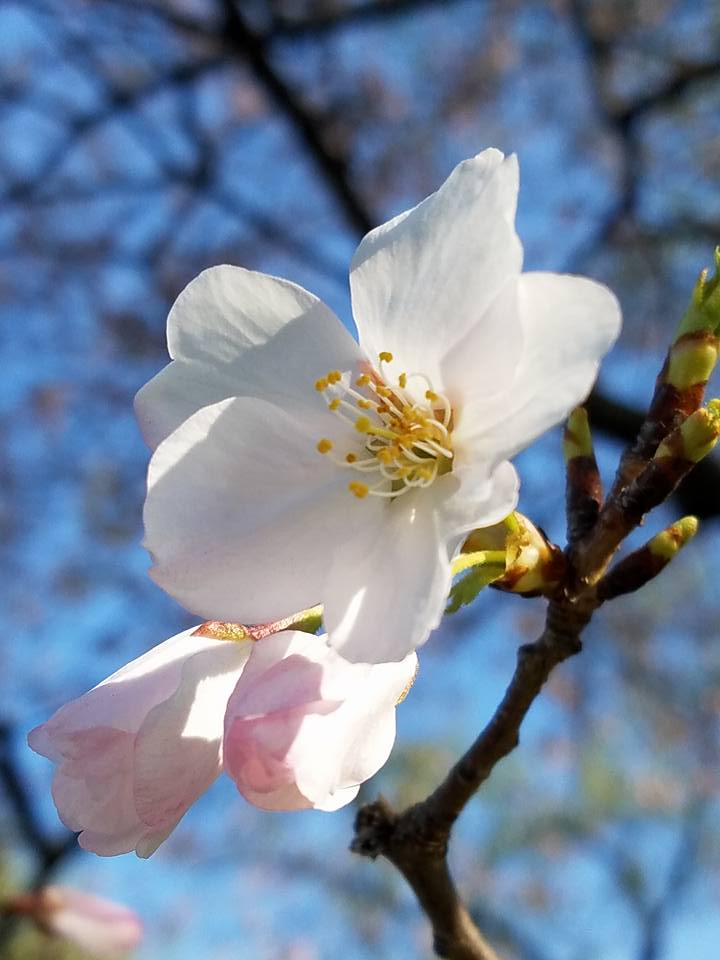
The planting of cherry trees in Washington DC originated in 1912 as a gift of friendship to the People of the United States from the People of Japan. In Japan, the flowering cherry tree, or “Sakura,” is an important flowering plant. The beauty of the cherry blossom is a symbol with rich meaning in Japanese culture.
Dr. David Fairchild, plant explorer and U.S. Department of Agriculture official, imported seventy-five flowering cherry trees and twenty-five single-flowered weeping types from the Yokohama Nursery Company in Japan. After experimenting with growing them on his own property in Maryland, he deemed that the cherry tree would be perfect to plant around the Washington DC area. This triggered an interest by a variety of individuals to plant the tree around Washington. In 1909 the Mayor of Tokyo, Yukio Ozaki, donated 2,000 trees to the United States on behalf of his city. When the trees arrived, they were riddled with disease and insects and to protect other agriculture, they were burned. The Tokyo Mayor made a second donation of trees in 1910, this time amounting to 3,020 trees. This started the forest of cherry trees that now line the Potomac basin around Washington DC. In a gesture of gratitude back to Japan, President Taft sent a gift in 1915 of flowering dogwood trees to the people of Japan. Thousands of trees have been added since, including another gift of 3,800 trees from Japan in 1965.


No. 17 West Virginia Travels to Face No. 22 Arizona State in Top-25 Weekend Series

Outdoor Fun Awaits At Local Parks With Izaak Walton League’s Hiking Series From April To September

Kalshi Approved for Margin Trading After Affiliate Kinetic Markets Gets FCM Registration

Coalition urges lawmakers to advance South Carolina Financial Freedom Act

Exercise scientist reveals the strength training mistake many women make, even after lifting for years

Florida High School Football Rankings: Top 25 teams – Oct. 21

How old is Bo Nix? What to know about Oregon quarterback ahead of 2024 NFL Draft

Cleary's 21 help Le Moyne down Central Connecticut State 69-64 in OT

99th annual Pony Swim held in Virginia

Indiana Members Credit Union announced as new anchor tenant at Bottleworks District

WATCH: Senate hearing goes silent after Angel Father confronts top Dem over daughter’s death

US diplomat Marco Rubio denounces settler violence, tolls in Hormuz strait

Iran-linked hackers have breached FBI Director Kash Patel’s personal emails | CNN Politics

Live: CPAC 2026 Day 2

Video: Will ICE Change Under Its New Leader?
-

 Detroit, MI1 week ago
Drummer Brian Pastoria, longtime Detroit music advocate, dies at 68
-

 Movie Reviews1 week ago
‘Youth’ Twitter review: Ken Karunaas impresses audiences; Suraj Venjaramoodu adds charm; music wins praise | – The Times of India
-

 Sports6 days ago
IOC addresses execution of 19-year-old Iranian wrestler Saleh Mohammadi
-

 New Mexico5 days ago
Clovis shooting leaves one dead, four injured
-
 Business1 week ago
Disney’s new CEO says his focus is on storytelling and creativity
-

 Technology5 days ago
YouTube job scam text: How to spot it fast
-

 Tennessee4 days ago
Tennessee Police Investigating Alleged Assault Involving ‘Reacher’ Star Alan Ritchson
-

 Texas1 week ago
How to buy Houston vs. Texas A&M 2026 March Madness tickets