Washington, D.C
National World War I monument made in Englewood is unveiled in Washington D.C.


‘A Soldier’s Journey,’ the centerpiece of the nation’s World War I monument, was five years in the making in New Jersey by artist Sabin Howard

Timelapse: National WWI Monument being made in Englewood
Timelaspe: Master Sculptor Sabin Howard and his team assemble one of the panels of the National WWI Monument which is to be unveiled in Washington DC.
Tariq Zehawi, NorthJersey.com
With candles glowing and trumpets blowing, in a ceremony that combined stirring music and somber reflection, America’s World War I memorial was officially dedicated Friday night in Washington, D.C.
“The greats of the Italian Renaissance and their lineage played forward to create excellence in this memorial, and I know they are watching tonight,” said Sabin Howard, who assembled the mammoth bronze frieze over a four-year period in a 5,000-square-foot studio in Englewood.
He was speaking to the crowd of about 1,000 military veterans, politicians and the lay public, gathered at the recently created National World War I Memorial Urban Park — formerly Pershing Park — abutting the Federal Triangle in downtown Washington.
“This memorial is like a wedding ring,” said Joseph Weishaar, the architect of the project. “It is a symbol honor and fidelity and commitment that has remained vibrant for nearly a century between the nation and the men who served in the first world war.”
“A Soldier’s Journey,” the centerpiece of the nation’s World War I monument is a sculpture that tells a story.
So it was fitting that sculptor himself should be on hand, to narrate.
“This is a story of what happens to one family and one soldier when he enters into service for his country.” Howard said in a recorded narration during the presentation. “The soldier is an allegory for the United States. It explains the hero’s journey through World War I.”
In the presentation, called “First Light,” the crowd was taken, panel by panel, left to right, through the 58-foot long, 10-foot high bronze frieze.
As first one section and then another lit up, Howard — his recorded voice — told the story. The father, being handed a helmet by his little daughter, going off to war. The soldier, now one among many, in an agonizing tableau of bayonets and bombs, with fellow doughboys screaming and nurses caring for the wounded. And finally — in the last panel — the returning civilian handing the helmet back to his little daughter.
Then, after the crowd had a good look, sequentially, at the 38 figures, all the lights went up. And there it was, all complete: “A Soldier’s Journey,” dedicated on General John J. “Black Jack” Pershing’s 164th birthday, and the new main attraction in what used to be called Pershing Park on 11th Street.
It is now the National World War I Memorial Urban Park — the $40 million project of the World War I Centennial Commission (the war ended Nov. 11, 1918) and paid for largely through donations.
An appropriate setting
The sculpture itself, the largest freestanding bronze relief in the western hemisphere according to Howard, is just part of the project.
The whole square has been re-landscaped, with fountains, a reflecting pool, and berms on three sides to dampen the traffic noise and create a quiet atmosphere for contemplation. An existing statue of General Pershing by Robert White (grandson of architect Stanford White), on site since 1983, has been worked into the new scheme.
“It’s a very serene place,” said Joseph Weishaar, the architect of the park. “Especially with the fountains going. You have the roar of the water, evocative of the sounds of war.”
Memorials: North Jersey Sept. 11 memorial events remember those lost 23 years ago
It was Weishaar, winner of a design contest by the Centennial Commission for his submission “The Weight of Sacrifice,” who brought Howard on board as his sculptor of choice.
“His accomplishment is one of amazing craft,” Weishaar said. “I don’t think it’s rivalled anywhere. My role is like a jeweler making a ring. I made the ring. But Sabin is the diamond. The sculpture is the diamond. That’s the piece that everybody is going to be wowed about.”
On the reverse side of the tableau is inscribed part of a poem by Archibald MacLeish:
“Whether our lives and our deaths were for peace and a new hope
or for nothing we cannot say; it is you who must say this.
They say: We leave you our deaths. Give them their meaning.
We were young, they say. We died. Remember us.”
Howard’s sculpture, like this verse, is not jingoistic. But neither is it cynical. It invites viewers to ponder the first modern war, the “war to end all wars” that killed 116,516 Americans (40 million worldwide) in a global cataclysm that was viewed by many afterwards as a tragic, senseless waste.
“As an artist, I’m very anti-war,” Howard said. “I didn’t make a sculpture about the glorification of war. I made a sculpture about human beings that are there in a very noble and heroic act of being in service to one’s country. This is their story. It’s to honor them. And I’ve had hundreds of letters from military families saying thank you, finally, for acknowledging us. The cool part is, they’re saying thank you for your service.”
That was, in its way, heroic too.
A long term project
For five years, Howard, his assistant Charlie Mostow, and a handful of others put in long days in the Englewood studio. For hours on end, models posed, Howard sculpted, and his wife, filmmaker Traci Slatton Howard, documented.
One by one, Styrofoam “maquettes” were covered with clay to create the figures, which were then transferred through a silicon mold to wax, which in turn became the ceramic shell. These were sent over to England to be cast in bronze. For the last month, on and off, Howard has been on-site in Washington D.C., supervising as the pieces were put in place with cranes, in the setting that Weishaar created for them.
“The reassembly was incredible,” he said. “Four panels, 38 figures, and everything has to fit. If it doesn’t, what are you going to do — chop away the stone or something?”
“A Soldier’s Journey” is a monument, in more than one sense.
To all the soldiers and civilians who served and died in World War I, certainly. More, to all soldiers, in all wars (veterans of the Iraq and Afghanistan wars served as models).
But additionally, it’s a monument to an idea: Sabin Howard’s fervent belief that modern America needs a public, neo-classical art. An art that unifies rather than divides. An art that can ennoble our squares and promenades, the way Michelangelo’s and Donatello’s sculptures adorned the piazzas of Florence.
“In the Renaissance, they used to make sculptures like the David, and they would put it in the square,” said Howard, who trained in Italy and at the Philadelphia College of Art (now the University of the Arts).
Such art, he said, uplifted. “It was a symbol of rising to the occasion, as a nation, and on a citizen level,” he said. “This is the exact same damn thing. I made a sculpture with 38 figures that shows a tapestry of the United States and its variety, with women, children, Democrats, Republicans, all under one flag as Americans. We are one unified country. That’s what the sculpture is.”
African Americans, Asians and Native Americans are included among the figures (though Howard takes the liberty of showing Black soldiers fighting alongside whites; the U.S. army was then segregated).
“This is something that brings us together,” Howard said. “Most modern art brings us apart.”
Aftermath of war
Ironically, it was World War I itself, and the ensuing cynicism about war and sacrifice, that gave rise to the iconoclastic modern art movements that dominated Western culture for the last 100 years. With “A Soldier’s Journey,” Howard wants to use that same war as a jumping off place, to bring the heroic back to art. “This is an American cultural renaissance,” he said.
His next project is also in that vein: an “American Exceptionalism Arch” project in Dallas, which will probably be completed 10 years from now. It too, will uplift and ennoble. “It’s another epic sculpture, which this many figures and this amount of story,” he said.
One thing he says he learned from working with veterans during the World War I project: the notion of being “in service of.”
“I feel that my work is in service to something greater than myself,” he said. “That’s what I’m so excited about.”



WASHINGTON – Washington, D.C., mayoral candidate Kenyan McDuffie on Thursday conceded the Democratic primary race to Janeese Lewis George.
Although the official certification of the primary race is continuing, McDuffie said in a statement that “it is clear that the voters have chosen a different path.” The former member of the D.C. council said he had contacted Lewis George and congratulated her. He thanked his supporters and urged them to continue working for the city.
“The campaign may be over, but the work of building a safer, more affordable, more prosperous city continues.”
The Associated Press has not declared a winner in the race. Lewis George had a little less than 53% of the vote Thursday morning, which is just a few percentage points above the 50% threshold to avoid ranked choice voting.
The city is scheduled to release preliminary ranked choice voting results on Sunday. AP will call the race before then if it is clear that the ranked choice process will be avoided.
Lewis George has pledged to aggressively stand up to federal intervention into Washington, D.C.’s, affairs, setting up a potential showdown with President Donald Trump over his administration’s moves to challenge the city’s limited autonomy.
If the results stand, Lewis George is likely to win November’s general election in the heavily Democratic city. The winner in the general election will replace Muriel Bowser, who decided not to run again after three terms.
Lewis George would join Robert White Jr., who won the Democratic primary for the district’s delegate to Congress, as the top local officials who likely will contend with the federal government’s intentions for the city. They each campaigned on a promise to take a harder line than their predecessors against the Trump administration’s moves on the district, including its deployment of the National Guard on an ongoing, open-ended mission meant to fight crime.
“As mayor, I will work with anyone who makes D.C. safer,” Lewis George told a crowd of cheering supporters Tuesday night, “but I will also stand up to Trump.”
Washington has limited autonomy and federal leaders retain significant control over local affairs, including approval of the budget and laws passed by the D.C. Council.
Trump further encroached on that autonomy last year when he briefly federalized the city’s police force and deployed an ongoing law enforcement surge that included the National Guard. His efforts to downsize the federal government also roiled the capital region, costing thousands of people their jobs. And he has been reshaping the city by renovating storied landmarks and putting his name or image on buildings.
Lewis George, a self-described democratic socialist and a member of the D.C. Council, has already come under fire from Trump, who last week threatened to place the city under federal control if she won.
“Maybe we’d take back Washington, run it on the federal basis,” he said.
Lewis George, 38, and a third generation Washingtonian, has vowed to overrule an executive order by the city’s police chief permitting local law enforcement to cooperate with Immigration and Customs Enforcement agents. Lewis George argued the order “hurt the trust of our community.”
She also pledged to use any levers available to her through the city’s home rule compact to resist what she called authoritarian infringements on the district’s local governance.
“We have legal tools we can use to fight back,” she told the AP in an interview before the vote. “And we know that when we have gone to court, we’ve won.”
Bowser found herself walking a fine line between staying in Trump’s good graces and responding to the concerns of constituents, many of whom said she didn’t push back hard enough on Trump’s actions. Eleanor Holmes Norton, the 18-term, 89-year-old delegate to Congress, meanwhile, faced mounting concern from critics who said she wasn’t forcefully pushing back on the Trump administration’s moves against the city.
Copyright 2026 The Associated Press. All rights reserved. This material may not be published, broadcast, rewritten or redistributed without permission.
Darren Lyn
18 June 2026•Update: 18 June 2026
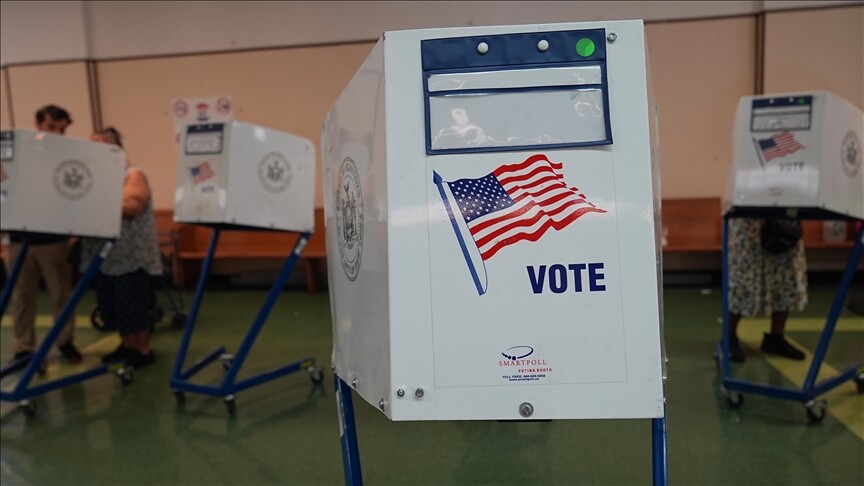
Democratic socialist Janeese Lewis George currently leads the vote tally as of Wednesday versus six other candidates in the Washington, DC Democratic mayoral primary, and if victorious, could be following in the footsteps of the most notable democratic socialist in the United States — New York Mayor Zohran Mamdani.
With 73% of the ballots counted since Tuesday’s primary election in the nation’s capital, the Associated Press (AP) has Lewis George leading with 52.9% of the vote. Her closest challenger is Kenyan McDuffie, who currently holds 36.5%.
The mayor’s office in the District of Columbia has traditionally been a Democratic stronghold, and political experts have said that any Republican challenger is not expected to put up meaningful competition for the mayor’s seat in the general election.
If Lewis George keeps her current lead and wins the majority, she will head to the November election as the favorite to replace three-term Mayor Muriel Bowser, who decided not to run for a fourth term.
A victory for Lewis George would be to the ire of US President Donald Trump, who told reporters that he could attempt a federal takeover of Washington if she won the mayor’s race, according to local media reports.
“We won’t put up with it,” Trump told reporters at a news conference.
Yet Trump has already seen a democratic socialist take power in America’s largest city, with the election of Mamdani as mayor of New York City.
Not to be outdone, the race for the mayor’s office in Los Angeles, California — the second largest city in the US by population — has a democratic socialist, Nithya Raman, in the runoff to vie for the position in November’s general election. Raman will face incumbent Democratic Mayor Karen Bass, who narrowly edged out Raman in the primary 34.3% to 29.0%.
In California’s 14th congressional district, two candidates will head to a runoff election to replace former US Rep. Eric Swalwell, who resigned from Congress in April amid allegations of sexual assault, including rape.
Aisha Wahab secured the first runoff spot on Tuesday with 38.3% of the vote, with the AP on Wednesday calling the second position to go to Melissa Hernandez, who tallied 17.2%.
The runoff election will be held on Aug. 18, with the winner finishing out the rest of Swalwell’s term.

At time of writing, the Associated Press estimates that around 64% of votes have been counted. Races where no candidate wins a majority of first choices will proceed to a ranked choice voting count – most likely the at-large Council and Ward 1 Democratic primaries. With RCV, all nominees will have support from a majority of their party – as will the winner in an at-large Council special election.
Mayor
In the closely watched mayoral race, Councilmember Janeese Lewis George leads with 52.8% of voters’ first choices, followed by former Councilmember Kenyan McDuffie at 36.6%. If Lewis George remains above 50% as the remaining votes are counted, a ranked choice tabulation will not be necessary to determine the winner.
Congressional delegate
Five candidates ran in the Democratic primary to succeed retiring Delegate Eleanor Holmes Norton. Councilmember Robert White won that election with 63.2% of first choices. Councilmember Brooke Pinto came in second with 21.5% of first choices.
At-large Council Democratic primary
Nine candidates ran for the Democratic nomination to succeed at-large Councilmember Anita Bonds. No candidate has won a majority of first choices. Oye Owolewa leads with 33.8%, followed by Lisa Raymond at 15.2% and Kevin Chavous at 13.8%. The result will likely be determined by a ranked choice voting count.
| Candidate | Share of first choices |
| Oye Owolewa | 33.8% |
| Lisa Raymond | 15.2% |
| Kevin B Chavous | 13.8% |
| Greg Jackson | 11.0% |
| Candace Tiana Nelson | 7.7% |
| Dwight Davis | 6.0% |
| Fred Hill | 5.4% |
| Dyana N. M. Forester | 3.7% |
| Leniqua’dominique Jenkins | 3.0% |
| Write-in | 0.4% |
In a choose-one election, Owolewa would have won the nomination despite 66% of voters voting for another candidate. In 2022, for instance, Councilmember Anita Bonds won the Democratic primary for this seat with only 36% of first choices. Now, ranked choice voting will ensure the nominee – whether Owolewa or someone else – has majority support.
At-large Council special election
In the special election for at-large Council, former Councilmember Elissa Silverman is leading with 54.8% of first choices, followed by appointed Councilmember Doni Crawford and Board of Education President Jacque Patterson, with 25% and 19% respectively. If Silverman maintains a majority of first choices, there will be no ranked choice tabulation.
Ward 1
In the competitive Democratic primary for Ward 1 councilmember, Aparna Raj leads with 47% of first choices. Depending on remaining ballots, Raj may win with a majority of first choices, or the winner may be determined by a ranked choice voting count.
Candidate
Share of first choices
Aparna Raj
46.7%
Michael Trindade Deramo
20.3%
Rashida Brown
17.2%
Jackie Reyes Yanes
10.0%
Terry Lynch
5.8%
Write-in
0.1%
Notably, in three Council races – the at-large Council Democratic primary, at-large Council special election, and Ward 1 Democratic primary – candidates cross-endorsed each other, asking voters to rank each other on their ballots. Past elections show that voters often listen to cross-endorsements by candidates they support, so it’s possible candidates who cross-endorsed will benefit when their races go to RCV tallies.
DC’s ranked choice voting elections offer a sharp contrast with the District’s recent past, in which candidates regularly won key primaries without majority support. Since 2012, every districtwide office and six of the eight wards have seen Democratic primaries won with less than 50% of the vote. Since 2020, Ward 2 and Ward 7 have had Democratic Council primaries won with less than 30% of the vote.
FairVote will post more analysis of the DC election over the coming week. In the meantime, visit Grow Democracy DC to learn more about RCV in DC.
-

 North Dakota2 minutes ago
NDSU, Dickinson State partner to expand nursing education
-
Ohio5 minutes ago
Court orders Ohio restrictions on kids’ use of social media restored
-

 Oklahoma9 minutes ago
Oklahoma Adds OF Adi Hansen From Southern Idaho
-

 Oregon17 minutes ago
Oregon man sentenced to 77 months in prison after pleading guilty to attempted kidnapping
-

 Pennsylvania19 minutes ago
Pennsylvania lawmakers push for data center regulations as development accelerates
-

 Rhode Island25 minutes ago
Rhode Island Pride marks 50th year as early marcher recalls Providence’s first parade
-

 South-Carolina32 minutes ago
South Carolina family raises awareness of rare Batten disease
-

 South Dakota35 minutes ago
South Dakota man whose life sentence was commuted by Noem now implicated in his niece’s death


