Science
Pace of N.I.H. Funding Slows Further in Trump’s Second Year


Spending on new medical research by the National Institutes of Health has fallen roughly $1 billion behind the pace of years past, delaying thousands of scientific projects and raising concerns within the agency that it may struggle to pay out the money it was allotted by Congress.
Instead of canceling grants en masse, as the N.I.H. did in the first year of this Trump presidency, it is now vetting them before approval with a “computational text analysis tool” that scans for terms including “racism,” “gender” and “vaccination refusal,” according to documents obtained by The New York Times.
That tool was meant to formalize a campaign against “woke science” that was initiated last year by the Elon Musk-led Department of Government Efficiency.
But the screening system is now exacerbating a slowdown in research spending: The N.I.H. awarded only about 1,900 new and competitive grants from October to late March, less than half the number it tended to give out by that point in the fiscal year during the Biden administration, an analysis by The Times showed.
The heaviest damage to the grantmaking apparatus was done by the protracted government shutdown in the fall, which delayed grant review meetings by months. The N.I.H. has struggled to catch up, and delays are affecting fields far beyond those ostensibly targeted by the administration’s crusade against diversity, equity and inclusion.
As of late March, for example, the National Cancer Institute had earmarked only about $72 million for new and competitive research grants, less than one-third of the nearly $250 million it had agreed to spend by that point in a typical fiscal year during the Biden administration, according to The Times’s analysis.
“It means that people get fired because there is uncertainty about whether the grant will come through,” said Dr. Joshua Gordon, a professor of psychiatry at Columbia University and a former director of the National Institute of Mental Health. “It means budgets get busted. It means research projects get stalled.”
However alarming the canceled grants and spending delays were last year, Dr. Gordon said, “I’m more worried this year.”
The Department of Health and Human Services, which oversees the N.I.H. and is led by Secretary Robert F. Kennedy Jr., has become involved this year in flagging certain grant awards and stopping their release, according to emails reviewed by The Times.
Mr. Kennedy faced sharp criticism from Democratic and Republican lawmakers alike over N.I.H. spending delays in congressional hearings this week. He is set to appear at two more hearings on Wednesday.
The N.I.H. has fallen behind in part because it lost thousands of workers last year to layoffs and early retirements. In some branches of the agency, what workers remain can barely keep up with renewing existing grants, much less awarding new ones.
One N.I.H. institute has less than half of the workers needed to vet grants for legal and financial compliance, employees were told at a recent meeting, notes from which were reviewed by The Times.
Under the most dire projections, the institute could leave $500 million of congressionally appropriated funding on the table because of difficulties processing grants, N.I.H. officials said at that meeting. They were temporarily deploying career scientists to what were effectively business roles to speed up grant awards.
The N.I.H. director, Dr. Jay Bhattacharya, has said that he is trying to root out ideologically motivated and insufficiently rigorous science. Conservatives accuse the N.I.H. of having fostered such research during the Obama and Biden presidencies by, for example, encouraging grant proposals on sexual- and gender-minority groups.
“Scientists will no longer have to mouth D.E.I. shibboleths to garner funding,” Dr. Bhattacharya and his top deputy wrote in an online article in December, the day before the N.I.H. outlined the new screening process to its employees.
Andrew Nixon, a health department spokesman, blamed the spending shortfall on “the Democrat-led shutdown,” which he said “delayed N.I.H.’s ability to issue grants” at the start of the fiscal year. Since then, he said, “timelines have returned to typical funding patterns.”
He added that the agency “uses a variety of review tools to ensure alignment with agency priorities” and that it was working to hire additional employees. “The N.I.H. intends to obligate all appropriated funds, as directed by Congress,” he said.
To understand why spending has slowed so dramatically at the N.I.H., the world’s premier funder of medical research, The Times interviewed 10 agency employees and reviewed internal documents, including spreadsheets of grants flagged by the screening tool and the list of roughly 235 terms it searches for.
The employees spoke on the condition of anonymity because they were not authorized to comment publicly.
The documents painted a picture of an agency whose leaders were seeking to exert greater control over scientific spending by, among other things, deciding whether certain grants were compatible with agency priorities. But in clamping down on the funding process, the N.I.H. created new choke points, leaving some proposals in limbo for days or weeks.
That has frustrated some senior N.I.H. officials, one of whom lamented in an email seen by The Times that it was taking too long to rework grant proposals. The official asked his staff to simply strip the proposals of disfavored terms instead.
The delays have also angered lawmakers. Congress sets the country’s medical research spending levels, even as the administration has leeway to prioritize types of studies. And despite Mr. Trump’s proposing major cuts last year, Congress preserved the N.I.H. budget at roughly $47 billion for 2026.
“It is very frustrating to understand that this administration can circumvent dollars that were designated for our scientists,” said Senator Angela Alsobrooks, Democrat of Maryland.
Congress’s budget buoyed American scientists. By late 2025, many believed that they had weathered the worst of Trump-era funding problems. The N.I.H. spent aggressively toward the end of the last fiscal year, overcoming earlier blockages and delays.
The Supreme Court also let stand a lower court’s ruling that the policy behind the cancellation of more than $780 million in N.I.H. grants was probably unlawful, a victory for groups that had argued the terminations were arbitrary and capricious.
But the Trump administration was preparing a far more systematic crackdown on what it saw as unreliable research.
In August, Dr. Bhattacharya publicly outlined the agency’s new priorities, including opposition to “research based on ideologies that promote differential treatment of people based on race or ethnicity,” a template that could be used to guide grant reviews.
Then, in December, the N.I.H. introduced its employees to the “computational text analysis tool,” allowing the agency to comb through new grant proposals and existing projects for phrases suggesting a grant “may not align with N.I.H. priorities,” a guidance document would later tell employees.
Roger Severino, a vice president of the conservative Heritage Foundation and a health official in the first Trump administration, said that weeding out such grants was necessary to rid the N.I.H. of the “politicization” of the Obama and Biden eras.
If the result was less spending on science, he said, that was only because the agency had been wasting money.
“There was a tremendous amount of bloat that grew up like barnacles on the N.I.H. research ship,” Mr. Severino said. “Those barnacles are being scraped off.”
Within some divisions of the N.I.H., the text search tool is flagging as many as half of grants, officials said, requiring staff scientists to extensively document how they will be reworked or why they already conform to agency priorities.
Flagged grants address cancer, diabetes, autoimmune diseases, H.I.V., heart disease, stroke, Alzheimer’s disease, nutrition and prenatal care, internal documents show.
In part because many of them look at the use of screenings or treatments, they sometimes include mention of “inequities” in access to care or “minority” groups who disproportionately suffer from a disease, causing the system to deem the grants not “clean.”
In one case, a biological science grant was held up for a week because the proposal had used “sex” interchangeably with “gender,” a flagged word.
American scientists already spend some 40 percent of their time on grant-related administrative tasks. Now they are being deluged by ever more paperwork, said Dr. Michael Lauer, who led external grantmaking at the N.I.H. until last year.
And because the N.I.H. is awarding grants to far fewer researchers this year, the chances of success have rarely been lower.
“This is lost time for all of us,” Dr. Lauer said. “Instead of spending their time doing science and hopefully making discoveries that will make us all healthier, they’re rewriting grant applications.”
Sheryl Gay Stolberg contributed reporting.
Methodology
The Times analyzed N.I.H. grants data from N.I.H. RePORTER for the fiscal years 2021 through 2026. The analysis excludes awards for intramural research conducted at the N.I.H. Clinical Center. The analysis focuses on new awards (Type 1 awards) and competitive renewals (Types 2, 4 and 9).
The analysis uses data through March 2026, the most recent month comparable to prior years. Previous records suggest that the data available on RePORTER for that month, however, may still be missing up to 10 percent of awards. The analysis accounts for that possibility.



Scientists hoped for years to make a machine that could emulate the movements of diving birds, such as puffins, and offer an affordable, unobtrusive way to monitor fragile marine ecosystems. A team of researchers at M.I.T. has been able to create such a waterproof winged robot, according to a study published July 9 in the journal Science.
Nearly one month after a fire destroyed a massive cold-storage facility in Boyle Heights, the neighborhood has been overcome by the stomach-churning stench of rotting food.
As facility operator Lineage works to remove more than 85 million tons of weeks-old food from its 500,000-square-feet warehouse, the rancid odors have attracted throngs of rats and swarms of flies, as a foul-smelling brownish liquid pours from the seams of the building.
Now, with a heat wave descending over much of Southern California, residents worry the odor could get even worse and scores of residents have called air quality regulators to complain. At the same time, environmental groups are accusing Lineage representatives and emergency responders of downplaying the risks pose by chemicals released during the fire.
Boyle Heights, a neighborhood that has been subjected to decades of toxic pollution from rail yards and other industries, has again become the center of attention in another environmental disaster. Already, the official response to the Lineage fire has eroded trust in government agencies, residents say.
Remediation work continues at a Lineage facility in Boyle Heights, where residents and nearby businesses have complained of a rotting food odor for weeks.
(Allen J. Schaben / Los Angeles Times)
On Tuesday, Sen. Alex Padilla (D-Calif.) visited the gutted warehouse alongside L.A. Fire Chief Jaime Moore and representatives of the South Coast Air Quality Management District and a contingent of environmental organizations. Padilla, along with Sen. Adam Schiff (D-Calif.) and Rep. Jimmy Gomez (D-Los Angeles), wrote a letter to the U.S. Environmental Protection Agency, calling on the agency to return to the cleanup zone to monitor air and water quality.
“Given the materials present in the warehouse, we are concerned about the long-term health and environmental impacts from contaminated smoke and water runoff on communities surrounding the warehouse,” the letter read.
Joe Lyou, president of nonprofit Coalition for Clean Air, told Padilla that he has heard of people becoming sick in the weeks after the event.
“I think that pointed to a problem with the messaging while the event first happened,” Lyou said. “It wasn’t consistent [with] if you smell smoke, see ash to get out and protect yourself — make sure you’re not exposed to it. There were different messages coming from different people, and we need to fix that.”
“The whole community was completely overwhelmed … and concerned about the ammonia, concerned about burning plastic, concerned about all sorts of other [emissions] that are really hard, difficult, expensive to measure. But … we’ll just never know some of those things,” Lyou said.

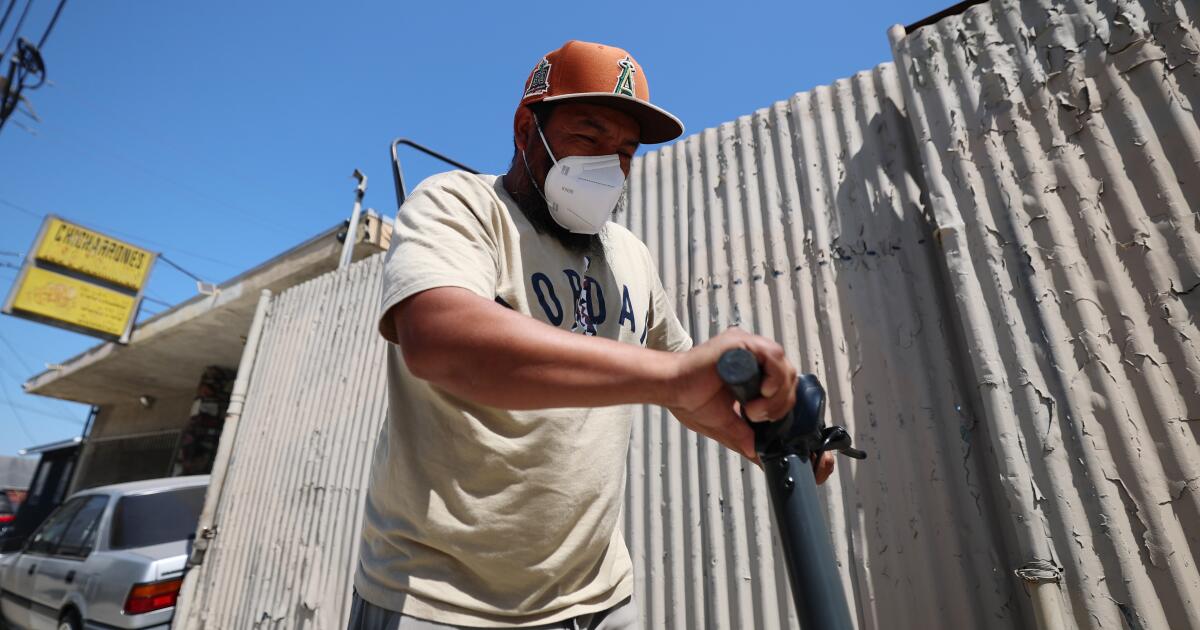
Street vendor Lupe Gonzalez pushes her cart away from a gutted warehouse in Boyle Heights.
(Allen J. Schaben / Los Angeles Times)
Chief Moore has faced criticism for his decision to advise residents to shelter indoors rather than to evacuate during the blaze. That stood in sharp contrast with Orange County fire officials, who evacuated tens of thousands of residents near an overheating chemical tank in Garden Grove in May.
On Tuesday, Moore told Padilla that the two incidents were very different. Moore said he had discussed the dilemma with TJ McGovern, the interim fire chief for the Orange County Fire Authority.
“He says everybody got mad at him because he evacuated everybody and nothing blew up,” Moore told Padilla. “But everybody’s mad at you because of the shelter-in-place [order] and it smells.”
Moore said that “there was nothing in the air that was hazardous” and that firefighters “never had a threat of an explosion.”
However, environmental experts said 14,000 pounds of flammable anhydrous ammonia were stored in tanks and used as refrigerant at the Lineage warehouse and posed a significant risk of explosion until it was removed days into the fire.
Environmental and community groups said L.A. fire officials also repeatedly emphasized the risks from ammonia in their radio communications. On the first day of the fire, a group of firefighters was hit by a plume of ammonia gas, and fire command quickly organized medical help.
“The majority of my division got exposed to ammonia gas. We’ll need to get them assessed.”
On Tuesday, Moore said no amount of ammonia was detected.
“When [firefighters] opened those doors, there was what looked like a big vapor cloud that came out,” Moore said. “That was the cold air mixing with the hot air that caused a vapor. It wasn’t ammonia.”
But residents remain skeptical.
Padilla’s visit follows a notice of violation that the South Coast Air Quality Management District issued to Lineage. The notice of violation was issued on July 12, after the agency received more than 40 public complaints of rotten, sour, garbage-type odors in the area. Inspectors confirmed the odors with community members and traced them back to cleanup operations at the facility, according to the air quality agency.
Boyle Heights residents are calling on Gov. Gavin Newsom to declare a mandatory evacuation of their community, saying the fire and the toxic aftermath are continuing to pose health risks. Without an evacuation order, they said, insurance companies won’t help residents who want to relocate with rent or mortgage relief.
“For nearly a month, a cold-storage warehouse fire has poisoned the air over the Eastside and Los Angeles County and City officials have refused to issue a mandatory evacuation,” read a statement from the community group Protect LA Now. “That refusal forces victims to pay their own way out, and leaves those who can’t afford to leave trapped in gases and toxins that no agency will name.”

Joe Lyou, president of the Coalition for Clean Air, explains how smell is affecting his health while talking to the media near a fire-gutted Lineage facility Tuesday.
(Allen J. Schaben / Los Angeles Times)
Tensions have been building in the community since the fire broke out on June 17 and burned for days.
At a contentious town meeting last week, Los Angeles Mayor Karen Bass struggled to open the meeting over the loud boos and yelling of community members, actions that were repeated as other elected officials took the microphone. The crowd grew even louder when Lineage Chief Operating Officer Jeff Rivera took to the stage and was met with shouts of “Liar!”
Air quality has been a constant concern for the community since the incident began. Beyond the health hazards of breathing in smoke from a building fire, there was a brief, temporary scare when an ammonia line that helped keep the building refrigerated was compromised, though Lineage has said the chemical was not detected in the air. Additionally, 85 million pounds of food thawed, burned and spoiled inside, creating a terrible smell that emanated from the property.
Nora Saenz, a resident of Bell, said she believed local leaders when they said there was no threat. During the fire, she took her niece and nephew to a community event in La Mirada, which was downwind of the fire.
Now Saenz fears what they might’ve breathed in.
“The day of the fire, we were told that the air was safe to breathe,” she recalled. “To this day, I don’t know what I exposed my niece and my nephew to.”
Times staff writers Salvador Hernandez, Clara Harter and Seamus Bozeman contributed to this report.
Video released by Chinese state media shows a state-owned aerospace company launching a rocket and recovering part of it on Friday. The successful launch of a reusable rocket was a major step for China toward challenging SpaceX’s satellite internet dominance.
-
 Lifestyle1 minute ago
They just completed all of L.A. Times’ 101 Best California Experiences — and we’ve got questions!
-
 Politics7 minutes ago
Blanche to face questions about his independence at attorney general confirmation hearing
-
 Sports19 minutes ago
How World Cup senior citizens like Lionel Messi have bio-hacked longer careers
-

 World31 minutes ago
Baltic presidents warn of Russian infrastructure attack plans
-
News1 hour ago
ICE should do traffic stops despite recent shootings, Trump says, seeming to oppose new suspension
-

 Los Angeles, Ca3 hours ago
Southern California hits hottest day of its extreme heat warning
-

 Detroit, MI3 hours ago
Steve Yzerman out as Detroit Red Wings GM, moves to senior advisor role
-
 San Francisco, CA3 hours ago
Supervisors urge California to expand S.F. speed-camera program


