Business
Contributor: ICE raids and migrant pay cuts are devastating California economies


Along the southern stretch of California’s Central Coast, President Trump’s crusade against immigrants has left a visceral mark. It seems these days that almost everyone there has seen or felt the aftermath of an immigration raid: cars with shattered windows left idling and businesses emptied of their usual employees and patrons. The human toll is stark. Raids around Christmas removed at least 100 people from our communities, leaving children without parents and families without primary earners — creating crises that cascade far beyond the moment of enforcement.
The economic consequences of Immigration and Customs Enforcement raids are equally severe. Recent farmer surveys have shown that immigration raids and the fear they generate have caused farmworker shortages, particularly in labor-intensive crops such as strawberries — the region’s most valuable agricultural commodity — where fruit rots on the plant without the immigrant workers who pick it.
Early research quantifying the economic impact of ICE raids in Oxnard estimates direct crop losses of $3 billion to $7 billion with significant spillover into other sectors of the economy. As families lose income to raids — whether through the direct loss of a working family member or in the form of lost business production or sales — they spend less in the local economy. The ripple effect means that the total economic impact of ICE raids is much greater than unpicked crops, with harm most concentrated among the most vulnerable: farmworkers.
Recent changes to a foreign worker program threaten to deepen the wound. The federal program, known as H-2A, allows growers and farm labor contractors to recruit temporary foreign workers to meet seasonal labor demand. It has become the fastest-growing work visa system in U.S. agriculture. It carries with it a well–documented history of wage theft, abuse and trafficking enabled, in part, by H-2A workers’ relative isolation and inability to seek other employment while in the United States.
Until October 2025, the wages paid to H-2A workers were, although low, not so low as to distort the labor market and drag down the wages paid to domestic farmworkers. In October, the Trump administration delivered a huge pay cut to H-2A workers and, in doing so, undercut wages for farmworkers across America regardless of visa status. Trump’s changes include both a direct wage cut as well as new provisions allowing employers to charge housing fees of up to $3 per hour worked.
Estimates of the pay that farmworkers will lose because of these changes range from $4.4 billion to $5.4 billion, or 10% to 12% of farmworkers’ annual wages. Given these figures, the losses suffered by farmworkers in Santa Barbara County alone — where I conduct research — could range from $126 million to $152 million annually, with subsequent decreases in spending and tax revenue reverberating through the region.
With H-2A labor now cheaper relative to domestic farmworkers, visa holders are likely to fill at least one-fifth of all agricultural jobs in Santa Barbara County. This exceeds the program’s 2023 peak in the county, when 18.1% of all agriculture jobs were filled by H-2A, before wage increases caused many growers to drop out of the program in 2024 and 2025. Including housing deductions, employers can now pay H-2A workers $13.90 an hour, significantly below California’s minimum wage of $16.90 an hour. Growers have a strong incentive to substitute resident workers for lower-cost H-2A labor, resulting in local farmworkers losing jobs and income. In addition, because of decreased income and employment, more farmworker families will be forced to rely on benefit programs such as CalFresh, increasing government expenditures.
The tax and budget consequences of expanded H-2A use should be a serious concern for local and state governments. Not only have Trump’s changes significantly reduced farmworkers’ taxable income, but H-2A workers themselves generate less local tax revenue and economic activity than resident workers would.
H-2A employers and employees are exempt from key payroll taxes, including Social Security, Medicare and unemployment insurance. At the same time, the program’s temporary structure — averaging about six months — means workers remit a larger share of their earnings abroad to support families they cannot bring with them, further limiting local spending and the sales tax base.
Elected officials are not powerless in the face of these changes. A range of policy levers could help stabilize a labor market under mounting strain, particularly those that reinforce a meaningful wage floor and limit further downward pressure on earnings. This could include raising the agricultural minimum wage, increasing the California Employment Development Department’s program oversight capacity, and bolstering legal protections for undocumented farmworkers organizing for better working conditions.
The United Farm Workers are currently challenging the Trump administration’s pay rate and housing deduction in court, arguing they constitute one of the largest wealth transfers from workers to employers in the history of American agriculture. Meanwhile, Assemblymember Maggy Krell (D–Sacramento) has introduced legislation to raise the minimum hourly wage for certain agricultural workers to $19.75 — effectively restoring the previous H-2A rate. But that fix, while essential, would not take effect until 2027 and still needs to be passed. In the interim, the state and local governments must act decisively to enforce the existing wage floor, ensuring employers cannot use expanded housing deductions to push workers’ pay below the legal minimum.
These are not radical steps; they are basic protections. The alternative is to accept a race to the bottom — on wages, on working conditions and on the economic stability of the region itself.
Matt Kinsella-Walsh is a graduate researcher with the UC Santa Barbara Community Labor Center and the Organizing Knowledges Project. He researches agricultural economics and labor in the North American strawberry industry.
Insights
L.A. Times Insights delivers AI-generated analysis on Voices content to offer all points of view. Insights does not appear on any news articles.
Viewpoint
Perspectives
The following AI-generated content is powered by Perplexity. The Los Angeles Times editorial staff does not create or edit the content.
Ideas expressed in the piece
-
The article argues that federal immigration enforcement has inflicted severe economic damage across California communities[1, 3, 7]
-
ICE raids created critical farmworker shortages in labor-intensive crops such as strawberries, with early research estimating direct crop losses of $3 billion to $7 billion in the Oxnard region[1, 14]
-
Immigration enforcement has generated widespread economic ripple effects, as families losing income have curtailed consumer spending, thereby harming local businesses and reducing municipal tax revenues[1, 3, 7]
-
Trump administration modifications to the H-2A visa program, including wage reductions and housing deduction provisions, will compound economic harms, with farmworkers losing an estimated $4.4 billion to $5.4 billion annually, or 10-12% of their yearly wages[1, 4]
-
These wage cuts will suppress domestic farmworker wages across all visa statuses[4, 8], decrease local tax revenue, and contract economic activity in agricultural communities
-
State and local governments should strengthen wage protections by raising agricultural minimum wages, increasing regulatory enforcement capacity, and bolstering legal protections for farmworkers to avert further economic deterioration
Different views on the topic
-
Agricultural industry representatives argue that labor costs have risen substantially over decades, placing significant financial strain on farm operations[2, 6]
-
Growers contend that without policy changes facilitating lower labor costs, some farms may face serious economic viability challenges[2, 6]
-
Industry representatives emphasize that farms operate on narrow profit margins[1], suggesting cost reductions are necessary for agricultural sector sustainability
-
Agricultural representatives highlight persistent labor shortages in the sector, pointing to historical difficulties attracting sufficient domestic workers to meet production demands, particularly in labor-intensive crops[2, 6, 8]
-
The industry maintains that access to temporary foreign workers through programs like H-2A remains essential to address longstanding workforce gaps and maintain agricultural production[2, 6, 8]

Business
Meta discontinues Instagram feature on new AI image generation tool after Hollywood backlash

A new tool that let people take publicly posted Instagram photos and use AI to generate new images from them drew such a big backlash in Hollywood that Meta has discontinued one of the features.
Instagram’s parent company, Meta, on Tuesday rolled out the new AI tool, called Muse Image, which makes it easy to “turn your ideas into high-quality visuals you can download and share anywhere.”
In a promotional video, Meta showed examples like adding a friend into a band photo.
But the tool came under fire from talent agencies, managers and union officials. They noted that many Instagram accounts were opted in by default, allowing users to manipulate the image and likeness of celebrities without their consent.
“I just think it’s wrong again to expect people to opt themselves out of something that literally has been proven to be able to create harm,” said Kyle Hjelmeseth, chief executive of Los Angeles-based influencer talent management firm G&B.
By Friday, Meta said a feature on Muse Image that helps pull photos from public Instagram accounts was no longer available.
“Earlier this week, we announced that one way for people to generate images in Meta AI is by @-mentioning public Instagram accounts that they want to reference,” Meta said in a blog post. “Our intent was to provide a useful creative tool and to give people control over whether their public content could be referenced in this way. We’ve heard the feedback that this feature missed the mark, so it’s no longer available.”
Creative Artists Agency, which raised concerns to Meta on behalf of its clients, commended the tech company for its swift decision.
“Putting individual rights and consent at the forefront is essential to building responsible technology,” the Century City-based talent agency said in a statement. “We look forward to ongoing conversations to ensure creators stay protected as technology evolves.”
Hollywood has long been wary of AI, after a string of deepfakes — videos or images depicting celebrities doing or saying things they never authorized. Jamie Lee Curtis and others have appeared in ads for products they never endorsed. Last year, OpenAI’s Sora 2 video tool drew outrage in Hollywood after users conjured up dead celebrities without their estates’ consent. OpenAI later said it would give rights holders more granular controls.
After Meta rolled out its new tool, there was immediate backlash from Hollywood.
“Anything other than a clear and conspicuous OPT-IN for these types of uses of Instagram users’ images is unacceptable, and an utter miscalculation of public sentiment regarding the obvious dangers and harms inherent in such use,” performers union SAG-AFTRA said in a statement.
United Talent Agency was also critical of Meta, saying it demands opt-in for the use of likeness, image and intellectual property of its clients on any platform.
“The use of such property without OPT-IN consent, credit and compensation is exploitation, not innovation,” the Beverly Hills-based talent agency said.
Meta’s initial response on Wednesday was that users can choose to opt out of having their photos used by Muse Image by changing their settings.
“We built Muse Image with strong controls and safety guardrails from day one,” Meta said in a statement. “Private accounts and those belonging to users under 18 are automatically excluded and adult users with public accounts can opt out with just a couple clicks. We will take action against any content that violates our Community Standards.”
Two days later, Meta removed a key feature from Muse Image, saying it received feedback that it “missed the mark.”
The launch fits a familiar Silicon Valley pattern — ship products first, ask for forgiveness later.
“They leverage their scale to make it easy to use the tools as well as to scale out the content that is available,” said Mickey Maher, chief business officer at Vermillio, which tracks people’s digital likenesses and intellectual property. “It’s not unique to this Meta product.”
Others said opt-out should be the default.
“This dark pattern of AI overreach, where essentially it’s a free-for-all when it comes to your content, information, is something that nobody actually wants,” said Lori Fena, former chair and executive director of the Electronic Frontier Foundation and co-founder of New York-based Personal Digital Spaces. “What we need in this new AI ecosystem is the ability to create trust and to have some sort of understanding and authenticity, and this does exactly the opposite.”

Television City, one of the most famous studios in the entertainment industry where generations of TV shows have been created, is expected to hit the market again as its owner grapples with debt.
It’s the latest sign of distress in Hollywood as the film and TV industry struggles from a sharp falloff in production activity across Southern California.
Television City’s owner, Hackman Capital Partners, is already in the process of selling the historic Radford Studio Center, which gave L.A.’s Studio City neighborhood its name. Hackman defaulted on a $1.1-billion mortgage in January and investment bank Goldman Sachs took over the property, which is now escrow for a sale to Netflix.
The sprawling Television City property is one of the most desirable locations in Los Angeles, sharing fences with the Original Farmers Market and the luxury Grove outdoor shopping center, each of which attracts millions of visitors every year.
If the studio at Beverly Boulevard and Fairfax Avenue where “American Idol,” “All in the Family” and scores of other shows were filmed becomes available as expected, the owners of the Grove and the Farmers Market would be among the likely contenders for the property for potential expansion of their businesses, said sources familiar with the matter who were not authorized to comment.
Grove owner Rick Caruso was among the bidders for Television City, formerly known as CBS Television City, last time it was on the market and could emerge as a possible bidder.
The highest bid when broadcaster CBS sold the studio in 2019 came from Hackman Capital Partners, an international movie studio operator and commercial property landlord that paid $750 million for the 25-acre site that is near Hollywood, Beverly Hills and and the Sunset Strip.
Hackman Capital’s plan to recoup its investment included continuing to operate Television City as a studio for rent while adding new revenue-generating features.
Last year the city approved Hackman Capital’s $1-billion plan to add 980,000 square feet of offices, sound stages, production facilities and retail space.
The original studio designed by famed Los Angeles architect William Pereira erected in 1952 has city landmark protections, but newer structures on the property do not and there are acres of surface parking that could be converted to other uses.
Both Caruso and Farmers Market owners A.F. Gilmore have sued to limit the planned expansion of the studio, calling it a “massively scaled” development that “would overwhelm, disrupt, and forever transform the community.”
The debate over the development has played out amid a serious downturn in the region’s entertainment industry, with studios shifting film and television production to Georgia, New Mexico and other out-of-state locations.
L.A.’s entertainment industry also suffered a series of blows including the COVID-19 shutdown, strikes by writers and directors in 2023 and cutbacks at studios that reduced demand for sound stages.
A group of Hackman Capital’s lenders led by Deutsche Bank filed a notice of default last month, saying they’re owed more than $357 million. Hackman Capital is still trying to renegotiate its debt.
“The studio market is evolving, and the financing environment for studio assets remains complex,” Chief Executive Michael Hackman said in a statement. “We are engaged in active discussions with our lending partners and are carefully evaluating all of the alternatives.”
A person familiar with the process but not authorized to speak about it publicly said Hackman Capital will be hard-pressed to pay its debt in light of challenges facing the industry. The notice of default is “the baby step to put Television City in play” for new buyers, the source said, “and it is in play.”
Already in play is Manhattan Beach Studios, another Hackman Capital property encumbered by a $240-million loan from Deutsche Bank that the lender is in the process of selling. A buyer could foreclose on the property and potentially change its use to advanced manufacturing such as aerospace or defense, which is in high demand in Southern California.
Brokerage Cushman & Wakefield, which is managing the sale, emphasized in marketing materials that the 22-acre site has “significant available power capacity” and “offers flexible uses” on “some of the most irreplaceable underlying land in the South Bay.”
After showing worryingly weak early interest, World Cup fans showed up at the last minute to boost Los Angeles hotel occupancy and room rates.
Ahead of the last tournament game in Los Angeles is on Friday, hotels popular with soccer fans said they were full and charging higher rates.
In early May, the American Hotel and Lodging Assn. reported a lack of hotel bookings just a month shy of the games.
About 80% of respondents said hotel bookings were below initial expectations, and more than 65% of L.A. respondents said bookings were lower than a typical summer. In the report, half of the L.A. hotel respondents said they assumed that visa barriers and distance from venues were contributing to the low early bookings.
The turnout that many were concerned had also been hurt by high ticket prices ended up being better than those first projections.
The Pierside in Santa Monica has been exceptionally busy during the World Cup, with many tourists opting to stay near the beach despite the longer trek to SoFi Stadium where the games are held. The Pierside has no rooms for this weekend.
“We’ll have a day or two gap, but other than that we’ve been full,” said a Pierside manager. “I think beach-side hotels have been busier, because tourists are more interested in going to the beach while here.”
In the so-called Stadium District, the Anthem Hotel saw even greater numbers of tourists than they had initially expected for the tournament, including both domestic and international guests.
Its few remaining rooms were going for more than $500 per night late in the week.
“Many guests are planning longer stays, using match days as the centerpiece of a broader Los Angeles itinerary,” said Ruben Flores, general manager at the hotel. “Being in the heart of the Stadium District puts us in a unique position to welcome fans who want the energy of the tournament to extend beyond the stadium.”
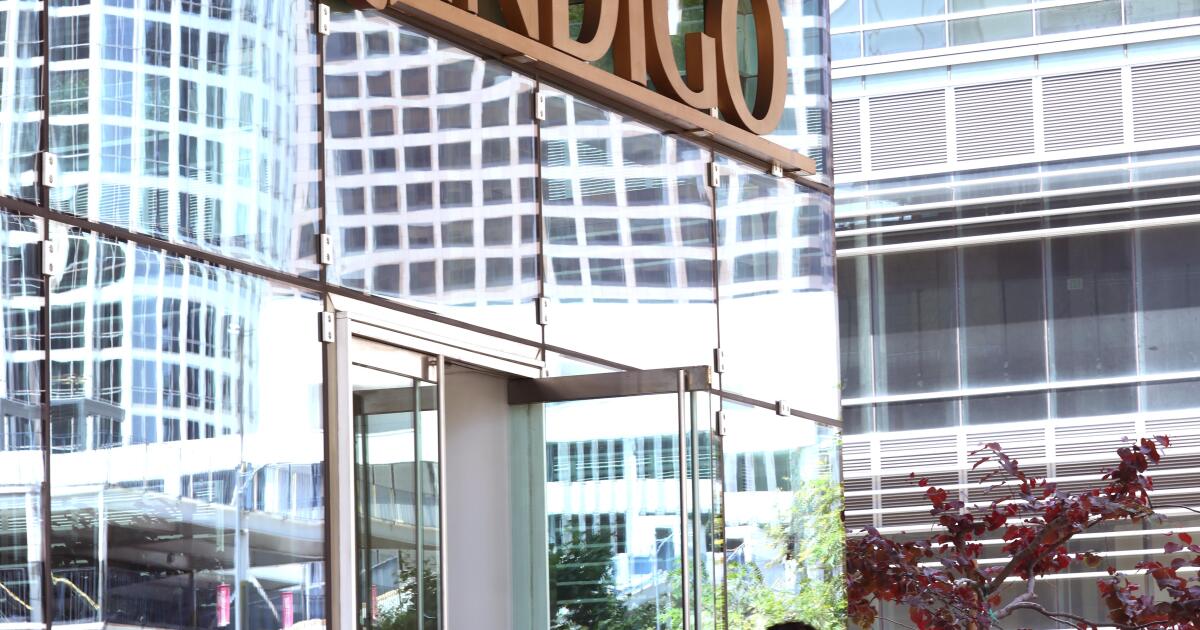
Downtown L.A.‘s Hotel Indigo got a surge in bookings the days leading up to the July 2 knockout game between Spain and Austria. Previously, FIFA had reserved thousands of rooms downtown for staff, media, and other stakeholders, but later canceled the reservation.
The American Hotel and Lodging Assn. attributed the delayed booking boom to young international travelers waiting until right before the game to book hotels in search of last-minute deals.
“Demand has picked up, consistent with a recent trend toward shorter booking windows for events of this caliber,” Rosanna Maietta, the association’s chief executive, said in a statement. “Unlike typical leisure travel, many travelers finalized plans and secured tickets closer to the start of the games.”
Not all hotels have seen the last-minute boom in bookings. Hotel June next to Los Angeles International Airport said its bookings were lower than expected.
“We were expecting more reservations, but I think it’s because the rates have gone up,” said Kira Moreno from Hotel June. “We have still been steady but not been too full or too busy, pretty similar to any other day.”
Airbnb proved to be a popular alternative to traditional hotels, with offers like the World Cup bundle, which included free World Cup tickets with select Airbnb stays at an average price of $365 per night.
In recent years, L.A. has struggled to bring tourists into the city. Last year, the number of international tourists went down by 5.5% from the year before, marking the first time tourism had fallen since the 2020 COVID-19 pandemic.
Immigration raids and wildfires dissuaded tourists from visiting, and even Canadian tourists who typically make up the largest number of foreign visitors to California dropped 21%.
Increased flight costs also discouraged many tourists. With the U.S.-Iran conflict continuing and the Strait of Hormuz closed, jet fuel prices skyrocketed, making international travel unrealistic for many tourists. International air travel to L.A. County had already fallen 30% from August to November 2025.
-
World34 seconds ago
Iranians Bury Slain Leader Amid Renewed Fighting
-
 Lifestyle41 minutes ago
Azar Nafisi on the movie adaptation of ‘Reading Lolita in Tehran’
-

 Technology53 minutes ago
After years of teasing, the viral Nopia synth is ‘basically finished’
-

 World56 minutes ago
Beloved musicians among victims in deadly Bahamas plane crash; aviation authority grounds flights
-

 Politics1 hour ago
Trump-aligned House holdouts accused of holding ‘life-saving’ veterans bill ‘hostage’ over SAVE America Act
-

 Health1 hour ago
Simple sitting change linked to lower risk of cancer death, study finds
-

 Sports1 hour ago
Golf star records lowest round in LPGA major history with astounding performance at Evian Championship
-

 Technology1 hour ago
Meta Verified scam threatens Facebook deletion

