Virginia
Virginia War Memorial uncovers a hidden treasure trove of voices of those who survived D-Day

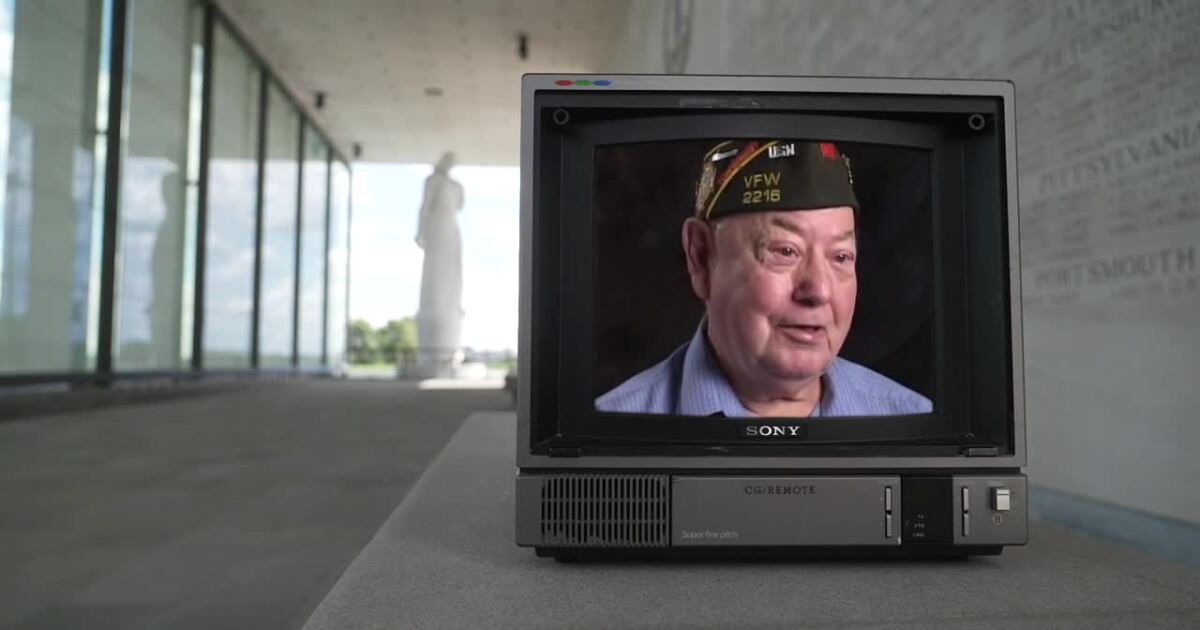
RICHMOND, Va. — The Virginia War Memorial in Richmond is a beautiful and solemn place for silence speaks for itself. But hidden deep inside this landmark fresh, voices are adding new chapters to a defining moment of World War II.
As curators and archivists were preparing the D-Day Plus 80 exhibit, the team made a discovery locked away for a quarter of a century.
“Almost nobody has heard these stories,” Virginia War Memorial Executive Director Clay Mountcastle said. ”This is the actual history to tell you what it was like and what they experienced.”
Mountcastle said interviews with 43 veterans of the Normandy invasion are now playing for the very first time.
“It is incredibly riveting to hear what they went through,” Mountcastle said. “So it was amazing to us. It kind of was this moment where we realized ‘Oh my goodness. Look what we have. We have to share this with everybody.’”
The recordings include U.S. Army nurse 1st Lt. Ruth Puryear.
“Then the commanding officer came in with a radio. We heard Eisenhower’s speech to the troops. The invasion of France had begun,” the Richmond was recorded saying.
U.S. Navy sailor StM1c Jerry Gaiter from Richmond, who was serving on a destroyer off the coast of D-Day, provided another voice from the past.
“Finally about noon they called us in for bombardment and we went in and bombarded the beach,” he said. “It was pretty rough that first day.”
The raw conversations were recorded in the late 1990s and early 2000s as part of the Virginians at War series used in high schools across the Commonwealth.
PFC Arthur “Art” Schintzel with the 1st Infantry from Williamsburg was wounded 11 times on D-Day.
“The ramps went down and the bullets came in,” Schintzel said. “It wasn’t long before I received a bullet wound in my left forearm.”
“They were aiming at your body and legs and all so they could put you out of commission,” PFC Henry Myers from Halifax remembered. “As it went on through the day, I passed out I lost so much blood.”
The unedited portions of the interviews were sitting in storage waiting to be found. Hours of stories from soldiers, sailors, nurses, pilots and paratroopers detailing June 6th, 1944 and the battles beyond have been digitized.
“That is when I saw the carnage on the beach what it looked like. The landing craft. Two tanks on fire. Bodies washing in the surf,” SSgt Bob Slaughter from Roanoke said in one recording.
1st Lt. Evelyn Kowalchuck recalled sleeping in a foxhole on Omaha Beach. The U.S. Army Nurse was haunted by what she witnessed trying to save lives.
“We had at times what we call sucking wounds. Chest wounds. Or head wound. When we came home to say England for the night very little was said,” said Kowalchuck. “We just laid there and cried. Something that most of us did.”
It is estimated only 5% of the Memorial’s D-Day interviews were ever viewed.
Glider Pilot Guy DeGenaro, from Richmond, survived delivering infantry into the heart of German-held territory. Fellow pilots weren’t so lucky.
“For a minute or so you don’t know if you’re going to be alive or dead,” Degenaro said. “That was something that stayed with me for the rest of my life.”
Memorial archivist Sylvia Marshall called these rare recordings audio and video a treasure.
“The fact that oral histories are so rarely linear you’re getting a more personal perspective of that day,” Marshall said. “And they were able to really speak to their experiences and speak to this powerful moment of history.”
T/Sgt. Raymond Mays remembers losing a good friend in the hedgerows.
“Bless his heart. A week or ten days later he lost his life,” the Richmond man said. “That was the end of our friendship at that time. He was a great man. A great man.”
Director of Exhibits and Collections Jesse Smith said preserving the stories was priority one.
“Some of these interviews give accounts like none other,” Smith said. “When we converted them to digital some of them were choppy. They would skip. So you could tell the tape was starting to break down.”
Had the recordings been damaged beyond repair, these tales could not be retold.
“Unfortunately when our veterans pass away they take their stories with them,” Smith said.
“Sadly, none of these veterans are still with us today,” Mountcastle added. “That underscores just how important it is to capture those stories when you can.”
By safeguarding and sharing these memories the legacy of these eyewitnesses endures.
“What a sight. Everybody shooting around you. Shells landing around you. Other small boats blowing up,” U.S. Navy Sailor Gerald Thomspson, from Staunton, said.
“This is invaluable to understanding our history. Not just as Virginians but as Americans. When you hear somebody tell their story it’s like they’re still with us,” Mountcastle said. ”There is no substitute.”
They are new voices from Normandy and stories from D-Day that echo across the decades.
The “D+80” exhibit is open to the public at the Virginia War Memorial. Admission is free.
Watch Greg McQuade’s stories on CBS 6 and WTVR.com. If you know someone Greg should profile, email him at greg.mcquade@wtvr.com.
EAT IT, VIRGINIA restaurant news and interviews



LOUISA, Va. — Michael Shull never imagined that a Democrat from the wealthy suburbs of Washington would represent his community in Congress. His corner of Virginia, with its sprawling farms and winding country roads, has been electing Republicans for more than three decades.
Then came an unusual nationwide redistricting battle, with Democrats and Republicans redrawing congressional lines to boost their chances in November’s midterm elections. Virginia could be next as voters consider a new map that would pair conservative rural areas with liberal suburbs, diluting Republicans’ electoral clout.
“Politicians should be elected to be their people’s voice,” said Shull, a Republican member of Augusta County’s board of supervisors. “Not their party’s voice.”
The vote on the constitutional amendment is on April 21, and early balloting has begun. If voters pass the referendum and it survives a court challenge, Shull’s area within the county would be split between the 7th and 9th Congressional Districts. While the 9th District would be the state’s lone Republican stronghold, the 7th District would resemble a lobster with the long tail beginning in Democrat-dominated Arlington and two claws reaching south into rural communities.
Congressional districts are usually redrawn once a decade, but President Donald Trump started a chain reaction last year by encouraging Texas Republicans to devise a new map to help the party in November. After a cascade of redistricting efforts, Republicans believe they can win a combined nine more U.S. House seats in Texas, Missouri, North Carolina and Ohio, while Democrats think they can win a total of six more seats in California and Utah. Virginia could give Democrats an extra four seats — enough to overturn the GOP’s slim majority, at least as things stand now.
“It’s about making sure that we fight back to what Trump’s done,” said U.S. Rep. Don Beyer, D-Va., He said the party needs to persuade voters that the referendum is “not about embracing gerrymandering.”
“I feel optimistic, but it’s close,” he said.
A print edition of the Goochland Gazette, with a front page story on the Virginia redistricting referendum, lies on a table at GG’s Pizza as members of the Goochland Democratic Committee Jen Strozier, Doug Mock, Chris Svoboda, Richard Grebe and Judi Sheppard hold a lunch meeting on future get-out-the-vote efforts, Thursday, April 2, 2026, in Maiden, Va. Credit: AP/Julia Demaree Nikhinson
A rural-urban divide
The referendum comes at a moment when Virginia Democrats have tried to make up ground in rural areas. Last year, Democrat Abigail Spanberger campaigned for governor in oyster towns and agrarian hamlets to engage with more conservative voters. Before that winning campaign, she had represented a congressional district that mixed city suburbs, exurbs and adjacent rural communities.
“Anyone who’s doing their job will be responsive to the communities that they seek to represent,” Spanberger said.
But her results were mixed. In counties where fewer people lived in rural areas, she outperformed Democrat Kamala Harris’ Virginia showing in the 2024 presidential race by an average of 6 percentage points or 7 percentage points. In more rural counties, Spanberger gained about 2 percentage points to 4 percentage points.
Democrat Anthony Flaccavento, former congressional candidate and co-founder of the nonprofit Rural Urban Bridge Initiative, is torn over the referendum.
Members of the Goochland Democratic Committee Jen Strozier, Doug Mock, Chris Svoboda, Richard Grebe and Judi Sheppard hold a lunch meeting on future get-out-the-vote efforts for the Virginia redistricting referendum, Thursday, April 2, 2026, at GG’s Pizza in Maiden, Va. Credit: AP/Julia Demaree Nikhinson

“At some level, it feels like kicking the can down the road -– which is something that my party has done for a long time –- when it comes to winning back rural and working-class voters,” Flaccavento said.
A welcome change for some
Democrats in rural areas who are tired of being outnumbered by their Republican neighbors are embracing the redistricting plan.
“Fight Back, Vote Yes,” said a sign at a No Kings protest in Louisa County. A second said, “Vote Yes. Stop ICE. No Kings.”
State Del. Dan Helmer, who helped spearhead the redistricting effort, greeted protesters and spoke to the cheering crowd. Helmer is now one of at least four Democrats running in the 7th District.
Helmer said Republicans “think that in red areas like Louisa and in rural areas, that people don’t know what’s going on. But I’m looking around right now, I see strong, proud patriots who know exactly what is going on, who know that we have an aspiring dictator who is trying to take away our democracy.”
Jennifer Lee, who has lived in Louisa for 33 years, said she was eager to support the new district lines. Lee said she felt Republicans were perpetuating a double standard, falsely claiming the 2020 presidential election won by Democrat Joe Biden was stolen from Trump but accepting his push to eliminate Democratic seats through gerrymandering.
“That’s their slogan, right? ‘Stop the steal,’” Lee said. “But they started ‘the steal.’ They’re stealing the seats now in all these districts.”
Democrats see a fight for survival
At a town hall hosted by Democrats at a rural Goochland County recreation center, voters nibbled on finger foods and passed around bottled water as they debated whether redistricting violated some kind of moral code.
“I’m sorry, morality just goes out the door right now. We have to do what it takes for us to survive,” said Bruce Silverman, a local nephrologist. He was voting “yes.”
At one point, Roberta Thacker-Oliver stood up to talk. She votes in the rural 9th District, which would become even more Republican with the new map.
“In the redistricting, the 9th is going to become bigger and redder,” she said, adding, “I need to know what to tell my community about why they need to take one for the team.”
“What do we tell them?” she said.
_

PDF Box
#17 Notre Dame (19-5, 8-3) – 1 | #4 Virginia (18-3, 10-1) – 4
DOUBLES – 3, 2
1. Dominko/Gregg (ND) vs. #5 Dahlberg/Dietrich (UVA), 2-4, 4-4, 5-4, 6-5, unfinished
2. Rice/Brockett (UVA) def. #47 Llorens Saracho/Nad (ND), 7-5
3. Santamarta/Kim (UVA) def. Lee/Patrick (ND), 6-0
SINGLES – 2, 4, 6
1. #2 Dylan Dietrich (UVA) def. #15 Sebastian Dominko (ND), 6-2, 2-6, 6-2
2. #14 Keegan Rice (UVA) def. #72 Perry Gregg (ND), 6-3, 6-3
3. #40 Andres Santamarta Roig (UVA) vs. Giuseppe Cerasuolo (ND), 6-3, 6-5, unfinished
4. Peter Nad (ND) def. #102 Jangjun Kim (UVA), 1-6, 6-1, 6-3
5. Kyran Magimay (ND) vs. Stiles Brockett (UVA), 6-1, 5-7, 1-1, unfinished
6. Douglas Yaffa (UVA) def. Luis Llorens Saracho (ND), 6-3, 0-6, 6-1


Idaho Senate rejects bill granting AG greater power

UConn vs Illinois live updates, news, predictions, how to watch Final Four game

Food Bank’s mobile pantries across the South Bend area set for April

When is the NFL draft? See prospect grades for Iowa, Iowa State players.

Where to watch Milwaukee Brewers vs Kansas City Royals: TV channel, start time, streaming for Apr. 4

Florida High School Football Rankings: Top 25 teams – Oct. 21

How old is Bo Nix? What to know about Oregon quarterback ahead of 2024 NFL Draft

Cleary's 21 help Le Moyne down Central Connecticut State 69-64 in OT

99th annual Pony Swim held in Virginia

Indiana Members Credit Union announced as new anchor tenant at Bottleworks District

Trump says ‘America needs God’ in Good Friday message touting ‘resurgence of religion’
Fact check: How can a country actually withdraw from NATO?

65, single, seeking a roommate: More seniors are being priced out of living alone

Video: Search and Rescue Underway After Iran Downs U.S. Fighter Jet

Nebraska Senate candidate restructures campaign after complaint over payments to family: report
-

 Culture1 week ago
What Happens When We Die? This Wallace Stevens Poem Has Thoughts.
-

 South-Carolina6 days ago
South Carolina vs TCU predictions for Elite Eight game in March Madness
-

 Miami, FL1 week ago
Jannik Sinner’s Girlfriend Laila Hasanovic Stuns in Ab-Revealing Post Amid Miami Open
-

 Education1 week ago
Video: Transgender Athletes Barred From Women’s Olympic Events
-

 Minneapolis, MN1 week ago
Boy who shielded classmate during school shooting receives Medal of Honor
-

 Vermont6 days ago
Skier dies after fall at Sugarbush Resort
-

 Politics6 days ago
Trump’s Ballroom Design Has Barely Been Scrutinized
-

 Atlanta, GA6 days ago
Fetishist ‘No Kings’ protester in mask drags ‘Trump’ and ‘JD Vance’ behind her wheelchair