Culture
Forty years later, Penguins feel Mario Lemieux's impact every day


Eddie Johnston, the general manager who drafted Mario Lemieux 40 years ago this month, had only one concern when he announced the historic selection at the old Montreal Forum — and it wasn’t whether Lemieux would pull a Penguins jersey over his head.
Lemieux did not.
Ironically, Lemieux’s first act with the Penguins was to somewhat distance himself from a franchise he would spend the next four decades personifying, influencing and owning on and off the ice.
“That was his agents, not Mario — he didn’t want to do it,” Johnston said. “Mario and I never talked about it. Not that day. Not to this day.
“I’d done my homework. Now, you hear about generational prospects. No, Mario wasn’t generational. He was once in a lifetime, and not just as a player — as a person.
“We (the Penguins) aren’t here without Mario.”
GO DEEPER
NHL 99: Mario Lemieux could ‘do things that nobody else could do’
Perhaps you’ve heard something similar before. For those unfamiliar, consider the circumstances in Pittsburgh preceding Lemieux’s arrival in 1984:
- The Penguins were nine years removed from bankruptcy.
- They averaged fewer than 8,500 fans during the 1982-83 season when they finished with only 45 points and a minus-137 goal differential despite a sixth-best 81 power-play goals.
- They practiced at a suburban high school rink, then one of only a few around Pittsburgh.
- They had never made it past two rounds of a postseason and were most known for two crushing playoff losses to the New York Islanders — a blown 3-0 series lead in 1975 and a 3-1 third-period lead in an overtime loss in a decisive Game 5 in 1982.
- Their owner, Edward DeBartolo, Sr., favored selling the franchise to support the more successful, and popular at the time, Pittsburgh Spirit, an indoor soccer team that also played at Civic Arena.
“When I played for the Oilers, we loved coming to Pittsburgh,” Paul Coffey said. “It was a great sports town. There were Steelers shirts and Pirates hats everywhere. All the same colors, that black and gold. We’d play the Penguins, and the games weren’t very competitive, to be honest, and I’d tell the guys after the game when we were having a few pops, ‘Man, if they ever figure out the hockey thing here, this will be a destination.’
“Well, they figured it out. The answer was Mario. I don’t think any player in our game has meant more to a city or franchise.”
That is a big statement, though it comes from a past teammate of Lemieux, Wayne Gretzky and Steve Yzerman — so Coffey, a Hall of Famer like those three, is a qualified expert. And it’s not as though Coffey is alone in that opinion.
Scotty Bowman, the NHL’s most accomplished coach, won one of his nine Stanley Cup championships behind the bench with Lemieux’s Penguins in 1992. The Penguins had won their first title in 1991, and Lemieux, coming off a back surgery in 1990 that diminished his wow-gosh shiftiness and afforded him only two more seasons playing in at least 70 games, had been dubbed the new “Mr. Hockey” by Sports Illustrated after averaging 2.05 points per game en route to consecutive Stanley Cup/Conn Smythe wins.
“That was what people called Gordie Howe,” Bowman said. “To give that to Mario, and he deserved it, was special.”
Arguably, he and the Penguins were at their peak, even with his bad back. He began the 1992-93 season with 39 goals and 104 points in 40 games before missing two months after being diagnosed with Hodgkin’s disease (now called Hodgkin lymphoma).
He returned after eight weeks of treatment, and virtually no time on the ice, to score 30 goals and 56 points in his final 20 games.
“He wanted Wayne’s (single-season points) record,” said former Penguins great Kevin Stevens, referring to Gretzky’s 215 points. “He was going to wipe it out if you ask anybody on our team.
“If Mario doesn’t get cancer that season, he might have got 100 goals and 230 points. I’m not kidding. And we win the Cup again, and he goes down as the greatest ever — even over Wayne.”
In the decades-old debate of Gretzky or Lemieux, Gretzky wins pretty much everywhere but Montreal and Pittsburgh. It’s Pittsburgh where Lemieux is universally viewed as the greatest, and not because of his three Hart Trophies, six Art Ross Trophies and those two Cup wins.
“He’s Paul Bunyan in Pittsburgh,” Bryan Trottier said. “I mean, the story of Mario has so much that you wouldn’t believe it’s real.
“He was never healthy by the time I got to Pittsburgh (1990). He had the back. He had the cancer. His hips were a mess. He couldn’t tie his own skates. Through all of it, he was still the best player in the league, but it went beyond that with Mario.
“He literally made the Penguins what they’ve become.”
Again, perhaps you’ve heard something similar before. For those unfamiliar, consider the circumstances in Pittsburgh following Lemieux’s Hodgkin’s disease diagnosis in 1993:
- He played in only 22 games in 1993-94 and sat out the 1994-95 season.
- He returned to capture another Hart Trophy, his third, and two more Art Ross Trophies, his fifth and sixth, but retired for three-plus seasons after the 1996-97 season.
- He was not paid the bulk of a then-record contract because of ownership’s financial issues.
- Amid ownership strife and crippling debt, the Penguins declared bankruptcy a second time and were at risk of being relocated or dissolved in the late 1990s, and Lemieux was their largest owed creditor.
“The Canadiens and Rangers were willing to pay him $25 million to play for them one season,” Johnston said. “He could have done it and made most of his money. But there was no chance. Not Mario.
“The Penguins meant too much to him.”
So, after doing the once-thought impossible by bringing the Penguins even with the Steelers and Pirates in popularity in the early 1990s, Lemieux ended the decade by forming an ownership group to purchase them from bankruptcy. A feel-good story — except that previous ownership had taken renovation money for Civic Arena instead of getting in on the sports facilities legislation that Pennsylvania politicians passed for Pittsburgh and Philadelphia’s teams. Lemieux owned the Penguins, but they remained in a bleak financial situation, especially with Jaromir Jagr’s hefty contract and an unfavorable revenue arrangement at their arena.
“Things weren’t great even after he had control of our team,” said Mike Lange, the longtime voice of the Penguins. “I’ll tell you, if Mario doesn’t come back in 2000, I don’t know if we make it long enough for ‘The Kid’ to arrive however many years later.”
Lange means Sidney Crosby — “Sid the Kid,” whom the Penguins drafted first in 2005. A lot was asked of Crosby, but it was nothing compared to what had been asked of Lemieux.
“Not even close,” said Crosby back in 2016. Crosby played with Lemieux briefly before the latter retired for good in 2005 and spent a couple of seasons living in Lemieux’s guest house.
“I mean, when you think of everything we have here — this (practice) facility, the (current) arena, the expectations — it’s all from what he did for the Penguins. It’s a special thing with Mario and this franchise. I don’t know if people outside of Pittsburgh really appreciate what it is. It’s unique. You just don’t see it very often.”
Michael Farber, who wrote about Lemieux often for Sports Illustrated, cited Babe Ruth with the New York Yankees and Bill Russell with the Boston Celtics as the only comparable athletes to Lemieux in terms of influencing a franchise. Unlike Lemieux, both finished with stints elsewhere — Ruth as a player with the Boston Braves, Russell as a coach/general manager with the Seattle SuperSonics.
Lemieux remains a minority owner of the Penguins.
His ownership group sold to Fenway Sports Group a few years ago, but Lemieux kept a fractional share. He’s not involved in any day-to-day decisions. However, as was evident when he returned for Jagr’s jersey retirement this past February, there is one Penguin who stands above all.
The Penguins carefully planned Lemieux’s participation in Jagr’s jersey retirement ceremony. He did not want to take away from Jagr’s big night. Still, when it came time for Lemieux to be introduced to a sellout crowd at PPG Paints Arena that evening, extra time was built in because the Penguins’ game night operations crew anticipated fans would want to give Lemieux a lengthy standing ovation.
They did. They always do.
“Of course they do,” Trottier said. “It’s not just that Mario was a great player for the Pittsburgh fans. It’s that they saw him deal with the health struggles. They see his charity doing work with the local hospitals. They know he saved the team twice.
“And, let’s be honest, the Penguins became the Penguins — high-flying, high-scoring, big stars like Jags and Crosby and (Evgeni) Malkin — because of Mario. The identity of the franchise is still based on what he was and did.”

Mario Lemieux waves to the crowd at Jaromir Jagr’s jersey retirement ceremony in February. (Justin Berl / Getty Images)
Forty years after drafting Lemieux, Johnston shared his one concern from that day in the Montreal Forum. He had planned to announce the pick in his native French tongue, but he was nervous his excitement would “mess it up.”
He did not.
“I’d spent so much time telling Mr. DeBartolo how special Mario was. He finally said, ‘Eddie, he’s just one man — no one person can live up to what you’re telling me,’” Johnston said.
“I told him, ‘Just watch. Mario’s going to be the best thing that ever happened to this team. They’ll be talking about him long after we’re gone.’”
They are, and perhaps nobody captured Lemieux’s importance to the Penguins better than Farber.
“Ruth and Russell are pretty good company,” Farber said. “Even if you want to look at just hockey, you get to Wayne, as you always do when you discuss Mario. But Wayne belonged to the sport.
“Mario belongs to the Penguins. And he has since he finally put on that jersey.”
Lemieux did don the Penguins crest a few days after the 1984 NHL Draft. There is a picture of him in it, standing atop Mount Washington, Pittsburgh’s skyline as the background.
Johnston loves that photo.
“Mario, wearing our jersey, our city — that’s all you see, and it’s perfect,” he said.
(Top photo: Allsport / Getty Images)



Welcome to Great Adaptations, the Book Review’s regular multiple-choice quiz about printed works that have gone on to find new life as movies, television shows, theatrical productions and more. With ancient Greek texts back in the cultural conversation — thanks to the new film based on Homer’s “Odyssey” — this week’s challenge highlights screen adaptations of other Greek plays, poems and histories. Just tap or click your answers to the five questions below. Scroll down after you finish the last question for links to the works and their screen versions.
Homer’s “Odyssey” has been translated into English countless times, with versions ranging from contemporary and accessible to highly poetic. A.O. Scott, critic at large for The New York Times Book Review, breaks down three translations and explains which one might be right for you.

Among the many complaints made about the modern American novelist, the loudest, if not the most intelligent, has been the charge that he is not speaking for his country. A few seasons back an editorial in Life magazine asked grandly, “Who speaks for America today?” and was not able to conclude that our novelists, or at least our most gifted ones, did.
This opening paragraph is from an essay titled “The Fiction Writer and His Country” by a writer whose work was influenced by Catholicism, the rural South and peacocks. Who was it?
-

 Sports4 minutes ago
AEW star Kenny Omega blasts social media user over Charlie Kirk comment
-

 Technology10 minutes ago
New bank scam laws could stop suspicious payments
-
 Business16 minutes ago
Environmental groups press to halt Imperial Valley lithium venture
-
 Entertainment22 minutes ago
Netflix stock plunges to 52-week low following mixed earnings report
-
 Lifestyle27 minutes ago
L.A. Affairs: After losing our spouses, we found love again. But were we cheating on our children?
-
 Politics34 minutes ago
A new piece of Democrats’ midterm strategy: Being ‘practical’
-
 Science40 minutes ago
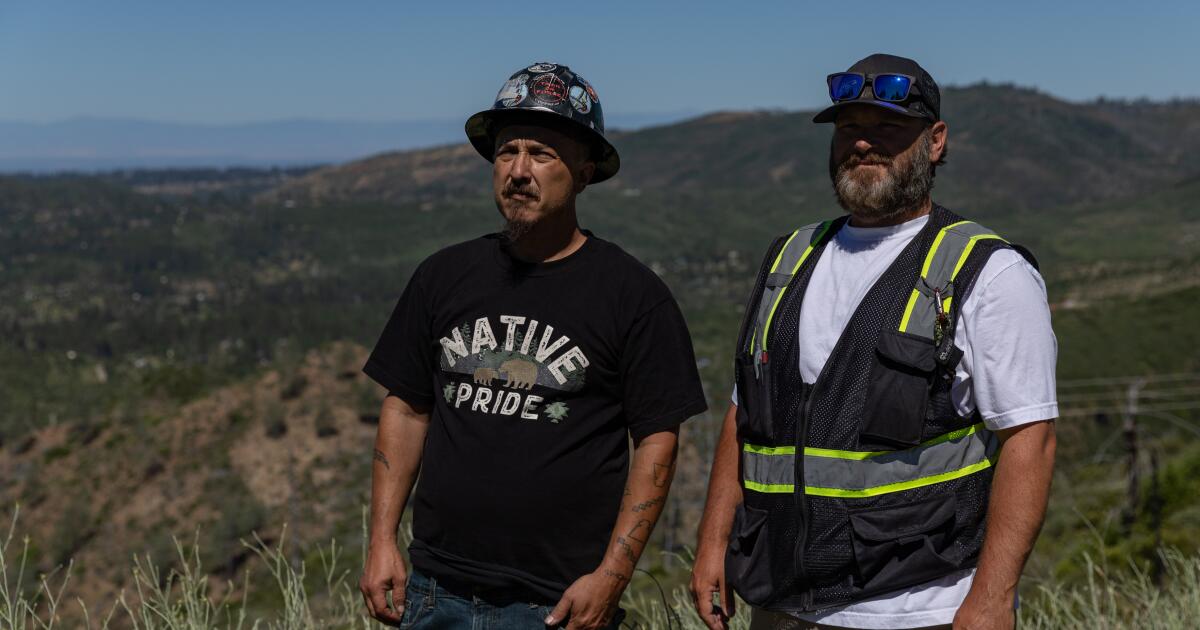
After wildfires destroyed 95% of this California tribe’s forests, members uncovered 1,200 ancestral sites
-
 Sports46 minutes ago
World Cup championship and third-place game: Start times and how to watch

