Tennessee
How Robert Saleh Won the Titans’ Head Coaching Job


Jump to a topic
- Tennessee Titans
- Miami Dolphins
- OC candidates
- Drew Petzing
- Coaching timeline
- Las Vegas Raiders
- Kansas City Chiefs
- Buffalo Bills
- Denver Broncos
- Seattle Seahawks
The coaching carousel continues to spin with the conference championships on the horizon. Let’s dive into our Tuesday notes …
Tennessee Titans
Robert Saleh’s interview with the Titans on Monday night wasn’t a coronation, the way that Miami’s interview with Jeff Hafley earlier in the day appeared to be, or Kevin Stefanski’s interview in Atlanta on Saturday was set up to be.
The 49ers’ defensive coordinator had to go in and win the job.
Unlike Hafley in Miami and Stefanski in Atlanta, Tennessee hadn’t yet had a chance to sit down with Saleh. Because of the Niners’ run and the NFL’s rules, Monday was his first interview with the team. The Titans had looked at a wide swath of candidates in the weeks before and had only Chiefs OC Matt Nagy in the building.
And from there? Win the job Saleh did.
The Titans got a good feel for him through the months of research that followed Brian Callahan’s firing. They went down the conventional path of talking to those closest to him in the coaching industry—Packers coach Matt LaFleur, one of Saleh’s best friends, and his boss for a couple of months at the end of the 2023 season, was particularly helpful. They also showed some creativity, dispatching veteran players like Jeffery Simmons to ask other players about specific candidates (49ers and Jets players spoke highly of Saleh).
Then, there was the interview. Saleh first spent three hours with the Titans’ football leadership, a group made of GM Mike Borgonzi, president of football operations Chad Brinker, and top lieutenants Dave Ziegler, Dan Saganey and Reggie McKenzie. They went through Saleh’s detailed plan for Cam Ward, in which Saleh demonstrated a real command of what Ward would need, including staffing on the offensive side (with experienced candidates) and a second-phase plan should a coordinator leave.
Just as important was his approach to setting up the entire organization and his level of detail in areas such as sports science. He explained how he’d take care of the players while pushing them hard enough to create a callous. And through it all, he showed the sort of presence and leadership that the football people knew owner Amy Adams Strunk was looking for, the type that Mike Vrabel brought to the building from 2018 to ’23.
The ownership group, led by Strunk, sat in for the quarterback-planning piece of the three-hour session, then brought Saleh to the cafeteria for dinner and the second part of the interview. That lasted for another hour and a half, where Strunk got to see Saleh’s energy and presence for herself.
And that left Borgonzi and Brinker to meet privately with Strunk, where Borgonzi made his recommendation that Saleh was the guy, feeling that there was no more reason to wait, as the team’s exhaustive research matched what they’d witnessed the previous five hours.
Saleh was offered the job, he accepted it, and the group then called Simmons and Ward over FaceTime to deliver the news.
Now, the work starts. As Brinker and Saleh’s agent, Doug Hendrickson, went to work on the contract around midnight, Saleh and Borgonzi got started on the staff.
Offensive coordinator, of course, is at the top of the list. Saleh is very close with ex-Dolphins coach Mike McDaniel, but McDaniel has options (we’ll get to those in a minute). I’d expect Rams OC Mike LaFleur (who I’d say is likely to stay in L.A.), ex-Cardinals coach Kliff Kingsbury, ex-Giants coach Brian Daboll (who Borgonzi knows well) and Steelers OC Arthur Smith to be on the list.
The roster, of course, still has a ways to go—which is similar to where the Jets were when Saleh took over in 2021 (and it was a lot better by ’23, when New York looked ready to contend before Aaron Rodgers tore his Achilles).
But in so many ways, Saleh will give the Titans organization what it needs after an ugly three-year stretch marked by constant hirings, firings and job re-assignments.
He has energy, positivity and presence—and experience from his time with the Jets, too.
That alone should give him and the Titans a chance.
Miami Dolphins
It’s worth reiterating what Hafley brings to the Dolphins. He is exactly what Miami was looking for on a few different counts. We went through those in the takeaways, so let’s bring in a little more detail now.
First, the Dolphins have had only 23 picks, an NFL low, in the past four drafts. Outside of Jaylen Waddle, their 2021 and ’22 classes are completely wiped out, when those players should be entering their prime. And outside of Waddle and maybe Chop Robinson, the roster is devoid of young cornerstones. So hiring personnel who are proficient in identifying and developing talent was paramount. Plucking from the Packers, both with GM Jon-Eric Sullivan and Hafley, makes a ton of sense from that standpoint.
Second, being in South Florida presents unique team-building challenges. It takes more effort for a GM and coach to build a football-centric culture in that setting. Hafley’s ability to reach guys should be an asset in meeting that challenge, an ability he demonstrated by maximizing veteran acquisitions like Xavier McKinney and Micah Parsons in Green Bay, and keeping Zay Flowers when he was head coach at NIL-deficient Boston College.
Third, collaboration was key for the Dolphins’ new model. They weren’t looking to hire a Bill Parcells-type figure (which is why, while they really liked and looked into hiring John Harbaugh, the timing wasn’t right). With Hafley, there’s no projection on how he’ll work with Sullivan. Those two were together in Green Bay, so there won’t be any relationship-building needed.
Bottom line: A lot of things lined up here, which is why the Dolphins were so aggressive on Monday, offering the job to Hafley shortly after he arrived at 3 p.m. ET.
OC candidates
McDaniel has become an interesting name on the market.
He’ll do a second interview with the Browns on Wednesday. He met with the Raiders on Monday. And he’s in the last group with the Buccaneers, who, as we mentioned in the takeaways, could eventually present him with the opportunity to succeed Todd Bowles as head coach. That’s why, while he’s high on Saleh’s list, it’d be hard for the Titans to count on landing him. I’d also say it might be tough to get LaFleur out of Los Angeles.
From there, Daboll becomes an interesting name, with his experience developing young quarterbacks (Jaxson Dart, Daniel Jones, Josh Allen) and his ties to both Saleh (the two coached opposite each other for three years in New York) and Borgonzi (the two worked together in Kansas City in 2012). Otherwise, there’s a deep well of Shanahan family coaches that Saleh can draw from, with contract situations, and other coaches’ willingness to let guys go through potential stumbling blocks they’ll have to work through.
Drew Petzing
Ex-Cardinals OC Drew Petzing arrives in Detroit with a strong link to line coach/running-game coordinator Hank Fraley, who worked with Petzing in Minnesota from 2014 to ’16. The Lions worked hard to keep Fraley from going to Seattle to be a coordinator last year, and so Fraley’s input in their next steps on offense was always going to be important. And as such, his word carried a lot of weight.
There was also buzz over the weekend among guys who’d interviewed there that Dan Campbell was going to want some level of familiarity, rather than just starting anew with an OC. Fraley’s ties to Petzing give Petzing that.
Coaching timeline
Last week, the Giants’ decision to hire Harbaugh accelerated the timeline for Kevin Stefanski. The Falcons moved fast, landing him on Saturday before the Titans could interview him, as planned, on Sunday. Similarly, Miami hitting the accelerator on Hafley led to Hafley canceling a Tuesday interview with the Titans and a Wednesday interview with the Raiders. And Saleh getting the Tennessee job on Monday night meant canceling his interview with the Cardinals, which was set for Tuesday.
We’ll see how fast the Browns, Raiders and Cardinals go from here. The Bills, Steelers and Ravens all have a little more flexibility to be patient, given how attractive their jobs are.
Las Vegas Raiders
For what it’s worth, and in case you missed it, Raiders minority owner Tom Brady, GM John Spytek and controlling owner Mark Davis were all in Miami last night to watch Indiana quarterback Fernando Mendoza—the odds-on favorite to become Vegas’ next franchise quarterback—and the Hoosiers win the national title.
What do those guys get out of that? Well, for scouts, there are a few things you glean from watching a quarterback live. The first is the obvious, and that’s the chance to see the ball come off his hand, which is a little different in person. The second is to “body type” him, which is scouting-speak for seeing how big a guy is and how much potential he might have to grow more into his frame. The third is seeing his interaction with teammates, between plays, in warmups, and after the game.
So, yes, there was more value in being there than just getting face time on ESPN.
Kansas City Chiefs
Eric Bieniemy’s potential return to Kansas City is interesting. As I understand it, Andy Reid would like to have Bieniemy on his 2026 staff, adding a layer of accountability, and may need to use the coordinator title to get him out of Chicago. Where that leaves Nagy, who’s on an expiring contract, is another layer to all of it. And Mike Kafka, who Reid loves, could be another piece of the equation.
Reid has spoken glowingly of Kafka to teams considering him as a coordinator candidate.
Buffalo Bills
The Bills are putting together a list and starting to send out requests today for their head coaching position after firing Sean McDermott on Monday.
This wasn’t on many people’s radar internally. And while there was undoubtedly a tension inside the building over the past few months, given the pressure on everyone to deliver in a year when Patrick Mahomes, Joe Burrow and Lamar Jackson didn’t make the playoffs, there wasn’t a lot of discussion between ownership and those running football operations on the dismissal of McDermott.
Also, GM Brandon Beane’s promotion to president of football operations means the plan now is for the head coach to report to him—rather than having both the GM and the coach reporting to owner Terry Pegula (as in the previous setup). Pegula is moving to that reporting structure because it’s one he’s more comfortable with as the owner of the NHL’s Buffalo Sabres.
Denver Broncos
J.K. Dobbins’s return could be a big deal for a Broncos team dealing with the loss of Bo Nix. Dobbins was hurt in Denver’s ninth game. In their first eight games, the Broncos had 130 or more yards rushing five times. In the 10 games since, they’ve only hit that mark once. And there’s a reason for it—while rookie RJ Harvey brings a lot to the table, he’s not the every-down workhorse that Dobbins is capable of being.
Seattle Seahawks
And one more injury note: Zach Charbonnet tearing his ACL is a big deal. Before he was hurt on Saturday, the last time a back other than Charbonnet or Kenneth Walker III carried the ball in a game for Seattle was Dec. 7, and that was converted receiver Velus Jones Jr. (who also came into Saturday’s game in Charbonnet’s spot). So keeping Walker healthy will be a big deal.
Also, it’ll make negotiations with Walker, a pending free agent and budding star, even more interesting after the season, since Charbonnet may have a hard time making it back for next year’s opener, which is less than eight months from now.
More NFL on Sports Illustrated


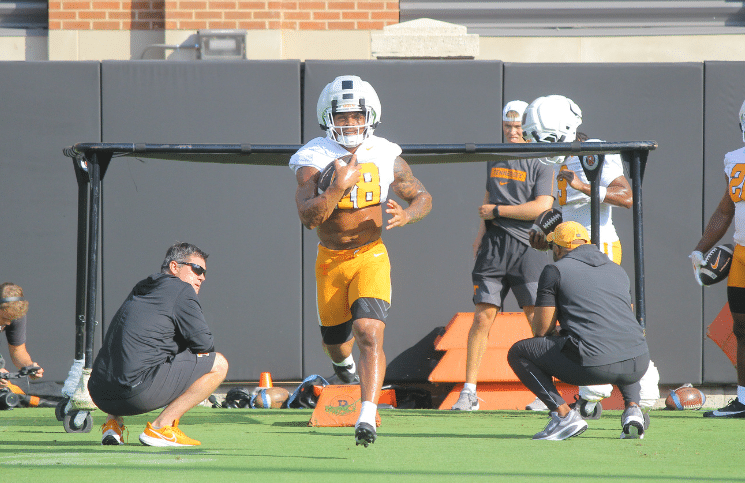
A position group that has stability at the top but questions behind the starter is running back. DeSean Bishop returns as the unquestioned starter after a dominant redshirt-sophomore year, but both the pieces behind him a year ago that split the load have departed.
Now, it’ll be a battle for reps between young returners Daune Morris and Justin Baker and Tulane transfer Javin Gordon. Tennessee has rotated up to three backs a game, as well, making a chance for two to be in a game-by-game position to contribute.
Bishop, the star of the room, has expectations that he could play his way into an NFL draft pick this upcoming year. This past season, he took 182 carries for 1,076 yards and 16 touchdowns. That was good for a really strong average of 5.9 yards per tote.
More From RTI: Tennessee Left Off Eight-Team List of SEC College Football Playoff Contenders
Gordon, the Tulane transfer, joins after his true freshman year with the Green Wave. While it wasn’t at the SEC level, he was very productive, posting 128 carries, 516 yards and five touchdowns.
Morris and Baker return after limited roles. Morris was the fourth back, meaning he got more run than Baker when injuries did occur. He finished his freshman year with 35 carries, 133 yards and a touchdown while also returning punts. Baker took 14 carries for 43 yards.
“It’s huge because you look at the production, you got a guy that understands what he’s walking into in terms of seeing it week in and week out in terms of the caliber of teams that we’re going against,” Tennessee running backs coach DeRail Sims said in the spring about Bishop returning. “His understanding of what it’s like when the game’s on the line and having to go out there and make plays in all three facets of the game, in running the ball, the protection piece, and the passing game. So it’s huge having Bish back.”
The other pieces of the running back room are three-star freshman Will Rajecki and redshirt-senior Hunter Barnes.

MURFREESBORO, Tenn. (WSMV) – Traffic on Interstate 24 will be impacted Sunday as Middle Tennessee Electric crews conduct electrical line work.
MTE said crews will be performing electrical line work across I-24 near Exit 76 in Murfreesboro Sunday, June 28.
“The project will require one full interstate traffic stoppage and multiple rolling roadblocks beginning at sunrise,” MTE said. “The work is expected to take approximately five to six hours to complete.”
MTE said Guardian Traffic Control will assist with traffic management.
The work could be rescheduled in the event of inclement weather.
Copyright 2026 WSMV. All rights reserved.

BRISTOL, Tenn. (WCYB) — Kids in Bristol got the chance to climb in some of their favorite trucks on Saturday.
Bristol Parks and Recreation hosted “Big Truck Day” at Bristol Tennessee City Hall.
The event included some of the kids’ favorite big trucks, a Bristol Motor Speedway pace car, face paint, and free popsicles.
Organizers say it’s great for kids to be able to see who’s behind those big trucks.
Parks and recreation officials say you can keep updated with their events on their Facebook page by clicking here.
-

 World6 minutes ago
Stars, Stripes, VIPs and Protests: Brussels hosts US Independence bash
-

 News31 minutes ago
Can the so-called nanobubbler save the Reflecting Pool? | CNN Politics
-

 Los Angeles, Ca2 hours ago
Climbers rescued from Tahquitz Rock in San Bernardino National Forest
-

 Detroit, MI2 hours ago
Report: Pistons Targeting 7-Time All-Star Wing to Pair With Cade Cunningham
-

 San Francisco, CA2 hours ago
6/28 Gamethread: Giants vs. Braves
-

 Dallas, TX3 hours ago
Dallas community gathers donations for Venezuela
-

 Miami, FL3 hours ago
Miami Heat Could Reunite With Playoff Hero This Offseason
-

 Boston, MA3 hours ago
Red Sox lefty makes latest rehab start, close to forcing tough decision

