South-Carolina
Botched South Carolina Drug Case Turns into Federal Lawsuit – FITSNews


by JENN WOOD
***
A federal civil rights lawsuit filed in South Carolina accused Greenwood County law enforcement officers of wrongfully arresting and prosecuting a Florida man for fentanyl and cocaine offenses after a traffic stop — despite immediate evidence that the pills in his possession were lawfully prescribed medication.
In a complaint (.pdf) filed in federal court, Bryan Joseph Getchius accused Greenwood County, the Greenwood County Sheriff’s Office (GCSO), sheriff Dennis Kelly, and three GCSO officers of false arrest, malicious prosecution, negligent supervision and violations of his constitutional rights following a May 2024 stop.
That stop yielded fentanyl and cocaine charges that were ultimately dismissed.
According to the complaint, Getchius was driving through Greenwood County on May 15, 2024 – returning to Florida after visiting family in South Carolina – when deputies stopped his vehicle after observing what they described as swerving. During the stop, deputies searched the vehicle and found a prescription bottle bearing Getchius’ name containing blue pills prescribed as Dicyclomine, a medication commonly used to treat irritable bowel syndrome.
The complaint alleges GCSO deputy Wesley McClinton used his cellphone during the stop to search the pill markings and confirmed they matched Dicyclomine — yet still proceeded with field drug testing that produced presumptive positive results for fentanyl.
***
WARRANTS BUILT ON FIELD TESTS
The supporting arrest warrants (.pdf) reveal officers charged Getchius with three felony drug offenses arising from the stop: trafficking fentanyl, possession with intent to distribute fentanyl, and possession of cocaine. According to the affidavits, these charges were based on pills and powder recovered from a prescription bottle that deputies said produced presumptive positive field-test results for fentanyl and cocaine.
Each affidavit — sworn by officer James Travis Freeman, who the lawsuit says was not present during the stop — described the pills as: “poorly made, broke apart with very small amount of force and were consistent with clandestinely manufactured fentanyl pills.”
The lawsuit argues those statements omitted a critical fact: deputies had already identified the pill markings as lawful prescription medication prior to Getchius’ arrest.
After the arrest, Greenwood County circuit court judge Frank Addy set a surety bond at $25,000 – and ordered Getchius placed on house arrest at his mother’s Greenwood residence under electronic monitoring.
The order allowed limited exceptions for employment, legal appointments, medical visits and religious services.
The complaint stated Getchius spent 15 days in jail before bonding out, then approximately seven months on home arrest – unable to return to his job in Florida or maintain the sobriety support network he had built after more than fourteen months of recovery.
***
RELATED | YET ANOTHER SLED AGENT CHARGED WITH DUI
***
SLED LAB RESULTS COLLAPSE THE CASE
According to the lawsuit, the evidence was submitted to the S.C. State Law Enforcement Division (SLED) forensic laboratory shortly after Getchius’ arrest, but final testing did not come back for more than sixteen months — a delay the complaint attributed to SLED’s well-documented forensic backlog, which it says involved roughly 18,000 pending cases statewide at the time.
When the final report (.pdf) was issued on October 1, 2025, SLED forensic scientist Elise London found every tested item contained Dicyclomine — and nothing illegal.
The SLED report specifically found:
- fifty blue tablets marked LAN 1282 were Dicyclomine,
- blue powder residue was Dicyclomine,
- eight capsules marked 0586 LANETT were Dicyclomine,
- two additional capsules marked 0586 LANETT were also Dicyclomine.
The lab further noted the tablets’ physical characteristics were “consistent with a pharmaceutical preparation,” directly contradicting warrant language describing them as crudely manufactured narcotics.
According to the complaint, prosecutors offered Getchius a plea deal after receiving the lab report — proposing he plead guilty to a reduced possession charge despite the absence of any controlled substance. He refused, and the charges were later dismissed.
***
BROADER QUESTIONS ABOUT FIELD TESTS
Beyond Getchius’ individual case, the lawsuit touches on a broader issue in South Carolina drug enforcement: arrests frequently begin with presumptive roadside field tests, while definitive laboratory confirmation may take months — or, in backlog cases, more than a year — leaving serious felony charges in place until forensic testing catches up with the allegations.
The complaint alleged Greenwood County failed to properly train its officers on the known limitations of field drug testing, probable cause standards, and the constitutional obligation to include exculpatory information in warrant affidavits.
It also alleged county officials permitted a broader practice of relying on field-test results even when contradictory pharmaceutical evidence was available at the scene.
Getchius seeks actual damages, consequential damages, punitive damages, attorney’s fees and costs.
***
THE COMPLAINT…
***
ABOUT THE AUTHOR …

As a private investigator turned journalist, Jenn Wood brings a unique skill set to FITSNews as its research director. Known for her meticulous sourcing and victim-centered approach, she helps shape the newsroom’s most complex investigative stories while producing the FITSFiles and Cheer Incorporated podcasts. Jenn lives in South Carolina with her family, where her work continues to spotlight truth, accountability, and justice.
***
WANNA SOUND OFF?
Got something you’d like to say in response to one of our articles? Or an issue you’d like to address proactively? We have an open microphone policy! Submit your letter to the editor (or guest column) via email HERE. Got a tip for a story? CLICK HERE. Got a technical question or a glitch to report? CLICK HERE.


In Laurens County, a dual-sided historic marker stands next to a mailbox off the side of the road. The name Jonathan Downs was commemorated on one side, while the other side was signed with the story of Lindley’s Fort in the American Revolution.
The Battle of Fort Lindley took place July 15, 1776, some 1,800 feet away from the modern-day historic marker. Private farmland now sits where the battle ensued, but physical pieces of history and oral retellings of the battle have continued to propel the story in Laurens County lore.
Loyalists to the British crown and Cherokee citizens planned an attack on a group stationed at the fort. The Little River Regiment used the fort as their base. Loyalist Capt. David Fanning described the scene as a “fort built with logs” in his autobiographical retelling of the Revolutionary War.
Cherokee land had continually been encroached on, which pushed members of the tribe to retaliate.
The loyalists who joined in the attack were dressed as Native Americans. They – along with other South Carolina backcountry loyalists – were referred to as Scopholites. The group took action at midnight for what became a two-hour fight in one of the first conflicts of the Cherokee War of 1776.
Historian Durant Ashmore said the crux of the battle was a clash of culture and a fundamental lack of understanding among the groups.
“One thing that has been very important to understand is the conflicts between cultures – the misunderstandings between cultures – and the deadly consequences that can result from that,” he said.
Luis-Alfredo Garcia
/
South Carolina Public Radio
Troops at the fort had at first not believed word of the upcoming attack when informed by a group of soldiers, according to a pension application of Matthew Brown, who was a 16-year-old boy stationed at a fort about 20 miles away from Fort Lindley. The men were drunk from a night of indulging in rum, which Ashmore said was a common occurrence during the war.
“The Little River Regiment did not believe them. They actually even leveled their guns at them, saying, ‘Who’s telling you such lies as this?’” he said.
Maj. Downs, however, prepped the troops for defense. Downs was a previous member of the First Provincial Congress, Second Provincial Congress, and South Carolina General Assembly.
A sizable chunk of the Patriot troops had already experienced fighting Cherokee citizens during the Anglo-Cherokee War that lasted from about 1758-1761. Soldiers at Fort Lindley responded to the attack by sending out troops in lines of 10. Eventually, the loyalists and Cherokee citizens retreated.
The patriot victory boosted local morale and belief in their cause, but for some unscathed loyalists and Cherokee citizens, the aftermath’s impact trumped the actual battle loss in consequences.
The morning after the battle, troops from the fort found about 30 horses at a campsite. One saddlebag contained the commission papers of Capt. James Lindley. Lindley was a staunch loyalist and the eponymous owner of Fort Lindley.
Six months prior to the battle, he had been captured at the Battle of Great Cane Break. Lindley had promised to not take up arms against patriot forces again, or he would face death. Although he was not captured in the midnight battle, he did succumb to patriot troops at the Battle of Kettle Creek and was hanged for breaking his parole.
As for the Cherokee citizens, their land was further encroached upon and people killed; about 2,000 were killed during the Cherokee War of 1776.
Ashmore said the consequences from escalating conflict were terrible.
“Patriots gathered together with the idea of a plan, the goal of eliminating the Cherokees. Genocide,” he said. “That’s what was preached to the backcountry settlers along with the ability to make their own decisions. A primary motivating factor in the American Revolution is the right of self-determination.”
Luis-Alfredo Garcia
/
South Carolina Public Radio
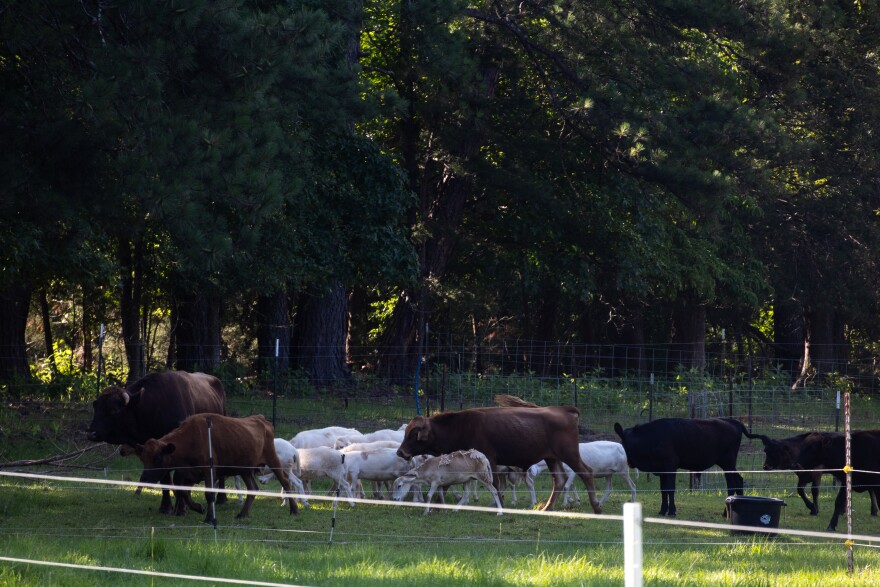
Now, private land with cows and sheep sits on the area where the fort once stood. Ashmore said he gives tours just during the winter to avoid the risk of ticks. The area where trenches once helped shield soldiers are still visible.
Some remnants from the fort now reside at the Laurens County Museum in the city of Laurens’ downtown area. The objects, although not individually labeled, will be part of an upcoming opening collection.

Luis-Alfredo Garcia
/
South Carolina Public Radio
Museum docent Julia Sermons said being informed of local history helps shape modern decisions.
“You have to know where you’re coming from to know where you’re going,” she said.
Ashmore, too, saw the same value.
“We are all in the middle of this,” he said. “This history – the important role that South Carolina played in the Revolution.”
An estimated 14 battles took place in Laurens County, according to Ashmore. He has been keeping track of local history for about 6 years. He said the county has set a 50-year plan to help with future record keeping.

Luis-Alfredo Garcia
/
South Carolina Public Radio


Video of SCHSL 5A Division 1 Upper State track and field championships
Here’s video of some of the action from the SCHSL Class 5A Division 1 Upper State boys and girls track and field championships held May 8 at Dorman.
Riley Vaughn of Spartanburg girls Track and Field was named the 2025-26 South Carolina girls Gatorade Player of the Year.
Vaughn won the shot put and discus events at the Class 5A-D1 state championships. She nailed a 13.1 meters on the shot and 41.77 meters on the discus. Her 14.41 in the shot at the region meet was the state’s best for 2026.
The 5-foot-10 junior helped lead Spartaburg to a fifth-place team finish. Vaughn had also competed on the national stage after taking third place in the shot put event at the Under Armour Nationals.
“Unbeaten in the discus throw on home state soil this year, Vaughn achieved success in both throws, but really sparkled in the shot put circle,” PrepCalTrack editor, Rich Gonzalez, said. “Her season-best there was the state’s top mark in the event in seven years and moved her to No. 4 on South Carolina’s all-time list.”
Vaughn is now part of an elite group of athletes who have won the prestigious award, including four-time Olympic gold medalist Sydney McLaughlin, five-time Olympic medalist Sanya Richards, and 11-time Olympic medalist Allyson Felix.
Vaughn was also named to the Greenville News’ All-Upstate First Team in girls’ Track and Field for the second consecutive season.
Kamryn Jackson covers high school and college sports for the Spartanburg Herald-Journal, Greenville News, Anderson Independent Mail, and the USA TODAY Network. Please email her at KEJackson@gannett.com and follow her on X @KamxJack (formerly Twitter).

-

 Michigan2 minutes ago
Michigan Recruiting Intel: Quarterback updates, notes on top targets
-

 Massachusetts5 minutes ago
Reed: Fight for tax relief is far from over
-

 Minnesota11 minutes ago
Children’s Minnesota doctor warns of Benadryl challenge dangers
-

 Mississippi18 minutes ago
Mississippi Lottery Mississippi Match 5, Cash 3 results for June 25, 2026
-
Missouri20 minutes ago
Missouri Lottery Pick 3, Pick 4 winning numbers for June 25, 2026
-

 Montana26 minutes ago
‘Hannah Montana’s Mitchel Musso On Why He Missed 20th Anniversary
-

 Nebraska32 minutes ago
HealthierU opens wellness coaching program to employees
-

 Nevada35 minutes ago
Shaquille O’Neal Foundation donates 260 supply-filled backpacks to Nevada students

