Entertainment
James Cameron once said ‘Avatar’ Neytiri design began with a young Q’orianka Kilcher. Now, she’s suing

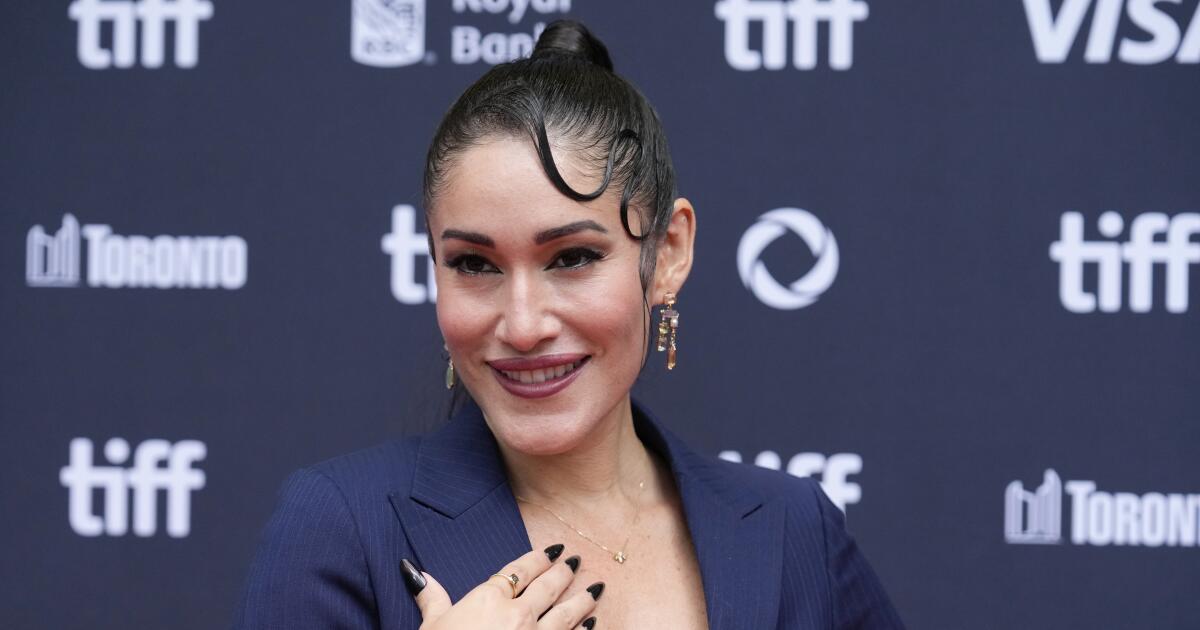
“Yellowstone” and “The New World” actor Q’orianka Kilcher has taken legal action against filmmaker James Cameron, Disney and others she says used her likeness in the wildly lucrative “Avatar” film franchise without her knowledge.
Kilcher, 36, filed her complaint Tuesday in California Central District Court and is suing on numerous counts including misappropriation of likeness, invasion of privacy and interfering with possible financial gain. She is seeking an unspecified amount in damages and a jury trial. The parties involved in the making of the “Avatar” film series “commercially exploited [Kilcher’s] likeness in developing and continuing the Avatar franchise” and “systematically avoided alerting or crediting her,” the lawsuit states.
Disney and a legal representative for Cameron did not immediately respond to a request for comment on Thursday. Cameron’s production company Lightstorm Entertainment, a California-based laser scanning studio and a New Zealand-based VFX firm are also among the co-defendants.
The claim at the core of Kilcher’s lawsuit is that Cameron in 2005 “extracted, replicated and commercially deployed her facial likeness” from a photo of a 14-year-old Kilcher as Pocahontas in the Terrence Malick film “The New World” and used it to inform the facial characteristics of Neytiri, a key character in the “Avatar” franchise played by Zoe Saldaña. Cameron spoke of Kilcher’s influence on the character in an interview with French YouTube channel Konbini. In the video, published in 2024 and noted in the lawsuit, James references the original sketch work for Neytiri. “The source for this was a photograph that was in the L.A. Times as part of the promotion for ‘The New World,’” he said. “It’s a young actress named Q’orianka Kilcher, who played Pocahontas in ‘The New World.’”
He adds in the video: “This is actually her lower face. She had a very interesting face. And I wound up meeting her years later and I gave her a signed print of this [sketch].”
The lawsuit alleges that the final look of Neytiri featured in the “Avatar” films “was not a fleeting inspiration or vague homage; it was a literal transplant of a real teenager’s facial structure into a blockbuster movie character.” In the 2024 interview, Cameron said the model of Neytiri had come to resemble Saldaña after she was cast. The first “Avatar” film was released in 2009 and grossed more than $2.9 billion.
The complaint also claims that the design process for Cameron’s Na’vi character moved on without Kilcher’s consent and that she was not compensated for influencing Neytiri’s design, further alleging that the film team’s actions “violated child performer laws and privacy laws designed to protect minors.” According to the lawsuit, the team behind “Avatar” did not “even attempt to have Plaintiff audition for the role of Neytiri” and refused the actor after her agent attempted to book a reading for the sci-fi epic.
Kilcher accuses Cameron of “creating a misleading narrative that she was simply unavailable” to appear in the original “Avatar” film and of leading her on with the idea of potentially appearing in later “Avatar” movies. Cameron released “Avatar: The Way of Water” in 2022 and “Avatar: Fire and Ash” in 2025.
The lawsuit said Cameron and Kilcher crossed paths at a Hollywood environmental charity event in 2010 and he instructed her to later pick up a “surprise gift” at his production offices. According to the lawsuit, Cameron gifted Kilcher a framed and signed print of the original Neytiri sketch with the note: “Your beauty was my early inspiration for Neytiri. Too bad you were shooting another movie. Next time.” Kilcher said she found the note confusing at the time. She had also contacted Cameron over the years, but “nothing concrete materialized,” according to the lawsuit.
The 99-page complaint describes Kilcher as an Indigenous actor-activist, noting she is of Quechua-Huachipaeri heritage. The lawsuit also alleged Cameron’s actions were hypocritical of his films’ messaging and detailed public backlash Cameron and the films faced for its depictions of Native groups.
“The result was a highly lucrative film franchise that presented itself as sympathetic to Indigenous struggles,” the lawsuit said, “all while silently exploiting a real Indigenous youth behind the scenes.”
According to her complaint, Kilcher “learned of the betrayal Cameron had kept from her” in August 2025, after video of the filmmaker discussing Neytiri’s design came across her social media feed. She “was shocked, heartbroken, and felt utterly betrayed,” and was motivated to reexamine and scrutinize archival “Avatar” materials. That included behind-the-scenes footage featured in a recent Blu-ray DVD release and an “Avatar” production art book, which, according to the lawsuit, did not credit the actor. The suit includes several side-by-side photos of Kilcher in “The New World” and various Na’vi characters from “Avatar” material.
In addition to damages and a jury trial, Kilcher seeks a public statement acknowledging her contributions and correcting “any false or misleading statement about her,” and payment of profits attributable to the “unauthorized” use of the actor’s likeness and identity.

Movie Reviews
‘Finnegan’s Foursome’ Review: Edward Burns’ Spiky-Quaint Sports Dramedy Is a Tale of Family Therapy Through Golf

Thirty years after “The Brothers McMullen,” the writer, director, and actor Edward Burns looks preserved in amber — his hair and beard have some silver, but at 58 he’s still lean and handsome in that prince-of-the-working-class Irish-American way. And it’s not just Burns who’s more or less unchanged; so is his filmmaking style. “Finnegan’s Foursome” is his 16th feature, and he’s still doing that shaggy-likable, spiky-quaint, semi-low-budget Edward Burns dramedy thing — the script that’s talky and kind of funny, though in a way that often sounds like a script; the camerawork that never strays too far from the functional; the acting that hovers between lively and broad. The style Burns works in is now closer to television than movies, and given that “Finnegan’s Foursome” is getting a streaming release (starting today), you could say it’s a minor indie movie that has found its rightful home.
It’s a sports comedy, about golf and Ireland and family conundrums (it would be overstating it to call them demons), and a key thing that might put you in the audience demo for it is if you happen to be a serious golfer. It’s a movie spun out of the love of the game. Burns, who first shows up in a samurai man-bun, plays Freddy Finnegan, a wealthy clothing entrepreneur who seems to have a happy and settled life, except that he’s got anger-management issues, all stemming from his rivalrous relationship with his irascible Irish father, Jack (Ian McElhinney).
At first, we think the movie is going to be about these two facing off. Jack, at his home in South Carolina (he came over from the old country in 1959), is hosting the latest edition of the Finnegan’s Cup — an annual golfing competition in which four members of the family face off against one another, mostly as an excuse for Jack, a retired golf instructor, to tell his old jokes and stories and reminisce about the days when he was good enough to rub shoulders with the Big 3 (Arnold Palmer, Jack Nicklaus, and Gary Player).
He’s a blustery egomaniac, though he strikes us as a warm-hearted one. And Freddy, of course, resents the hell out of him. But what we think are going to be the fireworks between these two come to a halt when one of the players hits a hole in one and Jack keels over in shock, dead of a heart attack.
The family now has to scatter Jack’s ashes in the four locations he has chosen in Ireland (two of them are golf courses). And that’s an excuse for Freddy, who resents his da even in death; his more benign older brother, Teddy (Brian d’Arcy James), a novelist who has been suffering from writer’s block; Freddy’s musician son, Frankie (Brian Muller), whom he treats nearly as cavalierly as his father treated him; and Teddy’s adult daughter, Marie (Erica Hernandez), to take a week’s vacation in Ireland, where they’ll play out the Finnegan’s Cup at a handful of fabled golf courses, smacking around some home truths along with the ball.
There’s plenty of on-the-nose dialogue (“His dying wish was to get us all back here to Ireland”), as well as cornball boasting (“It’s not about the clubs, little brother, it’s about the man who’s swingin’ ’em”) and generic braggadocio (“I believe that is what you call an eagle!”). Freddy and Teddy never stop making side bets and busting each other’s chops, mostly about who has the better golf game, this being the locker-room form of brotherly love. If the family tension simmers, it’s mostly because Freddy and Teddy have opposite feelings about their father. Listening to their back-and-forth taunts, Marie says, “I’m sorry, so this entire trip is nothing but constant ball-busting?” Swap in “movie” for “trip,” and you’ve got an idea of “Finnegan’s Foursome,” though you should also toss in Frankie doing his cringe mock-sports-announcer banter.
“Finnegan’s Foursome” is structured as a sports movie, and Burns, working with the cinematographer Jeff Muhlstock, connects you to the geometric majesty of the links. But when you watch a film like “Tin Cup,” part of the thrill is that you want to see the Kevin Costner hero win; that’s the dramatic Zen of a sports film. Watching “Finnegan’s Foursome,” we’re not overly invested in whether Edward Burns’ entitled a-hole gets a winning golf score over his novelist brother.
There’s a touching scene where three of the characters sing “The Parting Glass” at a pub. But here’s how “Finnegan’s Foursome” is a bit soft. The movie is about Freddy coming around to see that his da really did love him, and that he wasn’t such a bad guy (he gave him the love of golf, after all). But the reason we readily buy this is that it’s so apparent from the outset. Jack’s big crime? Being away “at the office” (i.e., the golf course) too much. As ultimate sins of parents go, it’s kind of a dated sin. You want to say to Freddy, “Stop whining.” Especially because the Jack we see, in his competitive Irish way, had a lot of spirit; he was no ogre. Of course, he also tried to “get into Freddy’s head” on the golf course, but that’s kind of a privileged problem. It’s Freddy who needs to dismantle the ogre of resentment in himself, and that’s not quite a movie — that’s therapy.
The blithe and likable “The Brothers McMullen” won the Grand Jury Prize at the 1995 Sundance Film Festival and went on to have a healthy theatrical life, launching Burns’ career as a homespun auteur — at the time, he almost seemed like the shoestring Irish-American answer to Woody Allen. I was a fan of the early Burns films (especially “She’s the One,” his 1996 crossover movie, costarring Jennifer Aniston and Cameron Diaz), but his moment in the spotlight didn’t last long. After crossing over, he kind of crossed back, retreating into the not-fully-on-the-radar indie wilderness. That’s where he has remained, and watching “Finnegan’s Foursome” you see why: He’s trying to stay true to his world (all the Irish chop-busting and piss-taking), but he hasn’t grown as a filmmaker. Then again, maybe that’s not so important. He doesn’t hit long drives, but by the end of “Finnegan’s Foursome” the ball is in the cup.

As the noise-rap-electro act Jane Remover shrieked and pleaded through a 90-minute marathon set at the Fonda on Thursday night, one very young couple dressed right out of a conservative‘s nightmare — gender-ambiguous, purple hair, facial piercings — tapped me on the shoulder. They politely asked if I could mind their newly bought vinyl for a bit as they thrashed in the heaving crowd. Of course, this unc obliged them.
Anyone who laments that L.A. crowds don’t dance should go to one of the last sets of Jane Remover’s three-night stand at the Fonda this weekend. It had the most genuinely raucous pit I’ve seen in 2026, made all the more feral for how sweet and earnest it was. After a hotly tipped Coachella set, this Live Exhibit tour affirmed that the subculture Jane Remover built may or may not have wider pop potential, but it’s getting big enough to count for stardom in the fractured music world of today.
Jane Remover is a trans polymath producer and singer-songwriter with influences across rave, shoegaze, trap and beyond. They’ve built up a ferocious elaboration on the hyperpop of predecessors like Sophie, who similarly packed so many good ideas into songs they became talismanic to fans, a tonic to reinvent yourself (new Charli XCX opener Underscores is another fellow traveler).
The music itself sounds like reverse-engineering the moment in the 2000s when metalcore kids discovered EDM. Only now it’s Discord-disaffected youth ramping up hardstyle techno, autotuned girlypop ballads and rage-rap to an explosive fusion point. “Census Designated,” Jane’s brash and dramatic 2023 coming-out LP, tipped them as a force beyond the underground. But they soon eclipsed it with 2025’s “Revengeseekerz,” a deliriously overheated mix of romantic yearning, internet score-settling and virtuosic production prowess.
Backed by just a DJ (Dazedgxd, who opened the set) and a retina-scorching light rig up front, Jane acknowledged on Thursday that the stakes were getting much higher. They joked that they’d played the El Rey like three times before this tour, and to judge by the wild-eyed passions out in the audience, the Fonda will probably be the smallest venue they’ll play for some time. “It gets so cold this high up,” Jane sang on “Turn Up or Die.” “Can’t go to hell but I can drop you off.”
The sentiments driving the music are ultramodern: self-aware, vicious and desperately vulnerable. The hilariously zesty “Angels in Camo” (home to the all-time banger of a line: “Jesus never had it with a freak b—”) wrapped up with a bloodletting plea that “I can’t let you b— win.” Jane wields that word like the flaming sword on the “Revengeseekerz” album cover, with all the casual lustiness of Future but also the wrath of a reclaimed slur.
On “Professional Vengeance,” they grappled with the weird lures of celebrity and intimacy, where no one really knows anyone but desire still courses; “Experimental Skin” found them craving and fighting off God and nihilism and technology and addiction all at once.
The tension in these tracks are the binding agent for Jane’s fan base — the music is full of contradictions and incompatibilities smashing together that just feel like being young right now. Other than a quick affirmation that fans of all identities and backgrounds will always be welcome at their shows, they let the contorting, violent music speak for itself about the way queer fans are feeling about life under siege in the United States.
If the set was a bit too long for the limited setup onstage, it was because Jane simply had that much music to let out — that caliber of emotion to unburden, that much want to acknowledge. It seemed like the set was closing with “In the Dark,” an aching ballad from their Venturing side project, plainly declaring “I still dream of us” through a fog of effects. But instead they ramped it back up for one last cathartic blast to close, sending their faithful out onto Hollywood Boulevard, sweaty and filthy and fundamentally known.

Photo: 1-2 Special/Everett Collection
The English director Mark Jenkin works a bit like a local artisan from another era. Filming in and around his native Cornwall, he shoots his pictures himself on a 16mm Bolex, the kind of camera that might have been used by film students decades ago and that produces tactile, slightly grainy images. He also edits the movies himself, and records his sound later, layering in dialogue and effects and music (sometimes composed by himself) with an austere, handcrafted precision. This gives Jenkin’s work a certain timelessness, as if it belongs to the past but not to any specific period of the past. True, such an old-fashioned approach could feel performative, like an unusually well executed Instagram filter. But Jenkin’s style ties directly to his subjects and his expressive philosophy. His latest, Rose of Nevada — which stars two name actors, Callum Turner and George MacKay, and opens in New York today after doing the festival rounds — has the beguiling simplicity of a fable and the captivating textures of a dream. It stays with you like an unexpected and unanswerable question.
Jenkin privileges atmosphere through the collection of minute, sometimes abstract details. Set in a sparsely populated and depressed fishing village, Rose of Nevada opens with the unexpected return of the empty boat of the title, thought lost decades ago. Its arrival is announced by close-ups of barnacles, of rusty edges on ancient metal, of curious plant growth and moldy, tangled coils of black rope, as if its return was just part of a broader natural order. The Rose of Nevada clearly has a tragic history, which perhaps explains the psychological paralysis of the few remaining townsfolk. But it’s here, and so it must set off on a new fishing voyage.
Joining the journey, almost as if they were pulled towards it, are Nick (MacKay), a downcast man who needs money and seems incapable of meeting his young family’s most basic needs, and a drifter, Liam (Turner), whom we first see running down a road as if he were fleeing something. Both men are alienated from their environs, though for different reasons: MacKay conveys Nick’s quiet awkwardness well, and Turner has a charming, freewheeling energy that suggests he’s up for anything. When they return from the fishing expedition, however, the two men find that they’ve transported back several decades in time, and they’re mistaken for — or rather, they appear to be inhabiting the bodies of — two young deckhands who died long ago. Now that it’s the 1990s again, the fishing village is thriving, its local pub crowded with people and blaring pop. Nick and Liam see the younger, happy versions of the broken townspeople they’d left behind. Liam (now known as Alan) suddenly has a family, and Nick (now known as Luke) suddenly has parents. It’s almost as if the young men have been offered to the harvest gods as a sacrifice. And it’s worked.
So, it’s a ghost story, and a time travel story, and a folk tale, and something of a kitchen sink drama, but it’s also none of these things, really, and that’s where Jenkin’s formal gambits come in. His filmmaking has a lovely, homespun directness. We can feel scenes and moments being constructed, which fixes our attention on seemingly simple exchanges. An example: Early on, we see Nick hand his daughter a candy. Other filmmakers might shoot such a scene in a quick, offhand manner to mask its emotional weight, but Jenkin goes in the opposite direction, shooting everything in relative close-up and cutting the action to both extend and clarify it: We see Nick pull the candy out of its box, we cut to the girl receiving the candy, we see his wife see the girl, we cut to the wife taking the candy, we cut to a close-up of her unwrapping it, we cut to the girl getting the candy back, and we see Nick’s response. On some level, this could be an introductory filmmaking exercise: a whole series of extremely deliberate shots and edits designed to show this man’s feeling of inadequacy. But within the general precision of Jenkin’s style, the moment doesn’t stand out. Instead, it’s one in a long line of specific, human moments through which he builds his narrative and conjures a mood.
Such straightforwardness give Rose of Nevada a fable-like quality: There’s no narration, but we feel the deliberate rhythms of the storytelling, the telling emphasis on certain details over others. But weirdly, it also has something of the opposite effect: The film’s intimacy and Jenkin’s attention to the elements (along with his fondness for elliptical, well-timed flash frames) lends everything an otherworldly aura. Despite the time travel premise, nobody’s running around looking for a time machine to take them back, nor are they wasting much time trying to figure out how the dynamics of time travel work. The writer-director lets the unexplainable remain unexplained, because he’s interested more in our emotional response to it. We watch how people interact with these transformed versions of Nick and Liam, and we watch Nick and Liam’s own disparate responses to this new world, to the competing philosophies of life that emerge from this bewitching film. Rose of Nevada’s power lies in its peculiarities.
See All
-

 Alaska5 minutes ago
Pilot dies in small plane crash southeast of Cordova
-

 Arizona8 minutes ago
Arizona’s Rugged Wilderness Area Has Gorgeous Mountain Trails And Scenic Camping Spots – Islands
-

 Arkansas13 minutes ago
Tulsa downs Northwest Arkansas | Northwest Arkansas Democrat-Gazette
-

 California20 minutes ago
California man arrested for alleged lewd acts, exploitation involving juveniles
-

 Colorado23 minutes ago
Colorado neighbors lament likely closure of Roxborough library; $22 million regional library breaks ground nearby
-

 Connecticut28 minutes ago
Diesel fuel spill shuts two lanes on I-91 north in Wethersfield
-

 Delaware35 minutes ago
Delaware history in News Journal archives June 21-27: Sussex flood
-

 Florida38 minutes ago
7 of our favorite Florida restaurants in Vero Beach and Fellsmere

