North Carolina
First Look: Edgecamp Pamlico Station Arrives on Hatteras Island, North Carolina


Hatteras Island, the southernmost of North Carolina’s Outer Banks, has a long legacy as a destination for kitesurfing, beach combing, and generally unplugging (complete with notoriously spotty cell service). Historically, lodging options included a smattering of inns, motels, campgrounds, and vacation rentals. Opening this month, the Edgecamp Pamlico Station hotel, designed by celebrity interior designer and potter Jonathan Adler, ushers in a new level of accommodations.
Pamlico Station owner Richard Fertig first came to the area in 2018 to learn to kiteboard. “I instantly found the island remarkable. The natural beauty, the wetlands—everything about it was so unique. I continued coming back year after year and found there were such limited places to stay,” he says. “I had the idea to create a hospitality experience that would open up this incredible destination to more travelers but also something that matched the Outer Banks’ world-class caliber.” The result is a residential-style hotel that offers a certain barefoot elegance along with wellness-focused amenities, concierge service, and easy access to nature. Each of the fourteen suites comes with an outdoor living space and water views of the Pamlico Sound.
Inside, the suites are cozy and upscale. “Our initial inspiration was Mother Nature—she’s the world’s best designer—and the environment surrounding Pamlico Station,” Adler says. “The hotel is alongside one of the largest preserved parcels of the Outer Banks’ shoreline, which is so beautifully remote and majestic, and we infused elements of it in the colors we used.” The interiors capture Adler’s signature upscale midcentury style, with a mix of ceramic tiles, organic textures such as mohair and bouclé, and cool metals.
“Design has the power to reflect back your most interesting and glamorous self,” Adler says. “And who doesn’t want to feel especially glamorous on vacation?”
Photo: Courtesy of Edgecamp Pamlico Station
Anchoring the bedrooms is the Adler-designed Riviera Wave Bed, featuring sand-colored bouclé and curved natural reeds that evoke the shape of water coming on shore. “I feel it’s important to design with a sense of place,” says the designer, noting that the colors of the surrounding landscape flow through the hotel’s living spaces in pops of green and blue.

Courtesy of Edgecamp Pamlico Station
“We mixed rattan and lacquer for a polished yet rustic look,” Adler says. Some suites come with a Malm fireplace in Bengal orange, perfect for warming up after a day out in the wind and waves.
Courtesy of Edgecamp Pamlico Station
Wellness is a theme at Edgecamp Pamlico Station, says Fertig, evidenced by a cold plunge and sauna for guests to use on demand. “We wanted to create a place where you can relax after a day of outdoor exploration. I like to say, ‘Play hard but recover intentionally.’ The wellness center was the perfect complement to the active lifestyle the Outer Banks offers,” he says. Suites come stocked with yoga mats, a Therabody massage gun, resistance bands, and a foam roller.

Photo: Courtesy of Edgecamp Pamlico Station
The building, formerly a retail center, has been thoughtfully designed to offer exterior access, which means guests can come and go as they please without having to traipse through a lobby. Railings and banisters are clad in organic material to blend into the landscape.
Courtesy of Edgecamp Pamlico Station
In the spa bathroom, floors and walls are covered in white and navy penny tile, and rain showers, stocked with Jonathan Adler grapefruit-scented amenities, stand ready to wash away sand and sunscreen.
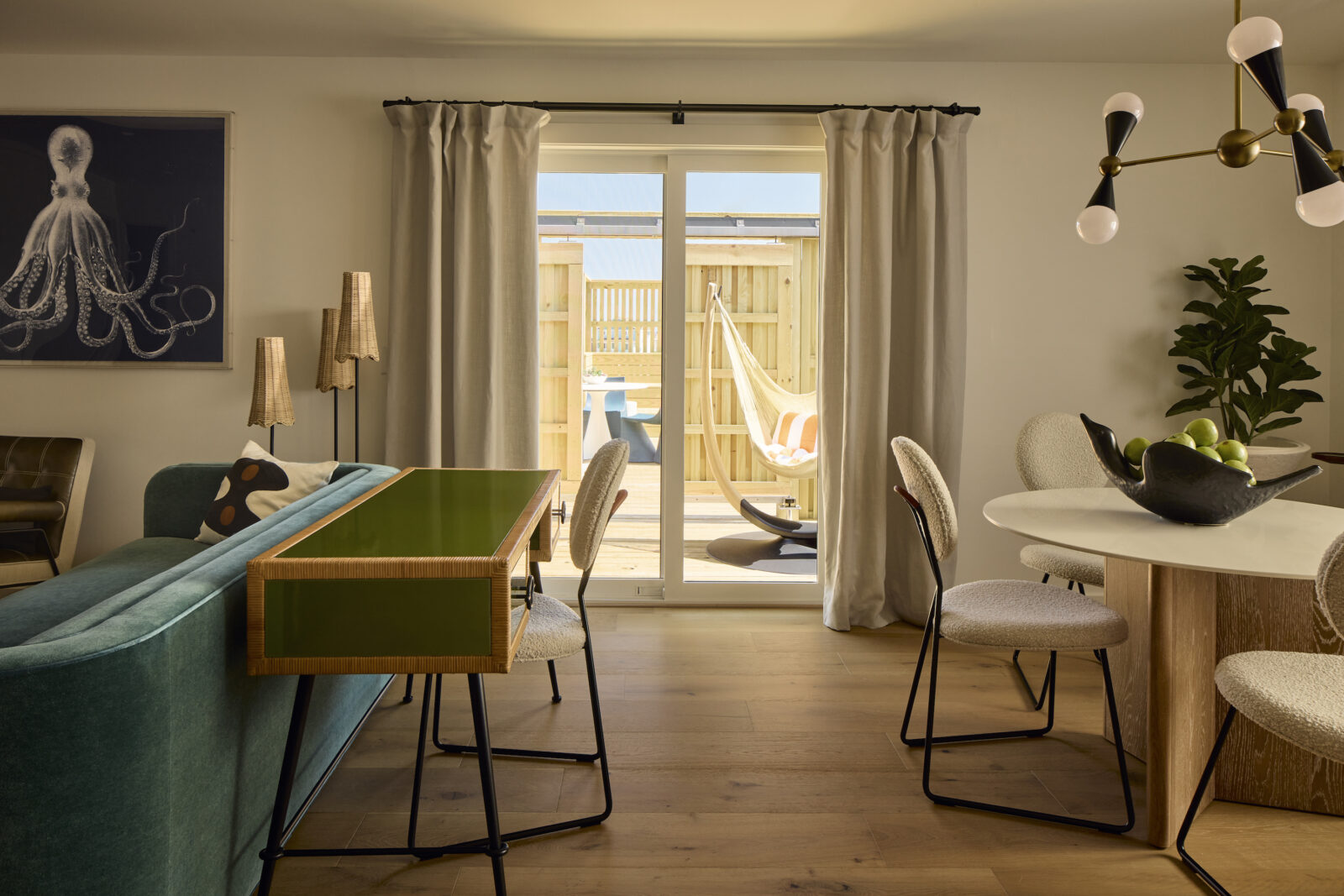
Photo: Courtesy of Edgecamp Pamlico Station
Each of the hotel’s fourteen suites comes with a dining area suited for four guests and a full kitchen, which visitors may choose to have pre-stocked with their favorite groceries. The concierge team can also arrange for a private chef to prepare in-room meals. “We’ve reimagined luxury by blending standout design, personalized and private service, and unparalleled access to outdoor adventure, creating an experience that’s really unlike anything else on the islands,” Fertig says.

Photo: Courtesy of Edgecamp Pamlico Station
For the suite living rooms, Adler commissioned custom rugs made of 100 percent recycled materials. He says sustainability can also be about longevity and durability. “In everything I design, whether it’s products or places, I want them to be of extraordinary quality so that you can appreciate them for years and years without having to throw away or adjust a thing,” Adler says. “My motto has always been, ‘If your heirs won’t fight over it, we won’t make it.’”
Courtesy of Edgecamp Pamlico Station
Adler, who considers himself “first and foremost a potter,” took pride in selecting artful ceramics and tile. The bedrooms are accented with his sculptural Grenade Column lamps and Soleil Tile Art, crafted from colorful ground recycled glass and stoneware.
Courtesy of Edgecamp Pamlico Station
A circa-1968 photograph of a paraglider in Acapulco, by society photographer Slim Aarons, is the nostalgic centerpiece of a suite living room. Beyond taking inspiration from the Outer Banks, Adler says, “We drew upon other glamorous beachside locales, like the French and Italian Rivieras in the fifties and sixties.”



ASHEVILLE, N.C. (WLOS) — As spring returns, so does the 25th annual Asheville Orchid Festival at the North Carolina Arboretum.
The annual show features world-class growers, curated displays, and thousands of orchids for sale.
NORTH CAROLINA ARBORETUM’S ‘SPRING INTO THE ARB’ RETURNS FOR YEAR 2
The event is part of “Spring Into the Arb”, a celebration of the return of spring featuring a series of activities. This year, a new and unique display takes center stage.
“We build this castle, and it’ll be a one-time thing, and we always create something special that goes with the theme. This year it was orchid kingdom,” said Graham Ramsey, president of the Western North Carolina Orchid Society.
This is an American Orchid Society-sanctioned judging event as world-class orchid growers and breeders present hundreds of carefully crafted displays.
NORTH CAROLINA ARBORETUM HOSTS BONSAI CARE DEMONSTRATIONS
Ramsey says growing orchids, while not a hard thing to get into, is an obsessive hobby.
BE THE FIRST TO COMMENT
“I started out with one orchid that belonged to my wife and next thing you know, we’re buying more, and it’s a very obsessive hobby, and by joining the Western North Carolina Orchid Society, we invite all orchid growers to come because that’s what we do, we sit around and talk about how to grow our orchids,” Ramsey said.

A North Carolina legislative committee is drawing passionate support — and criticism — as it pushes forward with recommendations to inject more secrecy and politics into a group tasked with disciplining lawyers across the state.
The committee plans to meet again this week, fresh off a dramatic hearing Tuesday, during which members of the committee sniped at one another, at least one appeared to have had no idea they’d be asked to vote on one particularly contentious item, and security had to forcibly eject a former state lawmaker who had refused to stop yelling accusations from a podium.
The target of that speaker, as well as the committee he was addressing: the North Carolina State Bar, a regulatory board in charge of licensing and disciplining North Carolina’s lawyers.
It’s the central focus of the State Bar Grievance Review Committee, which has tussled with the Bar and its supporters in the state’s legal community as it has sought to investigate allegations of cancel culture against politically outspoken lawyers and as it has recommended other reforms or demanded political inquisitions.
The committee, created in 2024, is a rarity in North Carolina: It consists of zero members of the state legislature. It’s led by Larry Shaheen and former state Sen. Woody White, two GOP insiders close with Republican state Senate leader Phil Berger. It can’t make changes on its own but can recommend them to the state legislature for approval.
Some previous suggestions by the committee have won broad and bipartisan approval at the state legislature, such as limiting who can report lawyers to the Bar.
But its most recent proposals — including making lawyer discipline a more secretive process, controlled entirely by political appointees — has raised concerns inside the Bar, as well as with some of the lawyers who make a living fighting the Bar on behalf of their clients.
Some of the new changes Shaheen and others on the committee are backing would ban non-lawyers from being involved in hearings of the Bar’s Disciplinary Hearing Commission, which is tasked with deciding whether — and how harshly — to crack down on lawyers accused of things such as stealing clients’ money, sleeping with clients or abusing drugs or alcohol.
The committee also wants to staff the Disciplinary Hearing Commission entirely with political appointees — almost all of them Republicans — and decrease transparency in the process, making more details confidential.
The Bar has deep reservations about those and other proposed changes, saying they’ll harm its goal of protecting members of the public from predatory or simply bad lawyers. The committee has not asked for the Bar’s input during this process, and relations between the two groups have become strained.
State Bar Executive Director Peter Bolac told WRAL he questions the need for these changes, which he said appear to have been put together “without broader input or a comprehensive understanding of the State Bar’s work.”
Bolac was at the most recent hearing on the changes, but he wasn’t invited to speak — whether to provide his own presentation, or to answer questions and concerns. He told WRAL the committee should attempt to learn how the Bar works, first, before trying to change it.
“Without a clear and shared understanding of how the current system functions, it is difficult to engage in a meaningful discussion about potential improvements,” Bolac said. “Nevertheless, we remain willing to participate in thoughtful, good-faith dialogue aimed at strengthening the system.”
Shaheen says he knows firsthand how the process works, having served on Disciplinary Hearing Commission he and his committee are now targeting. And he sees it as his mission to drastically change the way it operates, saying he has lost friends because of his association with it. “I have several lawyers, who have been long term friends of mine, who have come to me and, because of some of the things said to them, feel like I’m the devil,” Shaheen said.
‘Radical changes’
The committee’s most recent meeting was just the latest in the committee’s years-long attempt to make reforms to the Bar.
Alan Schneider, who has represented more lawyers facing disciplinary hearings than perhaps anyone else in North Carolina, often finds himself at odds with the Bar. He previously gave a formal presentation to this same committee on suggestions to reform it.
But he says the latest suggestions, to ramp up the political appointments, go too far.
“There were problems in the past in terms of maybe old cases weren’t heard as quickly as they could,” Schneider said. “But the changes were made. The State Bar heard, and the State Bar has acted. What I’d like this panel to understand is the necessity for all these radical changes. I believe it is unnecessary.”
White and Shaheen said the changes are necessary. Shaheen said increasing political control over the Bar would increase accountability, by making members of the Bar answer to politicians who ultimately answer to the people.
Under the new proposal, 19 of its 26 members would be chosen by various Republican politicians and the remaining seven would be chosen by Democratic Gov. Josh Stein.
“To have more folks appointed by public officials, we want to create more accountability, to make sure that the process is not weaponized against attorneys,” Shaheen said at the committee’s meeting on Tuesday.
White defended the push for less transparency.
“Nowadays when you can weaponize allegations in a nanosecond and publish them, put them out in a political context … that is unfair, for a lawyer to be accused of something before he or she is convicted of it,” he said.
‘Such sweeping reforms’
The committee is set to meet again Wednesday. The committee hadn’t released information on what issues it plans to discuss, but it’s expected to be closely watched by the state’s legal community.
The relative lack of public notice on what this committee is considering also raised the ire of interested parties at last week’s meeting.
Jane Meyer, a Tharrington Smith attorney in Raleigh who also chairs the Bar’s disciplinary group, questioned why the proposals voted on Tuesday were only made public a few days beforehand, and with no opportunity for the Bar — or the general public — to respond.
White had originally attempted pushing through a vote Tuesday without allowing members of the public to speak. But he relented after Andrew Heath, a conservative lobbyist who serves on the committee, urged him to allow Meyer and other members of the public to have two minutes each to give brief comments.
“That troubles me — that such sweeping reforms are being considered without much study, and without asking for input,” Meyer told the committee.
Given the sweeping nature of their recommendations, Wake County District Attorney Colon Willoughby suggested the committee should “do a little bit more study and maybe get a little bit more information.”
Willoughby specifically criticized the proposal to make it harder for members of the public to learn about accusations against attorneys.
“We should not be trying to restrict and make things more confidential,” he said. “We should make it more open. The public needs to have quicker and more complete access. I think people find their lawyers now, not from their Sunday school class or their bowling league or their Lions Club, but through the internet searches. They want information.”
They were among the passionate speakers at the hearing, but perhaps not the most passionate.
Two-plus hours into its most recent hearing on Tuesday, former state Rep. Edwin Hardy had his mic cut off and then was escorted out of the room by security. He was several minutes into speaking during the open public comment period as his comments turned into a rant involving former President Barack Obama, the late Gov. Jim Hunt, allegations of political favoritism, cocaine usage and more.
Hardy, a Republican who used to represent Beaufort County in the state House, was the only one ejected — even though he was also one of the few speakers who appeared to support the committee’s goal of major overhauls to the Bar. His comments were in line with the allegations White, Shaheen and others have been claiming for years about cancel culture.
“I got very vocal online because Obama won,” Hardy told the committee. “… Well guess what: I was very vocal, and the day after Obama won reelection, I got a phone call and the Bar told me I had been randomly picked for an audit.”
State records show that that 2012 audit found Hardy had been using poor accounting practices with trust accounts where he held onto money for clients — including taking actions that “allowed entrusted funds to be disbursed in a manner not authorized by or for the benefit of the client.”
However, the Bar found he didn’t steal any of the money, and that there wasn’t any evidence of his clients being harmed by his trust fund missteps. It allowed him to continue practicing law.

RALEIGH — NC State replaced Kevin Keatts with Will Wade in March 2025, introducing him 368 days ago in front of the Wolfpack community at Reynolds Coliseum. A little over a year later, Wade decided to leave his new program to return to LSU, the school that fired him for cause in 2022, beginning a long journey back to Power Four basketball.
Now, athletic director Boo Corrigan and the rest of the NC State administration must find a new leader for the men’s basketball program. To make matters more complicated, they won’t have a lot of time to do so, as the new head coach needs to be in place firmly before April 7, the day the transfer portal opens. However, early noise indicates the group in charge has eyes on two candidates.
Who are the candidates?
According to multiple reports, Corrigan and other power brokers at NC State zeroed in on Saint Louis head coach Josh Schertz and Tennessee associate head coach Justin Gainey as the primary two candidates for the opening. Both names were expected to be in the mix as soon as the Wade exit became more and more likely, although Corrigan shared no specific names during his Thursday press conference.
The NC State University Board of Trustees hosted an emergency meeting on Friday, with the primary subject being Wade’s buyout negotiation. Of course, speculation began quickly that there were discussions about the next coach of the Wolfpack, but that’s been confirmed not to be the case in the behind-closed-doors meeting for the board.
NC State Board of Trustees emergency meeting related to change in term of Will Wade’s buyout (from $5M to $4M, as AD Boo Corrigan said yesterday) not a new coach hire. Quickly went into closed session. No public business.
— Brian Murphy (@murphsturph) March 27, 2026
Even so, it seems as though NC State plans on making a strong push for Schertz first, despite his status as head coach at Saint Louis still and his recent agreement to a contract extension. That certainly makes things more complicated, but hiring Schertz would allow NC State to maintain any sort of positive momentum established by Wade and his regime in Raleigh. Still, Corrigan isn’t totally committed to a sitting head coach.
“I don’t think it has to be a sitting head coach at this point,” Corrigan said. “I think we want to find someone that knows how to coach and is a great coach, and has the ability to connect with people, both internal and external, with the players, be able to recruit. You have to be a good recruiter in this day and age.”
NC State will move as quickly as it possibly can, with Gainey and Schertz atop the list. That doesn’t rule out other options entirely, but all signs point to one of them being the most likely to be the next coach of the Wolfpack, ending the Will Wade era as quickly as it started.

The iconic South African theater that took on apartheid

All the latest in AI ‘music’

US allows Russian oil tanker to reach Cuba amid blockade as Trump says island ‘has to survive’

Dem senator warns deportation could let Virginia woman’s illegal immigrant killer ‘escape accountability’

Sleeping 11 minutes longer each night shows surprising health benefit, study finds

Florida High School Football Rankings: Top 25 teams – Oct. 21

How old is Bo Nix? What to know about Oregon quarterback ahead of 2024 NFL Draft

Cleary's 21 help Le Moyne down Central Connecticut State 69-64 in OT

99th annual Pony Swim held in Virginia

Indiana Members Credit Union announced as new anchor tenant at Bottleworks District
Dem senator warns deportation could let Virginia woman’s illegal immigrant killer ‘escape accountability’

Newsletter: G7 ministers to hold talks on war’s economic fallout

ICE officers could remain at airports after TSA workers are paid

Scathing report claims nation’s oldest labor union ‘betrayed’ MAGA members through ‘shocking’ spending

Republican US lawmaker demands Congress vote on any Iran troop deployment
-

 Sports1 week ago
IOC addresses execution of 19-year-old Iranian wrestler Saleh Mohammadi
-

 New Mexico1 week ago
Clovis shooting leaves one dead, four injured
-

 Miami, FL4 days ago
Jannik Sinner’s Girlfriend Laila Hasanovic Stuns in Ab-Revealing Post Amid Miami Open
-

 Tennessee6 days ago
Tennessee Police Investigating Alleged Assault Involving ‘Reacher’ Star Alan Ritchson
-

 Minneapolis, MN4 days ago
Boy who shielded classmate during school shooting receives Medal of Honor
-

 Politics1 week ago
Schumer gambit fails as DHS shutdown hits 36 days and airport lines grow
-

 Science1 week ago
Record Heat Meets a Major Snow Drought Across the West
-

 Technology1 week ago
YouTube job scam text: How to spot it fast